Why Do We Add an Extra Day in February? Leap Years Explained Simply
SUMMARY OF THIS ARTICLE
- We add an extra day in February because one year is not exactly 365 days.
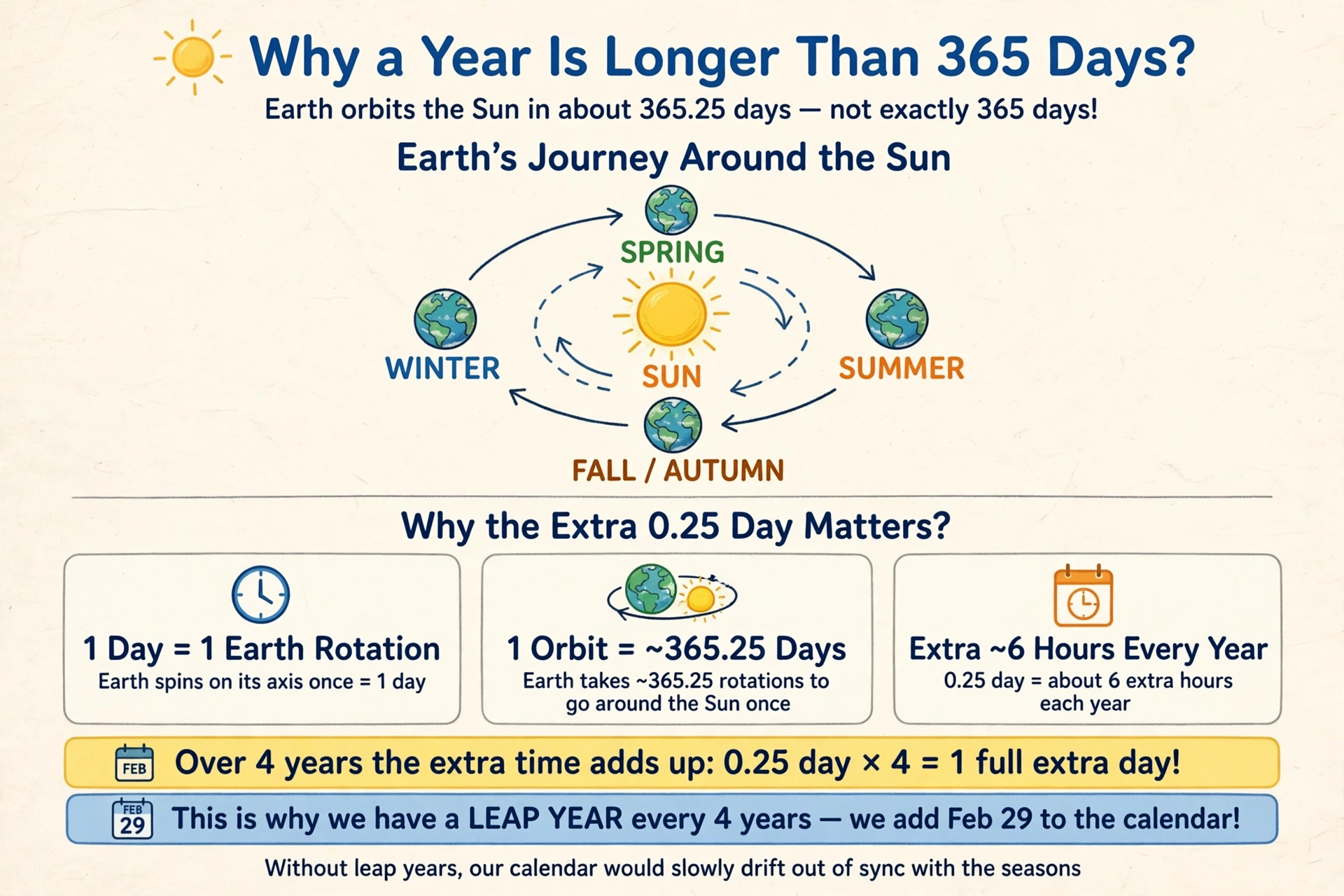
- Earth takes about 365 and a quarter days to go around the Sun.
- That small extra quarter day adds up to one full day every four years.
- We put that extra day on February 29, and we call that year a leap year.
- Without leap years, our calendar would slowly move away from the seasons.
Why February Gets an Extra Day
Have you ever looked at a calendar and seen February 29? Most years, February has only 28 days. But once every four years, it has 29 days. That year is called a leap year. It may seem strange. Why do we add a day? Why February? And why does it matter at all?
The answer is simple. Our calendar tries to match the real year. But the real year does not fit neatly into whole days. Earth needs a little more than 365 days to go all the way around the Sun. That little extra time causes a problem. If we ignore it, our calendar slowly breaks. Seasons start to move. Summer would slowly move into winter months. That would be very confusing for farmers, schools, and everyone who plans by the seasons.
So we fix the problem with a small trick. We add one extra day every four years. That day keeps the calendar in step with the Sun. It is a simple fix, and it has worked for hundreds of years.
In this article, we will explain leap years in very simple words. You will learn how long a year really is, why February was chosen, who made the rules, and how we know if a year is a leap year. You will also learn about the strange rules for years like 1900 and 2000, and what life is like for people born on February 29.
What Is a Year, Really?
When we say “one year,” we usually mean 365 days. That is the number on most calendars. But nature does not follow our calendar exactly. A real year is the time Earth takes to make one full trip around the Sun. Scientists call this a solar year.
A solar year is about 365 days, 5 hours, 48 minutes, and 45 seconds long. That is close to 365 days, but not exactly. The extra part is almost six hours. Think of it like this. If you start counting on January 1, after 365 days Earth has not quite finished its trip. It still needs about six more hours.
Six hours may not sound like much. But it adds up fast. After one year, we are six hours behind. After two years, we are twelve hours behind. After three years, we are eighteen hours behind. After four years, we are about twenty-four hours behind. That is one full day.
So every four years, we add one day to catch up. That day is February 29. Without it, after 100 years our calendar would be about 25 days behind the Sun. After 700 years, summer would start in what we now call winter. That is why the extra day is so important.
Long ago, people learned this by watching the sky. They watched the Sun rise in the same place each year. They watched the stars. They watched the seasons. They saw that 365 days was not quite enough. So they made a fix.
Why February?
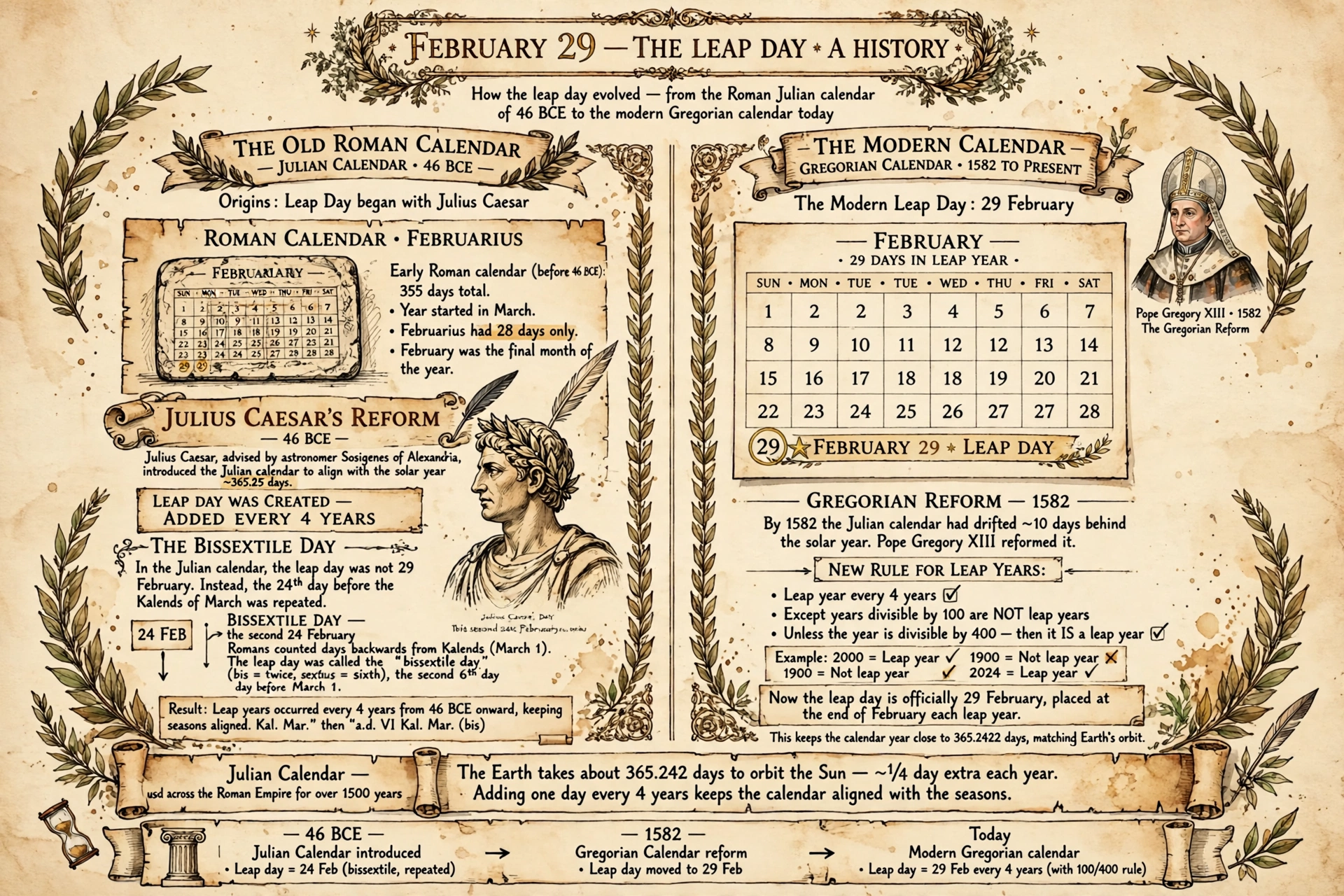
Why do we put the extra day in February? Why not in June or December? The answer comes from old Roman history. Long ago, the Roman calendar was different from ours. In the early Roman calendar, the year started in March. February was the last month of the year. It was also the shortest month.
When the Romans fixed their calendar, they added the extra day at the end of the year. That meant the end of February. Later, January and February moved to the start of the year, but the extra day stayed in February. That is why February is still the month that gets longer in a leap year.
February is also a good choice because it is already short. Adding one day makes it 29 days, still shorter than other months. It does not feel as strange as making a long month even longer.
Some people ask why we do not just add the extra day to December 31 instead. The answer is history and habit. People have used February 29 for a very long time. Changing it now would cause a lot of confusion for no real gain. So February keeps its special day.
Who Made the Leap Year Rules?
The leap year idea is very old. The ancient Egyptians knew that a year was a little longer than 365 days. But the first big calendar fix came from Julius Caesar, the Roman leader, in 45 BC. He made the Julian calendar. In that calendar, every fourth year was a leap year. That was a big step forward.
But the Julian calendar was still not perfect. It added a leap day every four years, no matter what. That made the average year 365.25 days long. The real solar year is a little shorter, about 365.2422 days. The difference is small, only about 11 minutes per year. But over hundreds of years, those minutes add up. By the 1500s, the calendar was about 10 days ahead of the Sun. Spring was starting too early on the calendar.
So in 1582, Pope Gregory XIII made a new calendar. We call it the Gregorian calendar. It is the calendar most of the world uses today. Gregory kept the leap day every four years, but he added two new rules to fix the small error.
Rule one: If a year can be divided by 100, it is NOT a leap year, even if it can be divided by four. So 1700, 1800, and 1900 were not leap years.
Rule two: If a year can be divided by 400, it IS a leap year, even if it can be divided by 100. So 1600 and 2000 were leap years.
These two rules make the average year very close to the real solar year. The Gregorian calendar will stay correct for thousands of years. It is a clever fix, made with simple maths.
How Do You Know If a Year Is a Leap Year?
You can test any year with three easy steps. You only need simple division.
Step one: Can the year be divided by four with no remainder? If no, it is not a leap year. For example, 2023 divided by four leaves a remainder, so 2023 is not a leap year. 2025 is also not a leap year.
Step two: If the year can be divided by four, check if it can also be divided by 100. If it cannot be divided by 100, it is a leap year. For example, 2024 can be divided by four, but not by 100, so 2024 is a leap year. 2028 will also be a leap year.
Step three: If the year can be divided by 100, check if it can be divided by 400. If it can, it is a leap year. If it cannot, it is not. For example, 1900 can be divided by 100, but not by 400, so 1900 was not a leap year. 2000 can be divided by 100 and by 400, so 2000 was a leap year.
That is all you need. Most people only need step one and step two. The 100 and 400 rules only matter once every hundred years. The next year that tests those rules is 2100. It can be divided by 100, but not by 400, so 2100 will not be a leap year. Many people alive today will see that happen.
Here is a quick list to help you remember. Recent leap years were 2016, 2020, and 2024. The next leap years will be 2028, 2032, and 2036. If you are reading this in a leap year, you are living in a year with a February 29.
What Happens If We Stop Adding Leap Days?
Imagine we stop adding leap days tomorrow. What would happen? At first, nothing would seem wrong. The change is very slow. After four years, the calendar would be one day behind the Sun. After 40 years, it would be ten days behind. After 100 years, it would be about 25 days behind.
That may not sound terrible, but think about what it means. The seasons are tied to the Sun, not to our calendar. The longest day of the year, in June, would slowly move to July, then to August. Christmas, in December, would slowly move toward autumn, then summer. Farmers who plant by the calendar would plant at the wrong time. Schools that plan holidays by the seasons would be confused.
After about 700 years, the calendar would be a full six months out of step. Summer in the north would happen in January on the calendar. Winter would happen in July. That would be a mess.
This is not just a guess. It happened before, with the old Julian calendar. By the 1500s, the calendar was ten days ahead. Pope Gregory had to delete ten days in October 1582 to fix it. People went to sleep on October 4 and woke up on October 15. Ten days just vanished from the calendar. That shows how important the leap year fix really is.
So the extra day is not just a fun quirk. It keeps our whole system of dates, seasons, and holidays in order. Without it, time itself, as we measure it, would drift away from nature.
People Born on February 29
People born on February 29 are called “leaplings” or “leapers.” They have a special birthday problem. Their birthday only comes on the calendar once every four years. So when do they celebrate in other years?
Most leaplings pick February 28 or March 1. Some celebrate on February 28, because it is the last day of February in normal years. Others celebrate on March 1, because that is the day after February 28. There is no one official rule. It is a personal choice, and sometimes it depends on the law in their country.
For legal things like driving licences and voting, most countries treat March 1 as the birthday in non-leap years. But for parties, leaplings can choose any day they like. Many leaplings enjoy the joke. They say they are only a quarter of their real age. A person who is 40 years old has only had ten real February 29 birthdays.
Famous leaplings include the composer Gioachino Rossini, who wrote the opera “The Barber of Seville,” and the actor and rapper Ja Rule. There are about five million leaplings in the world. That sounds like a lot, but it is only about one person in every 1,461 people, because February 29 comes only once in 1,461 days.
Leap day is also a fun day for weddings and events. Some couples choose to marry on February 29 because it is rare and easy to remember. In some old traditions, February 29 was a day when women could propose marriage to men. That tradition is mostly a joke today, but it shows how special the day feels.
Leap Years in Other Calendars
Our Gregorian calendar is not the only calendar in the world. Other cultures have their own ways to fix the same problem. The idea is always the same: add extra days or months from time to time to stay in step with the Sun and the Moon.
The Jewish calendar adds a whole extra month, called Adar II, seven times every nineteen years. The Chinese calendar also adds an extra month about once every three years. The Islamic calendar is different. It follows the Moon only, with 354 or 355 days per year. It does not add leap days to match the Sun. That is why Islamic months, like Ramadan, slowly move through the seasons over the years.
The ancient Romans, before Julius Caesar, added extra months when priests decided the calendar needed fixing. That system was messy, because priests sometimes added months for political reasons. Julius Caesar fixed that by making a clear rule: one extra day every four years.
Today, almost every country uses the Gregorian calendar for business and daily life, even if they also use another calendar for religious or cultural events. That is why February 29 is known all over the world, even in countries with other calendars.
Leap Seconds and Other Small Fixes
Leap years fix the big problem, but there are smaller problems too. Earth does not spin at a perfectly steady speed. Sometimes it spins a little faster, sometimes a little slower. Earthquakes, melting ice, and winds can change the spin by tiny amounts.
To keep clocks in step with Earth’s spin, scientists sometimes add a “leap second.” A leap second is one extra second added to the clock, usually at the end of June or December. The clock goes 23:59:59, then 23:59:60, then 00:00:00. It is a tiny fix, but it matters for computers, satellites, and navigation systems that need very exact time.
Leap seconds are different from leap days. Leap days fix the calendar year. Leap seconds fix the clock day. Both show the same idea: our human time systems need small fixes to match nature. Nature does not fit into neat numbers, so we adjust.
In recent years, scientists have talked about stopping leap seconds, because they cause problems for computer systems. But leap days are not going away. We will keep adding February 29 for a very long time.
Why This Matters in Daily Life
You may think leap years are just a fun fact. But they affect daily life in many ways. Computer systems must know the leap year rules. If a computer gets it wrong, dates can break. Banks, airlines, and hospitals all depend on correct dates. A mistake in a leap year rule could cause flights to be booked on the wrong day or payments to be late.
Schools and workplaces also plan around leap years. A leap year has 366 days, not 365. That means one extra day of work, school, or business. Some workers are paid by the day, so a leap year can mean one extra day of pay, or one extra day of work, depending on the contract. It is a small difference, but it is real.
Sports also feel leap years. The Olympic Games and the football World Cup happen every four years, but not always in leap years. The Olympics usually happen in leap years, like 2024, but the World Cup happens in years like 2022 and 2026, which are not leap years. Still, the four-year cycle is easy to remember because it matches the leap year cycle.
For most of us, leap day is just a bonus day. An extra day in the year is a gift. You can use it to learn something new, visit a friend, or just rest. It is a reminder that time is not as simple as it looks on a calendar, and that humans have worked hard for thousands of years to measure it well.
A Short History of Measuring Time
Humans have always tried to measure time. Long ago, people watched the Sun and the Moon. They made calendars from stone, like Stonehenge in England, to track the longest and shortest days. They divided the year into months based on the Moon. A Moon month is about 29.5 days. Twelve Moon months make about 354 days. That is about eleven days short of a solar year.
That is why many old calendars had to add extra days or months. The Egyptians used a calendar of 365 days, with no leap days at first. They knew it drifted, but they kept it for religious reasons. The Romans tried many fixes before Julius Caesar made his simple rule.
People also divided the day into hours. Ancient people measured an hour without modern clocks, using the Sun, water, and candles. That story shows how hard it was to measure even one day, let alone one year. Our modern calendar is the result of thousands of years of watching, maths, and small fixes.
Today, we use atomic clocks, which are so exact they would take millions of years to lose one second. But we still use the same basic leap year rules from 1582. That shows how good those rules were. They were made before computers, before telescopes were common, and before we knew exactly how long a year is. Yet they still work.
Frequently Asked Questions
1. What is a leap year in simple words?
A leap year is a year with 366 days instead of 365 days. The extra day is February 29. It happens about once every four years, to keep our calendar in step with Earth’s trip around the Sun.
2. Why is February 29 only every four years?
Earth needs about 365 and a quarter days to go around the Sun. That quarter day adds up to one full day after four years. We add that day as February 29, so the calendar catches up with the Sun.
3. Is 2100 a leap year?
No. 2100 can be divided by four and by 100, but not by 400. Under the Gregorian rules, that means it is not a leap year. The year 2000 was a leap year because it can be divided by 400.
4. What happens to people born on February 29?
They are called leaplings. In normal years, most of them celebrate on February 28 or March 1. For legal purposes, many countries use March 1. They still age normally, even if their exact birthday date only appears every four years.
5. Would the seasons change without leap years?
Yes, slowly. Without leap days, the calendar would drift away from the Sun by about one day every four years. After hundreds of years, summer and winter would swap places on the calendar. Leap years stop that drift.
Closing
So, why do we add an extra day in February? Because a year is not exactly 365 days. It is a little longer. That little extra time, about six hours each year, adds up to one full day every four years. We put that day in February, on February 29, because of old Roman history, and we call that year a leap year.
The rules are simple, but they are clever. Every four years, with two small exceptions for century years, we add a day. That keeps our calendar, our seasons, and our holidays in step with the Sun. Without it, time would slowly drift, and summer would one day fall in winter.
Next time you see February 29 on a calendar, remember what it means. It is not just a rare date. It is a small human fix for a big natural fact. Earth does not move in neat whole days, so we adjust. And that one extra day keeps the whole system working, year after year, century after century.