How Did People Send Messages Before Phones Were Invented? Explained Simply
SUMMARY OF THIS ARTICLE
- Before phones, a message could only travel as fast as a person, a horse, a bird, or a puff of smoke — so news that takes us one second today often took days or weeks.
- People sent messages in many clever ways: runners and riders, letters written on clay tablets and paper, smoke signals, drumbeats, waving semaphore arms, and pigeons trained to fly home.
- In 1840, Britain’s Penny Post made letters cheap for ordinary people for the first time, and the number of letters posted shot up almost overnight.
- The Pony Express carried mail across America in about ten days in 1860 and 1861, a record that lasted only eighteen months before the telegraph made it old news.
- In 1844, Samuel Morse sent the first long-distance telegraph message — “What hath God wrought” — and for the first time in history, words could travel faster than any living thing.
Your Message Would Take Three Weeks
You tap a screen, and your words land on the other side of the world before you have even put your phone down. Your friend replies while you are still holding it. A photo of your lunch can reach your cousin in another country in the time it takes to blink. But for nearly all of human history, sending a message was an adventure in itself — slow, costly, and full of things that could go wrong.
Picture this instead. Your brother moved to a town three days’ walk away, and you want him to know your mother is ill and he should come home. There is no phone and no postman with a van. You find someone going that way, or you pay a runner, or you write a letter and hope the next traveller heading in the right direction will carry it. Then you wait. A week. Two weeks. You have no way of knowing if the letter arrived, if it got lost on a muddy road, or if the traveller changed his mind and stayed home. That long, silent gap between sending and knowing was ordinary life for your great-great-grandparents and for everyone before them.
Feet First: The Oldest Messengers
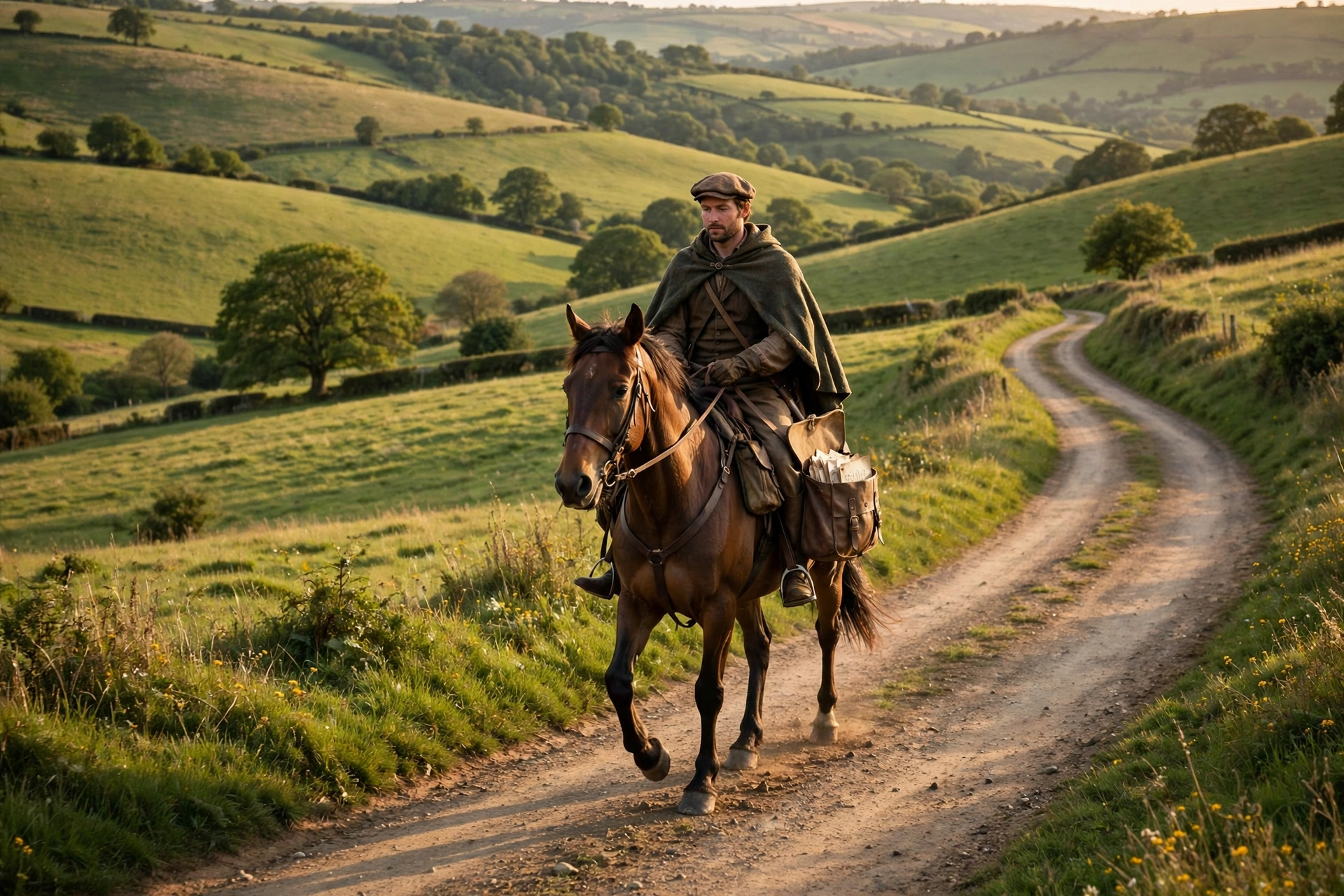
Long before anyone wrote a word down, messages travelled in people’s heads. A messenger was given a sentence to carry, and he carried it the way you might carry a basket of eggs — carefully, all the way, without dropping it. Village elders sent runners to the next village with news of a wedding, a warning of raiders, or an invitation to a feast. The runner memorised the words, ran, and spoke them out loud when he arrived.
Sooner or later, every powerful ruler worked out the same trick: do not send one runner the whole way. Set up a chain of them. The ancient Persian kings kept fresh horses and riders waiting at stations along their royal roads, so a message could change hands — and horses — again and again without ever stopping to rest. The Greek writer Herodotus, who lived more than two thousand years ago, marvelled at those couriers. He wrote that neither snow, nor rain, nor heat, nor darkness of night kept them from finishing their rounds at top speed, and that a mounted relay could cross the empire in about nine days, a journey that took three months on foot.
The Romans did the same thing on a grand scale, building relay stations with fresh horses along their straight, stone-paved roads. Ordinary people, though, could not use the emperor’s post. If you were a farmer or a shopkeeper, you sent your letter with a friend, a trader, or a sailor heading in the right direction, and you paid whatever the journey was worth. There was no timetable, no tracking number, and no promise at all. A letter might arrive in a week, or in a month, or never. You can see how much the world has changed by reading our guide to how people travelled before cars — the same slow roads that carried people carried their words too, at exactly the same speed.
Writing It Down: Clay, Ink, and Paper
The great leap forward was writing, because writing lets a message travel without its speaker. A spoken message dies if the messenger forgets it or never arrives. A written one waits patiently in a bag until someone picks it up and reads it, days or months later, in a place its writer has never seen.
The earliest writing we know about was pressed into soft clay. Around 3200 BCE — more than five thousand years ago — in the city of Uruk, in what is now Iraq, scribes used a cut reed to press wedge-shaped marks into damp clay tablets. The script is called cuneiform, and it began as a way of counting grain and goats before it grew into a way of writing whole sentences. Letters on clay tablets were sometimes slipped into a hollow clay envelope, with the address written on the outside. The clay dried hard, so the message could survive a long journey, a flood, or even a fire.
Later came ink on papyrus in Egypt, on silk in China, and on paper, which spread slowly around the world. Paper was light, cheap, and easy to fold and seal with wax. But writing solved only half the problem. A letter still had to be carried, and carrying was still slow. A ship could sit becalmed for weeks with no wind. A road could turn to mud and swallow a cart up to its axles. So people wrote their letters twice, sending one copy by one road and another by a different ship, just in case.
Smoke, Drums, and Waving Arms
Not every message was written down. Some were shouted across the sky. Smoke signals are the most famous example, and they really were used — by peoples of North America, by guards on the Great Wall of China, and by others besides. The idea was simple: light a fire on a hilltop where it can be seen for miles, and use puffs of smoke, or the fire itself at night, to send a warning. One column of smoke might mean “all is well.” Two columns might mean “strangers are coming.” It was fast — a signal could cross a valley in minutes — but it could only say a few agreed things. Rain, fog, or a strong wind could wipe the message out entirely, and there was no way to send it again until the sky cleared.
Drums were cleverer, because drums can talk in sentences. In parts of Africa, skilled drummers played the tones of their spoken languages on large wooden drums, and the sound carried from village to village across the forest. A good drummer could send real news — a birth, a death, a call to gather — and people miles away would hear it and answer back. To an outsider it might have sounded like music. To the people who knew the language of the drums, it was a conversation.
Then, in the 1790s, a French inventor named Claude Chappe built something that looked like a giant pair of arms on a rooftop. His semaphore towers stood on hilltops across France, each with two long wooden arms that could be turned into different positions, like a person waving flags in slow motion. A watcher on the next tower copied the position with a telescope, and so the message hopped from tower to tower, covering long distances in hours instead of days.
And nobody on the road could check the time easily, since ordinary people had no clocks at all — you can read how strange that was in our guide to how people told time before clocks, when the sun and the church bell were the only timetables most people had.
The Pigeons That Carried the Mail
If smoke and drums were the fastest ways to send a short message, pigeons were the strangest and most charming. A homing pigeon is not a magic bird that can find any address. It is a bird that knows one thing deeply: where home is. Take a pigeon away from its loft in a basket, carry it a hundred miles, and let it go, and it will fly back to that loft, over hills and rivers, through rain and wind, as if pulled by an invisible string.
Pigeons have been carrying messages for more than three thousand years. The earliest records come from ancient Egypt, where pigeons carried news between cities about the flooding of the Nile. During the siege of Paris in the Franco-Prussian War of 1870 and 1871, when enemy soldiers had surrounded the city and cut every road, pigeons became the city’s only link to the outside world. About four hundred birds carried hundreds of thousands of messages in and out of Paris, many of them photographed onto tiny strips of film so that one bird could carry far more than a single scrap of paper.
The pigeons’ finest hours came in the two world wars of the twentieth century. When telephone wires were cut by shells and radios failed, a pigeon could still fly through gunfire with a message rolled into a small canister. More than a hundred thousand pigeons served in the First World War, and about ninety-five in every hundred messages they carried reached their destination. One bird became famous: Cher Ami, a pigeon of the American army, carried a message through heavy fire in 1918 that helped save nearly two hundred trapped American soldiers, and was awarded a medal for bravery. Thirty-two pigeons in all received the Dickin Medal, the animal equivalent of a medal for gallantry. For that, the world needed something cheaper, plainer, and open to all — and it arrived in the shape of a small black stamp.

One Penny for Any Letter: The Penny Post
Before 1840, sending a letter in Britain was a rich person’s luxury. The person who received the letter paid for it, not the sender, and the price depended on how far it had travelled and how many sheets of paper it held. A letter from Scotland to London could cost two shillings — about half a day’s wages for a working person. A poor mother might refuse a letter from her son, not because she did not want to read it, but because she could not afford to pay for it.
A schoolteacher named Rowland Hill thought this was backwards. In 1837 he published a pamphlet arguing that the post should be cheap, simple, and paid for in advance by the sender. His plan was bold: one penny would carry a letter weighing up to half an ounce to anywhere in Britain, no matter the distance. Parliament argued, the post office grumbled, and then, on the 10th of January 1840, the Uniform Penny Post began. On the very first day, 112,000 letters were posted — more than three times the number posted on the same day the year before. A few months later, on the 6th of May 1840, the world’s first adhesive postage stamp appeared: the Penny Black, with a picture of the young Queen Victoria. You could lick it, stick it on, and know the letter was paid for.
The effect was like opening a door that had been shut for centuries. In 1840, about 168 million letters were sent in Britain. Ten years later, that number had doubled to about 347 million. People wrote to family who had moved away for work. Young couples wrote to each other. Shops wrote to customers, and customers wrote back. The letter stopped being a luxury and became a habit, and that habit changed how families stayed close across distance.
Ten Days on Horseback: The Pony Express
America in 1860 was a country split by distance. California had joined the United States, but it sat on the far side of a continent, nearly two thousand miles from the nearest telegraph wire. News from the east arrived by ship around South America, a journey of months, or by stagecoach, which took three weeks or more. A newspaper in California might print news of an election a month after it happened. People wanted something faster, and a freight company owned by three businessmen — Russell, Majors, and Waddell — promised to provide it.
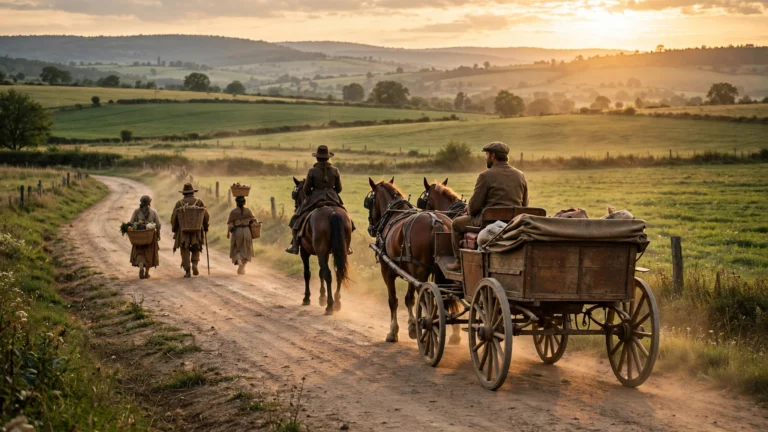
The Pony Express began on the 3rd of April 1860. Riders left St. Joseph, Missouri, and Sacramento, California, at the same time, heading towards each other. The route was about 1,966 miles long, with around 190 stations spaced ten to fifteen miles apart across prairies, deserts, and mountains. A rider would gallop to the next station, leap onto a fresh horse in about two minutes, and ride on. Each rider covered seventy-five to a hundred miles before handing the leather mailbag — called a mochila — to the next rider. The promised delivery time was ten days, and most runs finished in eight or nine.
But the Pony Express lasted just eighteen months. On the 24th of October 1861, the first telegraph line across the continent was finished, and two days later the last Pony Express rider came in. A wire could do in seconds what the fastest horse had done in ten days, and there was no going back. And it is worth remembering that the riders shared the trails with the new railways, whose iron horses were already changing how far a person could travel in a day — you can read who built the first of those engines in our guide to who invented the first train.
The Telegraph: Words Faster Than Horses
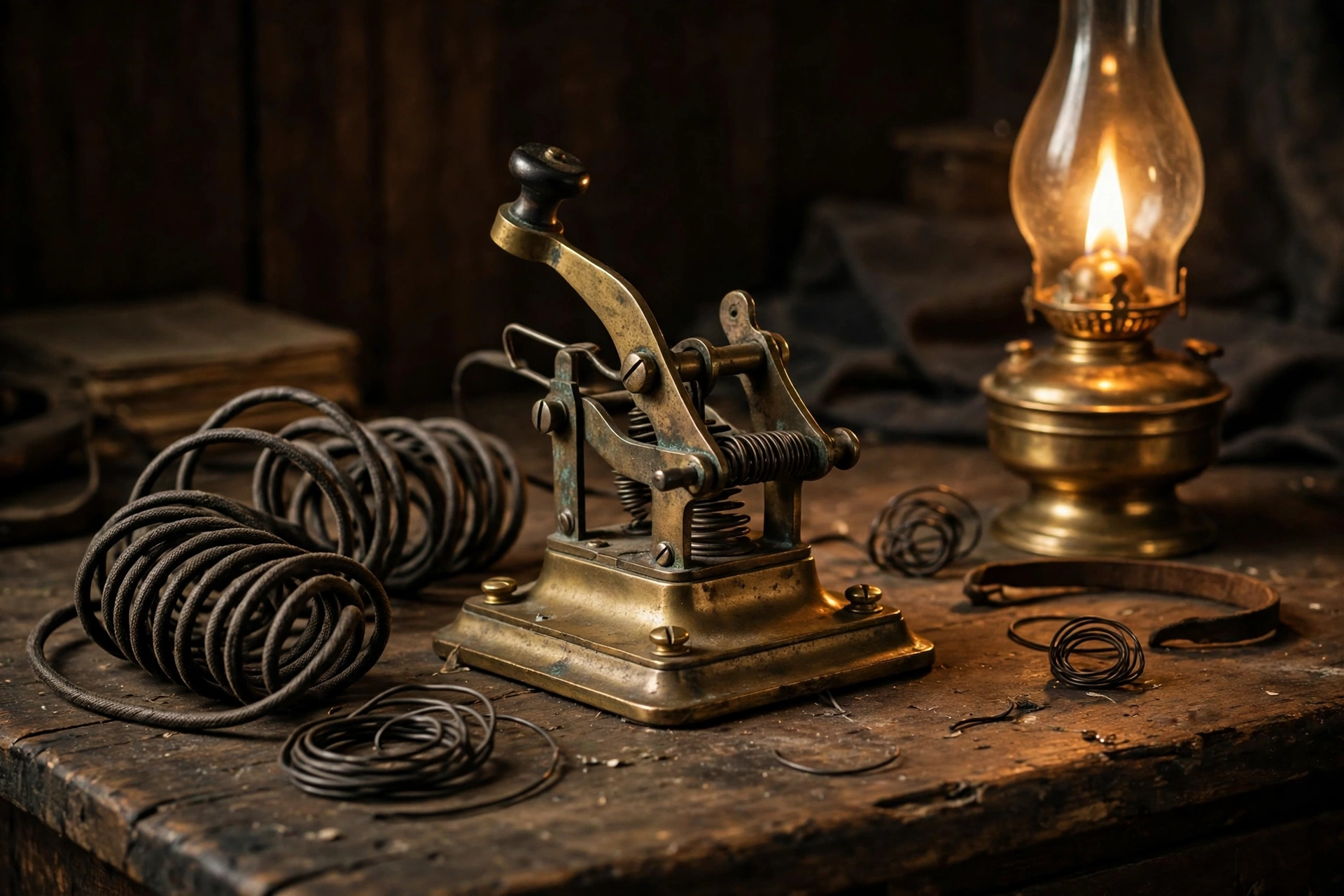
The telegraph was the first invention that separated a message from the messenger entirely. Instead of carrying words on paper, it sent them as electric pulses along a wire, in a code of short and long taps.
The man most people remember is Samuel Morse, an American artist who became an inventor. With his partner Alfred Vail, he developed a code of dots and dashes — Morse code — in which each letter had its own pattern of taps. In 1843, the United States Congress gave Morse 30,000 dollars to build a trial line between Washington and Baltimore, about forty miles apart.
On the 24th of May 1844, in front of a small crowd in the Capitol building in Washington, Morse sat at his key and tapped out the first official message: “What hath God wrought.” The words came from the Bible, from the Book of Numbers, and they had been chosen by Annie Ellsworth, the young daughter of the head of the Patent Office, who was there to watch. Vail, waiting in Baltimore, tapped the same words straight back. The message had travelled forty miles in the blink of an eye. A letter between the two cities took a day by train. The telegraph did it in a heartbeat.
Families could send a telegram — a short, paid-by-the-word message — to say “arrived safely” or “come home at once.” It was expensive, so people wrote telegrams the way we write text messages when we are nearly out of credit: short, blunt, and stripped of every word that was not needed. A few decades later, the telephone would go one step further and let people talk to each other in real time, and you can read how that happened in our guide to who invented the telephone.
Why a Message Could Take Weeks
So why did a simple message take so long for so much of history? The reasons stack up like the layers of a journey, and none of them had an easy fix. First, there was the road itself, or the lack of one. Rain turned a track to soup. Snow closed mountain passes for months. Rivers flooded and washed bridges away.
Second, there were the sea and the seasons. Before steamships, a letter crossing an ocean depended entirely on the wind. A ship from London to New York might make the crossing in three weeks with a fair wind, or take six weeks if the wind turned against it. Some ships never arrived at all. Families waiting for news from a son who had sailed away learned to wait months, and to dread the silence as much as any bad news.
Third, there was money. Fast messengers cost money, and most people had little of it. A poor family might send one letter a year, at Christmas, because that was all they could afford. A rich merchant could pay a courier to ride day and night, but a farm labourer had to wait for a neighbour who happened to be travelling. Speed was something you bought, and most people could not buy much of it.
Fourth, no one was in charge. There was no single postal service covering the whole world, no agreed set of rules, and no guarantee that a letter handed to a traveller in one town would ever reach the next. Letters passed from hand to hand, from ship to coach to rider, and every handover was a chance for something to go wrong.
What We Gained, and What We Lost
Phones gave us speed, and speed gave us a new kind of closeness. A parent can check on a child in another city in seconds. A friend can send a photo from a holiday beach while the sand is still on their feet.
But something was lost along with the waiting, and it is worth noticing. When a letter took three weeks to arrive, people wrote differently. They wrote long letters, full of detail, because they did not know when they would write again. Families kept those letters, tied them with ribbon, and read them again years later. A letter was not just a message. It was a keepsake.
Waiting also made news precious. When a ship came in after months at sea, the whole town gathered at the dock to hear what it carried. Today, we get so many messages that we barely read half of them. The phone buzzes, we glance, we swipe, and we forget. The people of the past would have been amazed by our speed, and perhaps a little sad at how little we treasure it.
Frequently Asked Questions
What was the fastest way to send a message before the telegraph?
It depended on the distance. For a short warning, smoke signals or drums could cross a valley in minutes, but they could only send a few agreed signals. For a real letter across a country, the Pony Express was the fastest of its day, covering nearly two thousand miles in about ten days in 1860 and 1861.
How did a homing pigeon know where to go?
It did not know an address. It only knew where home was. A pigeon lives in a loft, and if you carry it away in a basket and let it go, it flies back to that loft, sometimes across hundreds of miles.
What was the Pony Express?
The Pony Express was an American mail service that ran from April 1860 to October 1861. Riders on horseback carried mail about 1,966 miles between St. Joseph, Missouri, and Sacramento, California, changing horses every ten to fifteen miles at relay stations.
What did the first telegraph message say?
The first official long-distance telegraph message was “What hath God wrought.” Samuel Morse sent it on the 24th of May 1844 from Washington to Baltimore, a distance of about forty miles. The words come from the Bible, from the Book of Numbers, and were chosen by Annie Ellsworth, the daughter of the head of the Patent Office.
Why were letters so expensive before 1840?
Before the Penny Post, the person who received a letter paid for it, and the price depended on the distance it had travelled and the number of sheets of paper. Rowland Hill’s reform in 1840 set one flat price — one penny for a letter up to half an ounce, anywhere in Britain — paid in advance by the sender with a stamp.
Did people really use smoke signals?
Yes, but not the way films show it. Smoke signals could only send a few simple, agreed messages, such as a warning or an “all is well” sign. They were used by peoples of North America and by guards on the Great Wall of China, among others.
More from Zorium Daily
- Who Invented the Telephone?
- How Did People Tell Time Before Clocks Were Invented?
- How Did People Travel Before Cars Were Invented?
- Who Invented the First Train?
The next time your phone buzzes with a message from the other side of the world, think of the hands that carried words before it existed — the runner with a sentence held carefully in his head, the rider changing horses at midnight in the rain, the pigeon flying home through gunfire with a tiny tube on its leg, the clerk licking a Penny Black, and the man at a brass key tapping out four words that crossed forty miles in a blink. The tools changed, but the wish never did, and that is why the history of messages is really a history of people refusing to let distance win.