Who Was the First Person to Walk on the Moon? Explained Simply
SUMMARY OF THIS ARTICLE
- Neil Armstrong was the first person to walk on the Moon, during Apollo 11 on 20 July 1969.
- He stepped down at 10:56 pm EDT and said, “That’s one small step for [a] man, one giant leap for mankind.”
- Buzz Aldrin joined him on the surface about 15 minutes later, while Michael Collins waited alone in the command module above.
- The moonwalk lasted about 2 hours 36 minutes, and the astronauts collected rocks, planted a flag, and left a plaque behind.
- Only 12 people have ever walked on the Moon, and the last moonwalk happened in December 1972.
The Short Answer First
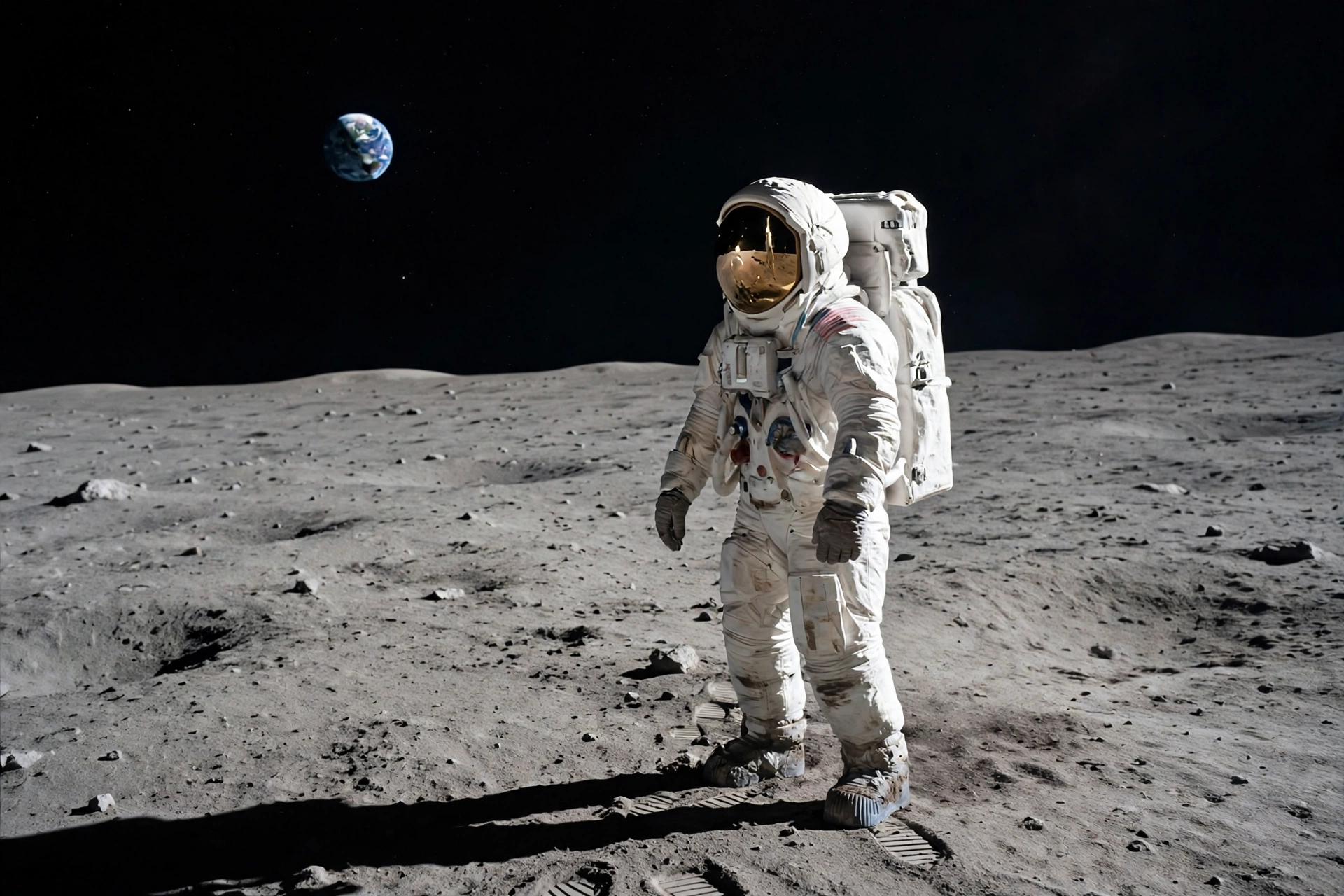
Neil Armstrong was the first person to walk on the Moon.
It happened on 20 July 1969, during a mission called Apollo 11. Armstrong climbed down a small ladder from his landing craft, put one boot on the grey dust, and spoke the words that people still remember today: “That’s one small step for [a] man, one giant leap for mankind.”
You may have heard that line before, in class or in a book or a film. It sounds grand, and it was. But the moment itself was quiet and careful. Armstrong did not jump down and run around. He tested the ground first, like a person stepping onto thin ice, to be sure the dust would hold him.
About 15 minutes later, Buzz Aldrin joined him. So Armstrong was first, Aldrin was second, and Michael Collins stayed up in the command module, circling the Moon alone while his two friends walked below. The whole moonwalk lasted about 2 hours 36 minutes. In that short time, the two men collected Moon rocks, set up science tools, planted an American flag, and left a small plaque. Then they climbed back up, left the Moon, and came home to Earth.
A Night That Stopped the World
Picture a summer evening in 1969. In living rooms all over the world, families pulled chairs close to the television. Shops closed early. Streets went quiet. People who did not own a television went to a neighbour’s house, or watched through a shop window.
An estimated 600 million people watched Armstrong step onto the Moon, about one person in every five alive at the time, all watching the same grainy black-and-white picture.
Mara, a twelve-year-old girl in Ohio, remembered it years later as the only night her father let her stay up past bedtime without an argument. She sat on the carpet in her pyjamas, her knees pulled up to her chest, while her father kept turning the volume up and down. “I don’t remember the picture very well,” she said later. “I remember the quiet. Nobody talked. Nobody even coughed.”
That quiet tells you something. People were not just watching a television show. They were watching something no human had ever done before. News travelled much more slowly in those days, and it is worth remembering how people sent messages before phones were invented — by letter, by radio, and by waiting. A man was standing on another world, 384,400 kilometres away, and if anything had gone wrong, there was no rescue team waiting nearby. And yet it worked. The landing was soft. The voice was calm. For one night, the whole world felt like it was in the same room, watching the same thing, hoping for the same ending.
The Race to Get There
Apollo 11 did not come out of nowhere. It was the end of a long race between two countries, the United States and the Soviet Union, and that race had started more than ten years earlier.
In 1957, the Soviet Union launched Sputnik, the first satellite, a small metal ball that beeped as it circled the Earth. That beep frightened a lot of people in America. Then in 1961, a Soviet pilot named Yuri Gagarin became the first person in space. America was behind, and everyone knew it. So in 1961, President John F. Kennedy made a bold promise: America would land a man on the Moon and bring him safely back to Earth before the end of the decade. Many people thought he was dreaming. The technology did not exist yet, and the computers of the time were weaker than a modern calculator. But the promise gave thousands of people a clear job to do. About 400,000 people worked on the Apollo programme in one way or another. Some built rockets. Some sewed spacesuits by hand. Some worked out, with pencil and paper, how a spacecraft should turn in the dark with no air to push against.
It was not just about pride. It was about learning how to do something no one had done, step by step, even when the steps were dangerous. Three astronauts died in a fire on the ground in 1967, during a test. That could have ended the whole programme. Instead, the engineers went back, fixed what was wrong, and kept going. By 1969, America had caught up. Apollo 8 had flown around the Moon at Christmas 1968, and Apollo 10 had tested the landing craft. Apollo 11 was the one that would try the real thing.
The Giant Rocket and the Long Trip
To get to the Moon, you need a very big push. The rocket that carried Apollo 11 was called the Saturn V, the largest rocket ever flown successfully. It stood 111 metres tall, taller than a 30-storey building. On 16 July 1969, Armstrong, Aldrin, and Collins sat on top of that rocket at the Kennedy Space Center in Florida. Below them were millions of litres of fuel. Above them was nothing but sky. When the engines lit, the whole rocket shook, and then it rose, slowly at first, then faster and faster, until it was a bright dot in the sky. The trip to the Moon took about three days. The Moon is about 384,400 kilometres from Earth. If you drove there in a car at motorway speed, without stopping, it would take you more than five months. Apollo 11 did it in 76 hours, because once you leave Earth’s pull, there is no air to slow you down, and you can keep gliding.
Inside the spacecraft, life was cramped and simple. The command module, where the three men lived, was about the size of a small car. They slept in bags tied to the wall, because in space there is no up or down, ate food from pouches, and drank water from bags with straws. They looked out of small windows and saw the Earth getting smaller behind them, until it looked like a blue marble hanging in blackness. Collins later wrote that the Earth looked so small he could cover it with his thumb.
On 19 July, Apollo 11 slipped into orbit around the Moon. The next day, Armstrong and Aldrin climbed into a smaller craft called the lunar module, nicknamed Eagle, and left Collins behind in the command module, Columbia, circling the Moon every two hours, waiting for a radio signal to tell him they were safe.
The Moment His Boot Touched the Dust
The landing itself was not smooth. Eagle was coming down towards a place called the Sea of Tranquility, a flat, dark area on the Moon. Armstrong looked out of the window and saw rocks. Big rocks, right where he was supposed to land. So he took control and flew the craft himself, looking for a clear spot, while the fuel gauge dropped lower and lower.
In the control room in Houston, Texas, people were quiet. The computer was flashing warnings. The fuel was nearly gone. Armstrong had about 30 seconds of fuel left when Eagle finally touched down, softly, on 20 July 1969 at 20:17 UTC, which was 4:17 in the afternoon in Houston. “Houston, Tranquility Base here,” Armstrong said. “The Eagle has landed.” People cheered. Some cried. But the work was not done. The astronauts had to check that the craft was safe, put on their bulky spacesuits, and get ready to step outside. That took hours, while millions of people waited by their televisions, not wanting to miss a second.
At last, Armstrong opened the hatch and climbed down the ladder. He stopped on the last step and looked around. Then he put his left boot on the surface. The time was 10:56 pm EDT on 20 July 1969. His words went out live to the world: “That’s one small step for [a] man, one giant leap for mankind.”
There is a small debate about the word “a.” Armstrong meant to say “for a man,” and most people believe he did, but the radio made it hard to hear. It does not change the meaning. One small step for one person. One giant leap for all of us. He described the dust as fine, like powdered charcoal, and said it stuck to his boots. The Moon’s gravity is only about one-sixth of Earth’s, so a person feels light there. Armstrong bounced a little as he walked, and the dust kicked up in slow arcs and fell straight back down, because there is no air and no wind on the Moon.
Buzz Aldrin and the Man Who Stayed Behind
About 15 minutes after Armstrong, Buzz Aldrin climbed down the ladder and joined him. Aldrin looked around and said something very human. He described the view as “magnificent desolation.” Magnificent, because it was beautiful. Desolation, because it was empty. Grey dust in every direction, black sky above, no trees, no water, no sound at all except the sound of his own breathing inside his helmet.
Aldrin was the second person to walk on the Moon, and he did the same kind of work as Armstrong. He helped collect rocks, helped set up tools, and took photographs. In one famous photograph, you can see Aldrin standing on the Moon, and in the shiny gold visor of his helmet, you can see a tiny reflection of Armstrong taking the picture. It shows both men in one frame, even though only one of them is facing the camera.
Meanwhile, up above them, Michael Collins was flying alone. He circled the Moon in Columbia, and every time he went behind the Moon, his radio went silent. For about 48 minutes of each orbit, he could not talk to anyone on Earth or on the Moon. He was completely alone, farther from any other human than anyone had ever been. Collins was not sad about staying behind. He had trained for years, and he knew his job mattered. If something had gone wrong on the surface, he was the one who would have to fly home alone and tell the world. He kept Columbia ready, checked the systems, and waited.
So when we say Armstrong was first, we should also remember Aldrin, who was right behind him, and Collins, who made the whole trip possible by staying in orbit and keeping the way home open. A moon landing was never a one-person job. It was a three-person job, and a 400,000-person job behind that.
What They Did on the Moon
The moonwalk lasted about 2 hours 36 minutes, and Armstrong and Aldrin did not waste a minute of it. They had a list of jobs, and they worked through it like two builders on a tight deadline.
First, they collected rocks. They picked up about 21.5 kilograms of Moon rock and dust and sealed it in boxes to bring home. Scientists on Earth had never held a piece of another world before. When they studied the Moon rocks, they learned that its surface had been shaped by huge impacts long ago. Even today, scientists still study those same rocks with new tools and keep learning new things from them.
Second, they set up science tools. They left a seismometer, a tool that listens for moonquakes, and a reflector, a set of small mirrors that scientists on Earth could bounce laser light off to measure the exact distance to the Moon. That reflector is still there, and scientists still use it.
Third, they planted a flag. The American flag was on a special pole, because there is no wind on the Moon to make a flag wave, so the flag had a rod along the top to hold it out straight. Armstrong and Aldrin had trouble pushing the pole into the hard ground, and they worried it might fall over. It stayed up, and they stood beside it for photographs.
Fourth, they left a plaque on the leg of Eagle. It read: “Here men from the planet Earth first set foot upon the Moon, July 1969 A.D. We came in peace for all mankind.” That word “peace” mattered. The Space Race had started as a contest between countries, but the plaque spoke to everyone. It said this step belonged to all of us, not just one nation.
They also spoke to President Richard Nixon by telephone from the Moon and took photographs of each other. Then, when their time was nearly up, they climbed back into Eagle, lifted off, and joined Collins in orbit. They left behind their boots, their cameras, and their footprints, because every gram they saved on the way home made the trip safer.
Why Those Footprints Are Still There
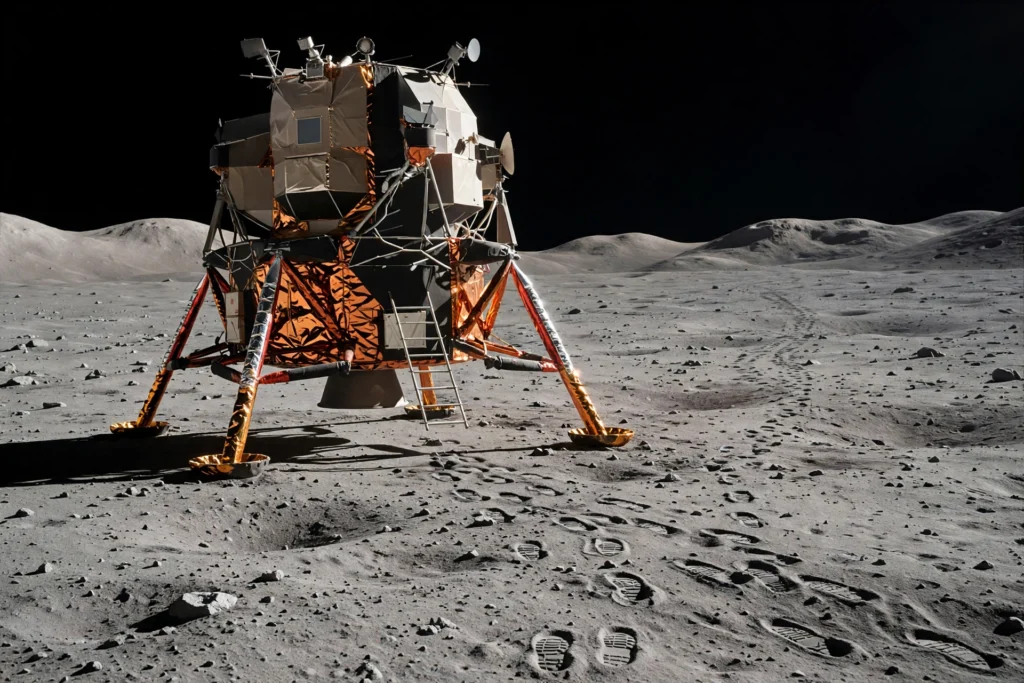
If you walk across a beach on Earth, your footprints wash away in a few hours. The tide comes in, the wind blows, the rain falls, and the sand smooths itself out. On the Moon, none of that happens.
The Moon has almost no air. There is no wind to blow dust around, no rain to wash it away, and no water running over the ground. So a footprint made in 1969 can still be there today, sharp and clear, as if it was made yesterday. The only things that change the surface slowly are tiny bits of space dust and the heat of the Sun, and those changes take thousands of years.
That is why people say the footprints will last for a very long time. Some scientists think they could last for millions of years. A boot print, made by a man in a hurry on a hot July night, may outlast every building, every road, and every book on Earth.
It is also why the Moon looks so still and quiet in photographs. There are no clouds. The sky is black, even in the daytime, because there is no air to scatter sunlight and make the sky blue. The Sun shines hard, the shadows are sharp, and the dust sits exactly where it fell. Next time you look at the Moon, remember that stillness. It is not empty in a boring way. It is a place that keeps a record. Every crater is a memory of a rock that hit it long ago. Every footprint is a memory of a human being who stood there, looked up at the Earth, and then went home.
You can see the Moon in the daytime sometimes, too, pale and white against a blue sky. If you want to know more, read about why we can sometimes see the Moon during the day. It is a small everyday mystery, and it has a simple answer.
Only Twelve People, Ever
Here is a fact that surprises most people. Only 12 people have ever walked on the Moon. All of them were American men. All of them flew on Apollo missions. And the last one walked on the Moon in December 1972, during Apollo 17.
That means no one has walked on the Moon for more than fifty years. Your grandparents may have been children when the last moonwalk happened. A whole generation has grown up, gone to school, started jobs, and had children of their own, all without a single person setting foot on the Moon.
After Apollo 11, five more Apollo missions landed on the Moon: Apollo 12, 14, 15, 16, and 17. Apollo 13 was supposed to land, but an explosion on the way damaged the spacecraft, and the crew had to come home without landing.
Each later mission stayed longer and did more science. Apollo 15 brought a small car, called a lunar rover, so the astronauts could drive farther from their landing craft. Apollo 17 stayed for three days and collected more rocks than any other mission. The last person to step off the Moon was Eugene Cernan, the commander of Apollo 17, in December 1972. Why did it stop? The short answer is money and attention. Moon missions were very expensive, and after the first landing, the excitement faded a little. NASA turned its attention to space stations and the Space Shuttle, which flew closer to Earth. But the story is not over. New missions are being planned now, and this time the plan is to send women as well as men, and to stay longer. Some of the people who will walk on the Moon next may be in school right now, doing their homework, unaware that one day they might look up and see the Earth from a place no one has visited in decades.
Why It Still Matters Today
You might ask a fair question. Why does it matter now, more than fifty years later, that one man stepped onto the Moon? We have phones in our pockets that are more powerful than the computers on Apollo 11. We have sent robots to Mars. What does an old moonwalk add?
It matters because it showed what people can do when they work together on a hard thing for a long time. Apollo 11 was not one clever idea. It was thousands of small jobs done well, by people who did not know each other, who trusted each other’s work. The seamstress who sewed the spacesuit had to trust the engineer who built the rocket. The engineer had to trust the pilot who would fly it. It also matters because it changed how we see ourselves. Before Apollo 8, no one had ever seen a photograph of the whole Earth from space. When people saw that blue marble hanging in blackness, they understood, in a new way, that we all live on one small planet, and that the borders we draw on maps are invisible from space. And it matters for a simpler reason. It gives children something to aim at. A child who hears about Neil Armstrong does not just learn a date for a test. They learn that a boy from a small town in Ohio, who liked building model aeroplanes, grew up to walk on the Moon. That is practice, study, patience, and courage, added up over years.
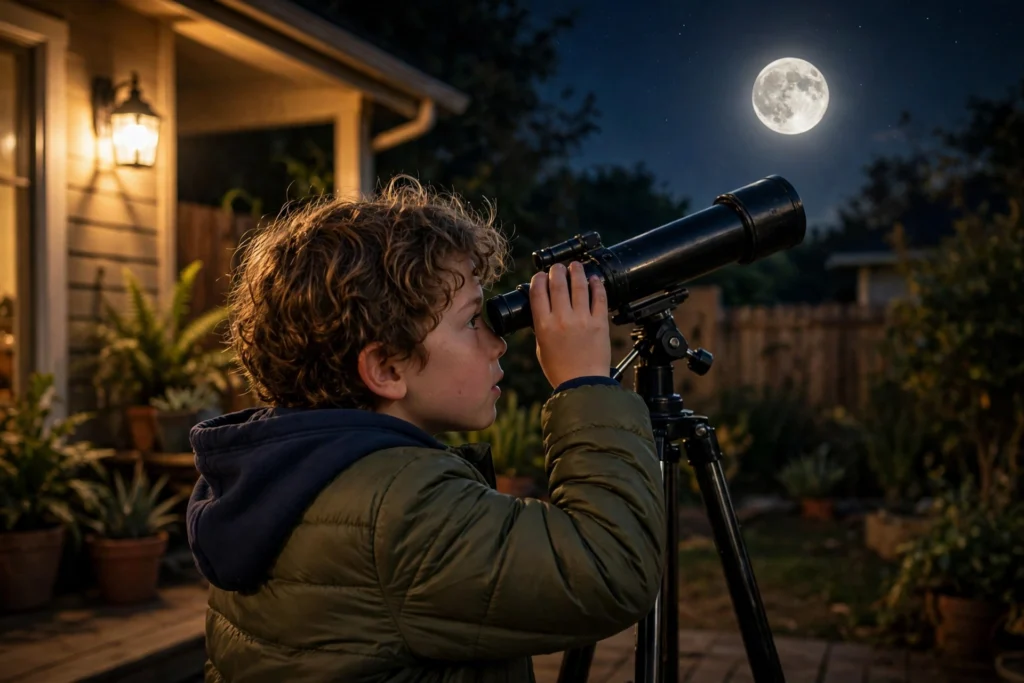
So look up tonight, if the sky is clear. Find the Moon. It will look the same as it always has, pale and calm and far away. But now you know something new about it. Human boots have stood there. Human hands have picked up its rocks. Human voices have spoken from its surface and been heard on Earth. And one day, perhaps in your lifetime, someone will go back.
Frequently Asked Questions
Who was the first person to walk on the Moon?
Neil Armstrong was the first person to walk on the Moon. He stepped onto the surface during Apollo 11 on 20 July 1969, at 10:56 pm EDT. Buzz Aldrin joined him about 15 minutes later, and Michael Collins stayed in orbit above them.
What did Neil Armstrong say when he stepped on the Moon?
He said, “That’s one small step for [a] man, one giant leap for mankind.” He meant that one person’s small step was a huge step forward for all people. The words were heard live by millions of people on Earth.
Who was the second person to walk on the Moon?
Buzz Aldrin was the second person to walk on the Moon. He climbed down the ladder about 15 minutes after Armstrong. He called the view “magnificent desolation,” because it was beautiful and empty at the same time.
How long did Armstrong and Aldrin spend on the Moon?
Their moonwalk lasted about 2 hours 36 minutes. In that time, they collected rocks, set up science tools, planted a flag, and left a plaque. Then they climbed back into their landing craft and flew up to meet Michael Collins.
How many people have walked on the Moon?
Only 12 people have ever walked on the Moon. All of them were American astronauts on Apollo missions. The last moonwalk was in December 1972, during Apollo 17, and no one has walked there since.
Why are the astronauts’ footprints still on the Moon?
The Moon has almost no air, so there is no wind or rain to wash footprints away. A footprint made in 1969 can still be there today, sharp and clear. Scientists think some footprints could last for millions of years.
More from Zorium Daily
- Who Invented the First Train?
- Who Invented the First Car?
- Who Invented the Telephone?
- How Did People Send Messages Before Phones Were Invented?
So tonight, if the sky is clear, step outside and look up at the Moon. It is the same pale, quiet place where Neil Armstrong once stood, and where his footprints still wait in the dust, under a black sky, with the Earth shining blue above them.