Who Invented the First Train?
By Zorium Daily News Desk
SUMMARY OF THIS ARTICLE
- No single person invented the train in one day. It grew step by step, from horse-drawn wagons in mines to steam engines on iron rails.
- Richard Trevithick built the first working steam locomotive in 1804. On 21 February that year, it pulled ten tons of iron and seventy men along a track in Wales.
- George Stephenson made trains useful for everyone. His Locomotion No. 1 carried passengers on the world’s first public steam railway in 1825.
- Stephenson’s Rocket won a famous race in 1829 and proved that steam trains could be fast, strong, and safe enough for daily travel.
- Trains changed the world: they made travel cheap and quick, helped towns grow, carried food and goods across whole countries, and spread to nearly every land on Earth.
The Train You Took This Morning
Picture a morning at a railway station. The platform is busy, and then a voice says the train is coming, and far down the track, a light appears. The train slides in, smooth and quiet, and its doors open. People step on, find their seats, and within minutes they are moving faster than any horse.
It feels normal, but stop for a second and think about it. A few hundred tons of metal, carrying hundreds of people, gliding along two thin strips of steel. Less than 250 years ago, nothing like this existed.
So who had the idea? Who built the first train? The answer is not one name. It is a story with two heroes, a bet, a race, and a lot of hard work in dark coal mines. And it starts, as many great stories do, with a problem that needed solving.
The Short Answer First
If you want the quick answer, here it is. Richard Trevithick, an engineer from Cornwall in England, built the first working steam locomotive in 1804. A locomotive is the engine that pulls a train. His machine ran on rails in Wales and pulled a heavy load of iron. It worked, but it was too heavy for the rails of its day, and it never became a regular service.
George Stephenson is the other name you need to know. In 1825, his locomotive, called Locomotion No. 1, ran on the Stockton and Darlington Railway in England. That was the first public railway in the world to carry passengers by steam. In 1829, Stephenson’s Rocket won the Rainhill Trials, and in 1830 the Liverpool and Manchester Railway opened.
So Trevithick invented the locomotive, and Stephenson made the railway. Both men matter. To understand why, we need to go back to a world where the fastest thing on land had four legs.
Before the Train: Horses, Wooden Rails, and Heavy Loads
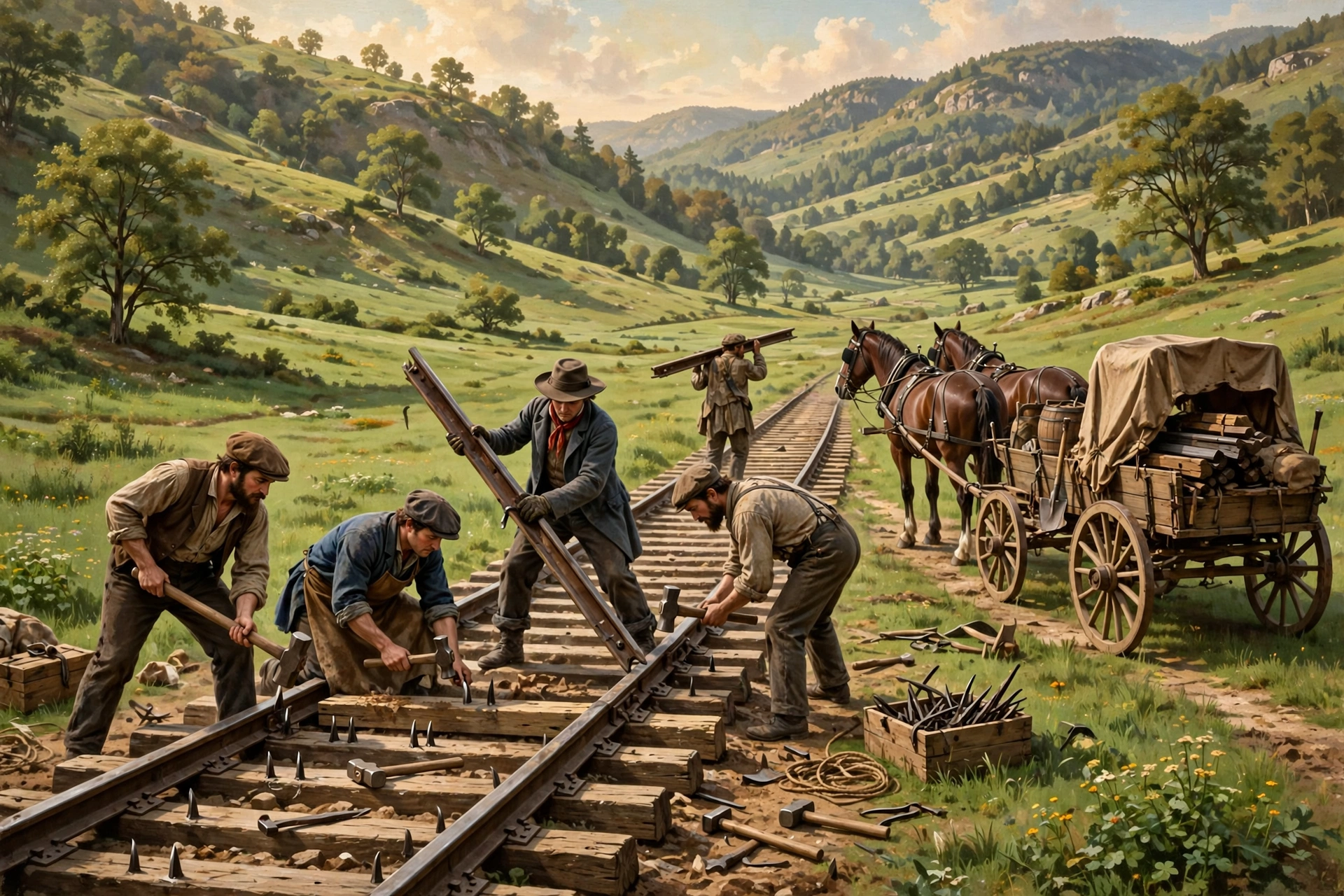
Long before steam, people already knew that rails made heavy loads easier to move. A wheel on a smooth rail rolls far more easily than a wheel on a rough, muddy road. So in the mines of Germany and England, as early as the 1500s and 1600s, workers laid wooden rails along the floors of mine tunnels. They put wagons on those rails and filled them with coal or iron ore. A horse, or sometimes a person, pulled the wagon along the track.
It worked, but it was slow. A horse gets tired, needs food and rest, and could never go very fast. For hundreds of years, that was the best anyone could do.
In the 1700s, Britain was digging more coal than ever before, to heat homes, run factories, and make iron. But coal is heavy, and the mines were often far from towns, rivers, and ports. Moving it by horse and cart was slow and costly. Mine owners needed a machine that could pull heavy loads all day, without getting tired or stopping for sleep. The answer was waiting in the steam from a boiling kettle.
If you want to picture that old world of slow travel, you can read our article about how people travelled before cars were invented. Horses, carts, and coaches were the best travel anyone knew, and a journey of a hundred miles could take days.
What Is Steam, and Why Did It Matter?
Steam is just water turned into a gas by heat. When you boil a kettle, the lid rattles. That rattling is steam pushing its way out. The push is strong. In the 1700s, engineers learned to trap that push inside a machine and use it to move a piston, a kind of sliding rod, back and forth. That movement could pump water out of a mine, or turn a wheel in a factory.
The first steam engines were huge, slow, and fixed in one place, far too heavy and weak to put on wheels.
Richard Trevithick changed that. He built a new kind of steam engine that used steam at high pressure. High pressure means the steam is squeezed tight, so it pushes much harder. His engine was smaller, lighter, and stronger than the old ones. It was the first steam engine that was small enough and strong enough to move itself. And once an engine can move itself, the next question is obvious. Why not put it on rails and let it pull a load?
The Cornish Giant: Richard Trevithick
Richard Trevithick was born in Cornwall, in the far south-west of England, in 1771. Cornwall was mining country. Trevithick grew up around mines, engines, and men who worked with their hands. He was tall and strong, and people called him the Cornish Giant. He was not a university man. He learned by watching, trying, and failing, and then trying again.
In 1801, Trevithick built a steam road vehicle that he called the Puffing Devil. It was a kind of early car, driven by steam, and it ran along the streets of Camborne, a mining town in Cornwall. It was noisy and hard to steer, but it moved under its own power, which showed a small steam engine could carry itself along a road.
Then came the chance that made history. In 1803, a mine owner named Samuel Homfray asked Trevithick to come to his ironworks at Penydarren, in Merthyr Tydfil, Wales. Homfray had a problem. His ironworks made iron, but the nearest canal, where boats could carry the iron away, was about nine and a half miles away. The road between the ironworks and the canal was a tramroad, a track with iron rails, and horses pulled wagons full of iron along it. It was slow work. Homfray wanted to know if a steam engine could do the job instead.
Trevithick took one of his high-pressure engines, mounted it on wheels, and turned it into a locomotive. It was a rough-looking machine, with a single tall cylinder, a huge flywheel, and a chimney that puffed out steam. It weighed about seven tons. Nobody had ever built anything like it before.
The Bet That Made History
Homfray was so sure the machine would work that he made a bet with another ironworks owner, Richard Crawshay. He bet 500 guineas, a huge sum of money at the time, that Trevithick’s locomotive could pull ten tons of iron along the tramroad from Penydarren to the canal at Abercynon, a distance of about nine and a half miles.
On 21 February 1804, the day of the test arrived. Behind the engine were five wagons carrying ten tons of iron, and seventy men climbed aboard for the ride. Then the engine started, and the whole train began to move.
It was not fast. The journey took four hours and five minutes, which works out to an average speed of about two and a half miles per hour, roughly the speed of a person walking briskly. At its best, the engine reached almost five miles per hour. But speed was not the point. The point was that it worked. A machine, with no horse in front of it, had pulled a heavy load along a railway. Homfray won his bet, and the world had its first working steam locomotive.
Guinness World Records recognises the Penydarren run as the first full-size working railway steam locomotive. Yet after that famous day, the locomotive made only three journeys, and then the horses went back to work.
Why the First Train Did Not Take Over the World
Why did such a great invention stop there? The answer is simple, and it is a good lesson about how inventions really work. An invention is not enough on its own. It has to fit the world around it, and in 1804, the world was not ready.
The problem was weight. Trevithick’s locomotive weighed about seven tons, and it ran on cast-iron rails. Cast iron is brittle, which means it breaks rather than bends. Under the weight of the engine, the rails cracked and broke. Every run damaged the track. Fixing the track cost more money than the engine saved. Homfray looked at the numbers and decided the horses were cheaper after all.
In 1808, Trevithick built another locomotive, Catch Me Who Can, and ran it on a round track in London as a kind of fairground ride. He was a brilliant inventor and a poor businessman, and he died in 1833 with little money and little fame.
That someone was George Stephenson. He was not the first to build a locomotive, but he was the first to build a railway that worked as a business, day after day, carrying real people and real goods. And that turned out to matter more than being first.
George Stephenson and the Railway That Changed Everything
George Stephenson was born in 1781, in a small village near Newcastle, in the north of England. His father worked at a coal mine, and George grew up in the same world. As a boy, he worked as a cowherd, then as an engineman, looking after the steam engines that pumped water out of the mines. He had almost no schooling, but he had a gift for machines.
By 1814, Stephenson had built his own locomotive, called Blücher, for the Killingworth coal mine. It pulled wagons of coal along the mine’s railway, and it worked well. Over the next few years, he built more, each one a little better than the last. He learned what Trevithick had not: how to make an engine that was strong without being too heavy for the rails, and how to build rails that could take the weight.
Then came the big chance. In 1821, Parliament gave permission for a new railway between Stockton and Darlington, to carry coal from the mines to the port of Stockton. Stephenson was put in charge of building the line.
On 27 September 1825, the Stockton and Darlington Railway opened. It was a grand day. Crowds lined the route. Stephenson himself drove the first train. The locomotive was called Locomotion No. 1, and behind it were 36 wagons: wagons full of coal and flour, a passenger coach called Experiment, and wagons crowded with people. About 450 to 600 people rode that day, and the train moved at about four miles per hour on average, reaching about eight at its fastest.
That day matters because the Stockton and Darlington was a public railway. It was not a private track inside a mine. It was open to the public, and it carried passengers as well as goods, by steam. It was the first time in history that ordinary people could buy a ticket and ride behind a steam locomotive on a public line. The railway age had begun.
The Rocket and the Race at Rainhill
The Stockton and Darlington was a success, but it was still slow, and many people doubted steam trains could ever be fast or safe enough. Early locomotives broke down often, and a train crawling at four miles per hour was not much better than a horse.
The answer came in 1829, on a stretch of track near a village called Rainhill, between Liverpool and Manchester. The owners of the new Liverpool and Manchester Railway needed engines for their line, and they did not want to guess. So they held a public competition, the Rainhill Trials, and offered a prize of £500, a very large sum, for the best locomotive. Five engines turned up to compete. They had to run up and down a mile of track, pulling a load, without breaking down.
Only one engine finished the test properly. It was the Rocket, designed by George Stephenson and his son Robert, and built by their company in Newcastle. The Rocket had a new kind of boiler, with many small tubes inside it, which made steam much faster. It reached about 30 miles per hour, or 48 kilometres per hour. No horse could keep up with that for long.
The Rocket won the prize, and the Liverpool and Manchester Railway opened on 15 September 1830. It was the first railway in the world to run between two big cities, the first to rely only on steam, with no horses at all, the first to run on a fixed timetable, and the first to carry mail by train. Soon, about 1,200 passengers a day were riding it. A journey between Liverpool and Manchester that had taken hours by coach now took less than two hours by train.
Why Steam Power Mattered
So why did steam matter so much? Why did it beat the horse, which had served people for thousands of years? The answer comes down to three simple things: strength, stamina, and cost.
A horse is strong, but only for a short time. It gets tired. It needs to eat and rest. A steam engine does not get tired. As long as it has coal and water, it keeps pulling, hour after hour, day after day. One locomotive could pull a load that would have needed dozens of horses, and it could do it without stopping for the night.
Steam was also cheap where coal was plentiful. A mine owner could feed his engine with coal from his own mine. Horses, by contrast, needed fields of oats and hay, and people to look after them.
And steam was steady. A horse slows on hills and stops when it is scared. A steam engine pulls at a steady pace, and it can be timed. That is why trains brought timetables. Before trains, each town kept its own local time, set by the Sun. Railway companies chose one standard time, and that idea later grew into the time zones we use today.
How Trains Changed Travel and Trade
Once trains worked, life changed fast. Travel was the first thing to change. Before trains, most people never went far from home. A trip to a city fifty miles away was a big event, planned for days. By train, it took a couple of hours and cost very little. Ordinary workers could visit family in another town, go to the seaside for a day, or move to a city to find work. The world got smaller.
Trade changed too. A train could carry tons of goods in one trip. Before trains, fresh milk and fish could only be sold near where they were made. By train, milk from a farm could reach a city the same morning, and fish from the coast could be on a dinner table inland by evening.
Towns changed as well. A town with a railway station grew fast. Shops opened near the station. Hotels, restaurants, and markets followed. New towns grew up around railway junctions, places where lines met. The railway decided which places would grow and which would shrink.
Newspapers could be sent across the country in hours, so people in far towns read the same news on the same day. And for the first time, ordinary people could travel just for fun. The seaside holiday and the day trip became possible because the train made them cheap and easy.
Think of a toy train set. A small engine, a few carriages, a circle of track on the floor. That toy is a copy of a real idea that changed the world.
Railways Spread Around the World
Britain was first, but the railway did not stay in Britain for long. Engineers from other countries came to see the Liverpool and Manchester Railway, and they went home full of plans. Within a few years, lines were opening all over the world.
France and Austria opened their first lines in 1828. Belgium, Germany, Russia, Italy, and Holland followed in the 1830s. In the United States, the first American-built locomotive, the Best Friend of Charleston, was put to work in 1830, and American railways grew faster than anyone expected. By 1860, the United States had more than 30,000 miles of railway, and in 1869, the first railway across the whole of North America was finished, joining the east coast to the west coast.
In Asia, the first line opened in India in 1853, between Bombay and Thane, a short journey of about 21 miles. It was the start of one of the largest railway systems in the world. In Africa, Egypt opened its first line, between Alexandria and Cairo, in 1856. In Australia, the first railway began in 1854, and Canada had none until 1853.
Each country built railways for its own reasons, but everywhere the effect was the same: trains joined places that had been cut off from each other.
There was a cost, and it should not be hidden. Building railways was hard, dangerous work, done by hand in all weathers, and some workers died in accidents. The trains brought great benefits, but the tracks were laid with real sweat and, too often, real suffering.
What Trains Look Like Today
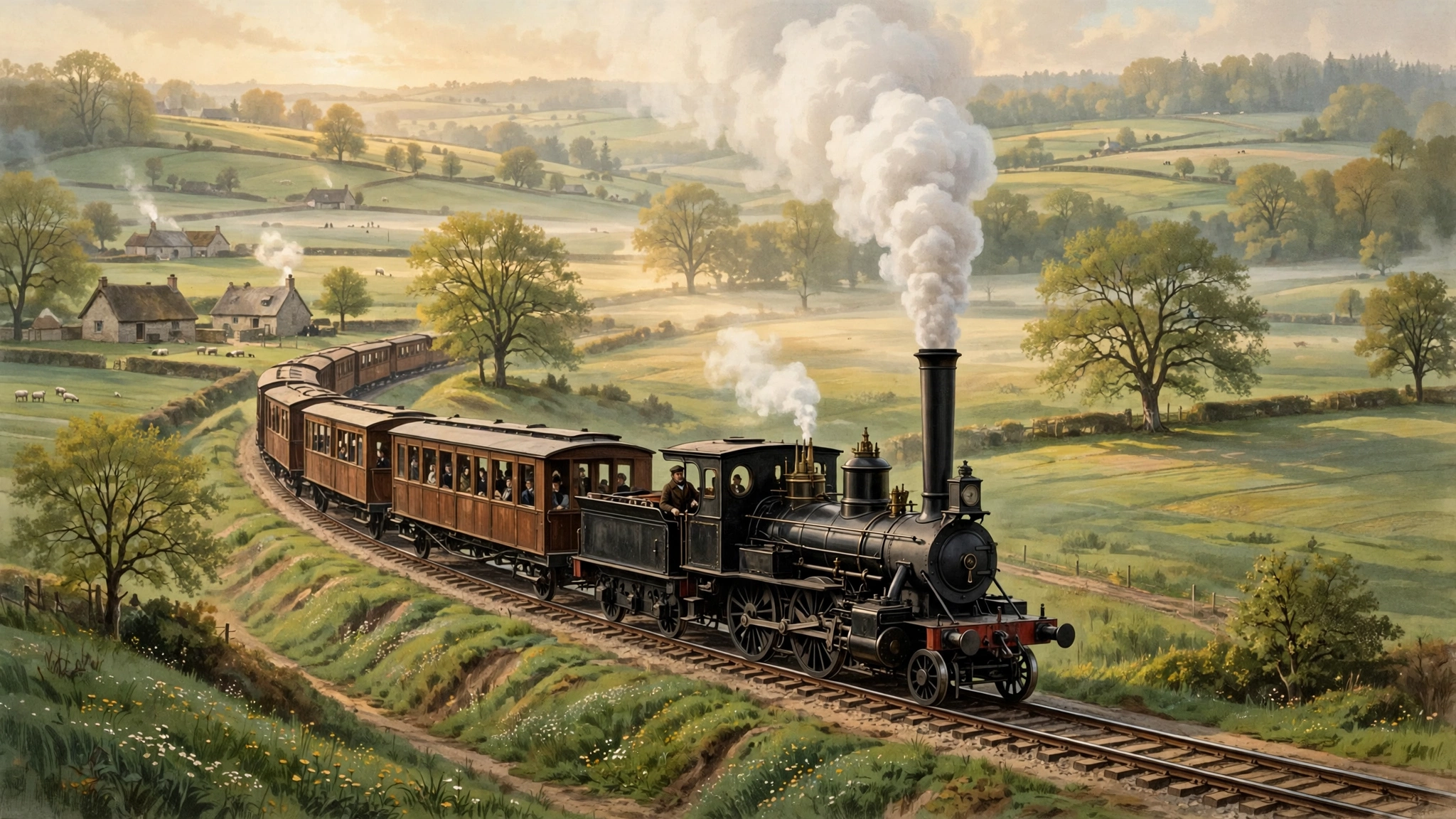
The trains of Trevithick and Stephenson would look strange to us now. They were slow, smoky, and noisy, and they burned coal by the ton. But the idea behind them is still with us. A train is still a set of wheels on rails, pulled by a powerful engine.
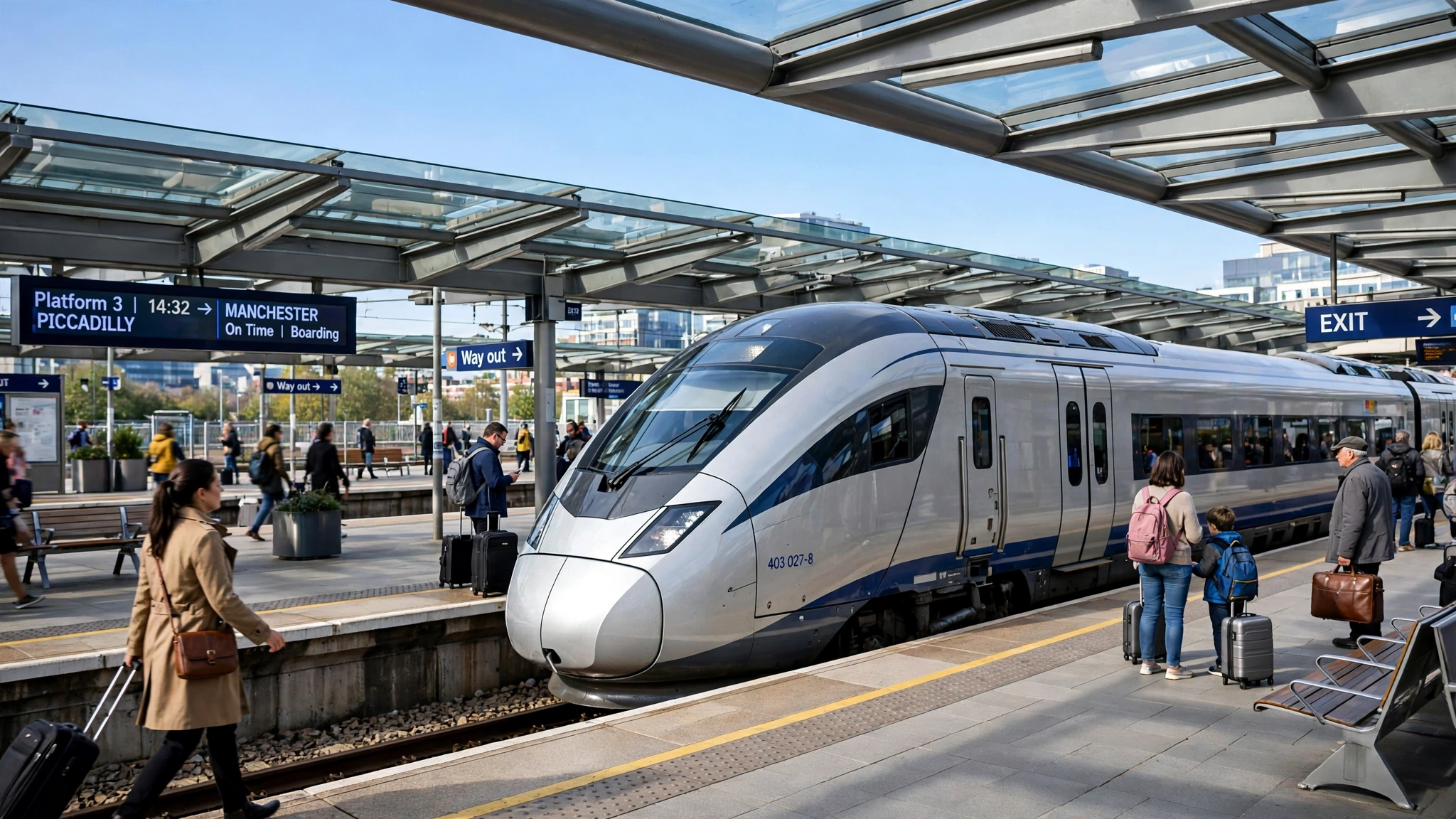
Today’s trains are very different. Most run on electricity, not coal. High-speed trains in Japan, China, and Europe travel at 300 kilometres per hour or more. Underground trains carry millions of people under big cities every day, and freight trains carry containers across whole continents.
And yet, if you stand on a platform today, you are watching the same idea Trevithick proved in 1804 and Stephenson turned into a daily service in 1825. Two rails. A powerful engine. A load no horse could pull.
So who invented the first train? Trevithick built the first locomotive. Stephenson built the first railway that worked for everyone. Between them, and with the help of many other engineers, miners, and workers whose names we will never know, they gave the world a new way to travel. The next time you step onto a train, remember the bet in Wales, the race at Rainhill, and the day in 1825 when a small black engine called Locomotion No. 1 set off from Shildon with hundreds of people behind it. That was the day the world started moving faster.
Frequently Asked Questions
Who invented the first train?
Richard Trevithick built the first working steam locomotive in 1804, in Wales. George Stephenson made trains useful for everyone, with the first public passenger railway in 1825. The train was the work of more than one person.
When did the first train run?
Trevithick’s locomotive made its first run on 21 February 1804, pulling ten tons of iron and seventy men along a track in Wales. The first public steam passenger train ran on 27 September 1825, on the Stockton and Darlington Railway in England.
How fast was the first train?
Trevithick’s 1804 locomotive averaged about two and a half miles per hour, and reached almost five miles per hour at its fastest. Stephenson’s Locomotion No. 1 in 1825 averaged about four miles per hour. By 1829, the Rocket reached about 30 miles per hour.
Why is George Stephenson called the Father of Railways?
Stephenson built the first public railways that worked as a business, including the Stockton and Darlington in 1825 and the Liverpool and Manchester in 1830. Trevithick built the first locomotive, but Stephenson built the railways people actually used.
What did trains run on before steam?
Before steam, wagons ran on wooden or iron rails in mines, pulled by horses or by people. These wagonways had existed since the 1500s and 1600s, but they were slow and could only carry small loads over short distances.
Are steam trains still used today?
Yes, but mostly for fun, as tourist attractions on heritage railways. Modern trains run on electricity or diesel, and high-speed trains can travel at 300 kilometres per hour or more.
More from Zorium Daily
- How Did People Travel Before Cars Were Invented?
- Who Built the First Roads in the World?
- Who Invented the Telephone?
- Who Invented Paper Money?
The next time you wait on a station platform, listen for the sound of the train coming. That sound began with a bet in a Welsh ironworks, a tall Cornish engineer who would not give up, and a railwayman from Newcastle who turned a clever machine into something ordinary people could use every day. The first train was slow, smoky, and heavy enough to break its own rails. Yet it carried the whole future with it, one wagon at a time.