
How Do Banks Make Money?
SUMMARY OF THIS ARTICLE
- A bank earns most of its money by charging borrowers more interest than it pays savers.
- Banks also earn money from fees, card payments, and safe investments.
- Your savings help the bank lend to other people, and that is why the bank pays you interest.
- Banks keep part of the money safe in reserve and follow strict rules.
- When a loan is not repaid, the bank loses money, so it checks borrowers with care.
Have you ever walked past a big bank building and asked a simple question? How does a bank make money? A bank does not sell food. It does not sell clothes. It does not make cars. Yet banks are some of the biggest businesses in the world. So where does that money come from?
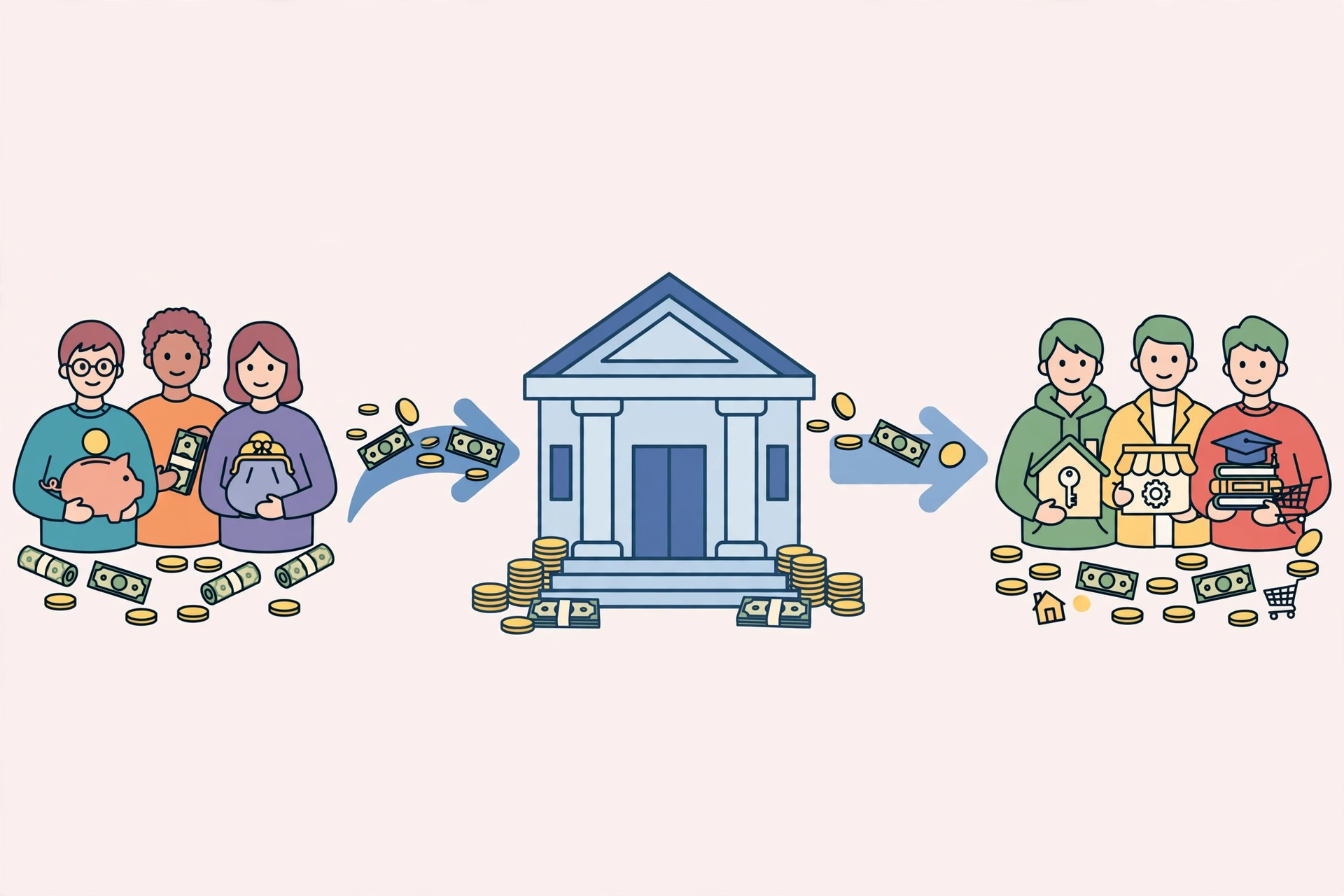
The answer is simple. A bank is a bit like a bridge. On one side, there are people who want to keep their money safe. On the other side, there are people who want to borrow money. The bank stands in the middle. It takes money from savers. It lends money to borrowers. It charges the borrowers more than it pays the savers. The gap in the middle is how the bank earns most of its money.
Think of a small example. The bank might pay you 2 percent a year on your savings, as an example. That means if you save 100 dollars, you get 2 dollars in a year. The bank might charge a borrower 8 percent a year, as an example. That means if a person borrows 100 dollars, they pay 8 dollars in a year. The bank pays 2 dollars and takes 8 dollars. The gap is 6 dollars. These numbers are only examples. Real rates change from bank to bank and from country to country. But the simple idea stays the same.
This article is general information only, not personal financial advice. It explains how banks work in a simple way. It does not tell you what to do with your own money. If you need help with a big money choice, talk to a trusted money adviser in your own country.
What a Bank Does in One Simple Idea
A bank does three main jobs. First, it keeps money safe. Long ago, people kept money at home. That was risky. Money could be stolen or lost in a fire. A bank gives people a safe place. You put your money in the bank. You can take it out when you need it.
Second, a bank helps people pay. You can pay a shop with a card. You can pay a bill online. You can send money to a friend. You can get cash from a cash machine. The bank moves money for you.
Third, a bank lends money. This job earns the most money for the bank. People borrow money to buy a home or a car. People borrow money to start a small shop. Businesses borrow money to buy tools, hire workers, or grow bigger. In return, the borrower pays the money back with interest. Interest is the extra money you pay for using someone else’s money.
These three jobs help each other. People put money in the bank because it is safe. The bank uses that money to make loans. The interest from the loans helps the bank pay savers and run its business.
Where the Money Comes From: Lending at Higher Interest Than It Pays Savers
Let us look closer at the main way a bank makes money. It is called the interest gap. It is the difference between the interest the bank pays and the interest the bank charges.
Imagine a bank has 1,000 savers. Each saver puts 1,000 dollars in the bank. That is 1,000,000 dollars in total. The bank pays each saver interest. Let us say the bank pays 2 percent a year as an example. That means the bank pays 20,000 dollars in interest to all the savers in one year. That is a cost for the bank.
Now the bank lends that money out. Let us say the bank charges 7 percent a year on these loans as an example. That means the bank earns 70,000 dollars in interest in one year. The bank pays 20,000 dollars to savers. It earns 70,000 dollars from borrowers. The gap is 50,000 dollars. The bank still has to pay its workers, its rent, and its other costs from that gap. What is left after those costs is its net profit.
Not all loans are the same. A home loan is often safer because the home itself is a kind of security. A loan to a small new business is often riskier. The bank may charge more interest for a riskier loan. More risk means more reward is needed. Less risk means less reward is needed.
A credit card is also a kind of loan. When you use a credit card, the bank pays the shop for you. You pay the bank back later. If you do not pay in full, the bank charges high interest. That is why it is important to learn how credit card interest works. Credit card interest is often much higher than home loan interest. That is because a credit card loan has no security. The bank takes more risk, so it charges more.
Fees and Charges
Interest is not the only way a bank makes money. Banks also earn money from fees and charges. Fees are small payments for a service. You may not notice them one by one. But when millions of people pay small fees, the total becomes very big.
First, there are account fees. Some banks charge a monthly fee for keeping an account. The fee may pay for the card, the app, and the help from staff. Some banks offer a free account if you keep a certain amount of money in it. Others offer a free account for students. The rules change from bank to bank. It is always good to ask what the fee is before you open an account.
Second, there are cash machine fees and card fees. If you use a cash machine from another bank, you may pay a small fee. If you take cash out in another country, you may pay a fee too. Some credit cards have a yearly fee. The fee may pay for rewards or travel help. Some cards are free. It depends on the card.
Third, there are transfer fees. Sending money to another country can cost money. Sending money fast can cost more. Some banks charge for a paper statement or for a special service, like a bank letter. These are all small services. Each one has a small price.
Fourth, there are late fees and overdraft fees. If you pay a loan late, the bank may charge a late fee. If you spend more money than you have in your account, the bank may charge an overdraft fee. These fees can be high. They are also easy to avoid if you plan well. A simple monthly budget can help you see your money clearly and avoid late payments. A budget just shows what comes in and what goes out. When you know that, you can pay on time.
Why do banks charge fees? Services cost money to run. A cash machine costs money to buy and fill. A card system costs money to keep safe. An app costs money to build and update. Staff cost money to train and pay. Fees help pay for these services. Fees can feel annoying. No one likes to pay a fee. But it helps to compare banks. One bank may charge many fees. Another bank may charge fewer fees. Some online banks charge almost no fees because they have no big branches to pay for. A small difference in fees can save you a good amount of money over a year.
Investing Deposits Safely
A bank does not only lend money to people. It also invests some money in safe places. This is another way a bank makes money. When you put money in a bank, the bank does not lock it in a big box and leave it there. That money would just sit still. It would not grow. Instead, the bank puts the money to work. Most of the money goes to loans. Some of the money goes to safe investments. These are places where the bank can earn a little interest with low risk.
One common safe investment is a government bond. A government bond is like a loan to the government. The bank lends money to the government. The government pays the bank back with interest. This is seen as very safe in many countries because governments rarely fail to pay. The interest is often low. But the risk is also low. That is a fair trade for a bank.
Another safe place is a deposit with the central bank. The central bank is the bank for all banks. It is run by the government. Banks can keep money there. The central bank may pay a small amount of interest. This is one of the safest places to keep money.
The key word is safe. A bank is not like a person who buys risky shares to get rich fast. A bank must protect the money of its savers. So it chooses safe, steady investments. It does not gamble with your savings. That extra money helps the bank pay you interest. It also helps the bank stay strong.
Why a Bank Pays You Interest on Savings
Now let us turn the question around. We know how the bank makes money. But why does the bank pay you interest on your savings? The answer is simple. The bank needs your money. Without your money, it cannot lend to anyone. It cannot earn interest. It cannot run its business.
Your savings are the raw material for the bank. Think of a baker. A baker needs flour to make bread. Without flour, there is no bread. In the same way, a bank needs deposits to make loans. Without deposits, there are no loans. So the bank pays you for letting it use your money. Interest is the price the bank pays to borrow your money.
The amount of interest you get depends on a few things. First, it depends on the type of account. A normal savings account may pay a low rate. A fixed deposit may pay a higher rate. A fixed deposit means you agree to leave your money in the bank for a set time, like six months or one year. Because the bank can use your money for longer, it can pay you more. That is a fair trade.
Second, it depends on the bank and the country. In some countries, interest rates are high. In other countries, they are low. Rates also change over time. When the central bank raises its rate, banks often raise the rates they pay savers. When the central bank lowers its rate, banks often lower the rates they pay. You do not need to know all the details. Just know that rates move up and down.
Many people save for a rainy day. They save for a sudden cost, like a broken phone or a visit to the doctor. This is called an emergency fund. A small emergency fund can save you from stress. It can stop you from borrowing at a high cost when something goes wrong. A bank account is a good home for an emergency fund because the money is safe and easy to reach.

What Happens When a Loan Is Not Repaid
What happens when a borrower cannot pay back the loan? This is the biggest risk for a bank. First, life can change fast. A person may lose a job. A business may lose customers. A family may face a big medical bill. When this happens, paying a loan can become very hard. The borrower may miss a payment. The bank will usually send a reminder. It will try to help find a solution. In many cases, the bank and the borrower can agree on a new plan. The borrower may pay a smaller amount for a while. This is better for both sides than a full failure.
Second, if the borrower still cannot pay, the bank loses money. This is called a bad loan. The bank lent money that may never come back. The bank must accept the loss. It must use its own profit to cover the loss. If many loans go bad at the same time, the bank can lose a lot of money. This is why banks are careful about who they lend to.
Third, the bank checks borrowers before it lends. It looks at income. It looks at past payments. It looks at debts. This check is called credit assessment. It is not perfect. It cannot see the future. But it helps the bank avoid the riskiest loans. A person with a steady job and a good payment history is more likely to get a loan. A person with many unpaid debts may be turned down or charged a higher rate.
Fourth, some loans have security. A home loan is secured by the home. A car loan is secured by the car. If the borrower cannot pay, the bank may sell the security to get some money back. This does not always cover the full loss. But it helps reduce the loss. Other loans have no security. A credit card loan has no security. That is why credit card rates are high. The bank takes more risk, so it needs a bigger reward to cover the losses from people who cannot pay.
What does this mean for you as a borrower? Borrow only what you need. Borrow only what you can pay back. Make a plan before you borrow. Can I pay this back if my income drops a little? Do I really need this loan now? Is there a cheaper way to pay? A small loan can help you. A big loan you cannot pay can cause stress for years. Learn to spot impulse buying before it turns into debt. Many loans start with a quick wish to buy something now. A short pause can save you a lot of money later.
How Banks Stay Safe: Reserves, Rules, and Good Habits
How does a bank stay safe when it lends money to so many people? The answer has three parts: reserves, rules, and good habits.
Reserves are money the bank keeps ready and does not lend. If many people want to take cash out on the same day, the bank can pay them from its reserves. If a few loans go bad, the bank can cover the loss from its reserves. The central bank sets a rule for how much a bank must keep in reserve. The exact rule changes by country. But the idea is the same everywhere. A bank must not lend every single dollar it has. It must keep some money safe and ready.
Rules are the second part. Banks follow rules set by the government and the central bank. These rules say how much money a bank must hold. They say how a bank must check borrowers. They say how a bank must report its work. They say what a bank can and cannot invest in. These rules are there to protect savers. They are there to stop banks from taking crazy risks. When a bank breaks the rules, it can be fined. In serious cases, it can lose its licence to work as a bank.
Good habits are the third part. Good banks do not put all their eggs in one basket. They lend to many different people. They lend to many different kinds of businesses. They lend in many different places. If one business fails, the bank still has many other loans. Good banks also train their staff well. They check their work often. They use computers to spot problems early. They keep clear records. These habits keep a bank safe.
You may also wonder about inflation. Inflation means prices go up over time. Your money buys less than it did before. If your savings earn 2 percent but prices rise by 4 percent, your money loses value in real terms. These are examples only. Real numbers change. But the idea is important. A bank account keeps your money safe. But you also need to think about how prices change over time.
5 Simple Things That Help You as a Customer
Here are five simple things you can do as a customer.
First, compare banks before you choose one. Look at the interest rate on savings. Look at the fees. Look at the loan rates. Look at the app and the service. A small difference can matter a lot over a year. Do not pick a bank just because it is near your home. Pick the one that fits your needs best. Ask questions. Read the fee list. A good bank will answer your questions clearly.
Second, pay your loans on time. Paying on time keeps your costs low. It avoids late fees. It also builds a good payment history. A good history helps you get a better rate next time you need a loan. Set a reminder on your phone. Or set up an automatic payment if you are sure the money will be there.
Third, keep a small emergency fund. Life is full of surprises. A small fund can help you handle a surprise without borrowing at a high cost. Start with a small goal. Save a little each week. Even a tiny amount is a good start. Keep this money in a safe and easy-to-reach account. Do not use it for fun shopping. Use it only for a real emergency. Over time, your fund will grow. You will feel calmer. You will have more choices.
Fourth, read your bank statement every month. It takes only a few minutes. Look at what came in. Look at what went out. Look for fees. Look for any payment you do not recognise. If you see something strange, ask the bank about it right away. Reading your statement helps you spot mistakes early. It also helps you see where your money goes. A statement is like a mirror for your money.
Fifth, borrow only what you need and what you can pay back. Before you take a loan, ask yourself three questions. Do I really need this now? Can I pay it back on time? Is there a cheaper way? If the answer to any question is no, wait a little. Think again. A loan can be a useful tool. It can help you buy a home or grow a business. But a loan is also a promise. You promise to pay it back with interest. Keep your promises small enough to keep. Your future self will thank you.
You can learn more about money in the Money category. There you will find simple guides on saving, spending, and planning.
Frequently Asked Questions
1. How do banks make money in one sentence?
Banks make money mainly by charging borrowers more interest than they pay savers, and they also earn money from fees and safe investments.
2. Is my money safe if the bank lends it to other people?
In normal times, yes. Banks keep reserves, lend to many different people, follow strict rules, and in many countries your savings are protected up to a limit by a deposit protection scheme. Check the rules in your own country for the exact limit.
3. Why is the interest on my savings so low?
The bank pays you a small rate because it takes the risk and does the work of lending, and it must also pay its staff, branches, and other costs. The rate also depends on the type of account and on rates in your country at the time.
4. Why do banks charge fees?
Banks charge fees to pay for services like cards, cash machines, apps, transfers, and staff help. Some fees can be avoided by choosing a cheaper account or by paying on time, so it is worth checking the fee list.
5. What happens if I cannot pay back a loan?
Talk to your bank as soon as you can. The bank may offer a new payment plan or a smaller payment for a while. If a loan is not repaid, the bank loses money, and your payment history may be affected, so early contact is the best step.
6. Can a bank fail?
Yes, a bank can fail, but it is rare in countries with strong rules, reserves, and deposit protection. Choosing a well-known bank that follows the rules helps lower the risk.
More from Zorium Daily
- Monthly budget — How to Make a Simple Monthly Budget That Actually Works
- Emergency fund — How to Build an Emergency Fund on a Small Income: A Simple Beginner’s Guide
- Impulse buying — How to Stop Impulse Buying
- Money — More simple money guides in the Money category