How Does a Food Truck Make Money? Explained Simply
SUMMARY OF THIS ARTICLE
- A food truck makes money the same way any small food business does: it sells food for more than the food and the running costs add up to.
- Most of the money comes from ordinary street sales — one burger, taco, or bowl of noodles at a time — but catering jobs and big events often pay better.
- Location is the whole game. A truck parked outside a busy office at lunch can sell out by two o’clock; the same truck on a quiet road may sell almost nothing.
- The costs never stop: ingredients, fuel, gas for cooking, permits, insurance, and rent for a shared commercial kitchen called a commissary.
- Industry guides suggest food ingredients usually eat up about 25 to 35 percent of what a truck takes in, and starting one can cost anywhere from around $30,000 to more than $200,000.
The Short Answer: It Sells Food on Wheels
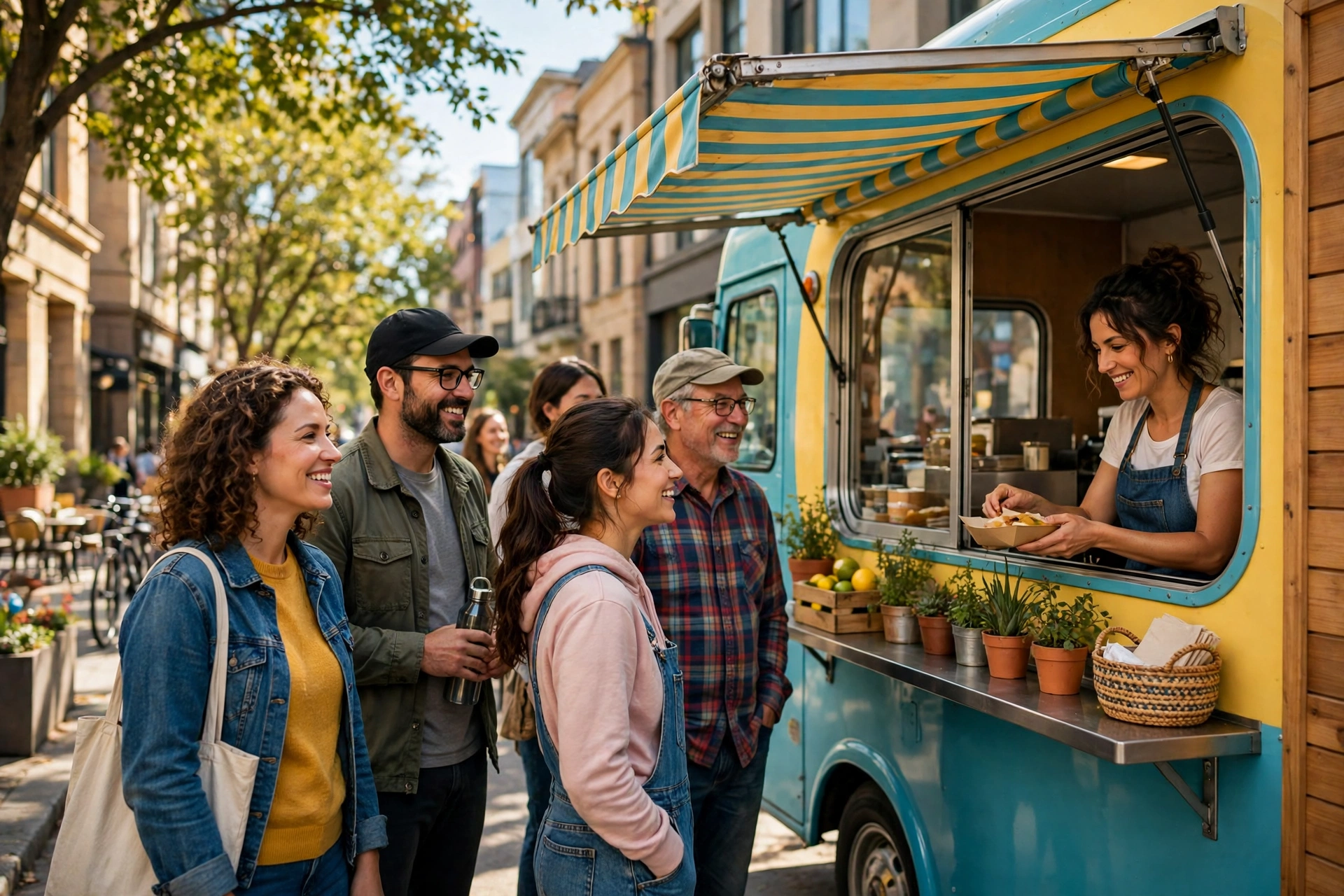
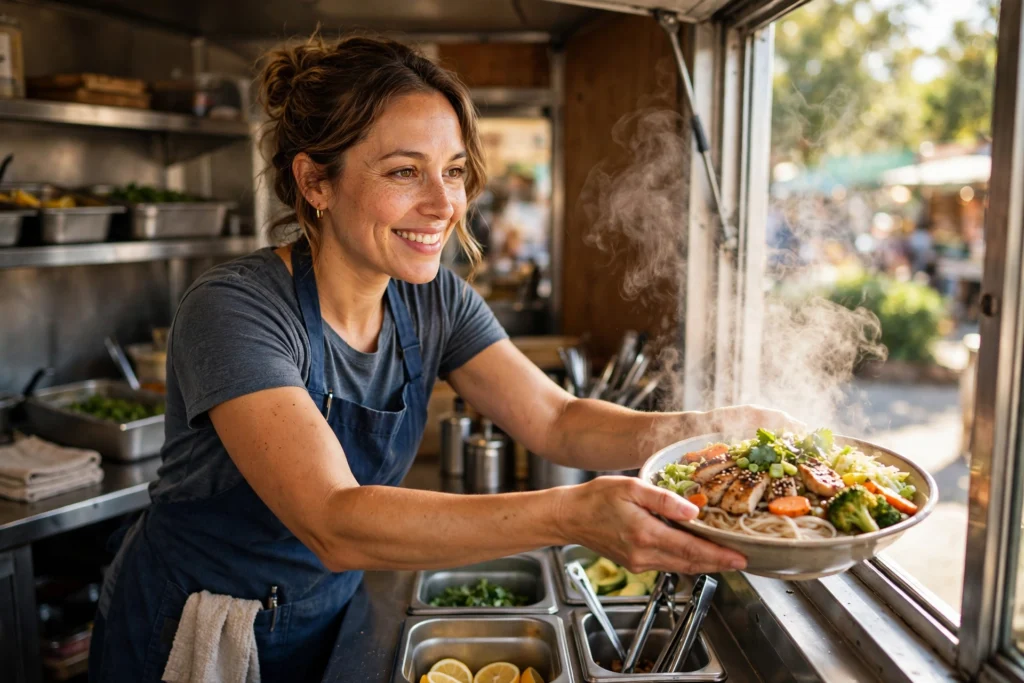
A food truck is a restaurant that can drive away. Instead of paying rent on a shop on a busy street, the owner buys a truck, fits a small kitchen inside it, and drives to wherever the hungry people are. Lunch near the offices. Dinner near the park. Saturday at the football ground. Sunday at the farmers’ market.
The money side works the same way it works for a bakery or a coffee shop. You buy ingredients, you cook something people want, and you sell it for more than it cost you to make. The gap between what comes in and what goes out is the profit, and that gap is what keeps the wheels turning.
What makes a truck different is that it can move. A shop sits in one place and hopes people walk past. A truck goes looking for them. If a street is quiet on Mondays, the truck simply does not go there on Mondays. If a new office block opens across town, the truck can be parked outside it the very next morning. That freedom is the truck’s biggest strength, and also its biggest headache, because every move costs fuel, time, and planning.
Most people picture the easy part: a cheerful truck, a queue of smiling customers, the smell of grilled onions drifting down the street. The hard part is invisible. Somebody has to buy the food, chop it, cook it in a space smaller than most home kitchens, wash up, fill the water tanks, empty the waste, and pay the permits, then do it all again tomorrow.
The Main Way: Selling One Plate at a Time
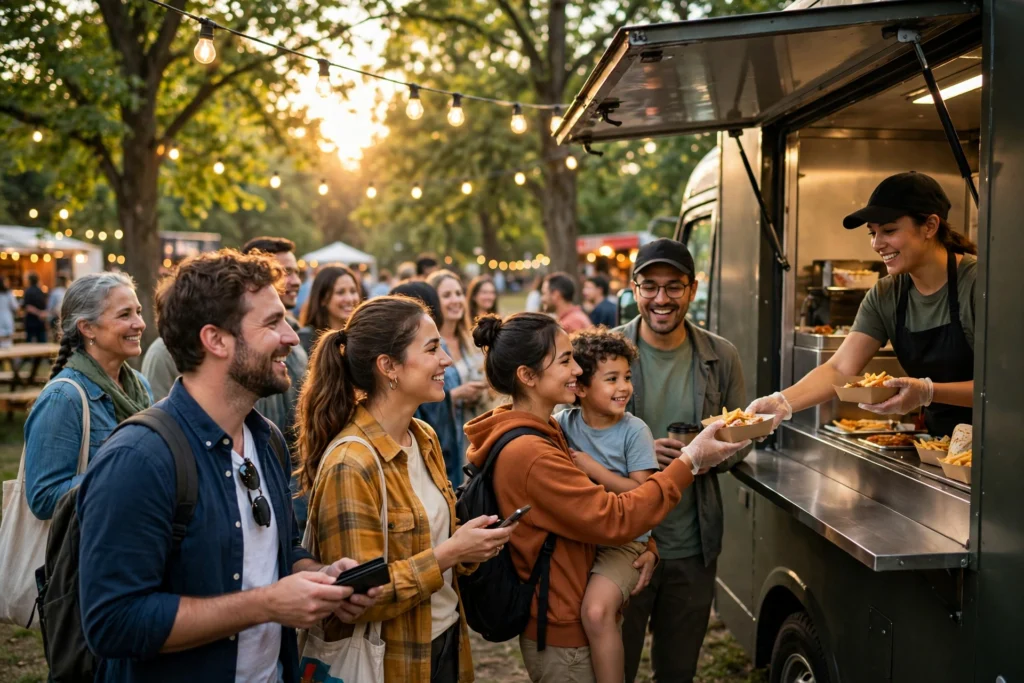
Street sales are the bread and butter of a food truck. A customer walks up, orders something, pays, and walks away eating it. Do that a hundred times in a day and you have a business.
The trick is the menu. A truck cannot cook everything. The kitchen is tiny, the storage is tiny, and there might be only one or two people working inside. So the best trucks sell a short menu of things they can cook fast and cook well. Tacos. Burgers. Noodles. Fried chicken. Wraps. One star dish, a few friends for it, and maybe a drink or two.
A short menu does three useful things. First, it keeps the cooking fast, so the queue moves and people do not walk away. Second, it keeps the shopping simple, because the truck only needs a handful of ingredients instead of fifty. Third, it lets the cook get really good at a few dishes instead of being average at many. Regulars come back for the thing only that truck makes properly, and regulars are worth their weight in gold.
Prices matter too. A truck meal usually costs a little more than fast food from a big chain, and a little less than a sit-down restaurant. Customers accept that, because the food is fresh and eating from a truck feels like a small treat. The owner has to find the sweet spot: charge too little and the truck works all day for nothing; charge too much and the queue disappears.
Speed is money in this trade. Every minute a customer waits is a minute another might decide not to join the queue. That is why the best trucks have their system down to a dance: one person takes orders and money, one person cooks, and the food comes out in three or four minutes. Some trucks take orders on a phone app now, so people can order from their desk and collect the food when it is ready.
The Second Way: Catering and Private Events
Here is something most people never see: a big part of a food truck’s money often comes from jobs where the truck never parks on a street. A company wants lunch for two hundred staff at a summer party. A couple wants a taco truck at their wedding. A school wants food for a sports day. The truck drives in, sets up, feeds everyone, and drives home with one big payment instead of a hundred small ones.
Catering pays better than street sales for a simple reason. The owner knows exactly how many people are coming, so nothing is wasted. On a normal street day, the cook has to guess how much food to prepare, and guessing wrong means either running out early or throwing food away at the end of the day. At a catered event, the number is agreed in advance, the food is bought to match, and the customer usually pays a deposit before the truck even moves.
Weddings are a favourite. Couples love the idea of a food truck at their reception because it feels relaxed and fun, and guests love queuing up for fresh food instead of sitting through a formal three-course dinner. The truck charges a flat fee for the event, sometimes plus a price per guest, and the couple gets dinner and entertainment in one package. Birthdays, office parties, film sets, and festivals all work the same way.
These jobs also bring in new customers. Somebody eats a great burrito at a wedding, asks for the truck’s card, and turns up at its regular lunch spot the following week. Word of mouth like that is free advertising, and for a small business, free advertising is the best kind there is.
The catch is that catering jobs have to be booked. A truck cannot just turn up at a wedding and hope for the best. Owners spend time answering emails, sending quotes, and keeping a calendar full weeks ahead. A truck with an empty calendar in three weeks’ time is a truck with a problem, which is why the best owners treat bookings like gold and look after every event customer as if they were the only one that mattered.
The Third Way: Festivals, Markets and Regular Spots
Festivals are where food trucks have their biggest days. Picture a music festival with ten thousand people, or a food festival on a sunny Saturday. Everybody is hungry, nobody wants to leave to find a restaurant, and the trucks are right there. A good festival day can bring in as much money as a whole quiet week on the streets.
But festivals are not free money. Most organisers charge the truck a fee to be there, and the popular ones charge a lot. Sometimes it is a flat amount, sometimes a percentage of everything the truck sells. The owner has to do the sums before saying yes. A big fee is fine if ten thousand hungry people walk past. It is a disaster if the festival is small, the weather turns bad, and only a few hundred show up.
Markets are the steadier cousin of festivals. A Saturday farmers’ market happens every week, rain or shine, and the same shoppers come back again and again. A truck that takes the same spot every week becomes part of people’s routine. That kind of loyalty takes months to build, but once it is there, it is the most reliable money a truck can earn.
Regular spots work the same way. Many trucks park in the same place at the same time every weekday: outside an office park at lunch, near a hospital in the evening, by the beach on a Sunday. Workers start to expect the truck, and expecting it means planning lunch around it. Some trucks even post their weekly schedule on social media so regulars know exactly where to find them. It sounds simple, but it is one of the smartest things a truck owner can do. People cannot buy from a truck they cannot find.
There is one more quiet earner: drinks and extras. A bottle of water, a can of soda, a bag of chips. These cost almost nothing to keep on the truck, and they add a dollar or two to almost every order. It is the same trick a supermarket uses when it puts sweets by the checkout: small extras, sold to people who are already buying.
A Worked Example: One Burger, One Day
Numbers make this much clearer, so let us follow one burger through a single day. This is a made-up example with round numbers, not a promise about any real truck, but it shows how the money moves.
Say the truck sells a burger for $10. The bun, the beef patty, the cheese, the lettuce, the sauce, and the paper wrapper cost about $3 in total. That leaves $7. But that $7 is not profit yet. Not even close.
Out of that $7, the owner still has to pay for the gas to cook the burger, the fuel to drive the truck to its spot, the rent for the kitchen where the food was prepared in the morning, the insurance, the card machine fee when the customer pays by card, and the permit that lets the truck park there legally. After all of that, a burger that sold for $10 might leave $2 or $3 of real profit. On a good day that is plenty. On a bad day it is not.
Now stretch it across a whole day. Imagine the truck sells 120 burgers on a busy Saturday at $10 each. That is $1,200 coming in. The ingredients cost about $360. Fuel, gas, and the day’s share of the kitchen rent and insurance might add another $250 or so. That leaves roughly $590 before the owner’s own pay and before anything breaks. A broken fridge or a flat tyre can eat that in one afternoon, which is why owners keep a little money aside for bad days.
On a slow Tuesday, the same truck might sell only 40 burgers. That is $400 in. Ingredients cost about $120, but the fuel and rent are almost the same as on Saturday, because the truck still had to drive there and the kitchen still had to be paid for. Suddenly the day barely breaks even. That is the truth of this business: good days pay for the bad ones, and the busy weekends carry the quiet weekdays.
That is also why the number of customers matters more than the price of one burger. Selling 120 burgers at $10 beats selling 60 burgers at $12, even though $12 sounds better. More customers mean more money in the till and less food thrown away, because everything that was cooked gets sold. Volume is the quiet hero of the food truck world.
The Big Bills: Food, Fuel, Permits and the Commissary Kitchen
Every business has bills, and a food truck has a set all of its own. Let us walk through the big ones, because they explain why a $10 burger only leaves a few dollars behind.
Food is the biggest bill by far. Industry guides suggest ingredients usually cost about 25 to 35 percent of everything a truck takes in. That means for every $100 in sales, roughly $25 to $35 goes straight back to the butcher, the baker, and the vegetable market. Prices jump around too. If beef gets expensive one month, the owner has to choose between raising the price, shrinking the patty, or earning less.
Fuel is the second bill, and it comes in two kinds. There is the fuel that moves the truck, and the gas that cooks the food. Most trucks run their grills and fryers on propane gas, and the engine runs on petrol or diesel. Industry guides put fuel and propane together at roughly $200 to $1,500 a month, depending on how far the truck drives and how much it cooks. A truck that stays in one neighbourhood spends far less than a truck that chases festivals two hours away.
Then there are the permits, and this is the part that surprises newcomers. A food truck cannot just park anywhere and start selling. It needs a business licence, a health permit from the local health department, and often a separate permit for each town or city it works in. Some cities cap the number of street permits, so a new truck may wait months for one. Industry guides put permits and licences at roughly $500 to $2,000 a year in many US cities, though in some places the cost can be far higher. Rules change from city to city, and a spot that is perfectly legal on one street can be illegal two streets away.
Insurance is another bill that never goes away. The truck needs commercial vehicle insurance, because an ordinary car policy does not cover a kitchen on wheels, and it needs liability insurance in case a customer gets sick or hurt. Industry guides suggest around $150 to $500 a month for both together. It feels like money for nothing until the day something goes wrong, and then it is the best money the owner ever spent.
The last big bill has a funny name: the commissary kitchen. A commissary is a big shared commercial kitchen that food trucks rent by the month. Most cities will not let a truck prepare food at home, so the owner rents space in a commissary to chop, cook, store ingredients, fill the water tanks, and wash up. Industry guides put commissary rent at roughly $300 to $1,500 a month. The truck also sleeps there overnight, because many cities do not allow a food truck to park on a residential street. The commissary is the truck’s home base, its pantry, and its garage, all in one.
Add those bills up and you get a picture of a business that can be profitable but never cheap to run. That is why the worked example matters: a truck has to sell a lot of food, most days, just to stand still.
Why Location Decides Everything
Ask any food truck owner what matters most and you will get the same answer every time: location, location, location. A great truck in a bad spot will lose money. An average truck in a great spot can do very well.
The best spots share three things. First, lots of hungry people with little time. Office workers on a lunch break, students between classes, hospital staff on a night shift, builders on a site. These people want food fast, they want it close, and they will come back tomorrow if it is good. Second, not much competition right next door. A truck parked beside three other trucks and a sandwich shop has to fight for every customer. A truck parked where there is nothing else to eat has the whole crowd to itself. Third, permission. The truck has to be allowed to be there, which means the right permit, the right hours, and no angry shopkeeper complaining to the council.
Time of day matters just as much as the place. The same car park that is packed at noon can be empty by three o’clock. Smart owners learn the rhythm of each spot the way a fisherman learns the tide. Offices mean lunch. Parks mean weekends. Bars and clubs mean late nights. A truck that serves breakfast burritos outside a train station at seven in the morning is fishing where the fish are; a truck that tries to sell breakfast burritos at midnight is not.
Weather is the wild card nobody can control. Rain empties streets, and a cold snap sends people indoors. Owners watch the forecast the way farmers do, and plan their week around it. A rainy week means fewer street days and more time spent chasing booked events.
Then there is the quiet power of being easy to find. The trucks that do best are the ones that tell people where they will be. They post the week’s schedule online, they keep the same spot on the same day, and they answer messages when someone asks where they are today. Hungry people are impatient people. If they cannot find the truck in ten seconds, they will eat somewhere else.
All of this is why the truck itself is only half the business. The other half is knowing where to be and when, and making sure people know about it. A beautiful truck with a brilliant menu still fails if it parks in the wrong place on the wrong day.
The Quiet Money: Regulars, Merch and Winter
Beyond the main ways of earning, a clever truck finds a few quiet extras. Regular customers are the biggest one. A person who buys lunch from the same truck three times a week is worth far more than a one-time visitor, so owners learn names, remember orders, and sometimes run a simple loyalty card: buy nine lunches, get the tenth free. It costs the owner one meal, and it buys a customer who keeps coming back.
Some trucks sell a little merchandise too — a T-shirt, a sticker, a branded cap. These do not make anyone rich, but they turn happy customers into walking adverts, and every person who wears the shirt is telling their friends about the truck without being asked.
Winter is the season that tests every truck. Cold days mean fewer people on the streets, so the smartest owners plan for it: more booked events, more catering, and hot drinks and soups on the menu. A truck that only works in summer is a hobby. A truck that survives winter is a business.
Frequently Asked Questions
How does a food truck make money?
A food truck makes money by selling food for more than the ingredients and running costs add up to. Most of it comes from street sales, one meal at a time, but catering jobs, weddings, festivals, and markets often pay better. After food, fuel, permits, insurance, and rent for a shared kitchen, what is left is the profit.
How much money can a food truck make in a day?
It depends on the day, the place, and the weather. A busy festival day might bring in over $1,000, while a slow rainy weekday might bring in only a few hundred dollars. After all the bills, a truck might keep roughly $2 to $3 from a $10 meal, so selling more meals matters more than charging more.
What does a food truck spend the most money on?
Food is the biggest cost, usually around 25 to 35 percent of everything the truck takes in, according to industry guides. After that come fuel and cooking gas, rent for the shared commercial kitchen called a commissary, insurance, permits, and repairs. The truck itself is the biggest one-time cost when starting out.
What is a commissary kitchen?
A commissary is a big shared commercial kitchen that food trucks rent by the month. It is where the owner prepares food, stores ingredients, fills the water tanks, washes up, and parks the truck overnight. Most cities require it, because food trucks are usually not allowed to prepare food at home. Industry guides put the rent at roughly $300 to $1,500 a month.
How much does it cost to start a food truck?
Industry guides suggest starting a food truck in the US can cost anywhere from around $30,000 to more than $200,000. A used truck is far cheaper than a new one, but the kitchen equipment, permits, insurance, and first months of running costs all add up. The exact figure depends on the truck, the menu, and the city.
Why do some food trucks fail?
The most common reason is a bad location, or too many quiet days. Other reasons are prices set too low to cover the bills, too much food wasted at the end of the day, and running out of money before regular customers build up. The trucks that last usually have a short menu they cook well, a few regular spots, and booked events to fill the quiet weeks.
More from Zorium Daily
- How Does a Bakery Make Money?
- How Does a Coffee Shop Make Money?
- How Does a Sweet Shop Make Money?
- How Does a Supermarket Make Money?
The next time you queue at a food truck, take a look at the whole picture. The sizzle of the grill and the smell of fresh food are the fun parts, but behind them sits a small business on wheels: a short menu cooked fast, a carefully chosen parking spot, a morning spent in a shared kitchen, and a stack of permits, fuel bills, and insurance papers. It is hard work in a very small space, and when it is done well, it is one of the friendliest ways to earn a living.