Who Invented Paper? Explained Simply
SUMMARY OF THIS ARTICLE
- Paper as we know it was first made in China about 2,000 years ago, and the man traditionally given the credit is a court official called Cai Lun.
- In 105 CE, Cai Lun showed the emperor a new way of making paper from tree bark, hemp waste, old rags, and worn-out fishing nets.
- Before paper, people wrote on clay tablets, bamboo strips, silk cloth, and papyrus — and each had a real problem that paper solved.
- The idea travelled slowly west along trade routes, reaching the Arab world by the 700s and Europe by the 1100s.
- Cheap paper plus the printing press meant books stopped being rare treasures for the rich and started reaching ordinary people.
The Question on Every Desk
Look down at your desk. There is probably a notebook there, or a sheet of paper with a shopping list on it, or a school exercise book with a torn corner. Paper is so ordinary that we barely notice it. We scribble on it, fold it, wrap sandwiches in it, and throw it away without a second thought.
Now try to picture a world with no paper at all. No notebooks, no books, no letters, no birthday cards, no paper bags. How would you write down a homework answer? How would a shopkeeper keep a record of what was sold? How would a story travel from one town to another?
For most of human history, that was the real world. People still needed to write things down, and they were clever about it, but every material they tried came with a catch. Paper is the story of how one simple idea — turning old rubbish into thin, light sheets — solved that problem.
The Short Answer: A Man Called Cai Lun, in China, Around 105 CE
Here is the short version. Historians say that paper, the kind you can fold, write on, and carry in your pocket, was first made properly in China about 2,000 years ago. The man who gets the credit is Cai Lun, a court official of the Eastern Han dynasty. In 105 CE, he presented the emperor with a new kind of paper made from tree bark, hemp waste, old rags, and discarded fishing nets.
That date comes from an old Chinese history book, the Book of the Later Han, written a few hundred years after Cai Lun lived. It says he submitted his new method to Emperor He, and the court liked it so much that paper quickly spread across the empire.
But there is a twist. Cai Lun did not invent paper out of thin air. Archaeologists have found scraps of rough hemp paper in Chinese tombs from the 2nd century BCE, more than 200 years before Cai Lun. That early paper was rough and patchy, and seems to have been used mostly for wrapping, not writing. What Cai Lun did was take a rough, unreliable material and turn it into something smooth, strong, cheap, and good enough to write on. He did not invent the idea from nothing. He made it work.
Before Paper: Writing on Clay, Bamboo, Silk, and Papyrus
To understand why paper mattered, you have to see what people were stuck with before it. Writing is one of the oldest human habits, and for at least 5,000 years people have wanted to record things. The trouble was finding something decent to write on.
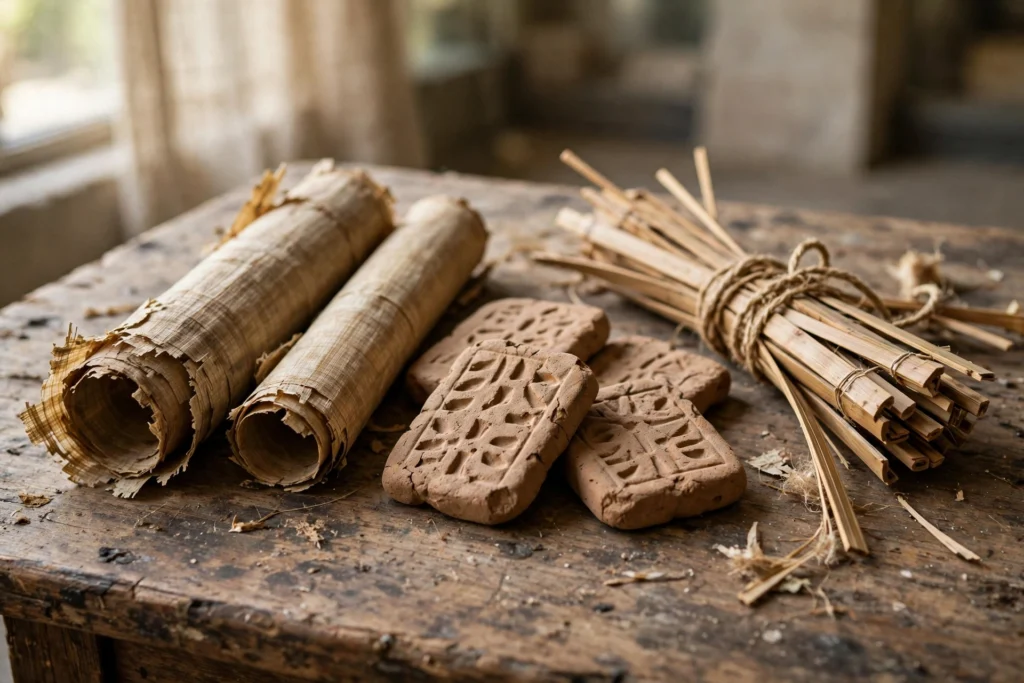
In Mesopotamia, in the land we now call Iraq, people pressed wedge-shaped marks into wet clay tablets with a reed stylus. Clay was cheap and it lasted for thousands of years — we can still read some of those tablets today — but a clay tablet is heavy and awkward. Imagine carrying your school books home if every page weighed as much as a brick.
In China, the usual writing surface before paper was bamboo. Scribes cut bamboo into narrow strips, wrote a few characters on each strip with a brush, and tied the strips together with string to make a sort of book. It worked, but a bamboo book was heavy and clumsy. Silk was the other choice — smooth and lovely to write on, but expensive, and only rich people and the court could afford it.
Over in Egypt, people made papyrus. They cut the stem of the papyrus plant into thin strips, laid them in two layers at right angles, pressed them together, and dried them into a sheet. Papyrus was light and it worked well, and the Egyptians used it for thousands of years. But it grew best along the River Nile, so it was not easy to get everywhere, and it was brittle — fold a sheet too many times and it cracked.
So here was the problem. Clay lasted but was too heavy. Bamboo was strong but heavy too. Silk was lovely but far too dear. Papyrus was light but fragile and hard to get. What the world needed was something light, cheap, and easy to make. That something turned out to be paper.
Who Was Cai Lun?
Cai Lun was not a king, a general, or a famous philosopher. He was a court official who worked inside the imperial palace. Historians say he was born around 50 or 62 CE in Guiyang, in what is now Hunan province, and by the year 89 he had risen to become a senior official under Emperor He of the Eastern Han dynasty.
His job was the kind where you notice problems other people walk past. The palace ran on paperwork — orders, records, reports, letters — and the court was always short of good writing material. Bamboo was heavy. Silk was dear. Cai Lun seems to have been the man who went looking for a better answer.
In 105 CE he took his new paper to the emperor, and the court was impressed. It was smooth enough to write on, strong enough to fold, light enough to carry, and cheap enough to make in large amounts. The emperor praised him, and Cai Lun was later made a marquis and given a small piece of land.
Cai Lun’s later life was not a happy one. Years after his paper triumph, he was caught up in a palace power struggle and ordered to answer for the death of a royal lady he had once questioned. Rather than face trial and disgrace, he took his own life in 121 CE.
His name survived him. In China, paper made by his method became known as “Cai Hou paper” — the paper of Marquis Cai.
The Recipe: Bark, Rags, Hemp, and Fishing Nets
So what was in Cai Lun’s paper? The list sounds like the contents of a rubbish bin. He used four main ingredients, all cheap, common, and easy to find.
First, tree bark — most likely the inner bark of the mulberry tree. Mulberry bark was easy to come by, because the tree’s leaves fed silkworms. The inner bark is full of long, tough fibres, which is exactly what paper needs. Soaked, pounded, and laid flat, those fibres lock together like a mat, and that mat is what becomes a sheet.
Second, hemp waste. The Chinese had grown hemp for centuries to make rope and cloth, and the leftover bits were thrown away when cloth wore out or the ends were cut off in weaving. Cai Lun gathered those scraps.
Third, old rags. Worn-out clothes, torn cloth, scraps too small to mend — all of it went into the vat. This is the part of the story that still surprises people. For more than a thousand years, most of the world’s paper was made from old clothes. Rags were the main raw material of paper mills in Europe right up to the 1800s. It was recycling, centuries before anyone had a word for it.
Fourth, discarded fishing nets. Old hemp nets were strong and fibrous, and when they wore out they were thrown aside. Cai Lun’s workers collected them too, cut them up, and soaked them with the rest.
Nothing in that list was expensive or rare. That was the whole point. Silk cost money, and bamboo took work to cut and tie. But bark, rags, hemp ends, and old nets were things people were already throwing away. Cai Lun’s great idea was noticing that rubbish could be turned into something precious.
How a Sheet of Paper Was Made, Step by Step
Making paper the old way was slow, hands-on work. The basic method Cai Lun’s workshop used stayed almost the same for more than a thousand years, and in some places in Asia, craftsmen still make paper by hand in much the same way today.
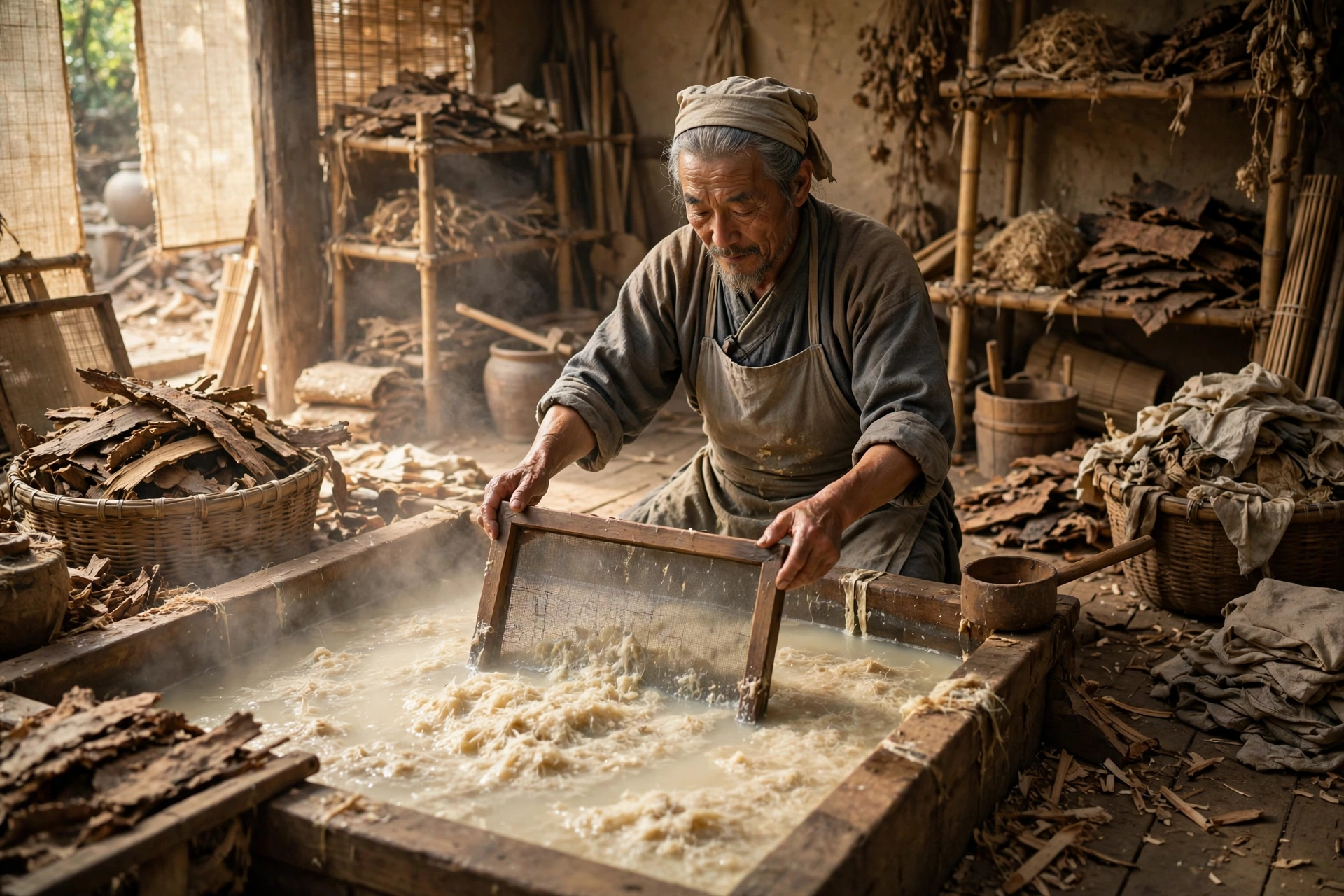
It started with soaking. The bark, rags, hemp, and nets were left in water until they went soft, then pounded in a stone mortar or with heavy wooden hammers until the fibres came apart into a loose, mushy pulp. This was the hardest part. The pounding had to go on long enough to break the fibres down, but not so long that they turned to mush with no strength left.
Next came the vat. The pulp was stirred into a big tub of clean water, so the fibres floated like a thin soup. A worker dipped a flat frame with a fine woven screen stretched across it into the vat, and lifted it out with a quick shake. The water drained through the screen, leaving a thin, even layer of fibres caught on the mesh. That layer was the sheet.
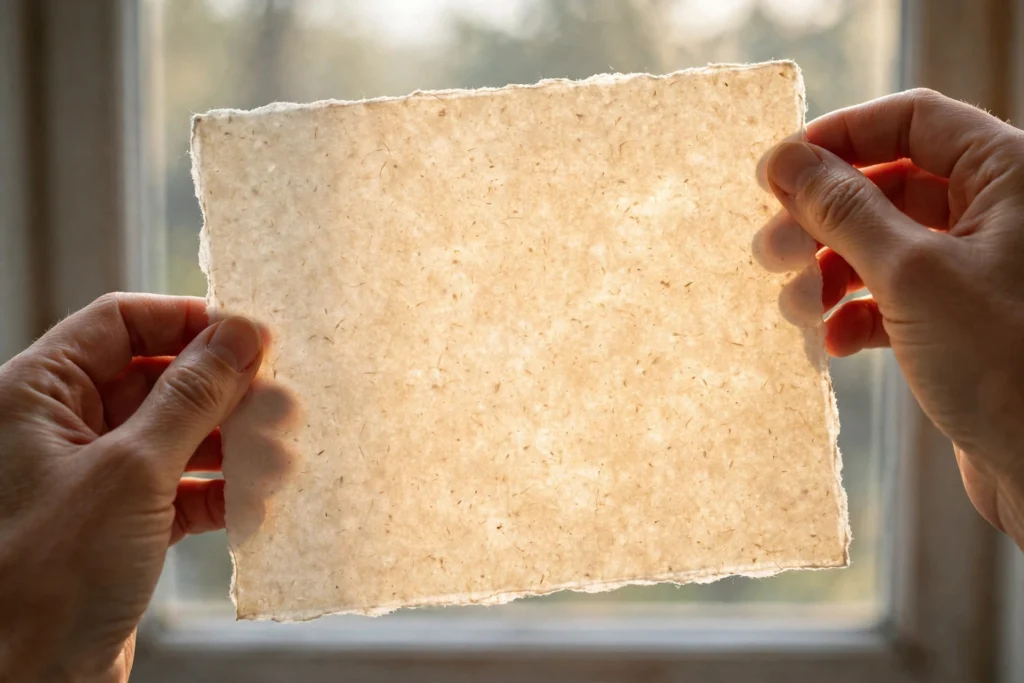
Then came pressing and drying. The wet sheet was lifted off the screen and laid on top of other sheets, with cloth between them, and the pile was pressed to squeeze the water out. After that, the sheets were peeled apart and stuck up to dry, often on a warm wall or a sunny board. Once dry, a sheet could be smoothed, trimmed, and stacked. It was light, it could be folded, and it took ink from a brush beautifully.
A sheet of paper weighed almost nothing, and you could fold a hundred of them into a small bundle and tuck them under your arm. That lightness changed what writing could do.
How Paper Travelled the World
Paper did not stay in China. It travelled slowly, the way all big ideas travelled in the old world — carried by traders, monks, and craftsmen along the roads that joined Asia to the rest of the world.
First it moved to China’s neighbours. Paper reached Korea and Japan along the same routes that carried Buddhist learning and Chinese writing. Buddhist monks needed paper for copying holy texts, and they took the craft with them. By the 600s, paper was being made in Japan, where craftsmen refined it into the beautiful washi paper still famous today.
Then it moved west along the Silk Road, the long chain of trade routes linking China to Central Asia, Persia, and beyond. The story goes that the secret reached Samarkand in the 700s, after a battle on the Talas River in 751, when an Arab army defeated a Chinese force and took Chinese papermakers prisoner. The prisoners, the story says, were put to work making paper there, and the craft spread from there.
Historians now doubt that simple version. Paper was probably already known in Central Asia before 751, and the spread was more gradual than one battle and a few prisoners. But the broad shape is right. By the late 700s, paper was being made in Samarkand, and by the 790s a mill was running in Baghdad under the caliph Harun al-Rashid. Within a century, paper had largely replaced papyrus across the Islamic world.
From Baghdad, the craft moved to Damascus, to Cairo, and across North Africa to Fez in Morocco. From North Africa, paper crossed the sea into Spain, where the first mill on the Iberian Peninsula is recorded at Játiva, near Valencia, in 1056. A traveller writing around 1154 praised the paper of Játiva, which was sold across the Mediterranean. It took about a thousand years for paper to travel from China to Europe — slow in a world where a message crosses the planet in a second, but in the old world a craft travelled at walking pace, carried in the hands and heads of the people who knew how to do it.
Paper Arrives in Europe
When paper reached Europe, it met parchment, made from animal skin, usually calfskin or sheepskin. Parchment was tough and lasted a very long time — a book could survive a thousand years if kept dry. But it was slow and expensive to make. Each sheet came from an animal, and a single big book could take the skins of a whole flock of sheep. Paper, made from rags, was far cheaper.
The first European paper mills were built in Spain and Italy. By the late 1200s, mills were working in Fabriano in Italy, where craftsmen added improvements like the watermark — a faint pattern pressed into the sheet while still wet, so you could hold it up to the light and see the maker’s mark. From Italy, papermaking spread north: a mill in France by 1348, in Germany at Nuremberg by 1390, and in England by around 1490. Each mill needed the same two things: plenty of clean running water, and a steady supply of rags.
Not everyone welcomed it. Some scholars and churchmen called paper flimsy and said it would not last, and for a while important documents were still written on parchment. But the price difference was too big to ignore. For everyday writing — letters, schoolbooks, shopkeepers’ accounts — paper won. A merchant who could buy ten sheets of paper for the price of one sheet of parchment was not going to keep buying parchment.
The Printing Press and the Paper Explosion
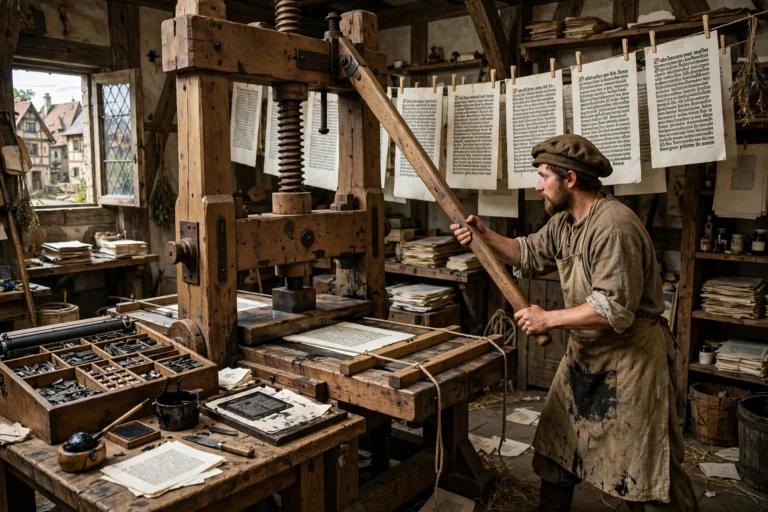
In the 1450s, a German craftsman called Johannes Gutenberg built a printing press with movable type in Mainz. Before Gutenberg, every book in Europe had to be copied out by hand, letter by letter, by scribes working for months. A single Bible could take a team of scribes years to finish, and the finished book cost as much as a house. Only the rich, the church, and universities owned books.
Gutenberg’s press changed the arithmetic. With movable metal letters, a printer could set a page once and print hundreds of copies from it. But a printing press is hungry. It needs reams and reams of paper, far more than any scribe ever used. If paper had still been as expensive as parchment, printing would have stayed a rich man’s hobby. Cheap paper made printing pay, and printing made paper mills boom.
The two inventions fed each other. More printing meant more demand for paper, and more paper mills meant cheaper paper, which meant more printing. Within fifty years of Gutenberg’s first Bible, printers across Europe had produced millions of books — Bibles, schoolbooks, law books, medical books, prayer books, plays, poems — all poured off the presses and into the hands of people who had never owned a book before.
When books were rare, knowledge stayed locked up with a small group of people. When books became cheap, it started to spread. Students could own their own textbooks, and ordinary readers could buy a pamphlet or a play. New ideas in science, religion, and politics could travel from town to town in printed form. The Reformation, the scientific revolution, the spread of schools — none of them would have moved as fast without cheap paper and the press.
Why Paper Changed Everything
Step back and ask: why did a thin sheet of plant fibre matter so much? Paper changed who could write, who could read, and who could keep records. Before paper, writing was heavy, dear, or fragile, and that kept it in the hands of a few people — priests, officials, rich merchants. Paper made writing light and cheap, and that opened the door to everyone else.
Think about a school. Without paper, a teacher has to write on a board and hope the children remember. With paper, every child can have an exercise book, copy down the lesson, and take it home. And a letter on paper could be sent to a friend in another town by anyone who could write. Our post on messages before phones shows how much effort old messages took — and paper made that effort far lighter. Centuries later, the telephone let people talk across the same distances without paper at all.
Paper also changed money. The Chinese were the first to use paper money, and you can read that story in our post on who invented paper money. A paper banknote only works if people trust the paper it is printed on — and without Cai Lun, there would have been no paper money at all.
None of this happened overnight. Paper took a thousand years to cross the world, and another few hundred years to become truly cheap. But each century, it got a little cheaper and a little more common.
Paper Today: Still Here After 2,000 Years
You might think paper’s story ended with computers. We read on screens, send emails instead of letters, and store our notes in the cloud. Yet paper is still everywhere — exercise books, printed reports, shop receipts, artists’ sketches. And a paperback book is still one of the cheapest ways to carry a whole story in your pocket.
The way we make paper has changed, though. The big change came in the 1800s, when inventors worked out how to make paper from wood pulp instead of rags. Trees were plentiful, rags were not, and wood pulp let mills make paper in huge amounts at a low price. That is the paper most of us use today.
There is a cost to that. Making paper from trees uses forests, water, and energy, and the world now uses so much paper that recycling has become essential. That brings the story full circle — Cai Lun made his paper from things people had thrown away, and today the most sensible paper is made the same way, from old paper pulped into new sheets.
So the next time you pick up a sheet of paper, take a second to feel it. It is light. It bends. It takes ink. Those simple qualities are the result of a recipe worked out nearly 2,000 years ago by a palace official who looked at a pile of old bark, rags, hemp, and fishing nets and saw something nobody else had seen: a way to carry words.
Frequently Asked Questions
Who invented paper?
Cai Lun, a court official of China’s Eastern Han dynasty, gets the credit. In 105 CE he presented Emperor He with a new method for making paper from tree bark, hemp waste, old rags, and fishing nets. Historians note, though, that rough hemp paper existed in China more than 200 years earlier, so Cai Lun refined paper rather than inventing it from nothing.
When was paper invented?
Most history books give 105 CE, when Cai Lun submitted his method to the emperor. But the story is older — archaeologists have found fragments of rough hemp paper in Chinese tombs from the 2nd century BCE. The year 105 CE marks the moment paper became a reliable, standard writing material.
What was paper made from originally?
Cai Lun’s recipe used four main ingredients: the inner bark of trees, most likely mulberry; hemp waste left over from making rope and cloth; old rags from worn-out clothes; and discarded fishing nets. All were cheap and easy to find, and full of the long plant fibres that lock together to form a sheet.
What did people write on before paper?
It depended on where they lived. In Mesopotamia, people wrote on wet clay tablets. In China, on bamboo strips tied with string, or on expensive silk. In Egypt, on papyrus, made from strips of the papyrus plant pressed together. Each had a drawback: clay was heavy, bamboo was heavy too, silk was dear, and papyrus was brittle and hard to get outside Egypt. Paper solved all four problems at once.
How did paper spread from China to Europe?
It travelled slowly, along trade routes. Paper reached Korea and Japan first, then moved west along the Silk Road to Samarkand and Baghdad, where mills were running by the 790s. From there it spread through the Islamic world to Egypt, North Africa, and Spain — the first mill is recorded at Játiva in 1056 — and from Spain and Italy it moved north, reaching France by the 1300s and England by around 1490.
Did paper help the printing press?
Yes, and the two needed each other. Johannes Gutenberg built his printing press with movable type in Mainz, Germany, in the 1450s, and a press is hungry for paper. Without cheap paper, printing would have stayed too dear to matter. Cheap paper made printing pay, and within fifty years millions of books were rolling off presses across Europe.
More from Zorium Daily
- Who Invented Paper Money?
- How Did People Send Messages Before Phones Were Invented?
- Who Invented the Telephone?
- How Did People Tell Time Before Clocks Were Invented?
Paper is one of those inventions that hides in plain sight. It is so cheap and so ordinary that we forget it was ever invented at all. Yet one palace official in China, working with bark, rags, hemp, and old fishing nets, found a better way — and his thin, light sheets carried words, stories, laws, and poems across the world, one page at a time.