How Does a Pharmacy Make Money?
SUMMARY OF THIS ARTICLE
- A pharmacy makes most of its money from filling prescriptions, and it keeps only a small slice of the price of each one after paying for the medicine.
- Generic medicines cost far less to buy than brand-name drugs, so they usually leave a bigger share of profit, while brand-name drugs often leave very little.
- The front of the shop adds useful money from vitamins, painkillers, skin creams, and everyday health products that the pharmacy keeps almost all of.
- Vaccines, health checks, advice, and delivery are growing income, because they pay for the pharmacist’s skill, not just for a box of pills.
- The biggest costs are the medicines themselves, staff pay, rent, and fees taken by insurance middlemen, so a pharmacy profits only when it fills many prescriptions and controls its costs well.
Introduction
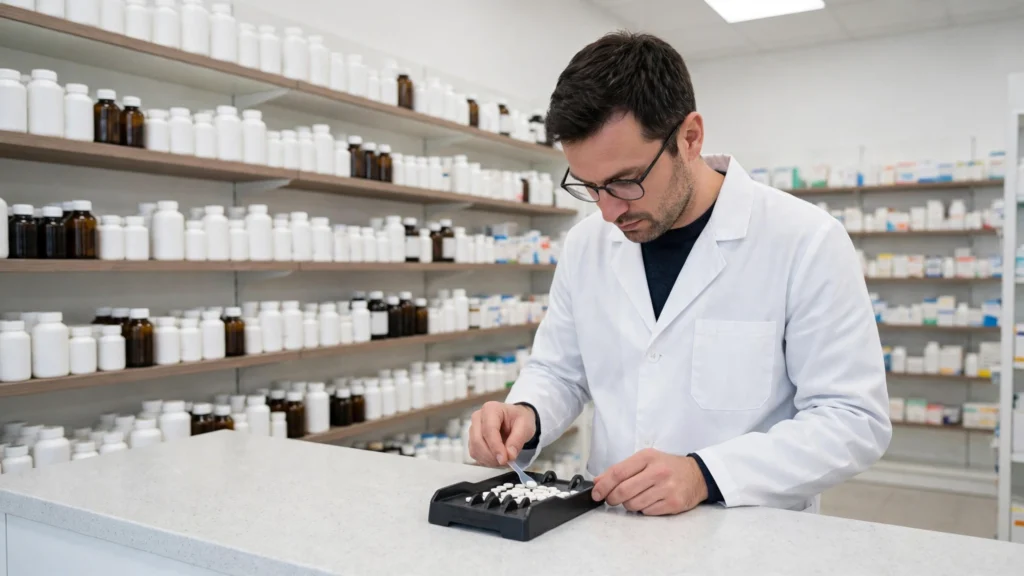
Picture a pharmacy on a Tuesday morning. A mum comes in with a prescription for her son’s ear infection. An older man waits for his blood pressure tablets. Behind the counter, the pharmacist checks each prescription, counts out the pills, sticks on a label, and explains how to take them.
It looks like a quiet, helpful little shop. But behind that calm counter is a business with serious bills. The shelves are full of medicines that cost a lot to buy, the shop pays rent every month, even on slow days, and the price of a prescription is not set by the pharmacy alone. Insurance companies and middlemen have a big say in what it gets paid.
So how does a pharmacy make money, and why do so many of them say the money is tight? This article follows the money from your pocket, or your insurance plan, through the till, and out again to the drug makers, the staff, and the landlord. All money figures here are typical examples.
The Simple Idea
Every business needs the same basic maths. Money in must be more than money out. If a business takes in more than it spends, it makes a profit. If it spends more than it takes in, it loses money.
A pharmacy follows this rule, but what it sells is unusual. It does not sell a thing people buy for fun, like a bookshop sells a novel. It sells health. Most customers walk in because a doctor told them they need a medicine, or because they feel ill and want to feel better.
Think of it like this. A gym sells a membership that brings in money every month, whether the member visits or not. A pharmacy is almost the opposite. It earns money one prescription at a time, and there is no monthly fee for being a patient.
The simple idea has three parts. First, fill as many prescriptions as possible. Second, buy each medicine for less than the pharmacy is paid for it, and keep the gap. Third, sell extra things while the customer is there, and offer services that pay for the pharmacist’s time and skill.
Prescription Medicines: The Main Money
Prescriptions are the heart of the pharmacy business. For most pharmacies, they bring in most of the total money. A typical small pharmacy might fill 150 to 300 prescriptions a day, and each one must be checked, counted, labelled, and handed over with advice. But the money the pharmacy keeps from each one is often surprisingly small.
Here is how it works. A doctor writes a prescription, and the patient brings it to the pharmacy, or the doctor sends it there by computer. The pharmacy buys the medicine from a wholesaler, a big company that buys drugs in huge amounts and delivers them to pharmacies. The patient may pay part of the price, called a copay, and the insurance plan pays the rest.
The pharmacy’s money comes from two pieces: a small gap between what it paid for the drug and what the insurance plan pays back, and a dispensing fee, a small payment for the work of filling the prescription. In a typical example, a dispensing fee might be around 10 to 15 dollars.
Here is the catch. Filling a prescription costs money too: the pharmacist, the assistant, the computer system that checks for dangerous drug mixes, the bottles, and the labels. In a typical example, it can cost around 12 dollars just to fill one prescription, so the fee may barely cover the work. That is why volume matters. One prescription earns only a little. Two hundred a day, day after day, add up.
Follow One Prescription: Where Does 50 Dollars Go?
Suppose a patient picks up a month’s supply of a common medicine, and the total price is 50 dollars. Does the pharmacy keep all 50 dollars? Not even close. Here is one simple way that 50 dollars might be divided, using typical examples.
First, the medicine itself. In a typical example, that might take about 40 to 44 dollars of the 50. The drug maker and the wholesaler have already taken their share, so the pharmacy’s gap on the drug might be only a few dollars.
Second, the work of filling it: checking the dose, checking it against the patient’s other medicines, counting the pills, and answering questions. In a typical example, that work might cost about 10 to 12 dollars. Third, the rest of the shop’s costs, perhaps another 2 to 3 dollars per prescription.
Add it up, and one 50-dollar prescription may cost the pharmacy 52 or 53 dollars to provide. On some prescriptions it loses a little money; on others it makes a few dollars. The average across hundreds of prescriptions is what matters, and a pharmacy can be busy all day and still lose money.
Brand-Name Drugs and Generic Drugs
Not all medicines are the same, and the difference matters a lot to a pharmacy’s profit. There are two main kinds: brand-name drugs and generic drugs.
A brand-name drug is the original medicine, made by the company that invented it. It has a fancy name, a patent that stops others copying it for a time, and a high price. When the patent runs out, other companies can make the same medicine, with the same active ingredient, and sell it much more cheaply. That cheaper copy is called a generic drug.
Here is the twist that surprises most people. Brand-name drugs bring in more money per sale, but they usually leave the pharmacy with the smallest profit. The pharmacy pays a high price to buy them, and the insurance plan pays back only a little more. In a typical example, the margin on a brand-name drug, the share of the price left after the cost of the drug, might be only a few percent, and after staff and running costs the pharmacy may lose money on that sale.
Generic drugs tell the opposite story. A generic medicine might cost the pharmacy only 3 dollars to buy, while the insurance plan pays back 12 dollars for it. The dollar amounts are small, but across hundreds of generic prescriptions a day, those small gaps add up. That is why most prescriptions filled today are generics. The catch is that insurance plans keep pushing the price they pay for generics down, so the gap keeps shrinking.
The Front of the Shop: Vitamins, Creams and Cough Syrup
Walk into most pharmacies and you will see two shops in one. At the back is the prescription counter. At the front are shelves of things you can buy without a prescription: painkillers, cough syrup, vitamins, skin creams, plasters, and sun cream.
This front part of the shop is smaller than the prescription business in total sales, but it is far more profitable per item. Nobody else sets the price. The pharmacy buys a bottle of painkillers for a few dollars and sells it for a few dollars more, and it keeps the gap.
Think of a movie theatre. The theatre keeps only a small share of the ticket money, because the film studio takes most of it. The real profit is in the popcorn, which costs very little to make and sells for a good price. A pharmacy works in a similar way: the prescription is the ticket, and the vitamins and creams are the popcorn.
A bottle of vitamins might sell for 12 dollars and cost the pharmacy 6 dollars to buy. A tube of skin cream might sell for 9 dollars and cost 4 dollars. None of these is a fortune on its own. But a customer who comes in for a prescription and leaves with cough syrup and vitamins has just added several dollars of profit to a visit that might otherwise have earned the pharmacy almost nothing.
Vaccines, Health Checks and Advice
In recent years, pharmacies have started to earn more money from something that is not a box of pills at all: their own skill. A pharmacist is a trained health professional, and more pharmacies now charge for that knowledge.
Vaccines are the biggest example. Many pharmacies now give flu jabs, Covid boosters, shingles vaccines, and travel vaccines. In a typical example, one flu jab might bring in 20 to 30 dollars, and the vaccine and the pharmacist’s time might cost about half of that. The gap is better than on most prescriptions, and the work is quick.
Health checks are another growing service. A pharmacist can check your blood pressure, test your blood sugar, or help you stop smoking, and these checks are often paid for by a health plan or by the customer.
Some pharmacies also make custom medicines, called compounding: mixing a medicine specially for one person, perhaps a cream in a special strength, or a liquid for a child who cannot swallow pills. It needs extra training, but in a typical example it can leave a much bigger margin than an ordinary prescription. A pharmacy that also sells its own skill has something no wholesaler can take away.
Insurance Companies and the Middlemen
To understand why pharmacies say money is tight, you have to meet the middlemen, called pharmacy benefit managers, or PBMs for short. A PBM sits between the insurance plan and the pharmacy. It decides which medicines the plan will pay for, how much the pharmacy will be paid, and which pharmacies the patient may use.
This gives PBMs enormous power. A handful of very large PBMs handle most prescriptions in the United States, and it is the PBM that sets the price a pharmacy will be paid. The pharmacy can argue, but it cannot set its own price. If it refuses, it loses the customer, because the patient’s insurance will not pay at a pharmacy outside the plan.
PBMs use practices that squeeze pharmacies hard. One is called spread pricing: the PBM charges the insurance plan one price for a drug and pays the pharmacy a lower price, keeping the difference. Another is a fee taken back months after the sale, called a DIR fee. The pharmacy fills the prescription, gets paid, and then months later some of that money is clawed back. These clawbacks have grown a lot in recent years, and they make it very hard for a pharmacy to know how much it really earned.
In some countries, the government sets drug prices and pharmacy payments directly, which is simpler but still tight. But the shape of the problem is the same everywhere: the pharmacy does the work, but someone else decides what that work is worth. That is one reason many small pharmacies have closed in recent years, even when they were busy.
Delivery, Online Orders and Drive-Through Windows
Many pharmacies now deliver medicines to your door, take orders online, and serve customers through a drive-through window. Each of these adds money, and each adds costs too.
Delivery suits an older person who cannot walk far, or a parent with a sick child at home. The pharmacy may charge a small fee, or offer it free to keep the customer. Either way, it costs money: a driver, a car, fuel, and time. A pharmacy that delivers to many homes in one area can make it pay; one that drives miles for a single prescription cannot.
Online orders save time at the counter and let the pharmacy plan its work better. A customer orders a repeat prescription on a website or an app, and the pharmacy gets it ready for collection or delivery. But the website, the messages, and the packing all cost money.
Drive-through windows are popular in some places, especially in the United States. A patient drives up, hands over a prescription, and waits in the car while it is filled. But it needs extra staff and extra space, and it only pays off if enough people use it. Big mail-order pharmacies, which fill prescriptions in huge warehouses and post them out, are hard for a small local pharmacy to beat on price. But they cannot offer a friendly face, a quick question answered on the spot, or a flu jab while you wait.
The Biggest Costs
Making money is only half the story. The cost of the medicines themselves is by far the largest: the drugs a pharmacy buys often take about 75 to 80 percent of all the money that comes in, in a typical example. That leaves only about 20 to 25 percent for everything else.
Staff pay is the next big cost. A pharmacy needs a qualified pharmacist, and most need one or two assistants as well. The pharmacist’s pay is high, because the training is long and the responsibility is great. In a typical example, staff pay may take about 10 to 15 percent of total income, and a pharmacy cannot cut this cost easily, because the law says a qualified pharmacist must be present.
Rent is the third big cost. A pharmacy needs a shop in a place people can reach easily, often on a busy street or near a doctor’s surgery. That kind of space costs a lot to rent each month, and the pharmacy must pay it even in a quiet month.
Then come the smaller costs that add up: the computer system, insurance, electricity, bags, bottles, labels, card fees, and medicines that go out of date on the shelf. When you put it all together, a well-run independent pharmacy often keeps only about 2 to 5 percent of its total income as profit, in a typical example. That is a thin slice, thinner than the slice kept by a coffee shop. One bad month, one big clawback, or one rise in drug prices can wipe it out.
A Simple Monthly Example
Here is a simple monthly example for a small neighbourhood pharmacy. These numbers are made up, to show how the maths works. Suppose the pharmacy takes in 250,000 dollars in one month: prescriptions bring in about 200,000 dollars, front-of-shop sales about 35,000 dollars, and vaccines, health checks, and other services about 15,000 dollars.
Now take away the costs. The medicines themselves cost about 190,000 dollars, staff pay about 30,000 dollars, rent about 8,000 dollars, running costs about 10,000 dollars, and fees and clawbacks from insurance middlemen about 5,000 dollars. Add those costs up: 190,000 + 30,000 + 8,000 + 10,000 + 5,000 = 243,000 dollars.
The pharmacy took in 250,000 dollars and spent 243,000 dollars. That leaves 7,000 dollars of profit for the month, or just under 3 percent. A good month might leave a little more; a bad month might leave almost nothing. If the pharmacy fills 10 percent more prescriptions next month, with the same staff and the same rent, a bigger share of that extra money can turn into profit. That is why losing customers hurts so much: the costs stay the same, but the money coming in falls.
Small Independent Pharmacies and Big Chains
Not all pharmacies are the same. A small independent pharmacy, owned by one pharmacist, works very differently from a big chain with thousands of shops. A big chain has size on its side: it can buy medicines in enormous amounts and get a better price from wholesalers, and run one computer system and one advertising campaign for all its shops.
But a big chain also has big costs: head offices, managers, and marketing, and its customers may feel like a number. A small independent pharmacy is very different. It may fill only 150 or 200 prescriptions a day, but the pharmacist often knows the customers by name. They know that Mrs Patel takes blood pressure tablets, and that Tom’s son has asthma. That personal care is something a big chain struggles to copy.
Small pharmacies also win by being flexible. They can deliver to an older customer who cannot get out, or order a special cream for one customer and have it the next morning. The hard part for a small pharmacy is buying power, so many join a buying group, where small pharmacies order together to get a better price.
Why Some Pharmacies Make More Than Others
Location comes first. A pharmacy next to a doctor’s surgery gets many prescriptions without trying hard, because patients walk straight from the doctor to the counter. But a great location costs more rent. The trick, as with a hotel, is to find a place where the extra customers are worth the extra rent.
Regular customers come second. A pharmacy with 500 regular patients who bring every prescription there has steady income, even on a rainy week. Regulars are built slowly, with kind service, correct medicines, and staff who remember a usual order.
Speed and accuracy come third. A prescription filled quickly and correctly makes a happy customer. One that takes an hour, or has a mistake in it, sends that customer elsewhere. A tidy front of the shop comes fourth: shelves that are easy to browse and fair prices make people buy more while they wait.
Common mistakes eat profit fast: ordering too much stock, so medicines go out of date; pricing front-of-shop products too low; ignoring the clawbacks from middlemen; and depending on prescriptions alone. You can read more business stories in our Business section.
Frequently Asked Questions
1. Do pharmacies make most of their money from prescriptions?
Yes. Prescriptions bring in most of the money for almost every pharmacy. But the profit on each one is often small, because the medicine is expensive to buy and insurance plans pay back only a little more than the cost. The front of the shop and services such as vaccines add profit on top.
2. Why are generic drugs better for a pharmacy’s profit than brand-name drugs?
Generic drugs cost far less to buy than brand-name drugs, but the payment a pharmacy receives does not fall by the same amount, so the gap is bigger in percentage terms. Brand-name drugs often leave only a few percent, and sometimes the pharmacy loses money on them after staff and running costs.
3. What is a dispensing fee?
A dispensing fee is a small payment for the work of filling a prescription. It covers checking the prescription is safe, counting the pills, labelling the bottle, and talking to the patient. In a typical example, it might be around 10 to 15 dollars, though it changes by plan and by place. It often barely covers the cost of doing the work.
4. What is a PBM, and why does it matter to pharmacies?
A PBM, or pharmacy benefit manager, is a middleman between the insurance plan and the pharmacy. It decides which medicines the plan will pay for and how much the pharmacy will be paid. A few large PBMs handle most prescriptions, so they have a lot of power. They can also take money back months after a sale, through fees called DIR fees.
5. How do pharmacies make money from vaccines?
A pharmacy is paid for each vaccine it gives, by the insurance plan or by the customer. In a typical example, a flu jab might bring in 20 to 30 dollars, while the vaccine and the pharmacist’s time cost about half of that. Vaccines pay for the pharmacist’s skill, not just for a box of pills, and they bring people into the shop.
6. Can a small independent pharmacy survive against big chains?
Yes, but it must be smart. It cannot beat a big chain on drug prices alone, because the chain buys in much larger amounts. A small pharmacy survives on personal service, regular customers, a good location, extra services such as vaccines, and careful control of stock and costs. Many do well this way, though the work is hard and the profit is thin.
More from Zorium Daily
- How Does a Hotel Make Money? — Rooms, food, events, and the thin profit on each night.
- How Does Netflix Make Money? — Monthly payments, ads, and the high cost of new shows.
- How Does a Movie Theatre Make Money? — Tickets, popcorn, and premium screens.
- How Does a Gym Make Money? — Monthly memberships and extra services.
A pharmacy is a simple idea with hard maths behind it. It buys medicines, checks them carefully, and hands them to people who need them, then adds vitamins, creams, vaccines, and advice around that work. It earns the most when it fills many prescriptions, buys wisely, keeps its regular customers happy, and controls its costs. The profit on any single prescription is small, often only a few dollars, and sometimes nothing at all. But across hundreds of prescriptions and dozens of vaccines each week, those small sums add up to a living, one patient at a time.