How Does an Ice Cream Shop Make Money? Explained Simply
By Zorium Daily Business Desk
SUMMARY OF THIS ARTICLE
- An ice cream shop makes most of its money by selling scoops in cones and cups. Each scoop sells for far more than the milk, cream, sugar, and cone that went into it.
- The big money is in the extras: sundaes, milkshakes, toppings, sauces, sprinkles, drinks, and take-home tubs. A plain scoop is the start, not the whole sale.
- Costs eat a large share of every sale: ingredients, rent, staff wages, freezers, and electricity. Trade guides put the net profit of a well-run shop at roughly 12 to 30 percent of sales, with most independent shops in the 15 to 25 percent range.
- Summer is the busy season. As a rough estimate, many shops take in roughly 60–70% of their yearly sales in the warm half of the year — winter is slow, and smart shops save summer money to carry them through it.
- A shop stays open by keeping customers coming back: good flavours, fair prices, friendly service, and a place people enjoy visiting again and again.
The Shop on the Corner That Smells Like Summer
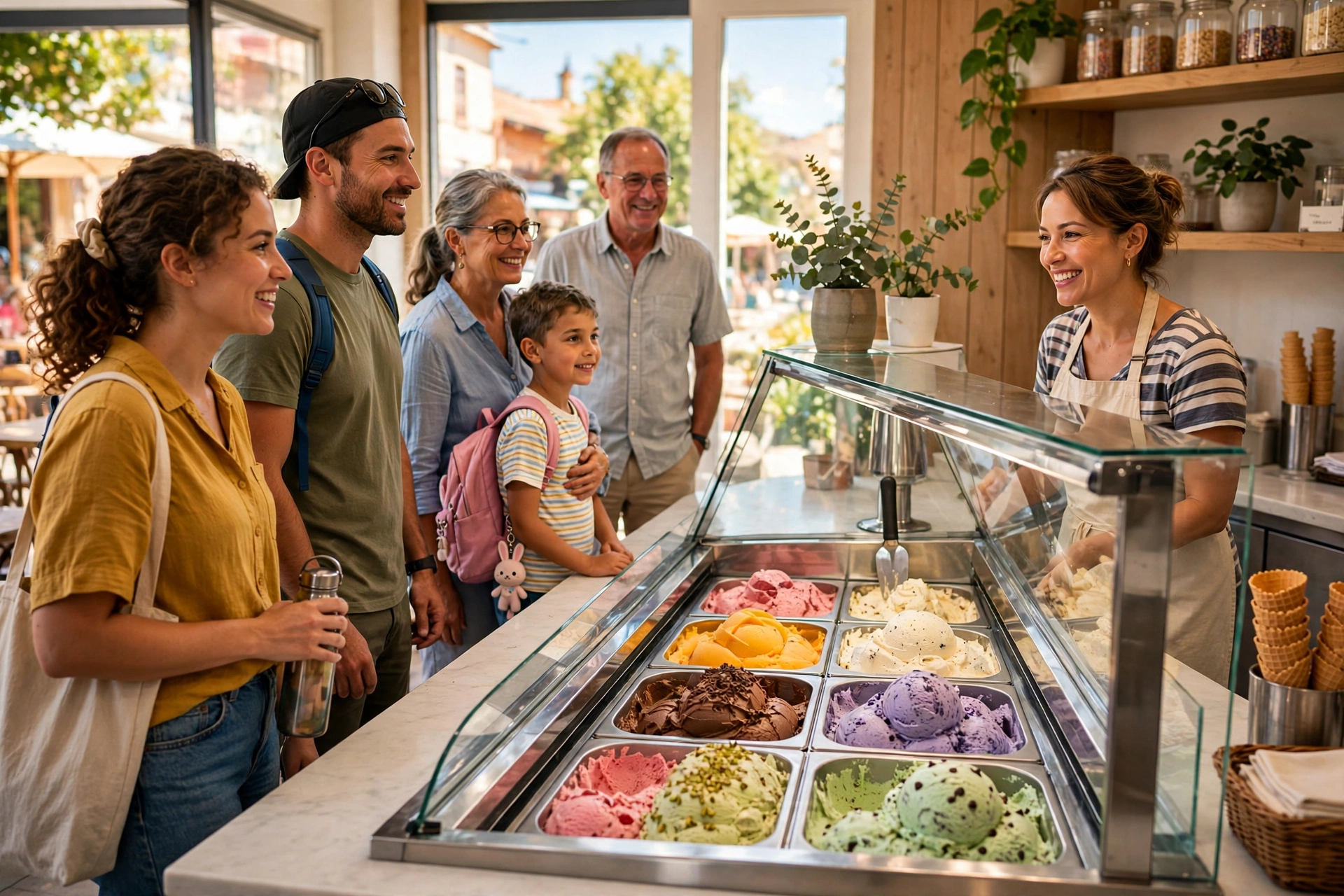
Every town has one. A small shop with a striped awning, a glass cabinet full of bright tubs, and a line of people spilling out onto the pavement on a warm afternoon. Inside, it smells sweet and cold at the same time, like vanilla and fresh waffle cones. A child presses their nose to the glass and points at the pink one. A teenager counts coins in their hand, trying to decide between a single scoop and a sundae. An old couple shares a tub with two spoons, the way they have done for years.
It looks like a happy little business, and in many ways it is. But behind the counter there is a real question hiding in plain sight: how does a shop like this actually make money? Ice cream is cheap to make. A scoop costs only a little in milk and sugar. Yet the shop pays rent every month, pays people to work there, and keeps big freezers running day and night, even in January, when hardly anyone wants an ice cream.
The answer is not one thing. It is a handful of small things that add up: the scoop itself, the extras piled on top of it, the drinks and tubs that go out the door, and the clever ways a good shop fills the slow months. Let us walk through it, one scoop at a time.
The Short Answer First
An ice cream shop makes money by buying ingredients cheap, turning them into scoops, and selling each scoop for several times what the ingredients cost. That gap between cost and price is where the money lives.
Here is the idea in one sentence. A scoop of ice cream might cost the shop less than a dollar in milk, cream, sugar, and a cone. The shop sells that scoop for four or five dollars. The extra money is not pure profit, because the shop still has to pay rent, wages, and the electricity bill for the freezers. But after all those bills are paid, a well-run shop keeps some money at the end. Trade guides that study this kind of shop say a healthy one keeps roughly 12 to 30 percent of its sales as profit, and most independent scoop shops land somewhere around 15 to 25 percent. Those are ranges, not promises. A shop in a dear location with high rent might keep less. A small shop with low rent and loyal customers might keep more.
The Main Sale: A Scoop in a Cone or a Cup
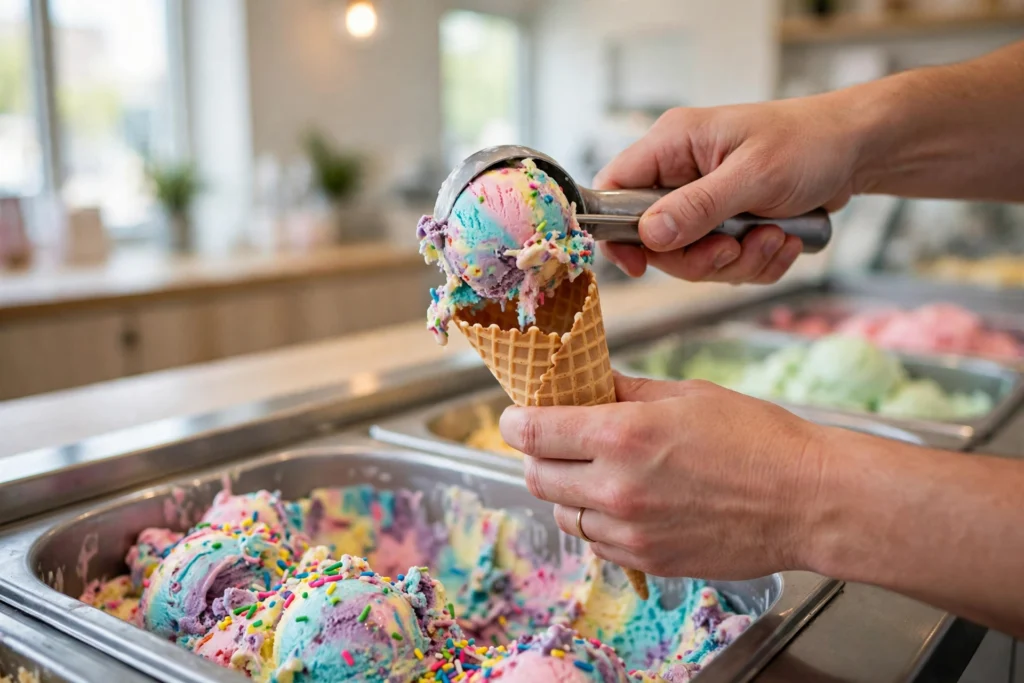
The heart of the business is the scoop. A customer walks in, looks at the tubs in the cabinet, picks a flavour, and gets one, two, or three scoops in a cone or a cup. This is the sale almost every other sale is built on.
Why does a scoop make money? Because ice cream is mostly air, milk, and sugar, and those things are cheap compared with the price of a finished scoop. When ice cream is churned, air gets whipped into it. That air is not a trick. It is part of what makes ice cream soft and light instead of a hard block of frozen milk. It also means a tub of ice cream goes further than you might think. The shop buys a tub, scoops it out over a day or two, and each scoop brings in a few dollars.
The Extras: Where the Real Money Hides
If scoops are the heart of the business, the extras are the secret. Walk into any ice cream shop and look at the menu board. You will see sundaes, milkshakes, floats, banana splits, waffles, and toppings. These are not there by accident. They are the most profitable things in the shop.
Think about a sundae. It starts with two or three scoops, which the shop was going to sell anyway. Then it adds a spoonful of hot fudge or caramel sauce, a squirt of whipped cream, a cherry on top, and maybe some crushed nuts. Each of those extras costs the shop only a few cents. But the sundae sells for several dollars more than the same scoops on their own. The customer is happy, because a sundae feels like a small celebration. The shop is happy, because the extra money mostly goes straight to the till.
Toppings work the same way. A sprinkle of chocolate chips, a drizzle of sauce, a handful of crushed biscuits: tiny amounts, tiny costs, real extra money. That is why the toppings bar is right there at the counter, where you cannot miss it, and why the person behind the counter asks, “Would you like sprinkles with that?” It is a friendly question, and it is also good business. Many customers say yes. The same goes for a flake stuck in a cone, a wafer on top, or a second sauce.
Milkshakes are another quiet money-maker. A milkshake is ice cream, milk, and flavouring, blended together and poured into a tall glass with a straw. It uses about two or three scoops of ice cream, plus a splash of milk. It sells for more than the same scoops would on their own, and it feels like a different treat altogether. Some shops add whipped cream and a cherry, or a drizzle of sauce around the glass, and charge a little more again. A coffee shop does the same kind of thing with its drinks, turning cheap milk and coffee into something people happily pay more for.
Take-Home Tubs, Cakes, and Party Orders
Not every sale happens at the counter. A good ice cream shop also sells ice cream to take home. Tubs, pints, and family packs sit in a freezer near the door, ready for someone who wants dessert for dinner or a treat for the weekend. A tub sells for more than the scoops inside it would cost the shop, and it takes no serving at all: no cone, no spoon, no person behind the counter to scoop it. The customer carries it home, and the shop has made a sale in seconds.
Ice cream cakes are a bigger version of the same idea. A cake made of ice cream, with layers of sponge or biscuit, cream, and decoration, sells for much more than an ordinary cake of the same size, because it is made to order and it is a centrepiece for a birthday. The shop takes orders in advance, makes the cake when it has quiet time, and hands it over on the day. Birthday parties, weddings, school fairs, and office parties all order them, and they bring in money without needing a queue at the counter.
Some shops go further and cater events. They turn up at a summer fair or a wedding with a cart or a small stall, and sell scoops to a crowd that is already in a good mood. A cart at a fair can sell hundreds of scoops in a single afternoon, and there is no rent to pay for that spot beyond the stall fee. It is hard work, but it is also one of the best days a small shop can have.
The Costs: What the Shop Has to Pay
Now comes the other side of the story, and it is the side many people forget. Every dollar that comes in is not profit. A large part of it goes straight back out again, on things the customer never sees.
The first cost is the ingredients themselves. Milk, cream, sugar, eggs, fruit, nuts, chocolate, cones, cups, spoons, and napkins: all of it has to be bought, week after week. Trade guides put the cost of ingredients and supplies at roughly 25 to 35 percent of a shop’s sales. That means for every 100 dollars that comes in, about 25 to 35 dollars goes on the things that end up in the customer’s hand. It sounds like a lot, but it is still much lower than in many food businesses, where ingredients can eat half the money. Ice cream is a kind business in that way.
The second cost is rent. The shop needs a place to be, and the best places cost the most. A small shop on a busy high street, near a park or a beach or a school, pays more rent than a shop on a quiet side road. But it also gets more customers. That is the trade-off every shop owner has to think about. A cheap spot with no passing trade can be worse than a dear spot full of people. Trade guides suggest rent usually takes about 5 to 20 percent of sales, though a prime spot in a big city can take more. The rent is due every month, rain or shine, busy season or slow season.
The third cost is people. Someone has to scoop the ice cream, keep the shop clean, smile at the customers, and count the money at the end of the day. Wages are often the biggest single cost after ingredients. Guides put labour at roughly 20 to 40 percent of sales, depending on how many people work there and how busy the shop is. A small family-run shop keeps this cost down, because the family works there themselves. A bigger shop with five or six staff members on a summer Saturday pays a lot more, but it also serves a lot more customers.
Then there are the freezers, and this is where ice cream shops are different from almost every other food business. The freezers never switch off. They run all day and all night, through summer and winter, keeping the ice cream at the right temperature. That takes a lot of electricity, and the bill is high. Guides put utilities, including electricity and water, at roughly 2 to 5 percent of sales, but in a hot climate or a big shop it can be more. The freezers themselves cost money too: a good dipping cabinet, the glass-fronted case that holds the tubs, costs thousands of dollars to buy, and it needs repairs now and then.
A Worked Example: One Made-Up Summer Day
Numbers are easier to follow with a real example, so here is one. This is a made-up example, with round numbers, to show how the money flows. It is not the accounts of a real shop, and real shops vary a lot. But it shows the shape of the business.
Picture a small ice cream shop on a sunny Saturday in July. It opens at ten in the morning and closes at ten at night. Over the day, 200 customers come through the door. Some buy a single scoop. Some buy a sundae or a milkshake. A few buy a tub to take home. On average, each customer spends 6 dollars. That is a reasonable average for a shop like this: some spend 3 dollars, some spend 10, and it evens out.
200 customers times 6 dollars is 1,200 dollars in sales for the day. That sounds like a lot of money, and it is a good day. Now watch it shrink.
Ingredients and supplies take about 30 percent, which is 360 dollars. That is the milk, cream, sugar, cones, cups, spoons, and napkins for the day. Wages take about 30 percent too, another 360 dollars, because on a busy Saturday the shop needs four people working: two scooping, one on the till, and one keeping things clean and stocked. Rent works out to about 100 dollars a day, and electricity and other bills add about 60 dollars. Small costs, like the card machine and cleaning, take another 40 dollars.
Add it up: 360 plus 360 plus 100 plus 60 plus 40 is 920 dollars. Take that away from the 1,200 dollars in sales, and the shop is left with 280 dollars. That is about 23 percent of the day’s sales, kept as profit. It fits neatly inside the range the trade guides give.
Now change the weather. It is a cold, wet Tuesday in January. Only 40 customers come in all day, and they spend 5 dollars each on average, because nobody is buying milkshakes in the rain. That is 200 dollars in sales. The ingredients cost only 60 dollars, because less ice cream was sold, and wages are lower too, say 100 dollars, because only two people are working. But the rent is still 100 dollars, and the electricity is still 50 dollars, because the freezers are still running. Small costs are 20 dollars. The total cost is 330 dollars, which is more than the 200 dollars that came in. The shop loses 130 dollars that day.
That is the ice cream business in a nutshell. Good days pay for the bad days, and the summer pays for the winter. A shop that only looks at its best days will think it is rich. A shop that only looks at its worst days will think it is doomed. The truth is in the whole year, added up.
Why Summer Pays the Bills and Winter Is Slow
Ask any ice cream shop owner what their year looks like, and they will tell you the same story. Summer is busy. Winter is quiet. Spring and autumn sit somewhere in between.
The reason is simple: people want ice cream when they are hot. On a warm day, an ice cream is not just a treat. It is a way to cool down. Families walk to the shop after school, couples stop by after dinner, and tourists queue up at the beach. The shop might sell five or ten times as much on a hot Saturday as on a cold Tuesday. One guide puts the summer months at roughly 40 to 50 percent of a year’s sales, and for the warm half of the year as a whole, many shops see roughly 60–70 percent of their yearly sales, as a rough estimate rather than a hard rule. The exact share depends on where the shop is: a shop by the sea in a hot country will be even more seasonal than one in a city with mild weather all year.
Winter is the hard part. The freezers still run. The rent is still due. The staff still need paying. But the customers are fewer, and they spend less. Some shops close for a few weeks in the middle of winter, to save on wages and electricity. Others stay open with shorter hours, or with only one person behind the counter. A few try to change what they sell in winter: hot chocolate, coffee, waffles, cakes, or warm desserts that suit cold weather. A shop that sells hot drinks in winter is not giving up on ice cream. It is keeping the lights on until summer comes back.
Ice Cream, and the Shops Around It
An ice cream shop does not live alone. It sits on a street with other food shops, and they all work in a similar way, even though they sell different things. A bakery turns cheap flour and sugar into bread and cakes. A sweet shop turns sweets into small, happy sales. A coffee shop turns milk and beans into drinks people buy every day. The pattern is the same in each case: buy ingredients for a little, turn them into something people want, sell them for more, and keep the costs under control.
What makes the ice cream shop special is the feeling. Few foods make people smile the way ice cream does. It is tied to summer holidays, to childhood, to birthdays, to a walk in the park with someone you love. A shop that sells ice cream is not just selling frozen milk and sugar. It is selling a memory, and a small moment of joy. That is why people queue for it, and why they come back.

Frequently Asked Questions
How much money does an ice cream shop make?
It depends on the size, the location, and how well it is run. Trade guides suggest a single small shop might take in roughly 200,000 to 500,000 dollars a year in sales, and keep roughly 12 to 30 percent of that as profit after all costs, with most independent shops in the 15 to 25 percent range. A small shop in a quiet town will make less. A big shop in a busy tourist spot will make more. The sales figure is not the profit: most of the money goes on ingredients, rent, wages, and electricity first.
Why is ice cream so expensive when it costs so little to make?
A scoop does cost the shop little in ingredients, but the price also has to cover rent, wages, freezers, electricity, insurance, and all the other costs of running a shop. The shop also sells far less in winter, so summer prices have to help carry the slow months. You are not just paying for the milk and sugar in your cone. You are paying for the shop itself, the person who scooped it, and the cold cabinet that kept it frozen.
What is the most profitable thing an ice cream shop sells?
The extras are usually the most profitable: toppings, sauces, sundaes, and milkshakes. A spoonful of fudge sauce or a handful of sprinkles costs the shop only a few cents, but it adds a dollar or more to the price. Take-home tubs and ice cream cakes are profitable too, because they need little or no serving. The plain scoop is the base of the business, but the extras are where the money grows.
Do ice cream shops make money in winter?
Many struggle in winter, and some lose money in the coldest months. Sales fall sharply because fewer people want a cold treat when it is cold outside. Some shops close for a few weeks, some cut their hours, and some sell hot drinks, waffles, and warm desserts to keep money coming in. A well-run shop saves money from the summer to cover the winter, so the year as a whole still makes a profit.
How much does it cost to open an ice cream shop?
Trade guides put the cost at roughly 75,000 to 250,000 dollars for a single small shop, depending on size, location, and how much building work the space needs. The biggest costs are fitting out the shop and buying equipment, like the dipping cabinet and freezers. A cart or a market stall costs far less to start, which is why many new owners begin that way and open a shop later.
Is an ice cream shop a good business?
It can be, for the right person in the right place. It has good margins, low ingredient costs, and happy customers, and people will always love ice cream. But it is seasonal, and it needs careful planning: low rent, tight control of waste, friendly staff, and savings set aside for winter. About one in five shops closes in its first year, so it is not easy money. The shops that do well are the ones run like a real business, with the numbers watched every week.
More from Zorium Daily
- How Does a Bakery Make Money?
- How Does a Coffee Shop Make Money?
- How Does a Sweet Shop Make Money?
- How Does a Supermarket Make Money?
The next time you stand in front of a cabinet full of bright tubs, choosing between mint choc chip and salted caramel, take a second to look around. The freezers are humming. The scoops are flying. Someone is asking for sprinkles, and someone else is carrying a tub to the till. It looks simple, and in a way it is: buy the ingredients for a little, turn them into something people love, and sell it for a fair price. But behind that simple idea is a careful balancing act of rent, wages, seasons, and savings, played out one scoop at a time. And when it works, it works sweetly, for the shop, and for everyone who walks in with a smile and walks out with an ice cream in their hand.