How Do Banks Keep Your Money Safe? Explained Simply
By Zorium Daily Money Desk
SUMMARY OF THIS ARTICLE
- Banks protect your money in layers: thick vaults and locks guard the cash, while rules, checks, and computer systems guard the numbers in your account.
- In the United States, the FDIC insures deposits up to $250,000 per depositor, per bank, per ownership category — so if an insured bank fails, your money up to that limit is paid back.
- The United Kingdom has its own safety net, the FSCS, which protects up to £120,000 per person, per bank. Other countries have their own schemes, and the limits are different everywhere.
- Your PIN, passwords, and one-time codes are the keys to your money. A real bank will never ask you for them, and you should never share them with anyone.
- If your card is lost or stolen, tell your bank straight away. The bank can freeze the card in minutes, and quick reporting limits how much you can lose.
The Piggy Bank Problem
Picture a piggy bank on a shelf. It is small and light, and anyone who walks in can pick it up. Drop it once, and it breaks. That is how people used to keep money — in a jar, under a mattress, or buried in the garden — and it never felt fully safe.
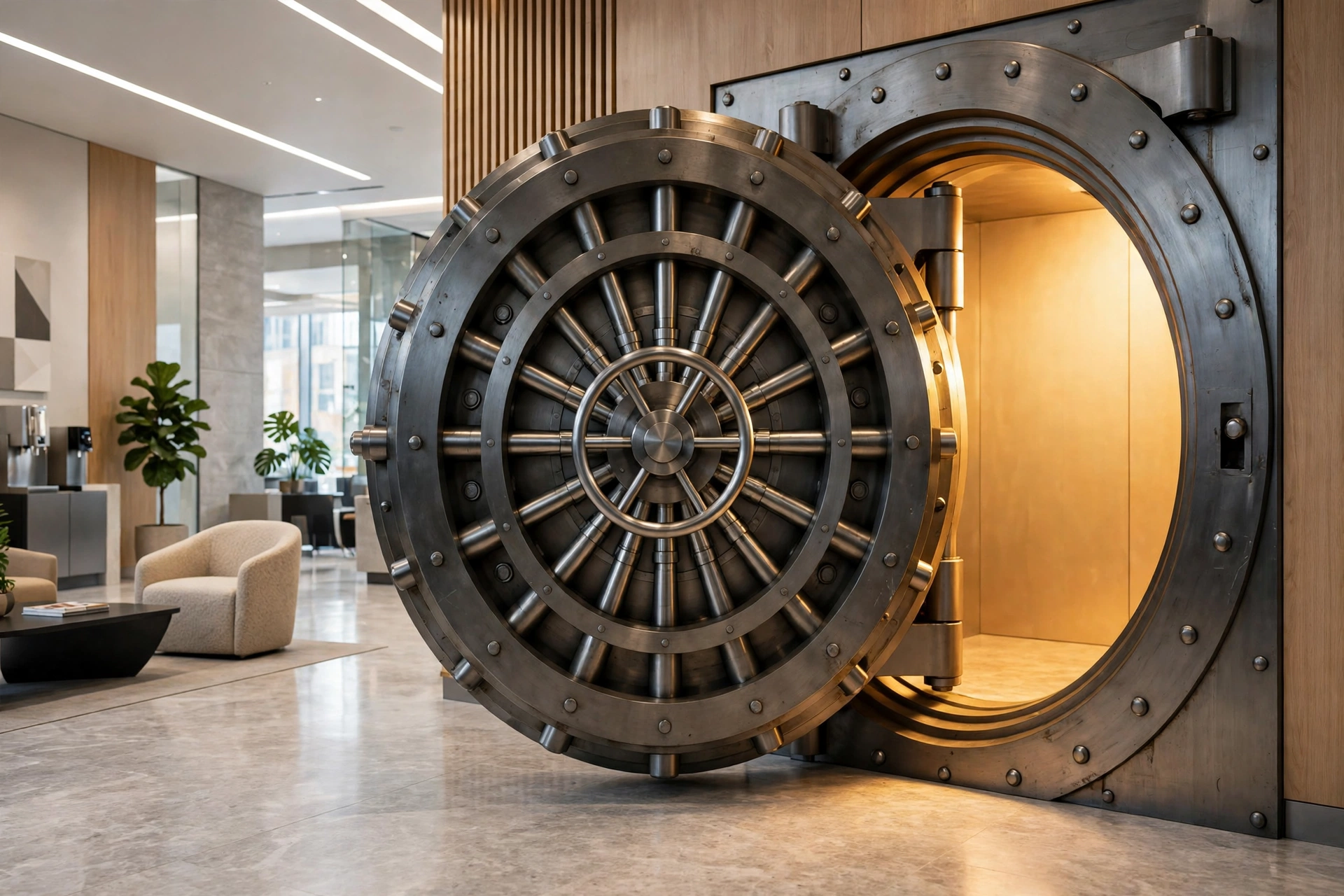
Now picture a bank. The building is big and solid, the doors are heavy, and behind the counter there is a room with walls thicker than your arm is long and a round steel door that weighs as much as a car. Banks take the piggy bank idea and make it about a thousand times stronger, then add rules, computers, and people whose whole job is watching out for trouble.
But here is the part most people never think about. When you hand your money to a bank, it does not sit in a little box with your name on it. Your money becomes a number in a computer, and the bank uses most of the cash to do other things. That sounds scary at first, but the safety of your money does not depend on your notes sitting untouched in a drawer. It depends on a whole system of protections working together, every day, even while you sleep.
The Short Answer: Your Money Is Protected in Layers
Think of a castle. It does not rely on one wall: it has a moat, then a wall, then a gate, then guards, then a locked room deep inside where the treasure sits. A bank works the same way. No single lock or rule keeps your money safe — it is the layers, one behind the other, that do the job.
The first layer is the building: strong walls, vaults, cameras, and alarms. The second is the law: governments set strict rules about how banks must behave, and check on them regularly. The third is insurance: if a bank fails, a government-backed scheme pays your money back up to a set limit. The fourth is technology: passwords, secret codes, and computer systems that watch every payment. And the fifth layer is you — the small, everyday habits that stop thieves before they start.
Each layer covers the gaps the others leave behind: a vault stops a robber but not a thief on the internet, and a password stops a stranger logging in but cannot help if the bank itself runs out of money. Put all the layers together, and you get something much stronger than any one of them on its own. That is why, in most countries, keeping money in a bank is far safer than keeping it at home: a house can burn down and a wallet can be stolen, while a bank account is guarded by all five layers at once.
The Big Strong Room: Vaults and Locks
The vault is the part you can see in the movies. A bank vault is a room built to be almost impossible to break into. Its walls are steel and concrete, sometimes more than a metre thick. The door is a huge round slab of steel, so heavy it needs a special hinge just to swing open. It locks with several bolts at once, and no single person can open it alone.
Vaults also have a time lock, a clever little clock inside the door that stops it from opening at certain hours, even if someone knows the combination. If a robber forces a member of staff to open the vault at night, the door simply will not move until morning. If anyone tries to drill or blast their way in, alarms go off and the police are called, often before the thief has made a dent.
The cash a bank keeps on hand is only a small part of the story, though. Most of your money is not paper notes at all: it is a number in the bank’s computer, and the bank keeps far less cash in the building than the total of everyone’s accounts. The vault protects the cash that is there — the rest is protected by the layers we will look at next. Even street money machines have their own protections: thick steel, cameras, alarms, and dye packs that stain stolen notes bright red so they cannot be spent.
The Safety Net: Deposit Insurance
Here is the layer that surprises most people, because it has nothing to do with locks or guards. It is a promise from the government: if your bank fails, a special fund steps in and pays you back, up to a set limit.
In the United States, that promise comes from the FDIC — the Federal Deposit Insurance Corporation, a US government agency. It insures deposits up to $250,000 per depositor, per insured bank, for each ownership category. If you have a savings account and a current account in your own name at one FDIC-insured bank, the two balances are added together and covered up to $250,000. A joint account gets its own cover, up to $250,000 for each person.
The United Kingdom has a similar scheme called the FSCS, the Financial Services Compensation Scheme. It protects up to £120,000 per person, per bank, a limit raised from £85,000 in December 2025. Like the FDIC, it pays your money back if an authorised bank fails. Almost every country has its own version, so the number that matters is the one in your own country.
Two things are worth knowing. First, these schemes cover deposits — the money in your current account, your savings account, and fixed deposits. They do not cover investments like shares, bonds, or crypto, even if you bought them through your bank. Second, anything above the limit is not covered, so spread money above the limit across two different banks, so each pot sits under its own limit.
Your Money Is Not Sitting in a Pile
Here is the part that worries people most when they first hear it: your money is not sitting in a vault waiting for you. When you deposit £100, the bank does not put your note in a box with your name on it. It lends most of it out to other people and businesses, and keeps only some ready for withdrawals. That is how banks earn their money — read our guide on how banks make money for the full story.
So why is that safe? Three reasons. First, the bank does not lend out all of it: the law says it must keep a share of deposits ready at all times, so your money is there when you ask for it. Second, its loans are spread across thousands of people and businesses, so if one borrower cannot pay, the bank does not fall over. Third, governments watch banks closely. Inspectors check the books, test whether the bank could survive a bad year, and step in early if it looks shaky.
Think of it like a library, which does not keep every book on the shelf at once — most are out on loan, being read. Yet when you walk in and ask for a book, the librarian can usually find you a copy, because the library holds some copies back. A bank works the same way: it keeps track of every penny it owes you, and holds enough ready for everyday withdrawals. Your balance is a record of what the bank owes you, backed by its own money, its loans, the rules it must follow, and the insurance scheme behind it.

The Secret Codes Only You Should Know
Now we move from the bank’s building to your pocket. Every time you use your bank, you prove who you are with a secret: a PIN for your card, a password for your banking app, and a one-time code sent to your phone when you log in or pay someone new. These secrets are the keys to your money.
The rule that matters most is simple: a real bank will never ask you for your full password, your PIN, or a one-time code. Not by phone, not by email, not by text, and not through a link. If someone calls and asks you to read out a code, that person is not from your bank. Hang up, and call the number on the back of your card yourself.
Thieves love these codes because one code can open the door. They send messages that sound urgent — “Your account will be closed today” or “A payment of £500 is leaving your account, reply now to stop it.” The hurry is the trick. A real bank does not rush you into sharing secrets or threaten to close your account in a text message. When a message makes your heart beat faster, slow down: that feeling is exactly what the thief is counting on.
A few small habits make your codes much harder to steal. Use a different password for your bank than for your email and shopping sites, so one leak does not open every door at once. Make the password long — a short sentence you can remember beats a jumble of symbols you will forget. Never write your PIN on your card or on a note in your wallet. If your bank offers fingerprint or face login, turn it on: a thief can guess a password, but they cannot easily borrow your face.
The Watchers: Fraud Monitoring and Alerts
Behind the scenes, your bank has watchers — part people, part computers — whose job is to spot payments that do not look like you. Every time you pay, the bank’s computer checks the details in a fraction of a second: where is it going, how big is it, and does it match what you usually do?
If you normally buy groceries near your home and suddenly your card is used to buy a television in another country at three in the morning, the system raises a flag. The bank may text you, “Was this you?”, block the payment, or ring you. This can feel annoying when you are the one trying to pay — perhaps you really are on holiday, buying a television at a strange hour — but the flag is the system doing its job. A quick “yes, that was me” and you are on your way.
You can help the watchers by turning on alerts. Most banking apps let you get a message every time money leaves your account, and your phone will buzz within seconds of every payment. If a thief ever uses your card, you will know before they can try again. The messages can feel noisy at first, but after a week they fade into the background — until the one day they matter. Banks also share information about new tricks and warn customers when a scam starts spreading, so one bank’s lesson can protect you too.
What to Do If Your Card Is Lost or Stolen
Losing a card is a horrible feeling. Your stomach drops and your pockets get searched three times. Take a breath — this is a problem with a clear fix, and the faster you act, the smaller it stays.
Step one: tell your bank straight away. Do not wait until you get home or until morning. Most banking apps have a button that freezes your card in seconds — look for “freeze card” or “block card.” If you cannot find it, ring the number on the bank’s website or on your bank statement. Banks have lines for this that stay open day and night.
Step two: check your recent payments in your app. If you see a payment you do not recognise, tell the bank — it will look into it, and in many cases it can take the money back. Step three: get a new card. Your bank will send one, usually within a few days, with a new number and a new PIN. Your old card becomes useless the moment the bank cancels it — it will be refused at every till.
Step four: if your whole wallet or phone is gone, change your banking password too, and check whether any other accounts used the same password — one stolen wallet can open more than one door if the passwords match. Here is the part that calms most people down: in many countries, the law limits how much you can lose from a stolen card if you report it quickly. The exact rules are different in each country, and your bank can tell you what applies to you. The point is simple — speed protects you. A card reported in ten minutes causes far less trouble than a card reported in ten days.
Everyday Habits That Keep Your Money Safe
Big systems do a lot of the work, but the small things you do every day matter just as much. None of these habits is hard, and together they close the gaps that thieves look for.
Check your statements. Once a week, take two minutes to scroll through your recent payments. You know your own spending better than any computer does. A small payment to a shop you have never heard of can be a thief testing whether your card works before a bigger payment. If something looks wrong, ring the bank. You do not need proof; a question is enough to start a check.
Be careful with public Wi-Fi. The free internet in a cafe or an airport is handy, but it is not the best place to log into your bank. If you need to check your balance while you are out, use your phone’s mobile data, or wait until you are home. And never log in to your bank from a computer that belongs to someone else — a hotel lobby computer, a library computer, a friend’s laptop you do not fully trust.
Keep your phone locked. Your banking app lives on your phone, so its lock screen is part of your bank’s security now. A short PIN or a fingerprint lock is enough — it takes two seconds to open, and it stops a stranger who picks up your phone from walking straight into your money. Watch out for links, too. Banks do not send you links asking you to log in. If a message claims to be from your bank and includes a link, do not tap it; open your banking app yourself, or type the bank’s web address yourself.
Finally, keep your contact details up to date with your bank. If the bank cannot reach you, it cannot warn you. A new phone number or address is worth a two-minute update in the app.
What Banks Cannot Protect You From
It is only fair to say what the layers cannot do. Banks are very good at stopping thieves who try to break in. They are much less able to help when you hand the money over yourself, believing a lie.
The most common trick works like this: someone pretends to be a builder, a landlord, a police officer, or even your own bank, and asks you to move money to a “safe account” or pay an urgent bill. You make the payment yourself, with your own codes, so the bank sees a normal payment from the real account holder. By the time you realise it was a trick, the money may be gone.
This is why banks ask extra questions when you send money to someone new, and show you the name of the person you are paying before you confirm. If the name does not match, stop — that warning exists because of this exact scam.
Banks also cannot protect you from promises that are too good to be true: a message offering to double your money in a week, a job that pays you for doing almost nothing, a prize you never entered. These are not banking problems, they are trust problems. No bank can stop you from believing a stranger, so the protection here is a habit: if something sounds too good, assume it is a trick until you have proof. The vault, the insurance, the watchers, and the codes all do their part. Your part is to pause, check, and ask before you send money anywhere new.

Frequently Asked Questions
Is my money safe in a bank?
For most people, yes — much safer than keeping cash at home. Your money is protected by vaults and locks, government rules, deposit insurance, and computers that watch for fraud around the clock. In the United States, the FDIC insures deposits up to $250,000 per depositor, per insured bank, for each ownership category, and no depositor has lost insured money since the FDIC began in 1933. Other countries have their own schemes with their own limits, so check the one where you live.
What happens if my bank closes down?
If an insured bank fails, the deposit insurance scheme steps in. In the United States, the FDIC pays back insured deposits, usually within a few days, up to $250,000 per depositor, per bank, per ownership category. In the United Kingdom, the FSCS does the same up to £120,000 per person, per bank. The cover is automatic when you open an account at an insured bank. Money above the limit is not covered, so large savers often spread it across more than one bank.
Does deposit insurance cover all of my money?
It covers your deposits — the money in your current account, your savings account, and fixed deposits — up to the limit in your country. It does not cover investments such as shares, bonds, or crypto, even if you bought them through your bank. If you have $300,000 in a single account in the United States, $250,000 is insured and the rest is not. Splitting the money between two different banks gives each pot its own cover.
What should I do if I lose my debit card?
Tell your bank straight away. Freeze the card in your banking app if you can, or ring the bank’s lost-card line — it is open day and night. Then check your recent payments for anything you do not recognise and report it. Your bank will cancel the old card and send a new one with a new number. In many countries, the law limits how much you can lose from a stolen card when you report it quickly, so speed really matters: ten minutes is far better than ten days.
Will my bank ever ask for my password or PIN?
No. A real bank will never ask you for your full password, your PIN, or a one-time code — not by phone, not by text, and not by email. If someone asks, they are not from your bank, however official they sound. Hang up or ignore the message, then contact your bank yourself using the number on the back of your card or on its official website. The same rule applies to links: your bank will not send you one asking you to log in.
Is online banking safe?
It is safe when you use it carefully. Banks protect online banking with passwords, one-time codes, and fraud monitoring, and they use encryption — a kind of secret code — to scramble your details as they travel. Your part is to keep your password secret, use a different password for your bank than for other sites, avoid public Wi-Fi or shared computers, and never tap login links in messages. If you do those things, online banking is far safer than carrying large amounts of cash.
More from Zorium Daily
- What Is a Savings Account and How Does It Work?
- How Do Banks Make Money?
- What Is Interest and Why Do Banks Pay It?
- What Is a Loan and How Does It Work?
Your money does not stay safe by luck. It stays safe because a bank is built like a castle — strong walls and a heavy vault door, strict rules checked by the government, an insurance promise that pays you back if the bank fails, computers that watch every payment, and secret codes that only you should know. And the last layer is the simplest one: you. Check your statements, keep your codes secret, and pause before you send money anywhere new. Do those small things, and the whole system works quietly, in the background, while you get on with your life.