Why Is the Dead Sea So Salty? And Why Can You Float in It?
SUMMARY OF THIS ARTICLE
- The Dead Sea is not a sea at all. It is a salt lake, and it has no river that flows out of it.
- The Jordan River brings tiny bits of salt and other minerals into the lake, but no water flows out to carry them away.
- The hot desert sun turns lake water into vapour, which is water that rises into the air, and leaves the salt behind.
- After thousands of years, the water became about ten times saltier than ocean water.
- The very salty water is heavy, so it pushes your body up, and that is why you float so easily.
Introduction: A Lake Where You Cannot Sink
Imagine you go for a swim, but you cannot sink. You lie back in the water, and the water holds you up like a soft bed. You do not need to kick your legs. You do not need to move your arms. You just float. This is what happens in the Dead Sea.
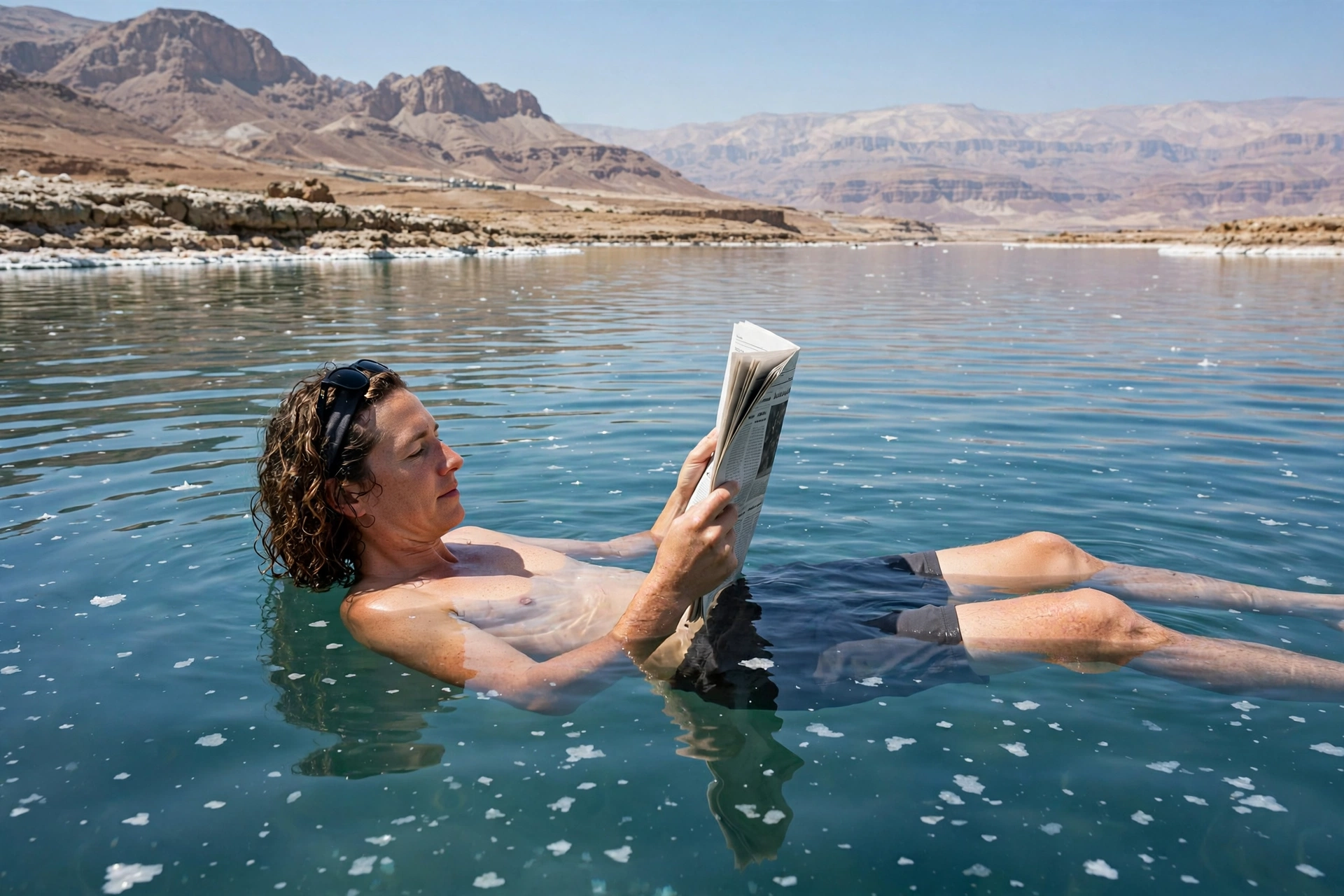
Many people have seen a famous photo of a person in the Dead Sea. The person is lying on the water, reading a book, as if the water were a chair. It looks like a trick. But it is real. The water is so salty, and so heavy, that it pushes the human body up.
But why is the Dead Sea so salty? And why can you float in it? The answer is a simple story about a lake, a river, a hot sun, and a very long time. In this article, we will tell that story in very simple words. If a word is hard, we will explain it right away, in plain words.
So let us start with the first surprise. The Dead Sea is not a sea.
First, the Dead Sea Is Not a Sea
The name can trick you. The Dead Sea sounds like a sea. But it is a lake. A lake is a large body of water with land all around it. A sea is much bigger, and it joins the oceans of the world.
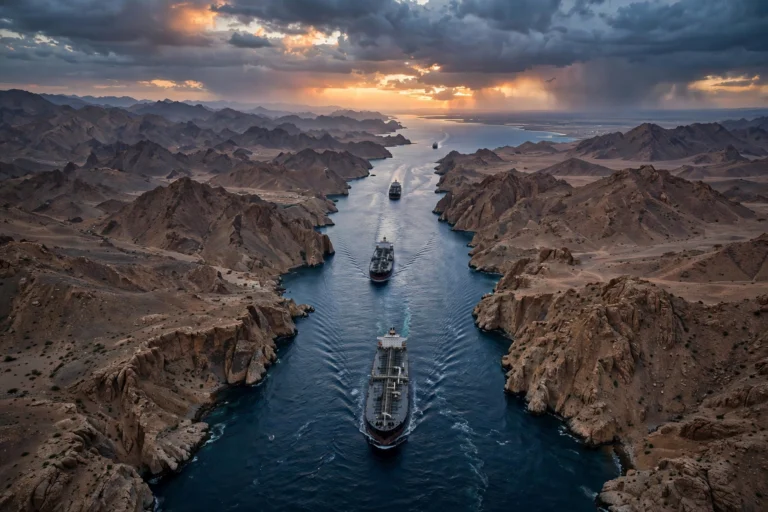
The Dead Sea does not join any ocean. It sits in a low place on land, with hills and desert all around it. Water flows into it, but no water flows out of it to the sea. That one fact is the key to the whole story.
The Dead Sea lies between Jordan on one side and Israel and Palestine on the other side. People have known about it for thousands of years. Old stories, old books, and old maps all talk about it. People went there to bathe in the salty water, and to take mud from its shores. Even today, many people visit it every year, just to float in it once in their lives.
But the lake got its sad name for a clear reason. Almost no fish can live in it. The water is too salty for them. Only very tiny living things, too small to see with your eyes, can live in it. People called it the Dead Sea because, to them, it looked like a sea with no life in it. The name stuck, and we still use it today.
So, remember the first point. The Dead Sea is a lake. It is a salt lake. And it has no way out.
Where Is It? The Lowest Place on Land
The Dead Sea is in a very special place. It sits about 430 metres below sea level. Sea level means the normal height of the surface of the sea. Most land is above sea level. The Dead Sea shore is below it. That makes it the lowest place on dry land on Earth.
Because it is so low, water from the land around it flows down into it. Rain falls on the hills. Small streams run down. The biggest river that flows into it is the Jordan River. It flows from the north, through a green valley, and into the north end of the Dead Sea.
But here is the problem, and also the secret. The Dead Sea has no river that flows out. Scientists have a long word for this kind of lake. They call it an endorheic lake. That is a hard word, so let us break it down in simple words. It just means a lake with no way out. Water comes in, but water does not flow out as a river. The only way water leaves is by turning into vapour in the hot sun.
This is like a bath with the tap on, but no drain. If you leave the tap on, the water will just stay there. In the Dead Sea, the river is the tap. The sun is the only way the water can leave, and the sun does not take the salt with it.
Why Is the Dead Sea So Salty?
Now we can answer the big question. Why is the Dead Sea so salty? The answer has three parts, and all three parts work together.
First, rivers bring salt. This may sound strange. The Jordan River looks fresh. You could drink its water, and it would not taste very salty. But all river water has tiny, tiny bits of salt and minerals in it. Minerals are natural stuff from rocks and soil, like salt, calcium, and magnesium. As rain falls on rocks and soil, it picks up tiny bits of these minerals. The river carries them along, bit by bit, day after day.
Second, the salt has nowhere to go. In a normal lake, a river flows in, and another river flows out. The salt that comes in can flow out again. But the Dead Sea has no river out. So the salt that comes in just stays. Year after year, century after century, more and more salt arrives, and none of it leaves. It is like putting a pinch of salt in a pot every day, but never pouring any water out. After a long time, the pot will be very salty.
Third, the hot sun takes the water away, but leaves the salt. The Dead Sea is in a hot, dry desert place. The sun is strong. The air is dry. Water on the surface of the lake turns into vapour and rises into the sky. Scientists call this evaporation. Evaporation just means water turning into a gas you cannot see, and going up into the air. When water evaporates, it leaves the salt behind. The salt does not rise with the water. It stays in the lake.
Put these three parts together, and you get the Dead Sea. River brings a little salt. No river takes salt away. Sun takes water away, but not salt. Do this for thousands of years, and the lake becomes super salty.
That is why the Dead Sea is so salty. It is not because someone poured salt into it. It is because nature kept adding a little salt, and kept taking away water, for a very, very long time.
What Kind of Salt Is in the Water?
When we say salt, most of us think of table salt, the white salt we put on food. The Dead Sea does have some table salt in it. But most of its salt is different.
A lot of the salt in the Dead Sea is magnesium chloride and other salts with long names. Magnesium is a mineral your body needs in small amounts, but in large amounts it tastes bitter, not like normal table salt. That is why Dead Sea water tastes much more bitter and harsh than ocean water. It is not just salty. It is bitter, and it can sting your skin if you have a cut.
How salty is it, in numbers? Ocean water is about 3.5 percent salt. That means in 100 cups of ocean water, about 3.5 cups would be salt, if you could take it out. Dead Sea water is about 34 percent salt. That is about ten times more. In 100 cups of Dead Sea water, about 34 cups would be salt. That is a huge difference.
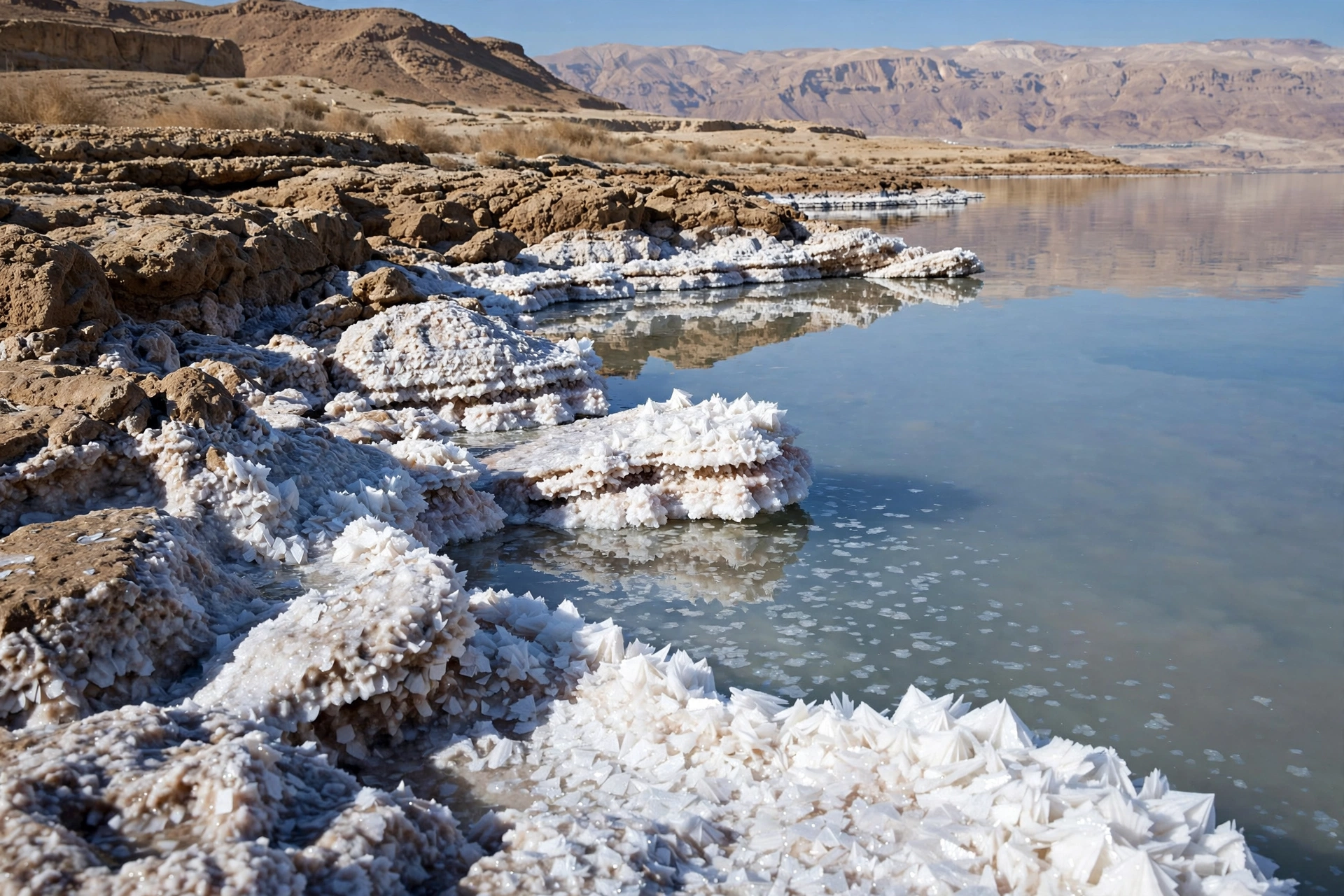
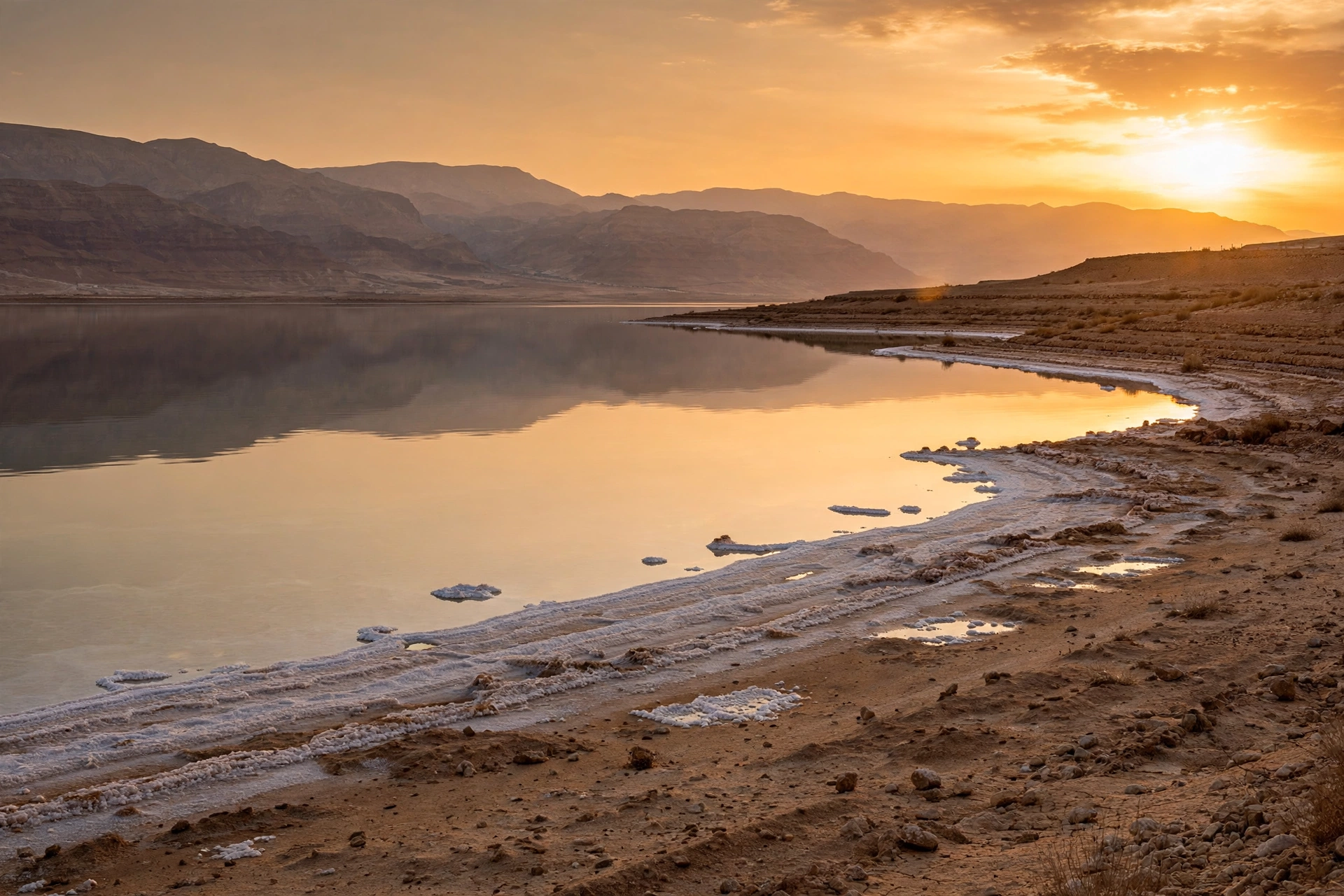
You can see this salt with your eyes. On the shores of the Dead Sea, white crusts of salt cover the rocks. They look like white snow, but they are salt. In some places, salt forms into strange shapes, like small white hills or lumps. When the water level goes down, it leaves salt behind on the shore, like a white ring around a bath.
So the Dead Sea is not just a little saltier than the sea. It is one of the saltiest lakes in the world. And that salt changes everything about how the water feels, and how your body acts in it.
Why Is the Water So Heavy?
Now we need one more simple science idea. It is called density. Density is a hard word, but the idea is easy. Density means how heavy something is for its size.
Think of two boxes of the same size. One box is full of feathers. The other box is full of stones. The box of stones is much heavier, even though both boxes are the same size. We say the stones have higher density. They pack more weight into the same space.
Water works the same way. Fresh water has low density. It is light for its size. Salty water has high density. The salt adds weight, but it does not add much size. So a cup of Dead Sea water weighs more than a cup of fresh water, because it has so much salt packed into it.
Your body also has a density. Your body is mostly water, with some fat, muscle, and bone. In fresh water, your body is about the same density as the water, or a little bit more. So you sink a little, and you need to swim to stay up. In the Dead Sea, the water is much denser than your body. The water is heavier for its size than you are. So the water pushes you up, hard.
This push has a name too. It is called buoyancy. Buoyancy just means the upward push of water on something in it. All water pushes up a little. Dead Sea water pushes up a lot, because it is so heavy with salt.
An old Greek thinker named Archimedes first wrote about this push, more than 2,000 years ago. Just remember this. Heavy, salty water pushes up more than light, fresh water.
Why Can You Float in It?
Now the fun part becomes clear. You float in the Dead Sea because the water pushes you up more than your body pulls you down.
Your body pulls down because of gravity. Gravity is the force that pulls everything toward the Earth. It pulls you down when you jump, and it pulls an apple down from a tree. In water, gravity still pulls you down.
But the water pushes up. In the Dead Sea, the push up is stronger than in normal water. The push is so strong that a large part of your body stays above the water, even if you do nothing. You can lie on your back, relax, and read a book. Your legs do not sink. Your head stays up. It feels strange at first, because you are used to working hard to stay afloat in a pool or in the sea.
Many people say floating in the Dead Sea feels like lying on a soft, invisible bed. You do not float high, like a boat. You float low, with your body just under the surface, but you do not sink. If you try to stand up, you may tip over, because your legs want to float up too. If you try to swim on your front, like normal swimming, it is hard, because your legs keep rising to the surface.
That is why photos of people reading in the Dead Sea look so funny, and so true. They are not holding on to anything. They are not swimming. The water is doing all the work.
Why You Cannot Swim Like Normal
Floating is easy in the Dead Sea. Swimming like normal is not easy. Many first-time visitors are surprised by this.
In a normal pool, you can swim on your front, kick your legs, and move forward. In the Dead Sea, your legs float up to the surface. Your body wants to lie flat, like a star. If you try to do a normal front swim, your legs rise, your head goes down, and you may get water in your face. That is not fun, because Dead Sea water in your eyes or mouth burns and tastes terrible.
The best way to enjoy it is to lie on your back and float. Move slowly. Do not splash. Keep your head up and your mouth closed. Many guides tell visitors to float for only a short time, and then get out, shower, and rest. We will talk more about safety in a later part of this article.
So, the Dead Sea is great for floating. It is not great for normal swimming. And that is fine. Most people do not go there to race. They go there to feel what it is like to float without trying.
Why Almost No Fish Live There
The name Dead Sea tells the truth about fish. Fish cannot live in water this salty. A fish body needs a balance of salt and fresh water inside it. In the Dead Sea, the water outside the fish is far saltier than the water inside the fish. Water would rush out of the fish’s body, and salt would rush in. The fish would dry out from the inside, even though it is in water. That is why fish die quickly in the Dead Sea.
But the Dead Sea is not fully dead. Very tiny living things can live in it. They are called microbes. Microbes are living things so small you cannot see them without a special tool called a microscope. Some microbes love salt. They live in the Dead Sea water and in the mud. In some years, after rain brings a little fresh water to the top of the lake, these microbes grow in large numbers, and they can even turn parts of the water a reddish colour.
Birds visit the lake, but they do not live in the water. In the main lake itself, life is very, very small, and very rare. A place can look empty, but still have tiny life in it.
Why Is the Water Level Falling?
The Dead Sea is in trouble. Its water level is falling. Every year, the surface of the lake goes down by about one metre. That may not sound like a lot, but over many years, it adds up. Old photos show beaches and buildings that used to be at the water’s edge. Now they are far from the water, on dry land.
Why is this happening? There are two main reasons.
First, people use more water from the Jordan River. The Jordan River is the main river that flows into the Dead Sea. But farmers, towns, and cities in the area also need that water. They take water from the river for crops, for drinking, and for homes. So less water reaches the Dead Sea than before. Less water in means the lake shrinks.
Second, the hot sun still takes water away by evaporation. The sun does not stop. It keeps turning lake water into vapour. If less water comes in, but the same amount of water goes out by evaporation, the lake must go down. It is like a bath with a small tap and a big drain. The water level falls.
People near the Dead Sea worry about this. A falling lake means less water for visitors. In some places, holes called sinkholes open up in the ground as the water goes down. A sinkhole is a hole that appears when soil under the surface washes away.
Many ideas have been talked about to save the Dead Sea, like bringing water from other seas, or using less river water. These ideas are big, costly, and hard to agree on, because more than one country shares the lake and the river.
This part of the story is sad, but it is important. The Dead Sea is a natural wonder, but it is also fragile. Fragile means easy to harm. What people do with rivers far away can change a lake that has been there for thousands of years.
How to Visit Safely
If you ever visit the Dead Sea, you can have a wonderful, safe time if you follow a few simple rules. These rules are easy, and they keep you safe.
Do not drink the water. Dead Sea water is not drinking water. It is far too salty, and it has minerals that can make you sick if you swallow a lot of it. If a little water gets in your mouth by mistake, spit it out and rinse your mouth with fresh water.
Do not get water in your eyes. Dead Sea water burns the eyes badly. Keep your head up when you float. Do not splash. Do not put your head under water. If water does get in your eyes, get out at once and wash your eyes with lots of fresh water.
Do not stay in too long. Most guides say to float for about 15 to 20 minutes at a time, then get out, shower with fresh water, and rest. The salt can dry out your skin, and it can sting small cuts. After your float, shower well. Put on skin cream if your skin feels dry.
Do not shave just before you go in. Shaving makes tiny cuts in the skin, and Dead Sea water will sting those cuts. It is better to shave a day before, or after your visit.
Do not go in if you have large open cuts, or if you are not well. Salt water can hurt open wounds, and it is not a medicine. If you have a health problem, ask a doctor first.
Wear water shoes. The shore can be sharp with salt and rocks. Drink plenty of fresh water too, because the desert is hot.
These rules are simple. Float on your back. Keep water out of your eyes and mouth. Stay in for a short time. Shower after.
Frequently Asked Questions
Why is the Dead Sea so salty?
The Dead Sea is so salty because the Jordan River brings tiny bits of salt into it, no river flows out to take salt away, and the hot desert sun turns water into vapour but leaves the salt behind. After thousands of years, the salt built up until the water became about ten times saltier than ocean water.
Why can you float in the Dead Sea?
You can float because the very salty water is heavy, and it pushes your body up. Scientists call this push buoyancy. In normal water, the push is small, so you must swim to stay up. In the Dead Sea, the push is very strong, so your body stays at the surface even if you do nothing.
Is the Dead Sea really a sea?
No. The Dead Sea is a lake, not a sea. It does not join the oceans. It sits between Jordan and Israel and Palestine, about 430 metres below sea level, and it has no river that flows out of it.
Can fish live in the Dead Sea?
Almost no fish can live there, because the water is too salty. Only very tiny microbes, living things too small to see, can live in it. That is why people called it the Dead Sea.
Is it safe to swim in the Dead Sea?
Floating for a short time is safe for most healthy people if they follow the rules. Do not drink the water, do not get it in your eyes, do not stay in too long, and shower with fresh water after. Do not swim like normal, because your legs float up and water can get in your face. If you have large cuts or a health problem, ask a doctor first.
Closing: A Strange Lake With a Simple Story
So, why is the Dead Sea so salty? And why can you float in it? The story is simple, once you see the parts.
A river brings a little salt. No river takes salt away. The sun takes water away, but not salt. After thousands of years, the lake becomes super salty. Super salty water is heavy. Heavy water pushes your body up. So you float.
The Dead Sea is a strange and beautiful place. It is the lowest place on land. It is one of the saltiest lakes in the world. You cannot swim in it like normal, but you can float in it like nowhere else. And it is in danger, because its water level is falling as people use more river water.
If you remember one thing from this article, remember this. Nature made the Dead Sea salty slowly, bit by bit, over a very long time. And nature made it a place where you float, not because of magic, but because salty water is heavy water. That is a simple idea, but it explains one of the most famous wonders in the world.