Why Is the Sky Blue?
SUMMARY OF THIS ARTICLE
- Sunlight looks white, but it is really made of many colours mixed together.
- Air is full of very tiny bits that are too small for us to see.
- When sunlight hits those tiny bits, the blue part of light spreads out in all directions.
- That spread-out blue light reaches our eyes from all over the sky, so the sky looks blue.
- At sunset, sunlight travels a much longer way through the air, so most of the blue is gone and red and orange are left.
Look Up on a Clear Day
Look up on a clear day. What do you see? A big blue sky. It is above us every day. It looks so simple. But it hides a neat trick of light and air.
Why is the sky blue? Why is it not white, like sunlight? Why is it not green or pink? The answer is in the sun, the air, and the way light moves.
This is a simple guide. We will take it one small step at a time. By the end, you will know why the sky is blue, why sunsets look red, and why the sky on the Moon looks black.
Let us start with the sun.
Sunlight Looks White, but It Is Not Just One Colour
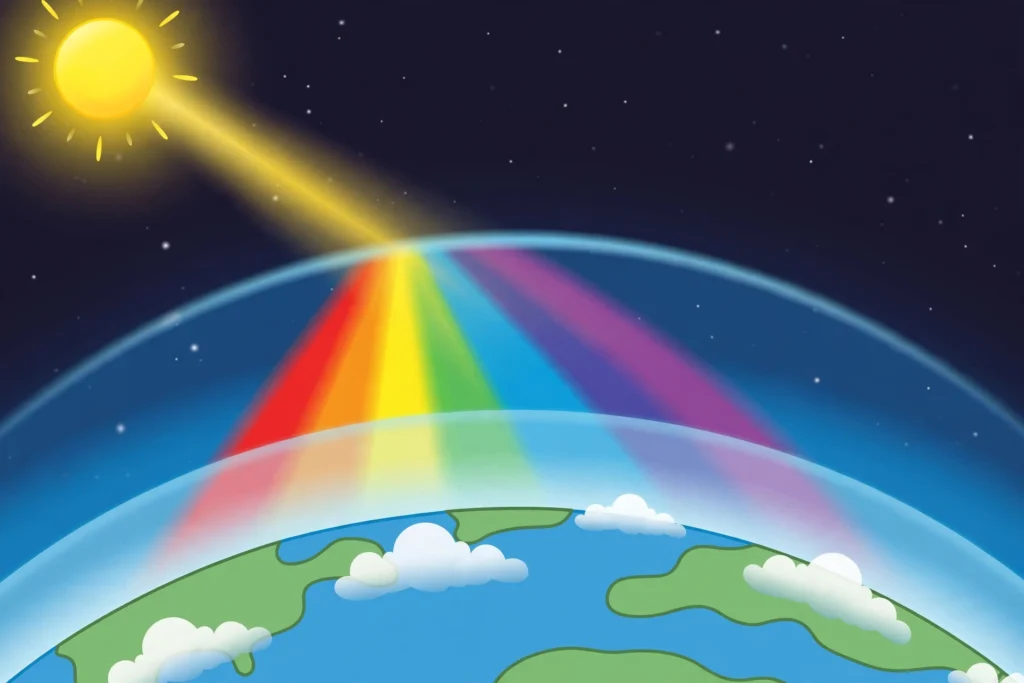
Sunlight looks white. It looks plain. But it is not plain at all. White sunlight is a mix. It holds many colours at once.
Think of a rainbow. A rainbow shows red, orange, yellow, green, blue, and violet. Those are the colours in sunlight. When they are all mixed, our eyes see white. When they are split apart, we see each colour on its own.
You can see this split in rain. When the sun shines while it rains, the rain drops split the light. That is why we see a rainbow in the sky. The same thing can happen with a glass of water in bright sun. Light goes in, and colours come out.
So sunlight is not one colour. It is a team of colours. Each colour moves in its own way. Some colours move in long, slow waves. Some move in short, quick waves. Blue light moves in short waves. Red light moves in long waves. This small fact matters a lot. Keep it in mind.
This is the first key idea in the science of light. Light may look simple, but it is full of colours. Once you know that, the blue sky starts to make sense.
What Is Air, Really?
We live at the bottom of a sea of air. We do not see it, but it is all around us. Air covers the Earth like a soft blanket. It goes up very high. We call this blanket the air around Earth.
Air is made of tiny bits. The bits are called gas bits. They are far too small to see with our eyes. Even a very strong glass would not show one bit on its own. But there are so many of them. They fill the sky from the ground up to space.
When we breathe in, we take in these tiny bits. When wind blows, they move fast.
Light from the sun must pass through this air to reach us. It does not just fly straight to our eyes with no stops. It meets the tiny bits in the air on its way down. What happens then is the heart of this story.
Think of it like this. The sun throws light down at Earth. The air is full of tiny bits. The light bumps into those bits. Some light goes straight on. Some light bounces off in new ways. That bounce is what paints the sky blue.
What Happens When Light Hits Air?
When light hits a tiny bit of air, it can scatter. Scatter is a simple word. It means spread out in many ways.
Picture a ball thrown into a room full of small balls. It hits one, then it may bounce left or right. Light acts a bit like that when it meets air bits.
But here is the neat part. Not all colours scatter the same way. Blue light scatters much more than red light. Blue light has short waves. Short waves hit the tiny air bits and bounce off much more often. Red light has long waves. Long waves pass by the tiny bits more easily. They keep going in a straight line for longer.
So as sunlight moves through the air, blue light spreads out all over the place. It goes up, down, left, and right. Red light mostly keeps going straight from the sun to Earth.
This spread of blue light is why the sky looks blue. Blue light comes to our eyes from all parts of the sky. It does not come only from the sun. It comes from above, from the side, and from all around. Our eyes take in that blue light. Our brain says, “The sky is blue.”
This is the simple science behind a blue sky. It is not paint in the sky. It is not a blue roof over Earth. It is light, spread out by air.
Why Blue and Not Violet?
Now you may ask a smart question. If short waves scatter most, why is the sky not violet? Violet light has even shorter waves than blue light. So violet should scatter even more. That is true. Violet does scatter a lot.
So why do we not see a violet sky? There are two reasons, and both are about our eyes and our sun.
First, the sun gives out less violet light than blue light. There is more blue in sunlight to start with. So there is more blue to spread and reach us.
Second, our eyes are not as good at seeing violet. Our eyes are made to see blue well. They do not pick up violet as strongly. Our eyes also mix some of the violet with blue and see blue.
Put those two facts together, and the sky looks blue, not violet. The violet is there, but our eyes do not show it to us as violet. They show us blue.
This is a good example of how light works. What we see is not just what is out there. It is also how our eyes and brain read the light.
Why the Sky Looks Deep Blue Overhead and Pale Near the Ground
Have you seen that the sky is not one flat blue? Look straight up at noon on a clear day. The sky looks deep, rich blue. Now look near the ground, far away at the edge of the sky. There it looks pale, almost white.
Why does the colour change? It is still the same air and the same sun. The change comes from how much air the light must pass through.
When you look straight up, you look through a short path of air. The blue light that reaches your eyes is clean and strong. It has not been mixed with too much other light. So it looks deep blue.
When you look far to the side, near the ground, your eyes look through a long path of air. The light must travel much farther through air bits. Along the way, more colours get mixed in. White light from dust, water drops, and haze joins the blue. The mix looks pale.
Dust and tiny water drops in the air also play a part. On a hazy day, there is more dust in the air. The sky looks whiter. On a very clear day, after rain has washed dust away, the sky looks a deeper blue. The cleaner the air, the deeper the blue.
So the sky is not painted one colour. Its colour shifts with the path of light and the state of the air. That is why a sky can look different in the morning, at noon, and in the late day.
Why Sunsets Look Red and Orange
Sunsets are one of the best shows in nature. The sun sinks low. The sky turns gold, orange, pink, and red. Why does the same sky that was blue at noon turn red at dusk?
The answer is the same idea, just pushed further. At sunset, the sun is low. Its light must travel a much longer way through the air to reach your eyes. It does not come straight down from above. It comes across a long, flat path.
Along that long path, almost all the blue light gets scattered away. It bounces off in other ways before it can reach you. The violet goes too. What is left is the light that does not scatter much. That is red, orange, and yellow light. Those long-wave colours keep going straight and reach your eyes.
That is why the sun itself looks red or orange at sunset. It is not that the sun has changed colour. It is that the blue has been taken out of its light on the long trip through air.
Clouds catch this orange light and glow. That is why sunset clouds can look pink, purple, and gold. The light hits the clouds, and the clouds throw it back to us in warm colours.
The same long-path idea also helps explain why the Moon can look orange when it is low in the sky. You can read more about that orange glow in this guide to the orange Moon. When the Moon is near the ground line, its light also travels a long way through air. Blue is scattered away, and warm colours are left. The Moon and the sunset follow the same simple rule.
This is why people love to watch the low sun and the low Moon. The colours are warm and soft. The light has had a long trip, and it shows.
What About the Sky at Night?
At night, the sun is on the other side of Earth. Its light does not reach our sky in the same way. So there is no blue light spread out for us to see. The sky looks dark.
But the stars are still there. In the day, stars are also in the sky. We just cannot see them well because the bright blue sky light is so bright. It drowns out the faint star light. At night, the blue is gone, and the stars can shine through.
The Moon also shines at night. It does not make its own light. It throws back sunlight, but that light is far too weak to turn the whole night sky blue.
So night is dark because the main source of scattered blue light, the sun, is not above us. When the sun comes back in the morning, the blue comes back too.
Why the Sky on the Moon Looks Black
The Moon is a great test of this idea. If the blue sky came from space itself, the Moon would have a blue sky too. But it does not. Photos from the Moon show a black sky, even in the daytime.
Why? The Moon has almost no air. It has no thick blanket of air bits like Earth has. Sunlight reaches the Moon’s ground with almost no bits to hit. So there is almost no scattering. Blue light does not spread out all over. It just keeps going straight from the sun.
That means if you stood on the Moon in the day, you would see a bright sun in a black sky. You could see stars too, even with the sun up. There would be no blue to hide them.
This tells us the blue sky is not a thing in space. It is a thing made by Earth’s air. Take away the air, and you take away the blue. The Moon shows us that clearly.
Earth is lucky to have air. It gives us the blue sky, weather, and sunsets, and it keeps us warm and safe.
Why Are Clouds White?
If air bits scatter blue light, why are clouds white? Clouds are made of water drops and ice bits. These bits are much bigger than air bits. They are big enough to scatter all colours the same way.
When sunlight hits a cloud, red, orange, yellow, green, blue, and violet all scatter about the same amount. When all colours mix again, our eyes see white. That is why most clouds look white.
Thick clouds look grey or dark. That is not because the light has changed. It is because the cloud is thick. Light has a hard time getting through. The bottom of a thick cloud gets little light, so it looks dark to us. The top, lit by the sun, still looks bright white.
So clouds are white for a simple reason. Their drops are big. Big drops do not pick blue over red. They throw all colours out in all ways, and the mix looks white.
Tiny air bits pick blue. Bigger cloud drops pick no colour at all. That one fact gives us both blue skies and white clouds.
Light in Nature: Fireflies and the Sky
Light does not only come from the sun. Nature makes light in other ways too. Fireflies are a good example. On warm summer nights, fireflies glow with a soft green-yellow light. They make this light in their own bodies. It is called cold light because it gives light with almost no heat.
Fireflies glow without needing the sun. Their light comes from a tiny chemical change inside them. It is a calm, cool light. You can learn how this works in this guide to firefly light. It shows how a small living thing can make light without fire.
The sky and the firefly are two sides of light in nature. One is sunlight spread by air. The other is light made by a living thing. Both are simple to grasp once you know the basic idea. Light can be split, spread, and made in many ways.
That hand-over is part of the same sky science. The sun goes down, the blue scatter fades, and other lights can be seen.
What Changes the Colour of the Sky?
The sky is not always the same blue. Many things can change it a little. Here are the main ones.
First, dust. Dust from deserts, fires, and cities floats in the air. Dust bits are bigger than air bits. They scatter all colours. More dust means a paler, whiter sky. After a big dust storm, the sky can look milky.
Second, water in the air. On humid days, there is a lot of water vapour in the air. Tiny water drops scatter light too. The sky can look pale or hazy. After rain, the air is cleaner. The sky often looks a deeper blue.
Third, smoke. Smoke from fires can turn the sun red even in the day. Smoke bits block blue light and let red through. That is why the sun can look red on smoky days.
Fourth, where you are. Near the sea, the air is often clean. The sky can look deep blue. In a busy city, dust and smoke can make the sky look grey-blue or pale. High up on a mountain, there is less air above you. The sky can look a darker, deeper blue.
Fifth, the time of day. At noon, the sun is high and the path through air is short. The sky is blue. In the morning and evening, the sun is low and the path is long. The sky turns gold and red.
A Simple Test You Can Try at Home
You can see scattering at home with a safe, simple test. You need a glass of water, a little milk, and a torch. Do this with an adult if you are young.
Fill a clear glass with water. Shine the torch through the side of the glass in a dark room. The light will pass through and the water will look mostly clear.
Now add one or two drops of milk and stir. The milk adds tiny bits to the water, like air bits in the sky. Shine the torch again. The water may look a little blue from the side, and the light seen through the water may look a little yellow or orange.
Why? The milk bits scatter blue light to the side, just like air bits do. The light that goes straight through loses its blue and looks warmer. It is a small model of the sky and the sunset in one glass.
Do not look straight into a bright torch or at the sun. Never look at the sun, even at sunset, with your bare eyes for long. The sun can hurt your eyes. The glass test is safe because the torch is weak and you look at the side of the glass, not into the beam.
This test is a fun way to see light spread with your own eyes. It turns a big sky idea into something you can hold in your hand.
Why This Simple Idea Matters
Why does it matter that the sky is blue? It matters because it shows how much we can learn from a simple question. A child looks up and asks, “Why is the sky blue?” The answer leads to sunlight, air, colours, and waves. It leads to sunsets, the Moon, and clouds.
It also shows that science is not just for labs. It is in the sky above us every day, in the sunset we watch with family, and in the Moon we see at night.
Next time you see a blue sky, think of the tiny air bits. Think of blue light bouncing all around you. Think of red light going straight on. You are seeing physics in action, right above your head.
And next time you see a red sunset, think of the long trip that light took. The blue was lost on the way. The red stayed. That is why the sky glows warm at the end of the day.
The Short Answer, in One Paragraph
If you need a short answer to give a friend, here it is. Sunlight holds many colours. Air is full of tiny bits. When sunlight hits those bits, blue light spreads out much more than red light. That spread-out blue light comes to our eyes from all over the sky. So the sky looks blue. At sunset, the light travels farther through air, the blue is scattered away, and red and orange are left. On the Moon, there is almost no air, so there is no spread, and the sky looks black.
That is the whole story in a few lines. It is simple, but it explains a lot. It explains blue days, red sunsets, white clouds, and black Moon skies. One rule, many sights.
Frequently Asked Questions
Why is the sky blue and not white?
Sunlight looks white because it holds all colours mixed together. But air bits scatter blue light much more than other colours. That blue light spreads all over the sky and reaches our eyes from every direction. So we see blue, not white. White would need all colours to reach us equally from all directions.
Why is the sky blue during the day but dark at night?
During the day, the sun is above us and its light is scattered by air. That scattered blue light fills the sky. At night, the sun is on the other side of Earth. There is no strong sunlight to scatter above us. So the sky looks dark, and we can see stars that were hidden by the bright blue in the day.
Why do sunsets look red?
At sunset, sunlight travels a long way through air to reach us. On that long trip, blue light is scattered away. Red and orange light, which scatters much less, keeps going and reaches our eyes. That is why the sun and the sky near it look red, orange, and gold at sunset. Clouds catch that warm light and glow pink and gold.
Why does the Moon look orange near the horizon?
The Moon looks orange near the horizon for the same reason sunsets look red. When the Moon is low, its light travels a long way through air. Blue is scattered away, and warm colours are left. You can read the full simple guide to the orange Moon glow to see how the same rule works for the Moon. When the Moon climbs high, its light takes a short path, and it looks white again.
Why is the sky on the Moon black?
The Moon has almost no air. With almost no air bits, there is almost nothing to scatter sunlight. Blue light does not spread out. The sky stays black even in daytime, and stars can be seen next to the sun. Earth has a blue sky because Earth has a thick air blanket, and the Moon does not.
Why are clouds white if the sky is blue?
Cloud drops are much bigger than air bits. Big drops scatter all colours about the same amount. When all colours mix, we see white. Tiny air bits pick blue, but big cloud drops do not pick any colour. That is why clouds look white against a blue sky, and why thick clouds look grey when little light gets through them.
Do other planets have blue skies?
It depends on their air. Mars has thin air and a lot of dust, so its daytime sky often looks butterscotch or pinkish, not blue. Each planet’s sky colour tells us about its air.