How Does a Clothes Shop Make Money? Explained Simply
SUMMARY OF THIS ARTICLE
- A clothes shop makes money by buying clothes at a lower wholesale price and selling them at a higher shop price, and the gap between the two prices is where its profit lives.
- Most of the money comes from everyday sales of shirts, trousers, dresses, coats and shoes, with a big lift from new seasons, school holidays, festivals and wedding season.
- The shop also pays for a lot of things: the clothes themselves, rent, staff wages, hangers and bags, electricity, heating and the fitting rooms.
- One coat can look very profitable, but after rent and wages little is left — many small clothes shops keep only about 5 to 10 cents of profit from each dollar of sales.
- Fitting rooms, friendly help and being able to try things on before you buy are the shop’s biggest edge over buying clothes online.
The Coat That Caught Her Eye
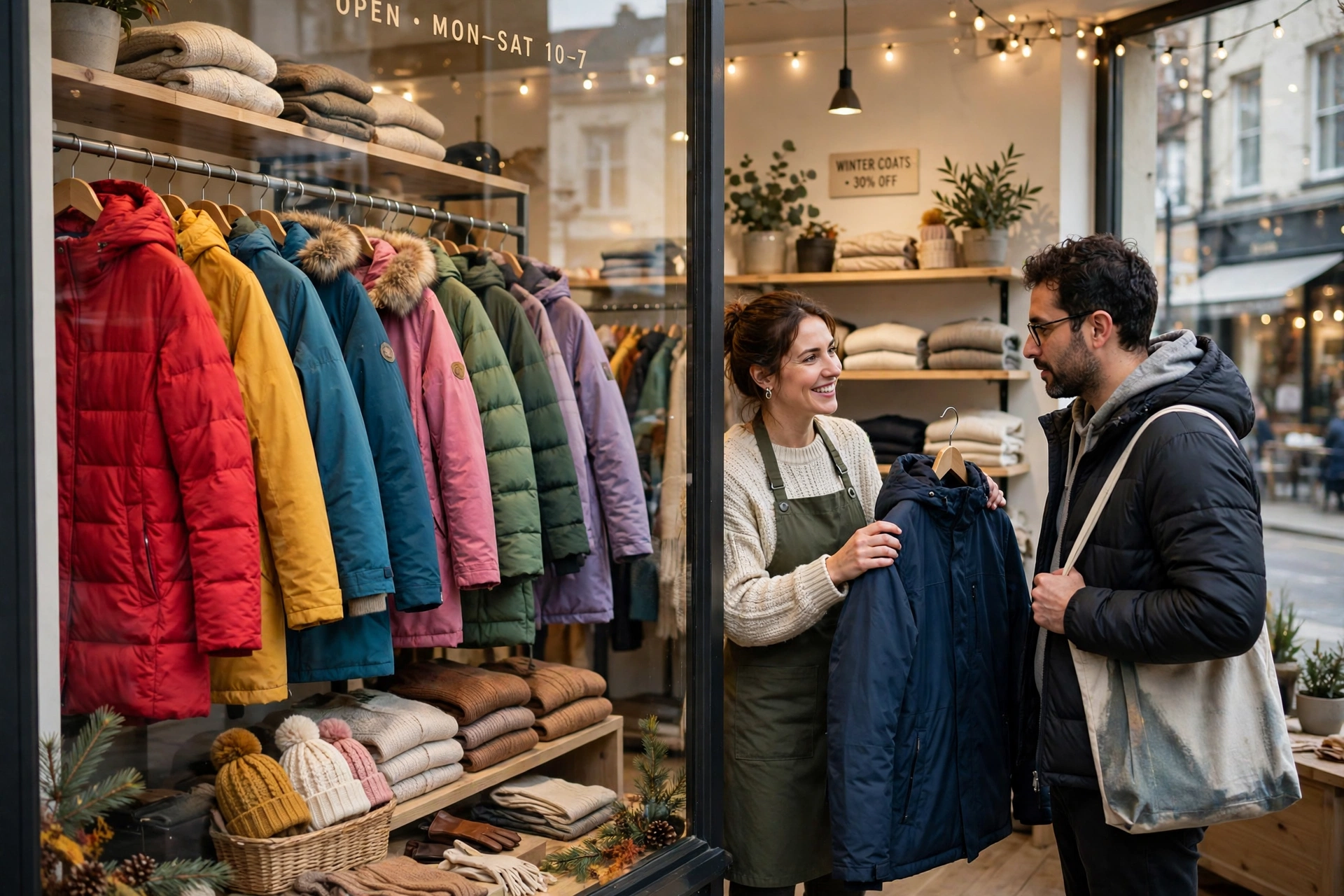
It is the first cold Saturday in November, and Sara is walking down the high street with her daughter, Lily, who is twelve. They are just looking, the way people do when the air turns sharp and the windows fill with thick coats and soft scarves. Then Lily stops. There it is, in the window of a small clothes shop: a deep red winter coat, with big buttons and a warm collar. Lily tries it on, looks at her mother with that face every parent knows, and Sara buys it. The price tag says eighty dollars.
It looks like a simple moment, and in a way it is. But behind that one sale there is a whole business at work. Somebody chose that coat, ordered it months ago, paid for it, hung it in the window, and kept the shop warm and bright. The eighty dollars did not all go into the owner’s pocket. Most of it was already spent long before Lily saw the coat. This article follows that eighty dollars, step by step, in plain words.
The Short Answer: Buy Low, Sell Higher
Here is the whole idea in one sentence: a clothes shop buys clothes from makers and wholesalers at a lower price, sells them to people like you and me at a higher price, and the difference pays for everything else. A wholesaler sells clothes in large amounts to shops. The shop buys dozens, sometimes hundreds, at once, in different sizes and colours, and because it buys so many, it pays less for each one. That lower price is the wholesale price. The price on the tag is the retail price. The gap is called the markup.
Suppose a shop buys a shirt for ten dollars and puts a price tag of twenty-five dollars on it. If it sells the shirt, fifteen dollars is left over before the other costs are paid. That fifteen dollars is not profit yet: it still has to cover the rent, the wages, the electricity and the bags. But without that gap, there would be nothing to cover anything with. No gap, no shop. The shop is not really selling cloth and thread. It is selling choice, convenience and confidence, and the markup pays for all of that work.
What a Clothes Shop Actually Sells
A clothes shop does not sell one thing. It sells a whole rail of things, and each one plays a different part. The heart of the shop is everyday clothes: shirts, trousers, dresses, skirts, jumpers and jeans. None of these sales is huge on its own, but there are dozens of them every day, and they add up. A mother buys school trousers for her son, a young man buys a shirt for a job interview, and a grandmother buys a soft jumper for the winter. These ordinary purchases are the steady base the shop depends on.
Then there are the seasonal stars. In winter, coats, scarves, gloves and thick jumpers take over the rails. In summer, it is light dresses, shorts, t-shirts and sandals. A coat is the big one: it costs more than a shirt and brings in more money in a single sale. That is why the window in November is full of coats, not t-shirts. Then there are the extras near the till: scarves, belts, hats, socks and bags. They cost little to make but sell for a good price, and a customer who came in for a dress often leaves with a scarf as well. And there are the big occasions: a wedding, a prom, a job interview, a holiday. People buy something nicer than usual then.
Where the Money Comes In
A clothes shop’s income comes from a few clear streams, and a healthy shop usually has more than one. A stream is just a business word for a different way money comes in. If one stream is slow, another can help. Walk-in sales are the base: people who come through the door, look around, try things on and buy. They do not make anyone rich in a single day, but they are steady, and steady matters. A shop that can count on a certain amount of money every day can order new stock with confidence.
Seasonal sales are the peaks. The weeks before winter, the weeks before school starts again, the festival season and the weeks before a big holiday are when clothes shops earn most. People buy coats before the cold arrives and new clothes for children before school. A shop that prepares well can earn in a month what it normally earns in two. Online sales are newer, but they are growing fast. Many small shops now sell through a website or a social media page as well as through the door, bringing in customers who never walk past the shop at all — but also new costs: packing, delivery, returns and sometimes a fee to the website. Clearance sales are another stream, and some shops also earn from small services like shortening trousers.
A Worked Example: One Winter Coat
Numbers make this much clearer, so here is a simple worked example with round numbers, not the accounts of any real shop. Every real shop is different, and prices change from place to place, but the shape of the maths is the same everywhere. Imagine the red winter coat Lily tried on. It sells for eighty dollars. That is the price on the tag, the money Sara hands over at the till. First, the coat itself. The shop bought it from a wholesaler for about thirty-two dollars, which covers the fabric, the buttons, the lining, the stitching and the journey from the factory to the shop.
Then the share of the shop’s running costs for that one coat: about twelve dollars, for the assistant’s time, the heating, the lights and the shop’s share of the rent. Then the bag, the tissue paper and the receipt: about two dollars. Add it up: thirty-two dollars for the coat, twelve dollars for the running costs, two dollars for the bag and packing. That is forty-six dollars of costs for one eighty-dollar coat. So thirty-four dollars is left over: the gross profit, about forty-three percent of the price.
Now here is the part that surprises most people. That thirty-four dollars is not the owner’s profit. Not yet. The rent, the wages, the insurance, the repairs, the advertising and the clothes that never sell still have to come out of it. Suppose the shop sells twenty coats like that one in a week. That is six hundred and eighty dollars of gross profit in one week. Over a month, that might be around two thousand seven hundred dollars from coats alone. But if the rent is two thousand dollars a month, wages are three thousand five hundred dollars, and electricity, insurance and heating are another one thousand five hundred dollars, the shop can easily end the month with very little left. A single coat looks very profitable. A whole shop, with all its bills, is a much tighter business.
The Big Costs: Where the Money Goes
Now the other side. A clothes shop’s money flows out just as fast as it flows in, and the list of costs is longer than most customers imagine. Stock comes first: the clothes themselves, and the biggest cost of all. A shop has to buy its clothes months before it sells them. The winter coats on the rail in November were ordered in the summer and paid for long before the first cold day. That means the owner’s money is tied up in rails of clothes, and if the coats do not sell, that money sits there, hanging on a rail, earning nothing. Buying stock is a gamble every season: order too little, and customers leave empty-handed; order too much, and the rails are still full in spring.
Rent is usually the next biggest cost. The shop pays the same rent every month whether it sells a lot or a little. A small shop on a busy street may pay far more than a bigger shop on a quiet street. Good location brings customers, but it also eats into profit before the first coat is sold. Staff wages come next. Even a small shop usually needs at least two or three people, and wages must be paid even on a slow Tuesday in February when hardly anyone comes in. Then there are the costs people often forget: hangers, bags, tissue paper, price tags, a till system, a card machine and the fees on every card payment, heating and lighting, insurance, repairs and advertising. None of these is huge on its own, but together they take a real slice of every sale. And a shirt that never sells still loses value: it takes up space, goes out of fashion, and in the end must be sold at a discount or given away.
Seasons: New Coats Full Price, Old Stock on Sale
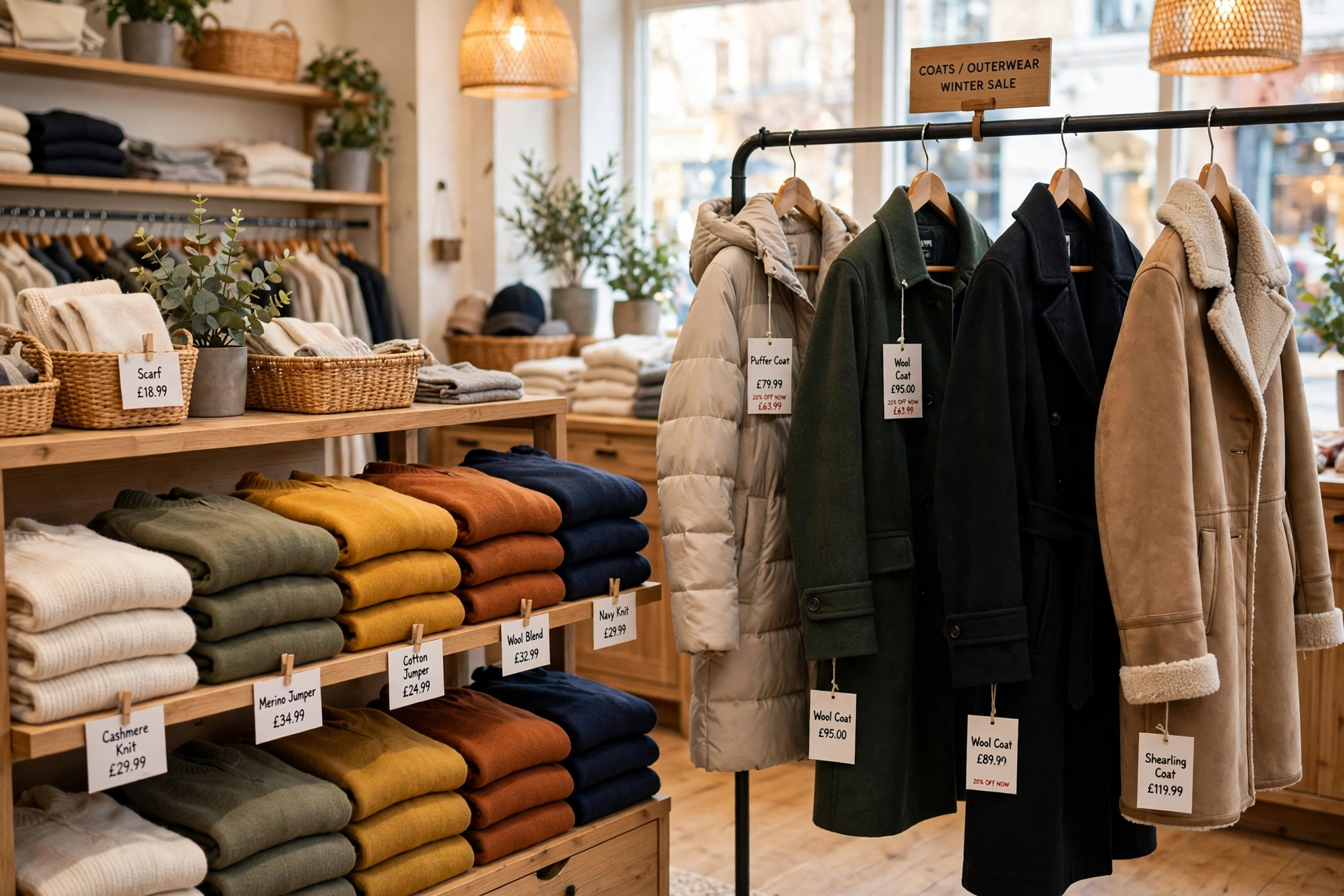
If you want to understand a clothes shop, watch the seasons, because the whole business runs on them. People buy coats when it gets cold and light dresses when it gets warm, and the shop has to be ready for each change, months before it happens. In late summer, the owner is already thinking about winter. She looks at last year’s sales, talks to her suppliers, and orders the new winter coats, jumpers and scarves, paying for them before a single cold day arrives. When autumn comes, those coats go on the rails at full price and sit in the window where everyone can see them. This is the best time for the shop: customers want a warm coat, they need it now, and they will pay the full price for the newest style.
Then winter passes. By February, the shop needs the rails for spring clothes. But some winter coats are still there, in the wrong sizes, or in a colour nobody chose. The shop cannot leave them there until next winter: they take up space, and the money spent on them is stuck on the rail. So the shop cuts the price. A coat that was eighty dollars in November becomes sixty dollars, then forty dollars, then half price. A coat sold at forty dollars is still better than a coat that never sells at all. The shop gets some of its money back, frees the rail for spring dresses, and the customer gets a bargain. The same pattern repeats in summer, and the cycle turns four times a year. Each turn is a fresh gamble, and a good owner watches her customers, remembers what sold and what did not, and orders a little more carefully each year.
Sales and Discounts: Why Prices Drop
If shops work so hard to set the right price, why do they keep cutting it? Walk down any high street in January and half the windows shout sale, half price, clearance. It looks like shops are giving money away, but there is always a reason behind the red sign. The most common reason is clearing old stock. Clothes go out of season, a new style arrives, and the shop needs the space. A coat sold at half price is still better than one that never sells at all.
The second reason is bringing people in. A big sale sign pulls people through the door, and once they are inside, they often buy more than the sale item. You go in for a discounted coat and come out with a coat, a scarf and a new jumper at full price. The sale is the invitation. The rest of the shop is where the money is made. The third reason is beating other shops: if three shops sell similar coats and one cuts its price, buyers walk to that shop first. The fourth is rewarding loyal customers: a customer who returns ten times is worth far more than one who comes once for a bargain and never returns. But not every discount is a real bargain. Sometimes a shop raises the price for a short time, then cuts it back and calls it a sale. A jacket was sixty dollars for months. The shop raises it to one hundred dollars for a week, then cuts it to sixty dollars and calls it forty percent off. You paid the normal price. A discount is only a real saving if the old price was honest and you wanted the item anyway.
The Fitting Room: The Shop’s Secret Weapon
Now we come to the part that makes a clothes shop different from every other kind of shop, and the reason small clothes shops can still survive when people can buy almost anything online. It is the fitting room. Think about buying a coat online. You see a photograph of a model wearing it, and the coat looks perfect on her. You order your size, you wait three days, and when the parcel arrives, the coat is too tight across the shoulders, the sleeves are too long, and the colour looks different in real life. You send it back and start again. That happens to millions of people, every single day.
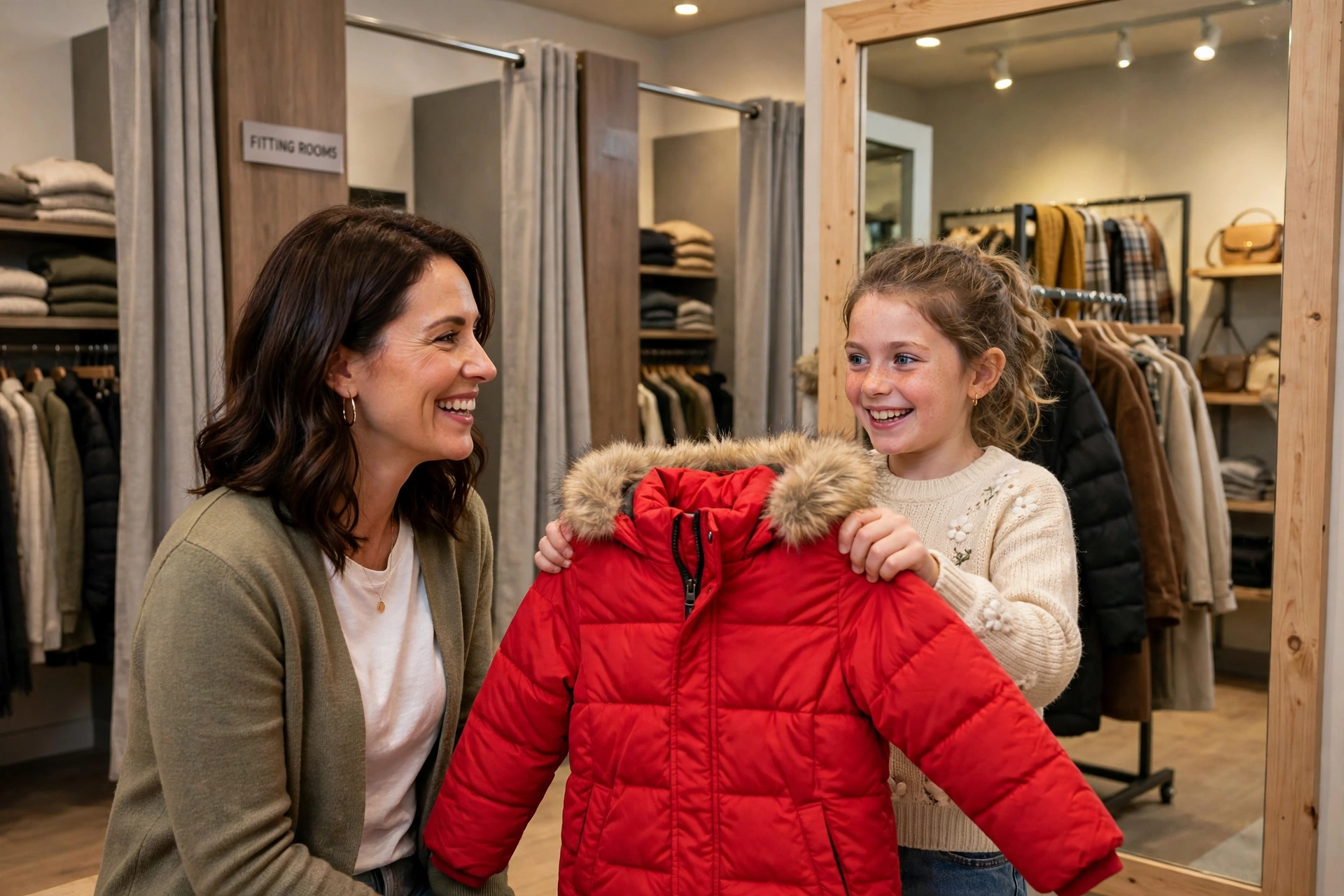
In a shop, none of that happens. You walk in, pick up the coat, feel the fabric, and walk into the fitting room: a small, private room with a mirror and good light. You try the coat on and see at once if it fits. You can try the next size up, or a different colour, all in a few minutes. You walk out knowing exactly what you are buying. That is the shop’s edge. A customer who tries something on is far more likely to buy it than one who only sees a photograph. She can feel the quality, see how it looks on her, and ask the assistant, does this suit me, and get an honest answer. That human moment is something a website cannot copy.
Fitting rooms cost the shop money, of course. They take up floor space, need cleaning and good lighting, and staff must keep them tidy. But they earn their keep many times over, because they turn browsers into buyers and cut down on returns. A coat tried on in a shop almost never comes back. A coat bought online comes back very often, and every return costs money. Trying clothes on also leads to happy accidents: you came in for a coat, tried a scarf with it, and bought both. Online, that hardly ever happens.
Location and Regular Customers
Location comes first in a clothes shop, just as it does in almost any shop. A shop near a market, a school, a busy bus stop, a train station or a shopping centre gets customers without trying: people pass by every day, and the street brings the customers to it. A shop tucked away down a quiet side road has the opposite problem. It may pay far less rent, but it has to work much harder to be found. Some quiet-street shops do very well this way: they become famous for one special thing, and people travel to find them. But that takes years of building a name. Rent and location pull in opposite directions. A prime spot costs more, but it can bring in far more sales. A cheap spot costs less, but the shop may sit half empty.
Regular customers are the backbone of a clothes shop. They come often, they buy quickly, and they bring friends. A customer who buys school clothes every September, a winter coat every November and a dress for every family wedding is worth far more than a customer who comes once and never returns. A shop with two hundred regulars has stable sales, even on a rainy week. How does a shop build regulars? First, by being steady: if the quality is good in January, it should be good in June too. Second, by being kind and fast: staff who remember a usual size, smile and serve quickly make people feel welcome. Third, by offering small extras: a loyalty card, or a call when the new season’s coats arrive in a regular customer’s size. These small acts cost little and build trust fast.
Frequently Asked Questions
How does a clothes shop make money?
A clothes shop buys clothes at a lower wholesale price and sells them at a higher retail price. The gap is called the markup, and it has to cover the rent, wages, heating, lighting, bags and all the other costs of running the shop. What is left after those costs are paid is the profit. A busy shop is not always a profitable one.
How much profit does a clothes shop make on one item?
It depends on the item. A winter coat that sells for eighty dollars might cost the shop about thirty-two dollars to buy, with another fourteen dollars for running costs and packing. That leaves about thirty-four dollars of gross profit, or about forty-three percent of the price. That is not the owner’s profit yet: rent, wages, insurance and unsold clothes still have to come out of it. Many small clothes shops keep only about 5 to 10 percent of sales as real profit.
Why are clothes cheaper in a sale?
Usually because the shop needs to clear old stock and make room for the next season. A winter coat still on the rail in February takes up space the shop needs for spring clothes, so the shop cuts the price to sell it fast. A coat sold at half price is still better than one that never sells. Sales also bring people through the door, and many buy other things at full price. A discount is only a real bargain if the old price was honest and you wanted the item anyway.
Why do clothes cost more in some shops than in others?
Because each shop pays different costs and serves different customers. A shop on a busy high street pays high rent, and that rent shows up in its prices. A shop that buys in large amounts may get a lower price per item than a small shop. A luxury shop charges more for a nicer setting, better service and a well-known name. A discount shop keeps its costs low on purpose and passes the savings on to you. Neither way is wrong.
Can a small clothes shop survive when people buy online?
Yes, but it has to offer something a website cannot. The fitting room is the biggest one: customers can try clothes on, feel the fabric and check the size before they pay. Friendly advice, a shop that remembers your size, quick alterations and no waiting days for a parcel all help too. Small shops that survive focus on good service, the right stock for their own street, and regular customers who trust them.
What is the biggest cost for a clothes shop?
Stock is usually the biggest cost, because the shop has to buy its clothes months before it sells them, and its money is tied up in rails of clothes until they are sold. Rent is often next, followed by staff wages. Together, stock, rent and wages take most of what a shop earns. Heating, lighting, bags, card fees, insurance and advertising take the rest. That is why a shop can look busy and still make very little profit.
More from Zorium Daily
- How Does a Sweet Shop Make Money? Explained Simply
- How Does a Bakery Make Money?
- How Does a Coffee Shop Make Money?
- How Do Shops Decide Prices?
A clothes shop is not a magic money box, and it is not a trick. It is a simple idea, done with care, season after season: buy clothes at a price that leaves room, sell them at a price people feel is fair, and use the gap to pay the rent, pay the staff, and keep the shop warm and bright. The red coat in the window is the start of that story, not the end of it. Behind it are months of ordering and a shopkeeper who guessed right about what her street would want this winter. Next time you try on a coat and it fits just right, you will know a little more about what you are really paying for — not just the fabric and the buttons, but the warm room, the honest mirror, and the person who helped you find it.