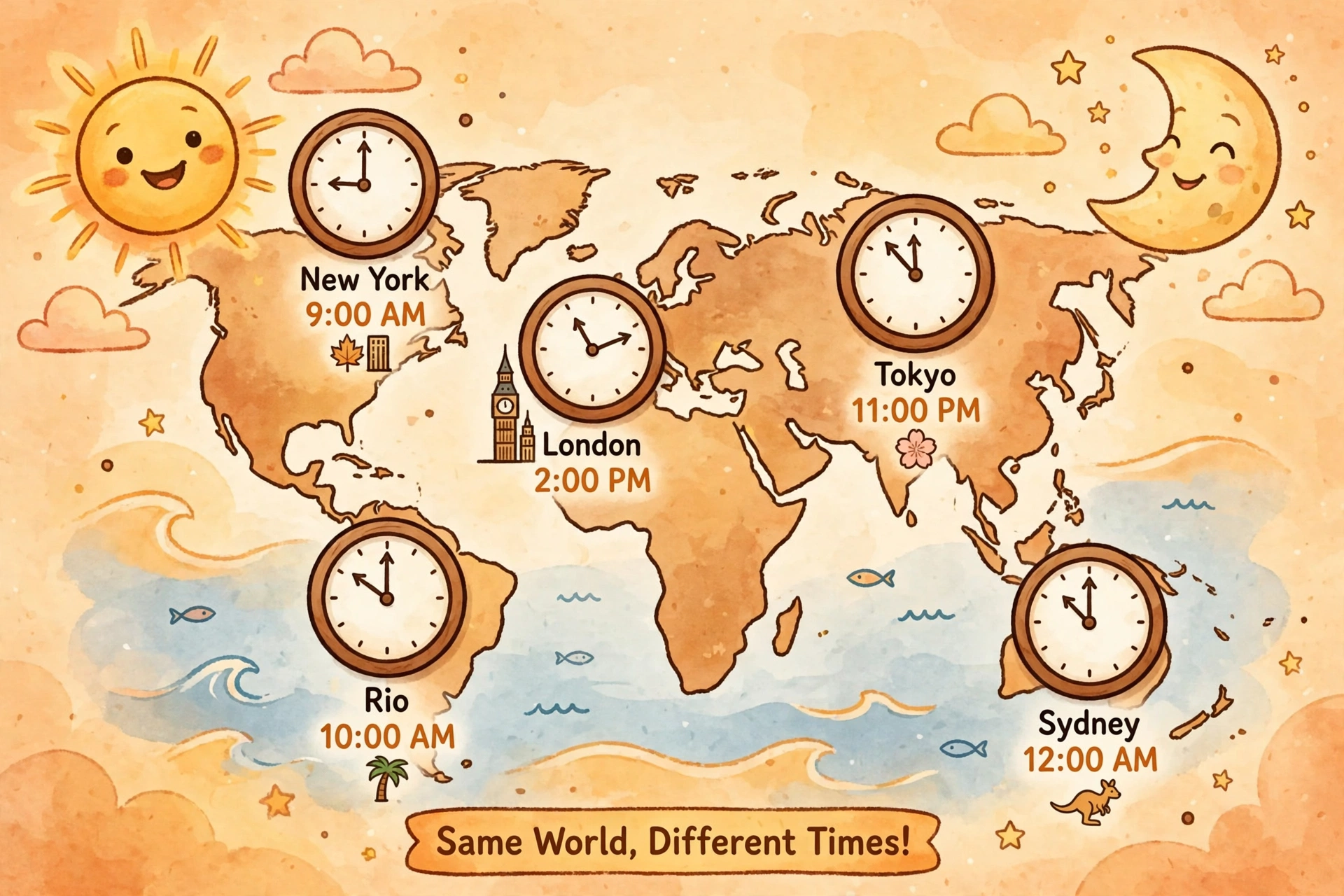
Why Do We Have Time Zones?
SUMMARY OF THIS ARTICLE
- Time zones are areas of the world that share the same clock time.
- Long ago, every town set its own time by the sun.
- Fast trains made this a big problem, because train times did not match.
- The world agreed to divide the Earth into time zones, starting from Greenwich in London.
- Time zones help trains, planes, phones, and the whole world work together.
A Simple Question With A Big Story
Have you ever called a friend in another country and found out it was night there, even though it was day where you live? Or have you watched a live game on TV and heard that it started at a very strange hour in another part of the world? This happens because of time zones.
A time zone is a part of the world that uses the same time on the clock. When it is noon in one time zone, it can be morning in another time zone and night in a third one. This is not a mistake. It is how the world is made to work.
But why do we have time zones at all? Why can we not all use the same time? The answer is a story about the sun, the Earth, trains, ships, and people who wanted life to be less confusing. It is a story from history, and it is much more recent than most people think. Only about 150 years ago, there were no time zones at all. Every town had its own time. That sounds free and simple. In real life, it was a mess.
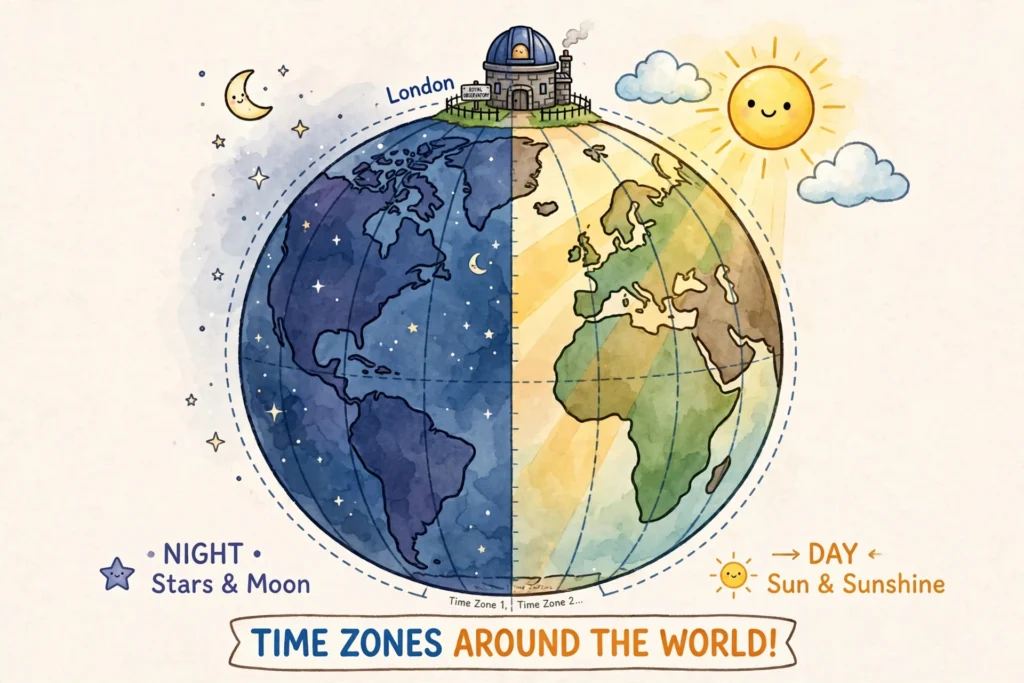
To understand why we changed, we first need to understand the sun and the Earth. The Earth is round, like a ball. It turns slowly on its own line, which we call its axis. It takes about 24 hours to turn all the way around once. As it turns, different parts of the Earth face the sun at different times. When your part of the Earth faces the sun, you have day. When your part turns away from the sun, you have night.
This is why you cannot have noon everywhere at the same time. Noon is the middle of the day, when the sun is high in the sky. But the sun cannot be high in the sky everywhere at once. When the sun is high over your town, it is low over a town far to the east, and it has already set in a town far to the west. The Earth is too big, and the sun is too far away, for one time to fit all places.
Long ago, people did not worry about this. They lived, worked, and slept close to home. They did not need to know the exact time in a town far away. They just looked at the sun. That was enough. But as the world changed, looking at the sun was no longer enough. People started to travel fast. They started to send messages fast. They started to do business with people far away. Then the old way of telling time broke down. A new way was needed. That new way became time zones.
How People Told Time Long Ago
For most of human history, people told time by the sky. The sun rose in the morning. It climbed high at noon. It set in the evening. The stars came out at night. The moon changed shape over a month. These were the first clocks, and they were free for all to see.
People made simple tools to help them. One of the oldest tools was the sundial. A sundial is a flat plate with a stick in the middle. The sun makes a shadow from the stick. As the sun moves, the shadow moves. Marks on the plate show the hour. It is simple, and it works well on a sunny day. But it does not work at night, and it does not work well on a cloudy day.
Later, people made water clocks and sand clocks. Water dripped slowly from one pot to another. Sand fell slowly from one glass bulb to another. These tools could work at night and indoors. But they were not very exact. They were good enough for daily life in a small town, but not good enough for a modern world.
People also divided the day into parts. Many cultures divided the day into 24 hours. They divided the week into seven days. If you want to know more about that, you can read about why we have seven days in a week. The idea of hours, days, and weeks is very old. But the idea that all towns should show the same hour at the same moment is very new.
In old times, each town set its clocks by its own sun. When the sun was highest in the sky over a town, that town called it noon. This was called local time, or sun time. It made sense. It matched what people saw with their own eyes. If you lived in one town, your noon was the true noon for your town.
The problem was that the next town, just a short walk away, could have a slightly different noon. The sun reaches its highest point a few minutes earlier in a town to the east, and a few minutes later in a town to the west. The difference was small. If you walked from town to town, you would not care much. But if you tried to make a plan that covered many towns, the small differences added up to a big mess.
The Trains That Broke Local Time
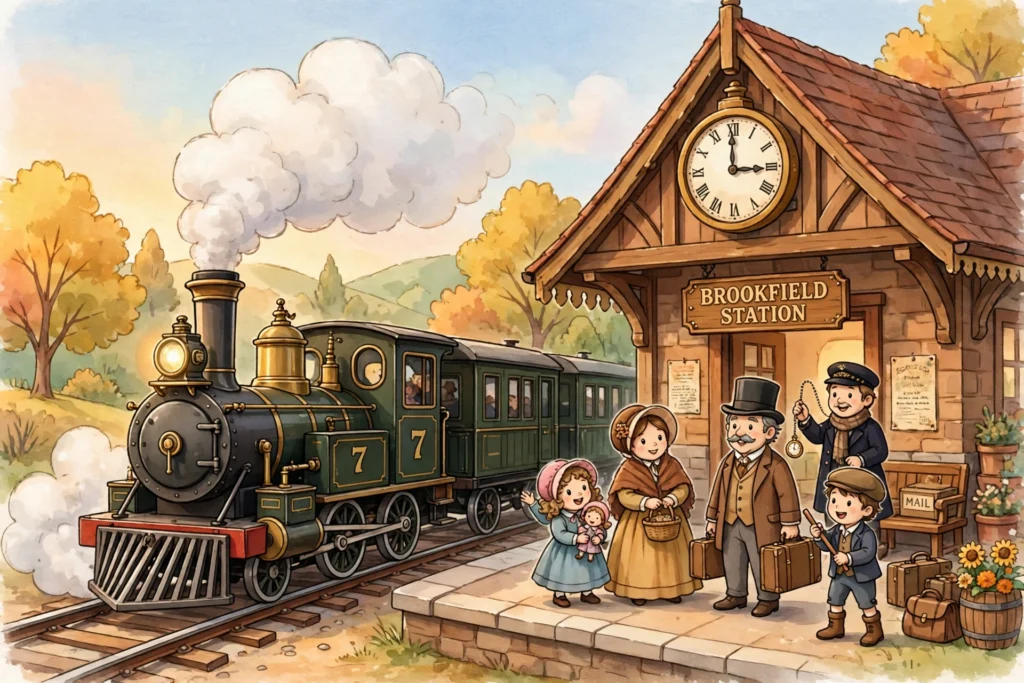
In the 1800s, something new changed the world: the railway. Trains could move people and goods much faster than a horse or a cart. A train could cross many towns in a single day. This was wonderful. It was also a huge problem for time.
Think about a train timetable. A timetable is a list that says when a train leaves and when it arrives. To make a timetable, you need one clear time for all the towns on the route. But if every town has its own time, what time do you write in the timetable? The time of the town where the train starts? The time of the town where it ends? Or the time of each town along the way?
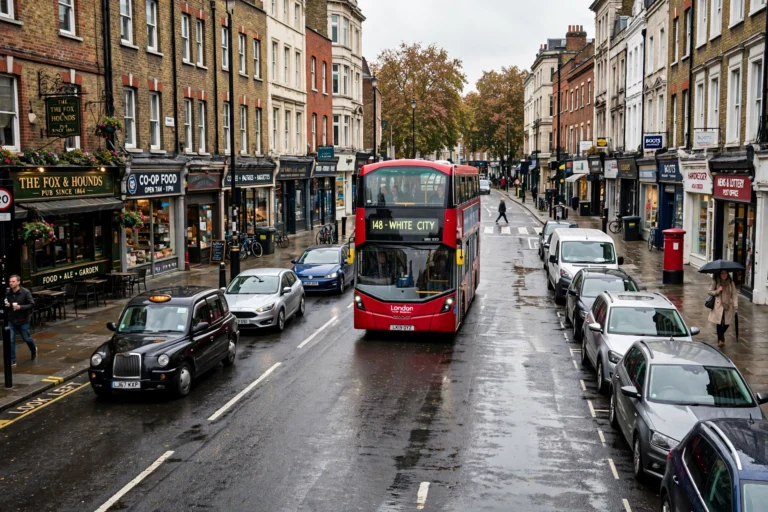
In Britain, this problem grew very fast. By the middle of the 1800s, Britain had many railway lines. Each town still had its own local time. A train that left London at 10 o’clock might arrive in a western town at what that town called 9:50, even though the train had been moving forward for an hour. That sounds silly, but it really happened. The clocks did not agree, so the times did not make sense.
So the railway companies in Britain made a big choice. They decided to use one time for all their trains, no matter which town the train was in. They chose the time of London, and more exactly the time at the Royal Observatory in Greenwich, a part of London. This time became known as railway time. Later, it became known as Greenwich Mean Time, or GMT.
Other countries watched and learned. In the United States, the problem was even bigger. The United States is a very wide country. Before time zones, it had dozens of different local times. Some towns used the time of a nearby big city. Some used sun time. Railway companies each used their own time. At one point, American railways used more than 50 different times. Imagine trying to plan a trip across the country with 50 clocks. It was a nightmare.
On November 18, 1883, American railway companies agreed to divide the country into four main time zones: Eastern, Central, Mountain, and Pacific. This day became known as the Day of Two Noons in some places, because clocks were moved back to match the new zone time, and noon seemed to come twice. People were confused at first, but the new system worked much better. In 1918, the United States government made these time zones law.
The railway story teaches us a simple lesson. Time zones were not made because scientists loved neat maps. They were made because real life needed them. Trains needed them. Workers needed them. People who wanted to meet on time needed them. The world was getting faster and more connected, and local sun time could not keep up.
Greenwich And The World Map Of Time
Once Britain and the United States had standard time, the rest of the world needed a shared plan. Ships also needed it. A ship at sea needs to know where it is. Sailors used the sun and stars, and they used clocks, to find their place on the map. But if every country used a different starting time, sailors could get lost. The world needed one starting line for time, just as it needs one starting line for maps.
In 1884, leaders and scientists from 25 countries met in Washington, D.C., in the United States. This meeting is called the International Meridian Conference. A meridian is an imaginary line that runs from the North Pole to the South Pole. The meeting had to choose one meridian as the prime meridian, the zero line from which all other times and longitudes would be counted.
They chose Greenwich. The prime meridian runs through the Royal Observatory in Greenwich, London. That is why we still say Greenwich Mean Time, or GMT. The line at Greenwich became 0 degrees longitude. Places to the east of Greenwich are east longitude. Places to the west are west longitude.
From this choice, the world map of time zones grew. The Earth was divided into 24 main time zones, one for each hour of the day. This makes sense, because the Earth turns 360 degrees in about 24 hours. If you divide 360 by 24, you get 15. So each time zone is about 15 degrees wide. When you move one time zone to the east, the clock goes forward by one hour. When you move one time zone to the west, the clock goes back by one hour.
The place that is 12 hours ahead of Greenwich is on the other side of the Earth, in the Pacific Ocean. There, a line called the International Date Line runs roughly from north to south. When you cross this line, the date changes. If you fly west across the line, you jump forward a whole day. If you fly east across it, you go back a whole day. This sounds like magic, but it is just the result of a round Earth and a 24-hour day. You cannot go all the way around the Earth and keep the same date unless you change the date somewhere. The Date Line is where that change happens.
Today, most of the world uses a system called Coordinated Universal Time, or UTC. UTC is very close to GMT, but it is based on very exact atomic clocks, not just the sun over Greenwich. When people say a place is UTC+6, they mean its clocks are six hours ahead of UTC. Dhaka, in Bangladesh, is UTC+6. That means when it is noon in Greenwich, it is 6 in the evening in Dhaka. London in winter is UTC+0. New York in winter is UTC-5, which means five hours behind Greenwich. These numbers help people all over the world compare times fast, without confusion.
Daylight Saving: Moving The Clocks For Summer
Time zones solve one problem: how to share time across a wide world. But people soon found another problem. In summer, the days are long. The sun rises early and sets late. In winter, the days are short. The sun rises late and sets early. People wanted to use daylight well, so they would not waste light in the early morning while they slept, and then need lamps in the evening while they were still awake.
The idea of daylight saving time is simple. In spring, you move the clocks forward by one hour. This is often called “spring forward.” In autumn, you move the clocks back by one hour. This is often called “fall back.” When you move the clocks forward in spring, you get one more hour of daylight in the evening. You lose one hour of daylight in the morning, but in summer the sun rises early anyway, so most people do not mind.
Who first thought of this? Many people give credit to Benjamin Franklin, a famous American thinker, who wrote in a funny letter in 1784 that people in Paris wasted daylight by sleeping late. But he was joking, and he did not make a real plan. Later, a man from New Zealand named George Hudson, and a British builder named William Willett, both pushed the idea in a serious way. Willett loved to ride his horse early in the morning and saw that many people were still asleep while the sun was already up. He wanted to move the clocks so people would use the light better.
The first country to use daylight saving time across the whole country was Germany, in 1916, during World War I. The reason was to save fuel. If people had more daylight in the evening, they would use fewer lamps and less coal. Britain followed soon after. The United States started it in 1918. After the war, many countries stopped it, then started it again in later wars and energy crises. Today, many countries in Europe and North America use it, but many countries near the equator do not. Near the equator, day length does not change much through the year, so moving the clocks does not help much.
Daylight saving time is not the same everywhere. Different countries start and end it on different dates. This can be confusing for travellers and businesses. Some people love it because summer evenings feel longer. Some people hate it because changing the clocks can make them tired for a few days. Some places have stopped using it altogether. For example, many parts of Asia, including Bangladesh, do not move their clocks in summer. They keep the same time all year.
It is important not to mix up daylight saving time and time zones. Time zones are about where you are on the Earth. Daylight saving time is about what season it is. A time zone tells you the base time for your area. Daylight saving time is a one-hour shift added on top of that base time for part of the year. If you travel in summer, you need to know both: the time zone and whether daylight saving time is in use.
Time Zones In Daily Life Today
Today, time zones are part of daily life, even if we do not think about them much. Your phone does most of the work for you. When you travel to a new country, your phone often changes its time by itself. When you set a video call with a friend abroad, your calendar can show both times. This feels easy now, but it took more than 100 years of work to make it easy.
Time zones matter for many jobs. Pilots and air traffic controllers must know the time in many zones at once. A flight that leaves Dhaka at night may arrive in London in the morning of the same day, or even the next day, because of the time difference. The flight time is only a few hours, but the clock time jumps more, or less, than the flight time. This is why flight tickets show both local times: the time at departure and the time at arrival.
Doctors, scientists, and news teams also use time zones. When a big event happens, news teams around the world need to report it at the right local time. When scientists work together across countries, they often pick UTC as a shared time, so no one is confused. When the stock market opens in one country, traders in another country need to know if they are awake or asleep. Time zones turn a round world into a shared schedule.
For normal people, time zones affect fun things too. If you love football, you may need to wake up early or stay up late to watch a match from another country. If you play games online with friends abroad, you need to find a time that works for all of you. If you have family in another country, you learn their time difference by heart. You learn not to call at 3 in the morning their time, even if it is a good time for you.
Time zones also affect our bodies. When you fly across many time zones fast, your body clock gets confused. Your body thinks it is night, but the local clocks say it is day. This is called jet lag. You may feel tired, hungry at strange times, or wide awake at night. It takes a few days for your body to catch up. Jet lag is proof that time zones are real in our bodies, not just on paper. Our bodies follow the sun and our daily habits, and a fast flight can break that pattern.
There are also some strange and fun facts about time zones. China is a very wide country, but it uses only one time zone for the whole country. That means in western China, the sun may rise very late by the clock, but people still use the same time as Beijing in the east. Spain is in the same time zone as Germany, even though Spain is further west. This is a choice made by history and politics, not just by geography. France has the most time zones of any country, because it has lands all over the world, including islands in the Pacific and the Caribbean. Some small places use half-hour or even 45-minute differences, like India at UTC+5:30 and Nepal at UTC+5:45. These odd times remind us that time zones are made by people, and people sometimes make unusual choices.
So why do we still keep time zones, now that phones and computers can do maths for us? We could all use UTC and just learn that “morning” means different clock times in different places. Some people have suggested this. But most people like time zones because they match daily life. We like noon to mean midday, when the sun is high. We like midnight to mean the middle of the night, when most people sleep. If the whole world used one time, noon in Dhaka would be morning in London and night in New York, but the clock would say the same number. That would feel strange. Time zones keep the clock close to the sun in each place, while still letting the world share a clear system.
In short, time zones are a balance. They balance nature and human life. Nature gives us a round, turning Earth with day and night in different places at different times. Human life needs shared plans, safe trains, clear flights, and easy calls. Time zones give us both: a clock that fits the local sun, and a map that fits the whole world.
Frequently Asked Questions
Why can we not all use the same time?
We could, but it would feel strange. If the whole world used one time, the clock might say noon when it is dark outside in your town. People like noon to match midday and midnight to match the middle of the night. Time zones keep the clock close to the sun where you live, while still giving the world a shared system.
Who invented time zones?
No single person invented them. Railway workers in Britain started using one railway time in the 1800s. American railways then made four zones in 1883. In 1884, countries at a meeting in Washington chose Greenwich as the starting line. Many people and countries built the system step by step.
What is Greenwich Mean Time?
Greenwich Mean Time, or GMT, is the time at the Royal Observatory in Greenwich, London. It was the first world standard time. Today, most experts use Coordinated Universal Time, or UTC, which is very close to GMT but is based on exact atomic clocks. For daily life, GMT and UTC feel the same.
Why does the time change when I travel?
Because the Earth turns, the sun is high in different places at different times. When you travel east, you move toward the sun, so your clock goes forward. When you travel west, you move away from the sun, so your clock goes back. Your phone often changes the time for you, but the reason is the turning Earth.
What is daylight saving time?
Daylight saving time is a one-hour clock shift in spring and autumn. In spring, clocks go forward by one hour, so evenings have more daylight. In autumn, clocks go back by one hour. It is not the same as a time zone. It is a seasonal change added on top of your time zone. Many countries near the equator do not use it.
Why is there an International Date Line?
The Earth is round. If you travel all the way around it, you need a place where the date changes, or you would come back with the wrong date. The International Date Line, in the Pacific Ocean, is that place. Cross it west, and you gain a day. Cross it east, and you lose a day.
More from Zorium Daily
If you liked this story about time and history, you may also like our story about why we have seven days in a week, which explains how our week took its shape. You can also read how ancient people measured an hour without modern clocks, using the sun, shadows, and water. For more stories like this one, visit the History section on Zorium Daily, where new simple stories about the past are shared every day.