Why Do We Have Weekends?
By Zorium Daily News Desk
It is Friday night. You put your school bag down and close your work laptop. Two free days are coming. No alarm clock. No rush. Time to sleep late, see friends, play games, or just do nothing at all.
Most of us love the weekend. But have you ever asked where it came from? Who decided we should work five days and rest for two? Was it always like this?
The weekend is not old at all. It is younger than the light bulb. For most of human history, there was no weekend. People worked six days a week, and sometimes seven. The two-day weekend we enjoy today is only about one hundred years old. It was built step by step, by faith, by factory workers, by trade unions, and by one famous car maker.
We will tell that story in simple words, from holy rest days to Henry Ford, and from the first half-holidays to the four-day week.

SUMMARY OF THIS ARTICLE
- For most of history there was no weekend. Most people worked six days a week.
- The idea of a weekly rest day comes from old faiths. Jewish people kept the Sabbath on Saturday, and Christians later kept Sunday as a day of rest.
- In the 1800s, factory workers in Britain won a half-day off on Saturday. This was the first step toward the modern weekend.
- In 1926, Henry Ford gave his car workers both Saturday and Sunday off, with the same pay. Other firms soon followed his lead.
- By the middle of the 1900s, the two-day weekend had spread across much of the world, but not every country keeps Saturday and Sunday.
Life Before Weekends: The Seven-Day Work Week
For most of human history, the weekend did not exist. People worked almost every day. If you lived 200 years ago, your week would look very different.
Long ago, most people were farmers. They woke at dawn and worked in the fields until dark, six days a week. On the seventh day, many rested for prayer. But farm work never really stopped: animals still needed food and water, and cows still needed to be milked.
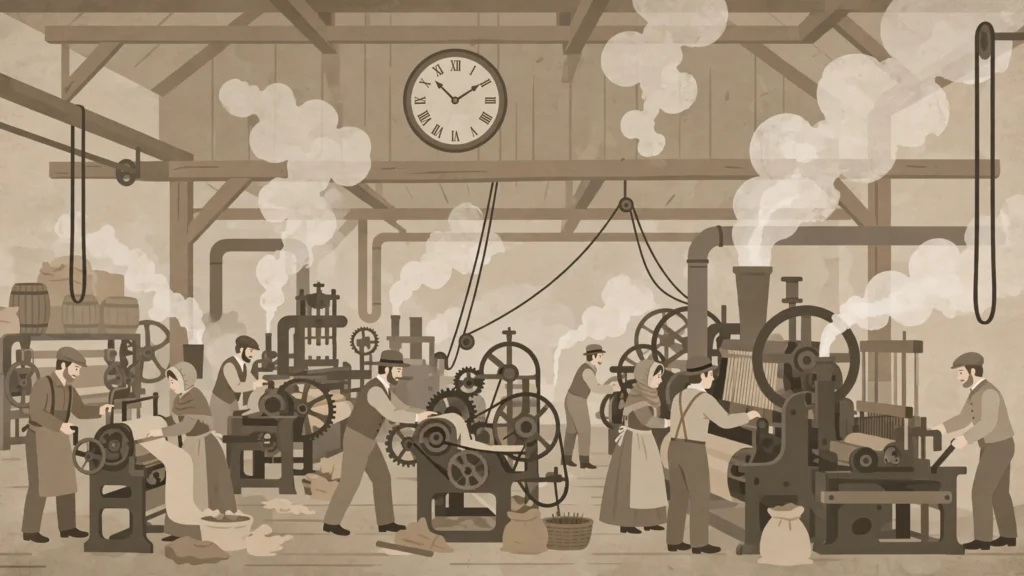
Then came the factories. In the 1700s and 1800s, new machines changed the world. This time is called the Industrial Revolution. People moved from small villages to big towns to work in factories. They made cloth, steel, pots, and tools. The factories were loud, hot, and dangerous. The work was hard, and the hours were long.
A factory worker in the 1800s often worked 12 hours a day, six days a week. That is 72 hours a week. Some, including children, worked even longer. They started before sunrise and finished after dark. They had only one day off: Sunday. And Sunday was not really free. It was a day for church, for washing clothes, and for rest, because the body was so tired.
People knew this was not fair. They were tired, their health was poor, and families had little time together. Slowly, workers began to ask a new question. Why must we work six long days? Why can we not have more time to rest and live? That question would change the world.
But where did the idea of a rest day come from? It started in faith, thousands of years ago.
Religious Rest Days Through History
The idea that people should stop work one day a week is very old. It comes from religion. Long before factories, people of faith kept a holy day of rest each week.
The oldest story comes from the Jewish people. In their holy book, the Torah, God made the world in six days and rested on the seventh day. From this story came a rule: work for six days, and rest on the seventh. That seventh day is called the Sabbath, or Shabbat. It starts on Friday evening and ends on Saturday evening. For thousands of years, Jewish families have kept it for prayer, family meals, and rest.
Over time, Christians began to mark Sunday as their special day. Sunday was the day they believed Jesus rose from the dead. So they met for prayer on Sunday, and Sunday slowly became the Christian day of worship.
In the year 321 CE, the Roman ruler Constantine made a law. He said Sunday should be a day of rest in towns across the Roman Empire. Shops and courts should close, and people should not work. The law did not invent the seven-day week, which was already in use. But it gave Sunday rest the power of Roman law. After that, Sunday rest spread across Europe, and it stayed for more than 1,500 years.
Muslims have their own weekly holy day too. Friday is the main day of prayer, when many Muslims gather at the mosque for the midday prayer, called Jumu’ah. In some Muslim lands, Friday became a day of rest.
This one rest day was precious, but it was not enough. As factories grew, one day could not heal a tired body. Workers wanted more, and in the 1800s, they began to win it, one small step at a time.
The First Saturday Half-Holidays and Factory Workers
The first big step toward the weekend came in Britain, in the 1800s. It was called the Saturday half-holiday. It sounds small today, but at the time it was a huge change.
Here is the problem workers faced. They worked all day Monday to Saturday and were paid on Saturday evening. Then they had Sunday to rest, but they were so tired that much of Sunday was spent in bed. Many workers took Monday off too, without asking. They called it “Saint Monday.” It was not a real saint’s day. It was a joke name for a day off that workers took for themselves. Factory owners hated it, because they lost a whole day of work.
Workers and reformers had a better idea. What if factories closed early on Saturday? Workers could finish at lunch time, or at 2 in the afternoon. Then they would have Saturday afternoon free, plus all of Sunday, to shop, play sport, visit family, and rest. And they would come back on Monday fresh and ready, instead of taking Monday off.
The fight took many years. Campaigns for a shorter week began in the 1840s, and slowly, one factory after another agreed. By the second half of the 1800s, many British factories closed at noon or early afternoon on Saturday. Saturday afternoon became a time for football, markets, and family walks.
The word “weekend” itself first appeared in print in 1879, in a British magazine. At first it meant only Saturday afternoon to Sunday night, because workers still worked on Saturday morning. But the idea had been born: the end of the week could belong to the worker, not just to the boss.
Trade unions played a big part in this fight. A trade union is a group of workers who join together to ask for better pay and hours. One worker alone could not change a factory, but hundreds together could.
By 1900, the Saturday half-day was common in Britain and Europe. But the full two-day weekend had still not arrived. That final step came from a surprising place: the United States, and a car maker named Henry Ford.
Henry Ford and the 5-Day Week
Henry Ford is one of the most famous names in the story of the weekend. He did not invent the idea of rest, but he did more than anyone else to make the five-day week normal.
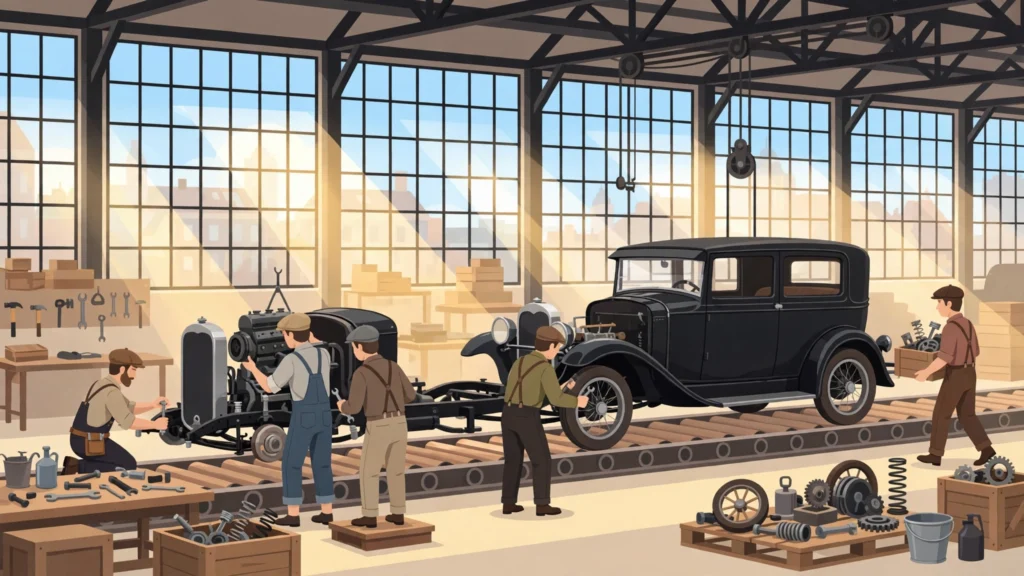
Ford ran the Ford Motor Company in the United States, and his factories made cars, including the famous Model T. In 1914, he shocked the business world by paying his workers five dollars a day, double the normal pay. He wanted loyal, healthy workers who could buy the cars they made.
Then, in 1926, Ford made an even bigger move. His factories would close on both Saturday and Sunday. His workers would work five days a week, 40 hours in total, and keep the same pay they had earned for six days. This was the five-day week.
Why did Ford do it? First, he believed rested workers did better work. Tired workers made mistakes. Rested workers were faster and safer. Second, he wanted his workers to have time to use their cars. With a weekend, they would drive more, travel more, and spend more money. That was good for Ford, and good for other firms too.
Ford was not the very first to try this. In 1908, a cotton mill in New England had already given its workers both days off. It had Jewish workers who kept the Sabbath on Saturday, and Christian workers who wanted Sunday off for church. The owner solved the problem by closing on both days.
But Ford was the biggest name, so the whole world noticed. Other large firms soon followed, and in 1929 a trade union called the Amalgamated Clothing Workers won a five-day week for its members. Step by step, the five-day week became normal in the United States.
The final step came from the law. In 1938, the United States passed the Fair Labor Standards Act, which later fixed the normal work week at 40 hours. Workers who worked more had to be paid extra. The law did not use the word “weekend,” but it made the five-day week the standard for most American workers.
By the 1940s, the two-day weekend was normal in the United States and much of Europe. After about 100 years of slow change, workers had won two whole days off every week.
How the Two-Day Weekend Spread Around the World
Once the five-day week worked in the United States and Britain, it began to spread. But different countries took it up at different times, and for different reasons.
In Europe, the weekend spread through the 1930s, 1940s, and 1950s. Trade unions in France, Germany, and other countries asked for the same deal American workers had won. After the Second World War, the five-day week came with the new factories and offices. By the 1960s, it was normal across most of Western Europe.
In Japan, the five-day week came later. For many years, Japanese workers had only one day off a week, or one Saturday a month. It was not until the 1980s and 1990s that the full two-day weekend became common there.
In many other countries, the weekend spread with trade, schools, and global firms. When big firms opened offices in a new country, they often brought the five-day week with them. When schools took Saturday and Sunday off, families followed. When the world began to share the same calendar, with the same seven days in a week, the same 12 months in a year, and the same time zones, the weekend went with it.
Today, the five-day week is the most common pattern in the world. But some countries have a different weekend, and some workers still work six days. Some people now ask: if we won two days off, could we win three?
Why Saturday and Sunday?
Why did the weekend become Saturday and Sunday, and not Friday and Saturday, or Sunday and Monday? The answer is a mix of faith, history, and chance.
Sunday came first. Christians kept Sunday as a day of rest and prayer. In 321 CE, the Roman ruler Constantine made Sunday rest a law. For more than 1,500 years, Sunday was the one day off in most of Europe. When the weekend grew, Sunday was already there, fixed in law, church life, and family habits. No one wanted to give it up.
Saturday came second, for two reasons. First, Saturday was the day before Sunday. If workers stopped at noon on Saturday, they had a long stretch of free time: Saturday afternoon plus all of Sunday. It was the easiest way to add a second rest day to the one people already had.
Second, Saturday was the Jewish Sabbath, so Jewish workers could not work on Saturday. Where Jewish and Christian workers lived side by side, the fair answer was to close on both days. The New England cotton mill in 1908 is the best-known example. The two-day weekend was born from that simple act of fairness.
The names tell the same story. Saturday is named after Saturn, the Roman god of farming and time, and Sunday after the Sun. They come from the seven bright lights people watched long ago: the Sun, the Moon, Mars, Mercury, Jupiter, Venus, and Saturn.
So Saturday and Sunday were not chosen by a single vote or law. They grew out of old faith, old names, and the needs of workers and bosses. Once schools, churches, and shops planned around them, the pattern locked itself in.
Weekends in Different Countries and Cultures
Not everyone has Saturday and Sunday off. The weekend looks different in different parts of the world, and the day of rest often follows the faith and history of each land.
In most of Europe, North America, and Australia, the weekend is Saturday and Sunday. Offices and schools are closed, and Sunday is often quiet, with many shops closed or open for short hours.
In many Muslim countries, the weekend is different. Friday is the holy day of prayer, so Friday is often part of the weekend. For many years, countries such as Saudi Arabia and the United Arab Emirates had a Thursday-Friday weekend. In recent years, several have moved to Friday-Saturday, so they share Saturday with the rest of the world for business. This shows how trade shapes the weekend.
In Israel, the weekend is Friday and Saturday, because Saturday is the Jewish Sabbath. Many shops and offices close from Friday evening to Saturday evening, and Sunday is a normal work day. This surprises many visitors, but it makes sense when you know the faith of the land.
In some countries, the weekend is only one day. In parts of Asia and Africa, many workers still work six days a week. The two-day weekend is common in big cities and big firms, but it is not yet for everyone.
In many countries, when a public holiday lands on a Saturday or Sunday, workers get another day off, often on Monday. And big festivals have their own rules. You can read about how 1 January became New Year’s Day in most of the world.
The weekend is not the same everywhere. It bends to fit faith, trade, and local life. But the idea behind it is the same in every land: people need regular time away from work.
What Weekends Do for Health and Family
Why do weekends matter so much? Why do we feel so happy on Friday night, and so sad on Sunday night?
First, weekends help our health. Long hours without rest can cause stress, bad sleep, and poor health. Stress is the feeling of pressure when life asks too much of us. A weekend gives the body time to heal. We sleep longer. We eat better. We walk, play, and breathe fresh air. Studies have found that people who take regular time off feel less stressed and have fewer health problems. Rest is not laziness. Rest is part of health.
Second, weekends help our minds. When we work all the time, our minds get tired too. We find it hard to think clearly, and we make more mistakes. A break helps the mind reset. After a weekend, many people come back with new ideas and more energy. Play helps the brain learn and grow, for children and adults too.
Third, weekends help families. During the week, parents work and children go to school, and the time together is short. On the weekend, families can talk, cook together, visit grandparents, and play. Children need to know their parents are there, not just busy. Strong family time helps children feel safe and loved.
Fourth, weekends help friendships and communities. Sport teams play on Saturdays. Churches, mosques, and temples meet on weekends. Neighbours meet at markets and parks. All of these need shared free time. Without a weekend, they would be hard to plan.
Fifth, weekends help the economy too. When people have free time, they spend money on fun. They go to cinemas, restaurants, and shops. They travel and buy tickets for games and shows. Henry Ford saw this clearly: workers with free time become customers. Hotels, cinemas, and sports clubs all depend on the weekend.
So the weekend is not just a nice extra. It is good for our bodies, our minds, our families, and our towns.
The Future of the Weekend: The Four-Day Week
The weekend was won about 100 years ago. Now some people ask: could we win even more? The idea is called the four-day week: working four days instead of five, with the same pay, so Friday, Saturday, and Sunday are all free. People have talked about it for years, but it has now become a serious test in many countries.
In 2022, Britain ran a large test. More than 60 firms tried a four-day week for six months, with the same pay. Most firms said work did not fall. Workers felt less stressed, slept better, and had more time for family. Many firms kept the four-day week after the test ended.
Other countries have tried it too. Iceland ran a big test from 2015 to 2019, and Spain, Japan, and New Zealand have run smaller tests. Some firms now offer a four-day week all the time.
Supporters give three reasons. First, machines and computers now do much of the work people used to do, so we can make more in less time. Second, rested workers do better work, just as Henry Ford found 100 years ago. Third, people want more time for life: for children, for health, for learning, and for rest.
But not everyone agrees. Some bosses worry about the cost. Jobs such as hospitals, shops, and transport need people every day, so a four-day week would mean hiring more staff. Some workers worry they would have to do five days of work in four days, which would be more stressful, not less.
Historians believe the weekend will keep changing. The one-day rest became a day and a half, then two days. The two days may one day become three. Or the future may bring more flexible hours and more work from home.
One thing is clear. The weekend was not given to us. It was won by people who asked for more time to live. Whatever the future holds, the same question will stay: how much of our life should belong to work, and how much to us?
Frequently Asked Questions
Who invented the weekend?
No one person invented it. The weekly rest day came from old faiths. Factory workers and trade unions in Britain won the Saturday half-holiday in the 1800s. A cotton mill in New England gave workers both days off in 1908. Henry Ford made the five-day week famous in 1926, and the law in the United States fixed the 40-hour week in 1938 and 1940. The weekend was made by many people, over a long time.
Why do we have Saturday and Sunday off, and not other days?
Sunday was already the Christian day of rest, fixed by Roman law in 321 CE. Saturday was added because it is the day before Sunday and the Jewish Sabbath. Where factories had both Jewish and Christian workers, the fair answer was to close on both days. Once schools and shops planned around them, the pattern stayed.
When did the word “weekend” first appear?
It first appeared in print in 1879. At that time it meant Saturday afternoon to Sunday night, because many workers still worked on Saturday morning. The full two-day weekend came later, in the early 1900s.
Did Henry Ford invent the five-day week?
No, but he made it famous. A cotton mill in New England had already tried a five-day week in 1908. Ford took up the idea in 1926 and gave his car workers both days off with the same pay. Because Ford was so big and famous, other firms followed him.
Do all countries have the weekend on Saturday and Sunday?
No. Most of Europe, North America, and Australia use Saturday and Sunday. Many Muslim countries use Friday and Saturday, because Friday is the holy day of prayer. Israel also uses Friday and Saturday, because Saturday is the Jewish Sabbath. In some countries, many workers still work six days a week. The weekend is common, but it is not the same everywhere.
Will we have a three-day weekend in the future?
Maybe. Many firms and countries are now testing a four-day week, which would give workers three days off. Early tests in Britain, Iceland, and other countries have shown good results: workers feel happier and less stressed, and work does not fall. But not all jobs can do it easily, and some bosses worry about cost. No one can say for sure when, or if, a three-day weekend will become normal.
More from Zorium Daily
If you liked this story, you may like these too. Read more about seven days — Why do we have seven days in a week. Read more about 12 months — Why do we have 12 months in a year. Read more about time zones — Why do we have time zones. Read more about New Year’s Day — Why do we celebrate New Year’s Day on 1 January. You can also explore more stories in History.