Why Do Leaves Change Colour in Autumn?
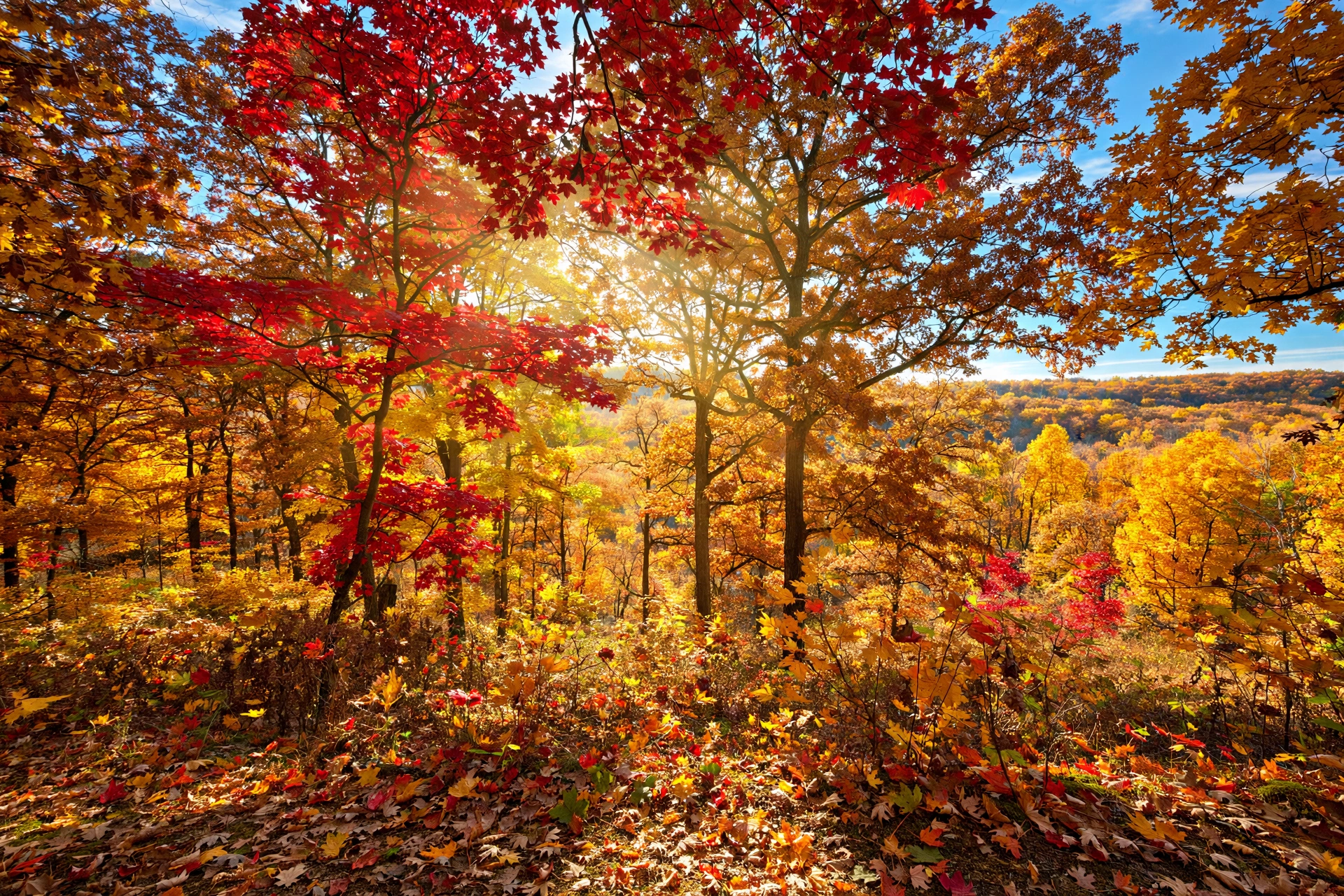
Every autumn, something quiet and wonderful happens. Green trees turn gold. Hills turn red and orange. Parks fill with leaves that look like they were painted by hand. You can walk down one street in summer and see only green. You can walk down the same street in October and see red, yellow, orange, purple, and brown, all on the same tree.
Why does this happen? Do leaves change colour by chance? Do they get cold? Or is there a plan inside the tree?
The answer is simple and clever. The tree is getting ready for winter. It is saving food and water, and taking back the good things from its leaves before it lets them fall. The colour change is a sign of that work.
In this article, we will explain the whole story in very simple words: why leaves are green in summer, what makes them turn yellow, orange, red, and purple, why some years are brighter than others, why leaves fall at all, and why some trees stay green all winter.
SUMMARY OF THIS ARTICLE
- Leaves are green in spring and summer because of a green colour called chlorophyll, which helps the tree make food from sunlight.
- In autumn, days get shorter and nights get cooler, so the tree stops making new chlorophyll and the old green colour fades away.
- Yellow and orange colours were already in the leaf all year, hidden under the green, and they show up when the green fades.
- Red and purple colours are made fresh in autumn, when sugars get trapped in the leaf by cool nights and bright days.
- Before a leaf falls, the tree takes back useful food from it, then cuts the leaf off cleanly so the tree can save water and survive winter.
Leaves change colour in autumn because the tree stops making chlorophyll, the green colour that powers food-making in summer. As the green fades, yellow and orange colours that were hidden underneath appear. Some trees also make new red and purple colours. Then the tree takes back nutrients from the leaf, seals off the stem, and lets the leaf fall. The tree does this to save water and energy through winter, when it cannot make much food.
The Green Secret
To understand autumn, we first need to understand summer. Why is a leaf green at all?
A leaf is like a small kitchen for the tree. Its job is to make food. The tree cannot walk to a shop. It cannot eat like we do. So it makes its own food from sunlight, air, and water. Scientists call this process photosynthesis. That is a long word, but the idea is simple. Photo means light. Synthesis means making something. So photosynthesis means making food with light.
Inside each leaf are tiny green parts called chloroplasts. Think of them as tiny kitchens. Inside those kitchens is a green colour called chlorophyll. Chlorophyll catches sunlight and uses that light energy to turn water and a gas from the air, called carbon dioxide, into sugar. Sugar is food for the tree. The tree uses sugar to grow new leaves, to grow taller, to make seeds, and to stay alive.
Chlorophyll is green. It is so strong that it hides the other colours in the leaf. That is why a healthy summer leaf looks green. The green is not paint on the outside. It is the colour of the worker inside the leaf.
But a leaf has other colours too. It has yellow and orange colours all year. These are called carotenoids. Beta-carotene is one of them. It is the colour that makes carrots orange. The same family of colours lives in leaves. In summer, you cannot see them well because the green chlorophyll is much stronger. It covers them up, like a thick green blanket over a yellow and orange shirt.
As long as days are long and warm, the tree keeps making fresh chlorophyll to replace the old chlorophyll that breaks down, so the leaf stays green.
Shorter Days, Less Sunlight
Autumn brings two big changes. Days get shorter. Nights get longer and cooler. These changes tell the tree that winter is coming.
The most important signal is the length of the day. Scientists call this the photoperiod. That is just a fancy word for how long the day lasts. Trees can sense how much daylight they get. As summer ends, each day gets a little shorter. The tree notices this steady change. It is a very reliable clock. Weather can be warm or cold, wet or dry, in any one year. But the length of the day changes in the same way every year. So the tree trusts daylight more than temperature.
When days get short enough, the tree starts a slow shut-down. It is not a sudden panic. It is a planned, step-by-step change. Scientists call this process senescence. That word means growing old in a planned way. The leaf is not just dying by accident. It is ageing on purpose, so the tree can reuse its good parts.
First, the tree slows down photosynthesis. There is less light, so there is less food to make. It is no longer worth keeping the leaf kitchen open at full speed. The tree stops making as much new chlorophyll. The old chlorophyll keeps breaking down, as it always does, but now it is not replaced. Day by day, the green fades a little more.
At the same time, the tree starts to take back useful things from the leaf. Leaves are full of good stuff. They have nitrogen, which is a key part of proteins. They have other minerals and sugars. The tree does not want to waste these when the leaf falls. So it breaks down the big molecules in the leaf into smaller pieces, and moves those pieces back into the branches, the trunk, and the roots. There, they can be stored safely through winter and used again in spring to grow new leaves.
A tree that drops its leaves is not throwing food away. It is packing up its kitchen and closing the doors until spring, and the colour change is the visible sign of that packing up.
Green Fades, Yellow and Orange Appear
Yellow and orange are the easiest colours to explain. They were there all along.
Remember the carotenoids. These yellow and orange colours live in the leaf through spring and summer. They help catch light and they protect chlorophyll from too much sun. They are like helpers in the kitchen. In summer, the green chlorophyll is so strong that it hides them.
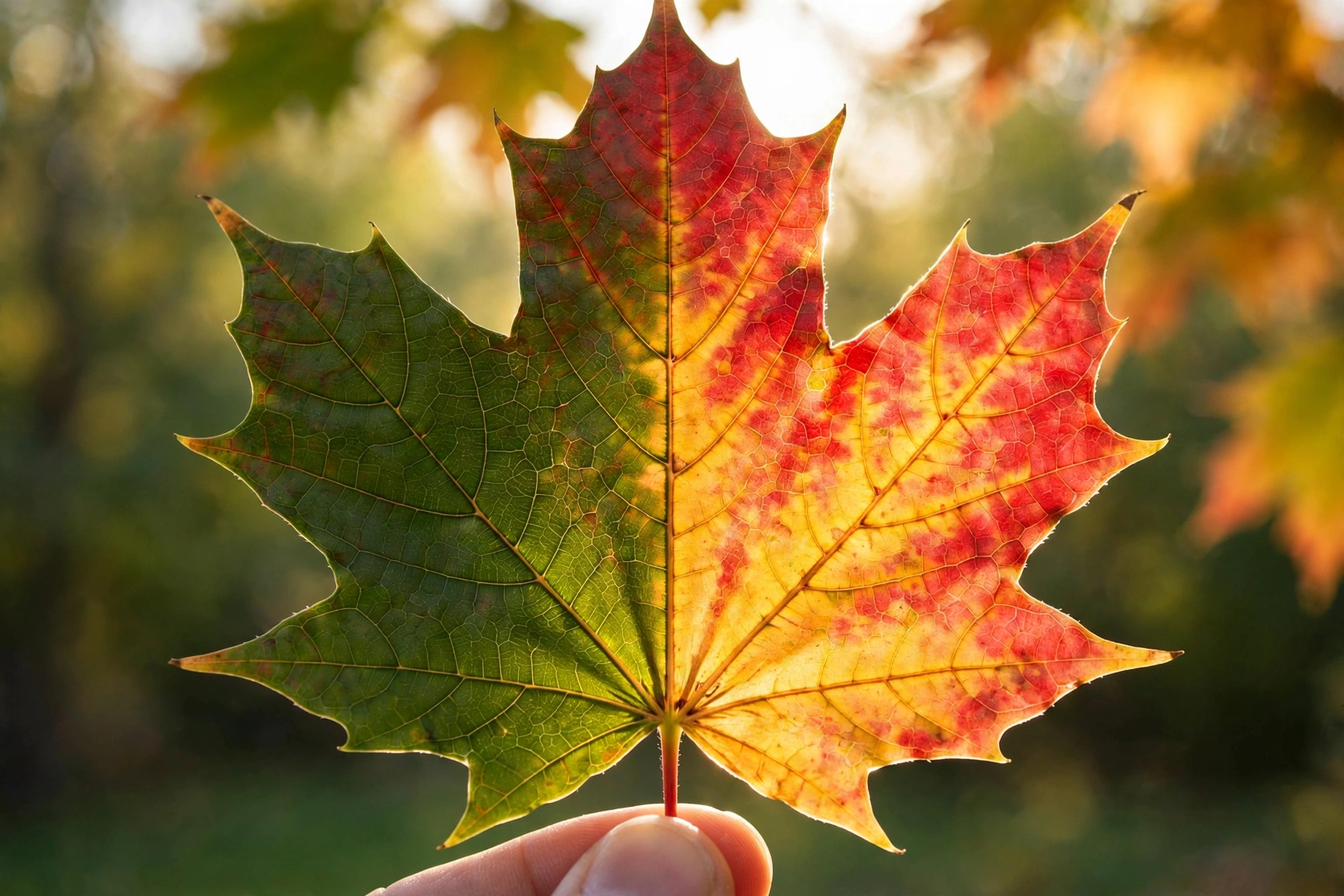
In autumn, the green blanket gets thinner and thinner. The chlorophyll breaks down and is not replaced. Slowly, the yellow and orange colours show through. First, the leaf may look a little pale green. Then it turns yellow-green. Then it turns full yellow or gold. Some leaves turn orange when they have more beta-carotene, the carrot colour, than yellow xanthophylls.
That is why many trees turn yellow or gold in autumn. Birch trees, aspens, poplars, and many maples turn bright yellow. Ginkgo trees turn a clear, glowing yellow that looks almost like gold in the sun. These trees are showing you colours that were in their leaves since spring. The tree did not make new yellow paint. It just took away the green.
The same idea is true for other colours in nature. Sunlight looks white, but it is really a mix of many colours. You can read about how light and air make colours in our guide to Why Is the Sky Blue? In that story, blue light spreads out in the air and paints the sky blue. In a leaf, colours are also hidden and revealed by what happens to light. The sky and the leaf are different, but both show that colour is not always what it seems at first glance.
Where the Red Comes From
Red and purple are different. They are not just revealed. In many trees, they are made fresh in autumn.
These red and purple colours come from a group of colours called anthocyanins. You have seen anthocyanins in food. They make red cabbage purple, cherries red, grapes purple, and apple skins red. They live in the sap, the juice inside leaf cells.
In summer, most leaves have very little anthocyanin. In autumn, some trees start to make a lot of it. The answer is linked to sugar. On a bright, sunny autumn day, the leaf still makes sugar, even as chlorophyll fades. But cool nights change what happens to that sugar. In cool weather, the tiny tubes that carry sugar out of the leaf start to close up. Sugar gets trapped inside the leaf. It builds up. When sugar builds up, and there is bright light, the leaf starts to make anthocyanins from that sugar.
The more sugar is trapped, and the more bright light the leaf gets, the more red it can become. That is why the brightest reds often appear after sunny days and cool, but not freezing, nights. The leaf is full of sugar, it gets plenty of light, and it turns that sugar into red paint.
Maple trees are famous for red leaves. So are sweetgum, dogwood, and some oaks. In North America, the red maple and the sugar maple put on one of the best red shows in the world. In Japan, Japanese maples turn a deep, rich red that people travel far to see.
Why would a tree spend energy making red paint in a leaf that is about to fall? Scientists are still debating the exact reason. One idea is that anthocyanins act like sunscreen, protecting the leaf from bright light while it is still taking back nutrients. Another idea is that red leaves warn insects away, or help the leaf handle cold and stress. All three ideas may be partly true. What is clear is that red is not a waste. It is part of the leaf’s last job.
Purple leaves work in a similar way. The same anthocyanins can look red, purple, or even blue, depending on how acidic the sap is inside the leaf cells. That is why one tree can have red leaves on one branch and purple leaves on another. The paint is the same family, but the mix inside each leaf is a little different.
Brown is the last colour in the story. It is not bright like yellow or red. But it is part of autumn too.
Brown comes from tannins. Tannins are bitter chemicals that live in leaves, bark, and some fruits. You can taste tannins in strong tea. They make your mouth feel dry. In a leaf, tannins are there all year, but they are hidden by green, yellow, and red.
As a leaf gets very old, its cells start to break down. The other colours fade. The tannins are left behind. They turn brown as they are exposed to air and as the leaf dries out. That is why many oak leaves turn brown rather than bright yellow or red. Oaks have a lot of tannins. Beech leaves also often turn a soft brown-gold.
Brown can also appear when the colour change is cut short. If a leaf is hit by a hard frost, or if it dries out fast in wind, it may turn brown before it has time to turn yellow or red. The green is gone, but the other colours did not get time to show well. The leaf just dries and turns brown. So brown is not a failure. It is the final stage. It tells you the leaf has finished its work, the colours have faded, and the leaf is ready to fall and feed the soil.
Why Some Autumns Are Brighter Than Others
If you have watched autumn for a few years, you will know that some years are amazing and some years are dull. One year, the hills are on fire with red and gold. The next year, the leaves turn brown and fall fast, with little colour at all. Why?
Weather is the main reason. The tree sets the plan, but the weather decides how bright the paint will be. The best recipe for bright autumn colour is simple. Warm, sunny days and cool, but not freezing, nights. Add dry weather, with not too much rain or wind.
Warm, sunny days help in two ways. First, they keep photosynthesis going, so the leaf makes sugar. Second, bright light helps make red anthocyanins. A sunny autumn gives the tree the light and sugar it needs for reds. Cool nights help too. Cool nights trap sugar in the leaf, because the tubes close up. Trapped sugar is the raw material for red. Cool nights also slow down the loss of colour, so the show lasts longer. But the nights must not be too cold. A hard frost kills the leaf cells before the red can form. A light frost can help bring out yellow, but a hard frost ends the show early.
Rain and cloud have the opposite effect. A cloudy, wet autumn means less sunlight. Less sunlight means less sugar and less red. Rain can also wash colours out and make leaves fall early. Strong wind can strip leaves off before they have fully changed colour. A storm in the middle of autumn can end the display in one night.
Dry weather helps in another way. If the soil is a little dry in late summer, the tree may make more red. But if the summer was very dry and hot, the tree may be weak, and its leaves may turn brown early and fall before they colour well. It is a balance. A little stress helps. A lot of stress hurts.
The same rules hold in New England, Canada, Japan, and Britain: sun plus cool nights makes bright colour, while cloud and rain make dull colour.
Why Leaves Fall
Why do leaves fall? Why does a tree not just keep its leaves all winter? The answer is about water. In winter, water in the ground can freeze. A tree cannot drink frozen water easily. At the same time, cold, dry winter wind pulls water out of leaves. If a tree kept its leaves in winter, it would lose water faster than it could take it in. It could dry out and die.
Leaves also catch snow. A tree full of broad leaves in a snowstorm would hold a lot of heavy snow. Branches could bend and break under the weight. By dropping its leaves, a tree becomes slim and bare. Snow slides off. Wind passes through. The tree saves water and stays safe.
So dropping leaves is a survival plan. It is called being deciduous. Deciduous trees are trees that lose their leaves in autumn and grow new ones in spring. Most broadleaf trees in cool parts of the world are deciduous. Maple, oak, birch, ash, beech, and elm are all deciduous.
To drop a leaf safely, the tree builds a special layer of cells where the leaf stem meets the branch. Scientists call this the abscission layer. Think of it as a neat line of weak cells, like the dotted line on a piece of paper where you tear it off.
Through summer, the leaf stem is held tight. In autumn, the tree makes less of a plant chemical called auxin, which keeps the join strong. As auxin drops, the weak layer forms. The tubes that carry water and food to the leaf get blocked. The leaf is cut off from the tree. A small scar is left behind, sealed up so germs and water cannot get in easily. Then, with a gust of wind, or even with no wind at all, the leaf falls. This is a clean cut, not a tear.
Why Evergreen Trees Stay Green
Evergreen trees do a different thing. Pines, firs, spruces, and holly keep their leaves, which we call needles, through winter. Their needles are small, thick, and waxy. They lose very little water. They are built to handle cold and snow.
A broad, flat leaf loses water fast in cold, dry wind. A thin needle loses water slowly. Its waxy coat seals it in, like a raincoat. Its small size also means snow slides off easily. So an evergreen can afford to keep its leaves all winter and keep making a little food on sunny winter days.
Evergreens do lose old needles, but they lose them a few at a time, all year, not all at once in autumn. That is why a pine forest stays green in winter while a maple forest turns bare. The two kinds of tree have two different plans for the same problem. One drops its leaves and waits. The other keeps small, tough leaves and carries on. Both plans work, in the right place.
What the Colours Tell Us
Autumn colours tell us more than just that winter is coming. They tell us about the tree, the weather, and the year that has just passed.
First, colour tells us what kind of tree it is. A bright yellow tree in a park is likely a birch, an aspen, or a ginkgo. A deep red tree is likely a maple. A brown tree is likely an oak. Each kind of tree has its own mix of colours, set by its genes, the instructions inside its cells. Weather can make the colour brighter or duller, but it cannot make a birch turn red like a maple.
Second, colour tells us about the weather. A bright, fiery autumn tells us the days were sunny and the nights were cool. A dull, brown autumn tells us there was too much cloud, rain, or frost. The trees record the season in their leaves, like a diary you can read from a hilltop.
Third, colour tells us about the health of the tree. A tree that turns colour early, in August, may be stressed by drought or by insects. A tree that stays green very late may be in a warm, sheltered spot. Gardeners watch autumn colour for this reason. It is an early warning sign.
Fourth, the colours tell us about our changing climate. Warmer autumns can delay the colour change, because nights stay warm longer. Drier summers can also stress trees and make colours less bright. Scientists watch when leaves change colour each year, because it is a simple, visible sign of how trees are coping with a changing world.
Fallen leaves have a job too. They make a soft blanket on the forest floor, shelter small creatures in winter, then break down and feed the soil for spring growth.
The orange of autumn is not the only orange in nature. The Moon can look orange too, for a simple reason linked to light travelling through air. You can read about that in our guide to Why Does the Moon Look Orange Near the Horizon? And on a clear autumn afternoon, you may even spot the pale Moon in the daytime sky. You can learn why in our guide to Why Can We Sometimes See the Moon During the Day?
So the next time you see a red maple or a golden birch, stop for a moment. You are seeing a tree at work: chemistry, light, and a survival plan, all in one leaf.
Frequently Asked Questions
Why do leaves change colour in autumn?
Leaves change colour because days get shorter and nights get cooler in autumn. The tree stops making new chlorophyll, the green colour that makes food in summer. As the green fades, yellow and orange colours that were hidden underneath show up. Some trees also make new red and purple colours. Then the tree takes back nutrients and lets the leaf fall.
What makes leaves turn red?
Red leaves get their colour from anthocyanins, which are red and purple colours made fresh in autumn. On sunny days, the leaf still makes sugar. On cool nights, sugar gets trapped in the leaf. That trapped sugar, plus bright light, helps the leaf make anthocyanins. The more sugar and light, the redder the leaf can become.
Why do some leaves turn yellow and others turn red?
It depends on the tree. Every tree has its own mix of colours. Trees that turn yellow have a lot of carotenoids, which are yellow and orange colours that were in the leaf all year. Trees that turn red make a lot of anthocyanins in autumn. Weather can make the colour brighter or duller, but it cannot change a yellow tree into a red tree.
Do all trees lose their leaves in autumn?
No. Deciduous trees, like maple, oak, and birch, lose their leaves in autumn and grow new ones in spring. Evergreen trees, like pine, fir, and spruce, keep their needles through winter. Their needles are small, thick, and waxy, so they lose very little water and can handle cold and snow.
What is the best weather for bright autumn colours?
Warm, sunny days and cool, but not freezing, nights, with dry weather, give the brightest colours. Sunlight helps make sugar and red colours. Cool nights trap sugar in the leaf. Rain, cloud, strong wind, and hard frost can make colours dull and make leaves fall early.
Why do leaves fall from trees?
Leaves fall so the tree can save water and survive winter. In winter, water in the ground can freeze, and cold wind pulls water out of leaves. If the tree kept its leaves, it could dry out. Leaves also catch snow, which can break branches. The tree builds a weak layer where the leaf meets the branch, seals it off, and lets the leaf fall cleanly.