Why Is the Sky Dark at Night?
By Zorium Daily News Desk
Step outside on a clear night, far from street lights, and look up. The sky is dark, deep, and full of tiny points of light. Stand there long enough, and a strange question may pop into your head.
There are so many stars out there. More stars than anyone could ever count. So why is the sky not bright? Why is it dark at all?
SUMMARY OF THIS ARTICLE
- The night sky is dark because the Sun has set, so no sunlight is left for the air to scatter into blue.
- Stars are far away, so their light is faint by the time it reaches us.
- If the universe were endless and had always existed, every point in the sky should be as bright as the Sun. It is not. This puzzle is called Olbers’ paradox.
- The universe is about 13.8 billion years old, so light from the most distant stars has not had time to reach us, and space is stretching, which weakens faraway light.
- City lights wash out the stars, while a dark countryside sky shows thousands of them.
The Short Answer
The sky is dark at night because the Sun is gone. During the day, sunlight fills the air and the air scatters it, which makes the whole sky glow blue. At night, the Sun is on the other side of the Earth. There is no strong light left to scatter, so the blue glow switches off.
What is left is starlight. And starlight is weak. The stars are so far away that their light arrives as tiny pinpricks. It is lovely to look at, but it is far too faint to light up the sky the way the Sun does.
That is the simple answer. But a deeper question hides behind it. If there are countless stars in every direction, should their light not add up and make the whole sky glow? That question kept scientists busy for over two hundred years. We will come to it soon.
First, Why Is the Day Sky Blue?
Think about a bright, clear afternoon. The sky is blue from one side to the other. It looks like a painted ceiling over the world. But it is not paint. It is light, bouncing around in the air.
Sunlight looks white, but it is really a mix of many colours. You can see this in a rainbow. Red, orange, yellow, green, blue, and violet are all hiding inside white sunlight. When sunlight enters the air, it bumps into tiny bits of gas, mostly nitrogen and oxygen. Those bits are far too small to see, but there are so many of them that they fill the whole sky.
When light hits those tiny bits, it scatters. That means it spreads out in all directions. And here is the key part: blue light scatters much more than red light. Blue light has short waves, and short waves get knocked off course more easily. Red light has long waves, and it mostly keeps going straight.
So as sunlight moves through the air, blue light spreads out all over the sky, reaching your eyes from above, from the side, and from everywhere at once. That is why the whole sky looks blue. You can read the full story in our guide to Why Is the Sky Blue?
The Sun Goes Away at Night
The Earth turns. That is the whole secret of day and night. As the Earth spins, your part of the world turns away from the Sun in the evening, and turns back towards it in the morning. The Sun does not go out. It is simply shining on the other side of the planet.
When the Sun is below the horizon, its light no longer passes through the air above your head. There is nothing strong left for the air to scatter. The blue glow fades, first into gold and pink at sunset, and then into dark.
This is also why the stars come out at night, or seem to. The stars were there all day. They never left. You just could not see them, because the bright blue sky washed them out. It is like trying to see a candle next to a floodlight. At night, the floodlight is gone, and the candles can finally be seen.
The Moon works the same way. It does not make its own light. It shines because it throws back sunlight, as you can read in our guide to Why Can We Sometimes See the Moon During the Day?
Why Stars Cannot Light Up the Whole Sky
A star is a sun. Some stars are bigger than our Sun. Some are hotter and brighter. So why do they look like tiny, faint dots, while our Sun is so bright that you cannot even look at it?
Our Sun is about 150 million kilometres away. Light from the Sun takes about eight minutes to reach us. But on the scale of space, the Sun is right next door. The next nearest star, a small red star called Proxima Centauri, is about 4.2 light-years away. A light-year is the distance light travels in one year, about 9.5 trillion kilometres. So the nearest star after the Sun is more than 40 trillion kilometres away.
Think of a lamp in a long hallway. Stand next to it, and it hurts your eyes. Walk to the far end, and the same lamp looks like a small, dim dot. Now stretch that hallway until it is trillions of kilometres long. That is what starlight has to cross.
Light also spreads out as it travels. Imagine blowing up a balloon with a picture on it. As the balloon grows, the picture stretches and gets fainter. Light behaves in a similar way. It spreads over a bigger and bigger area as it moves away from a star. By the time it reaches your eyes, only a tiny share of it is left.
Add it all up, and you get a dark sky with bright dots in it. The stars are there. Their light is real. But each one is so far away, and its light is spread so thin, that together they still cannot light the sky the way one nearby Sun can.
And yet, a worry creeps in. There are billions of stars in our galaxy alone, and billions of galaxies beyond that. Even if each star is faint, should all of them together not add up to a bright sky? That worry is not new. It is a famous puzzle, and it has a name.
A Puzzle That Bothered Thinkers for 200 Years
In 1823, a German doctor and astronomer named Heinrich Wilhelm Olbers wrote down a puzzle that had been floating around for hundreds of years. It is now called Olbers’ paradox. A paradox is a puzzle where good thinking seems to lead to an answer that cannot be true.
Imagine the universe goes on forever in every direction, full of stars spread out more or less evenly, like trees in a forest that never ends. Pick any direction and look. If the forest never ends, your line of sight must end at a tree, sooner or later. No gap goes on forever, because in an endless forest, a tree will always be in the way.
Now do the same with the sky. If space goes on forever and is full of stars, then wherever you look, your line of sight should end at a star. Every tiny patch of sky should have a star in it. And if every patch is covered by a star as bright as the Sun, the whole night sky should be as bright as the surface of the Sun. There should be no dark at all.
But it does not blaze. It is dark.
Olbers tried to fix the puzzle himself. He suggested that dust and gas in space might soak up the light from distant stars. But dust that soaked up so much light would heat up and glow, lighting the sky just as much as the stars would have. Other answers failed too. The puzzle stayed open for more than a century, until a whole new picture of the universe solved it.
Answer One: The Universe Is Not Old Enough
Olbers’ puzzle quietly assumes that the universe has been around forever. It assumes starlight has had endless time to reach us from every direction. But that is not true. The universe has a beginning.
Scientists have worked out that the universe began about 13.8 billion years ago, in a hot, dense state that we call the Big Bang. That is a very long time. But it is not forever. And because it is not forever, light has only had a limited time to travel.
Light is fast. It moves at about 300,000 kilometres per second. Nothing we know of moves faster. But space is so vast that even light needs time. Light from a star 13 billion light-years away has been travelling for 13 billion years. Light from farther away has not reached us yet, because the universe has not been around long enough.
Think of a candle lit far away in a huge dark field. You will not see it at once. Its light is still on its way to your eyes. You see darkness, not because there is no candle, but because its light has not arrived yet.
The universe works the same way, on a scale that is hard to picture. There may be stars and galaxies far beyond what we can see. Their light is still travelling towards us. Some of it will never reach us in our lifetimes. So the sky is not covered in stars. There are dark gaps between the stars we can see, and through those gaps, we are looking at the darkness of space itself.
This is the main answer to Olbers’ paradox. The British cosmologist Edward Harrison showed in the 1960s that the finite age of the universe is the biggest reason the night sky is dark. The stars we can see are many, but not endless. Each one burns for a limited time, and its light has only had a limited time to travel. So darkness has room to exist between them.
Answer Two: Space Itself Is Stretching
The universe is not just sitting still. It is expanding. Space itself is stretching, like the surface of a balloon being blown up. The galaxies are moving apart, not because they are flying through space like rockets, but because the space between them is growing.
When space stretches, it stretches the light travelling through it. Light moves in waves, and as space grows, those waves get pulled longer. Longer waves carry less energy, and light with very long waves slips out of the range our eyes can see. Scientists call this redshift.
This has a real effect on the night sky. The light from the most distant galaxies is stretched so much that our eyes cannot pick it up. It arrives as a faint glow of microwaves, far too weak and too long in wave for human eyes. The whole sky is filled with this faint leftover glow from the early universe. Scientists call it the cosmic microwave background. It is everywhere, but it is invisible to us.
So the stretching of space dims the faraway light even more. Between the young age of the universe and the stretching of space, the light from the countless distant stars is far too weak to paint the sky bright.
Put the two answers together, and the paradox falls apart. The universe is not endless and unchanging. It had a beginning, and it is still growing. The dark sky is not a mistake. It is evidence, and it helped scientists see that the universe is a young, growing place with a history.
So Why Is the Night Sky Not Fully Black?
It is not fully black, and there are a few reasons for that.
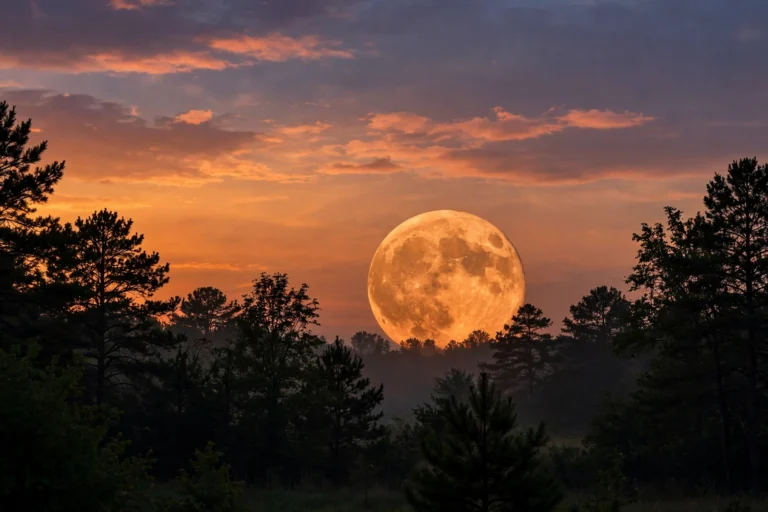
The first is the Moon. When the Moon is up, it can light up the whole landscape. A full Moon is bright enough to read by, or nearly. It throws sunlight back at us, and that light scatters a little in the air, softening the dark. Around a new Moon, the sky gets much darker.
The second is the planets. Venus, Mars, Jupiter, and Saturn do not make their own light either. They shine by reflecting sunlight, just like the Moon. They look like bright stars, but they are close neighbours compared to real stars, so they can look brighter than most stars in the sky.
The third is the air itself. High above us, the air gives off a very faint glow, called airglow. It comes from chemical reactions in the upper air, where sunlight charged up tiny bits of gas during the day. At night, they slowly release that energy as soft light, too faint for our eyes but visible to cameras as a green or red band.
The fourth is lightning and meteors. A lightning bolt can light up the whole sky for a split second, even from a storm far away. You can learn how those giant sparks work in our guide to What Causes Thunder and Lightning? A meteor can flash bright for a moment too. These are brief, passing lights, not a steady glow.
And the fifth is us. Human lights. Street lamps, car headlights, lit windows, and signs all throw light up into the air. In a city, that light bounces off dust and water drops and forms a glowing dome over the town. It never fully goes dark.
City Lights vs Country Stars
If you live in a city, you may have never seen a truly dark sky. That is not your fault. It is light pollution.
Light pollution is the glow made by too much human light shining where it is not needed, mostly up into the sky. A street lamp that throws light sideways and upwards wastes light. A bright sign left on all night wastes light. All of that light scatters in the air, and it washes out the stars.
In a big city, you may see only a few dozen stars on a clear night. The sky looks orange-grey or brownish, not black. The Milky Way, the bright band of our own galaxy, is nowhere to be seen. It is still there, of course. It is just hidden behind the glow of the city.
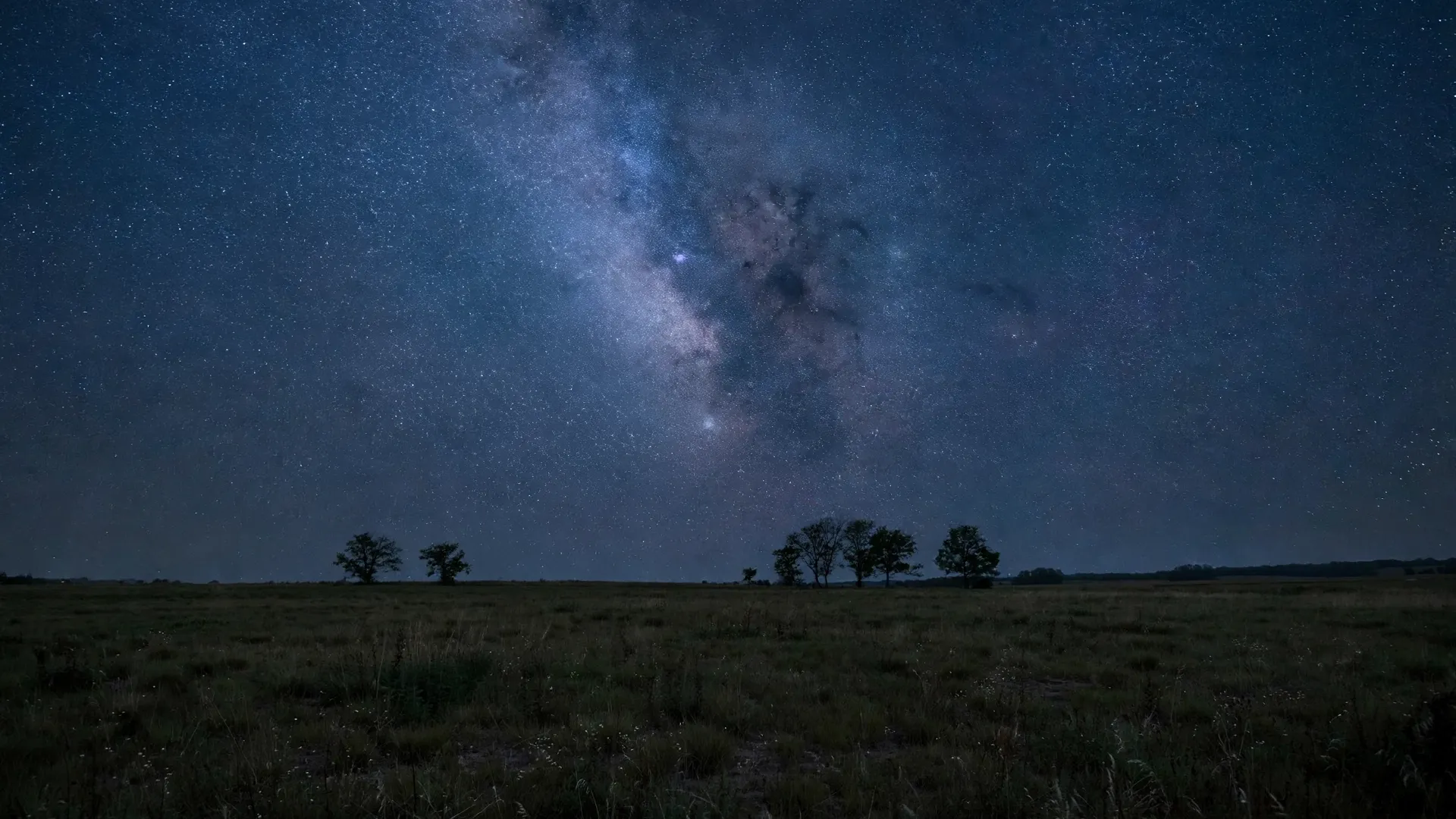
Drive an hour or two out of the city, into the countryside, and the change is startling. The sky turns a deep blue-black. Hundreds of stars appear, then thousands. The Milky Way rises like a pale river of light across the sky. Meteors flash. Faint galaxies that no city eye could ever see become soft smudges of light.
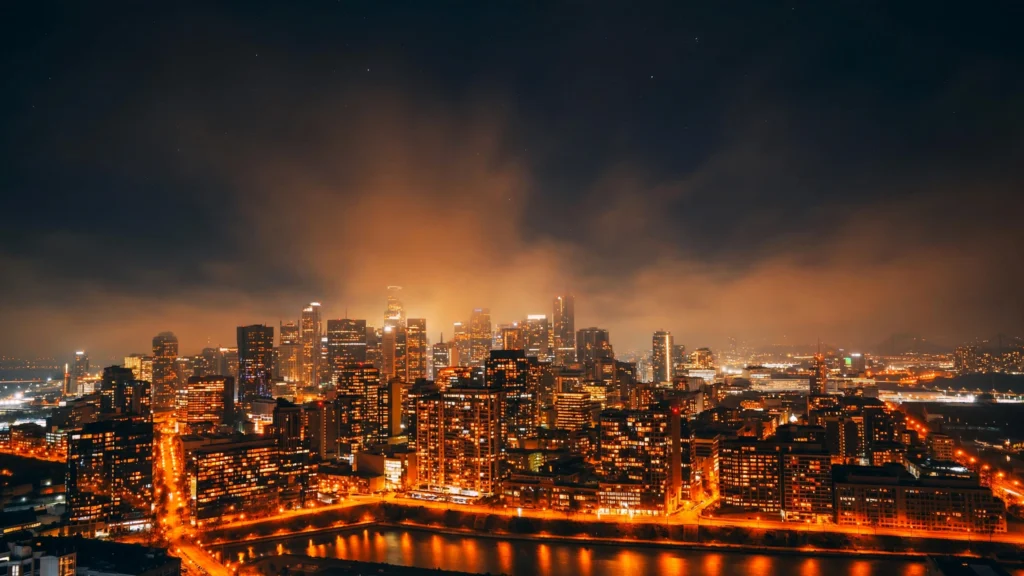
The difference is not the sky. The sky is the same. The difference is the light we make, and how much of it gets in the way. Astronomers need truly dark places, far from cities, because even a small amount of scattered light can hide the faintest objects they want to see.
The good news is that light pollution can be fixed. Lamps that point down waste far less light. Warmer, dimmer lights help, and switching lights off when no one needs them helps even more. Visitors to dark-sky parks often say the same thing: they had forgotten how many stars there are.
What a Truly Dark Sky Looks Like
If you ever get the chance, go somewhere truly dark on a clear, moonless night. A hilltop, a beach, or a quiet village far from any town. Give your eyes time. That part matters.
When you step out of a bright room into the dark, you can barely see anything at first. Your eyes need time to adjust. The pupil, the tiny opening in the centre of your eye, slowly gets wider to let in more light. The cells that work in dim light slowly wake up. This takes about 20 to 30 minutes. After that, you will see far more stars than you did at first.
That is why astronomers use red torches at night. Red light spoils the adjustment far less than white light. And it is why one glance at your phone can set your eyes back. The bright screen tells your eyes it is daytime again, and the adjustment starts over.
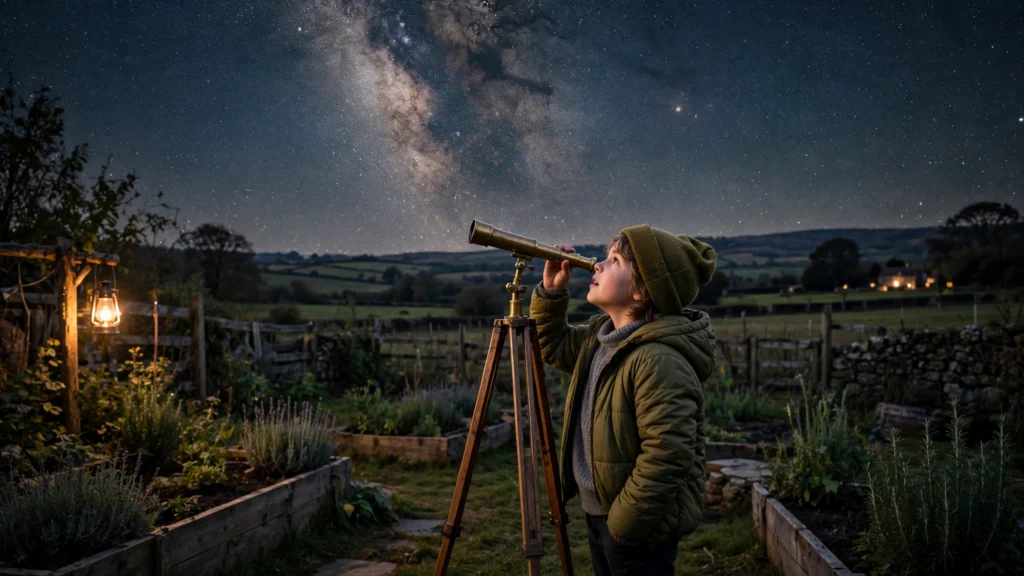
Once your eyes have adjusted, a dark sky is one of the most beautiful sights on Earth. You can see the Milky Way as a cloudy band, made of millions of stars too far away to see one by one. You can see constellations, the patterns people have named for thousands of years.
Here is a quiet thought to carry with you. When you look at a star, you are looking back in time. Its light left years ago. Some of the stars you see may have already died, but their light is still on its way to you. The night sky is a picture of the past, arriving late.
Why This Question Matters
Why does it matter that the sky is dark at night? It matters because it shows how a simple question can open a door to the biggest ideas there are.
A child looks up and asks why the sky is dark. A doctor in Germany in 1823 writes the question down in careful form. A hundred and forty years later, scientists find that the answer is tied to the age of the universe and the stretching of space. A small question about the night becomes a clue about how everything began.
It also matters because the dark sky is something we can lose. Each year, more lights go up, and fewer stars are visible from towns and cities. A child growing up in a bright city may never see the Milky Way. That is a loss for wonder, not just for science. People have looked at the stars for thousands of years and felt small, curious, and part of something bigger.
The dark sky also reminds us where we are. We live on a small planet, circling one ordinary star, in a galaxy of billions of stars, in a universe that is still growing. The darkness above us is not empty. It is full of light still on its way, and space still stretching.
Frequently Asked Questions
Why is the sky dark at night if there are so many stars?
The sky is dark at night because the Sun has set, so there is no sunlight for the air to scatter. Stars are very far away, and their light is faint by the time it reaches us. Even with billions of stars, each one is so distant that together they still cannot light up the sky the way the Sun does.
What is Olbers’ paradox?
Olbers’ paradox is a puzzle from 1823. It says that if the universe went on forever and was full of stars, every point in the night sky should be covered by a star, and the whole sky should be as bright as the Sun. But the sky is dark. The answer is that the universe is about 13.8 billion years old, so light from the most distant stars has not had time to reach us, and space is stretching, which weakens faraway light.
Why can we see stars at night but not during the day?
We can see stars at night because the bright blue sky is gone. During the day, sunlight scatters in the air and makes the whole sky glow blue. That glow is far brighter than starlight, so it washes the stars out. At night, the Sun is on the other side of the Earth, the blue glow switches off, and the faint stars can finally be seen.
Why is the sky darker in the countryside than in the city?
The sky is darker in the countryside because there is less light pollution. City street lights, signs, and lit windows throw light up into the air, and that light scatters and forms a glow that hides the stars. In the countryside, there are few lights, so the sky stays dark and thousands of stars become visible.
Does the Moon make the night sky brighter?
Yes, the Moon can make the night sky much brighter. A full Moon throws back a lot of sunlight, and it can light up the landscape and soften the dark. Around a new Moon, when the Moon is dark, the sky is at its darkest, and the most stars are visible.
Is the night sky ever fully black?
No, not quite. Even on the darkest, clearest night, far from any city, the sky has a very faint glow. Some of it comes from airglow, a soft light made by the upper air. Some comes from starlight itself, and from the faint glow of the Milky Way. To our eyes it looks almost black, but it is never fully empty of light.
More from Zorium Daily
- Why Is the Sky Blue?
- Why Can We Sometimes See the Moon During the Day?
- What Causes Thunder and Lightning?
- Why Is the Ocean Salty?
Tonight, when the Sun goes down and the first stars come out, take a minute to look up. The dark above you is not a blank wall. It is a clue to the age of the universe, a sign that space is still growing, and a reminder that the light you see left its star long ago.