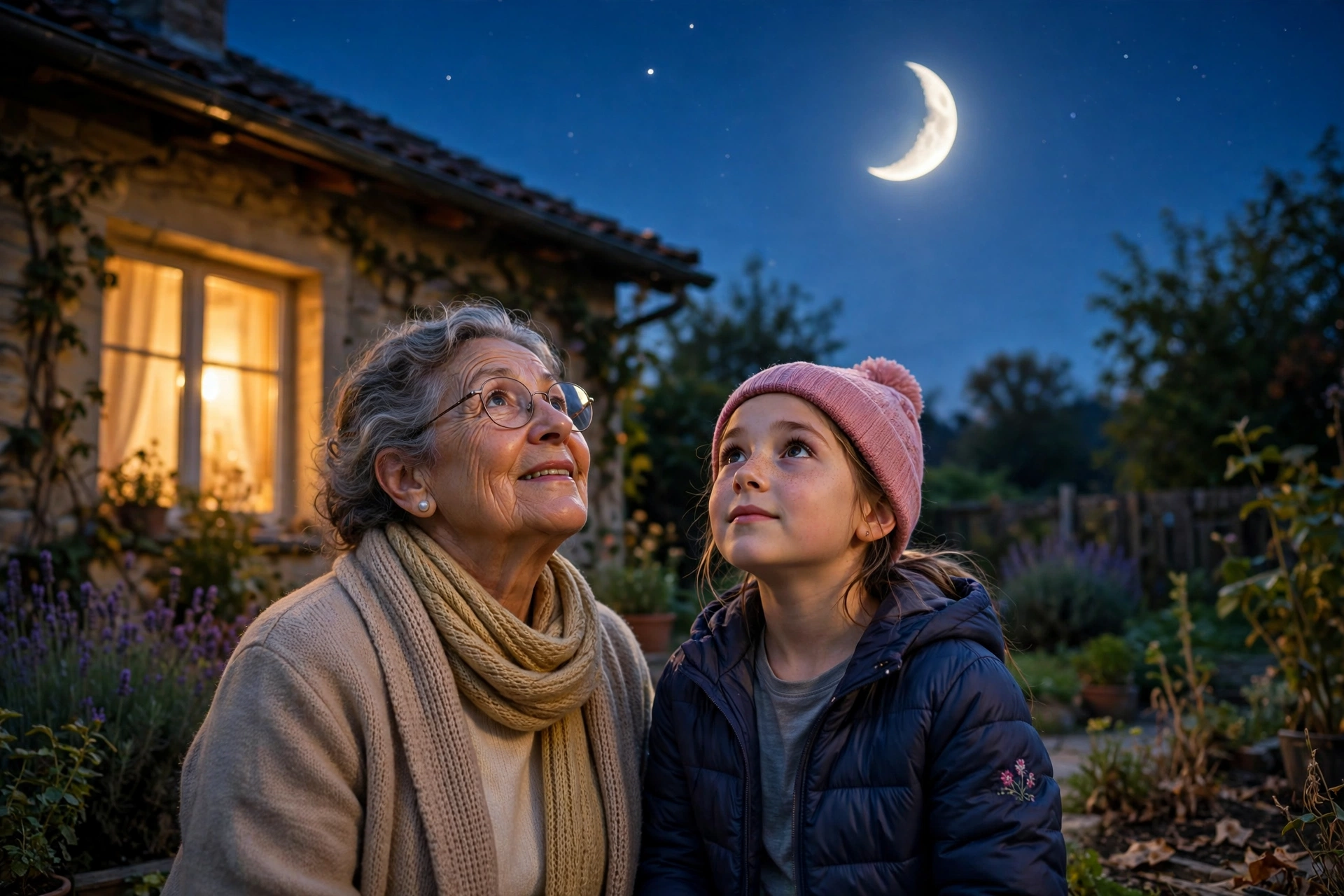
Why Does the Moon Change Shape? Explained Simply
SUMMARY OF THIS ARTICLE
- The Moon never changes shape at all. It is always a round ball, and it makes no light of its own.
- The Sun always lights exactly half of the Moon, just as it always lights half of the Earth.
- As the Moon travels around the Earth, we see a different share of that lit half, and that is what we call the phases.
- One full round of phases takes about 29.5 days, from one new Moon to the next.
- The changing shape is not Earth’s shadow. Earth’s shadow only falls on the Moon during a lunar eclipse, which is a different and much rarer event.
The Moon That Looked Different Last Night
It was a Tuesday evening, and Sara was walking home from her friend’s house with her little brother, Tom. The sky was clear, and the Moon was out early, hanging low over the rooftops. Tom stopped in the middle of the pavement and pointed up.
“Sara, look,” he said. “The Moon is broken.”
Sara looked up. The Moon was not the big round disc they had seen the week before. It was a thin curved sliver, like a fingernail clipping, bright on one side and gone on the other. It really did look broken, as if someone had taken a bite out of it.
“Did it break?” Tom asked. He sounded worried, the way small children do when something familiar suddenly looks wrong.
Sara laughed, but then she stopped. She had seen the Moon full and round, and half, and vanished altogether, and she realised she did not actually know why.
That evening, when they got home, their grandmother was sitting by the window with a cup of tea. Sara asked her the question, and her grandmother smiled, because it is one of the oldest questions people have ever asked.
The answer is simpler than most people expect. The Moon is not breaking or shrinking. It is going round and round the Earth, a round ball lit by the Sun, while we watch it from a different angle each time.
The Short Answer: The Moon Never Changes Shape
Here is the whole idea in one sentence: the Moon stays the same round shape all the time, but the amount of its sunlit side that we can see changes as it moves around the Earth.
Think of a ball in a dark room with a single lamp shining on it. The lamp lights one half of the ball. The other half stays dark. The ball itself does not change. But if you walk slowly around the ball, you will see a different amount of the lit half. From one side you see the lit half face on. From the opposite side you see only the dark half. From the sides, you see a bit of light and a bit of dark, and the ball looks like a half circle or a curved sliver.
The Moon is that ball and the Sun is the lamp, except that in real life it is the Moon that moves, travelling around the Earth once every month.
The Moon Makes No Light of Its Own
The first thing to understand is that the Moon is not a lamp. It does not glow the way the Sun does, and it does not shine the way a light bulb does. If you could stand on the Moon in the daytime, the ground under your feet would be grey rock and dust, lit up by the Sun, much like a grey pavement on a sunny afternoon. The Moon is a cold, rocky world, about a quarter as wide as the Earth, and it has no light of its own.
So why does it look so bright in the night sky? Because it throws sunlight back at us, the way a white wall throws back the light of a lamp. The Sun shines on the Moon, and the surface of the Moon bounces some of that light back toward the Earth. That bounced light is what we see.
The Moon’s surface is dark grey rock, and it only bounces back about one tenth of the sunlight that hits it. It still looks bright because the Sun is so strong and the night sky is so dark.
The Sun Always Lights Half of the Moon
Here is a picture worth holding in your mind, because it unlocks the whole story. Imagine the Sun far away to one side, shining its light in straight lines across space. Now imagine the Earth, a ball, in the middle. Half of the Earth faces the Sun and has daytime. The other half faces away and has night. Nobody finds that strange. We all know that when it is noon where you live, it is midnight on the other side of the world.
Now put the Moon in the picture. The Moon is a smaller ball, travelling around the Earth. The Sun lights half of it too, always, in exactly the same way. One half of the Moon is in daylight, and the other half is in night. That never changes. What changes is where the Moon is on its journey around us, and therefore which part of its lit half happens to be facing our way.
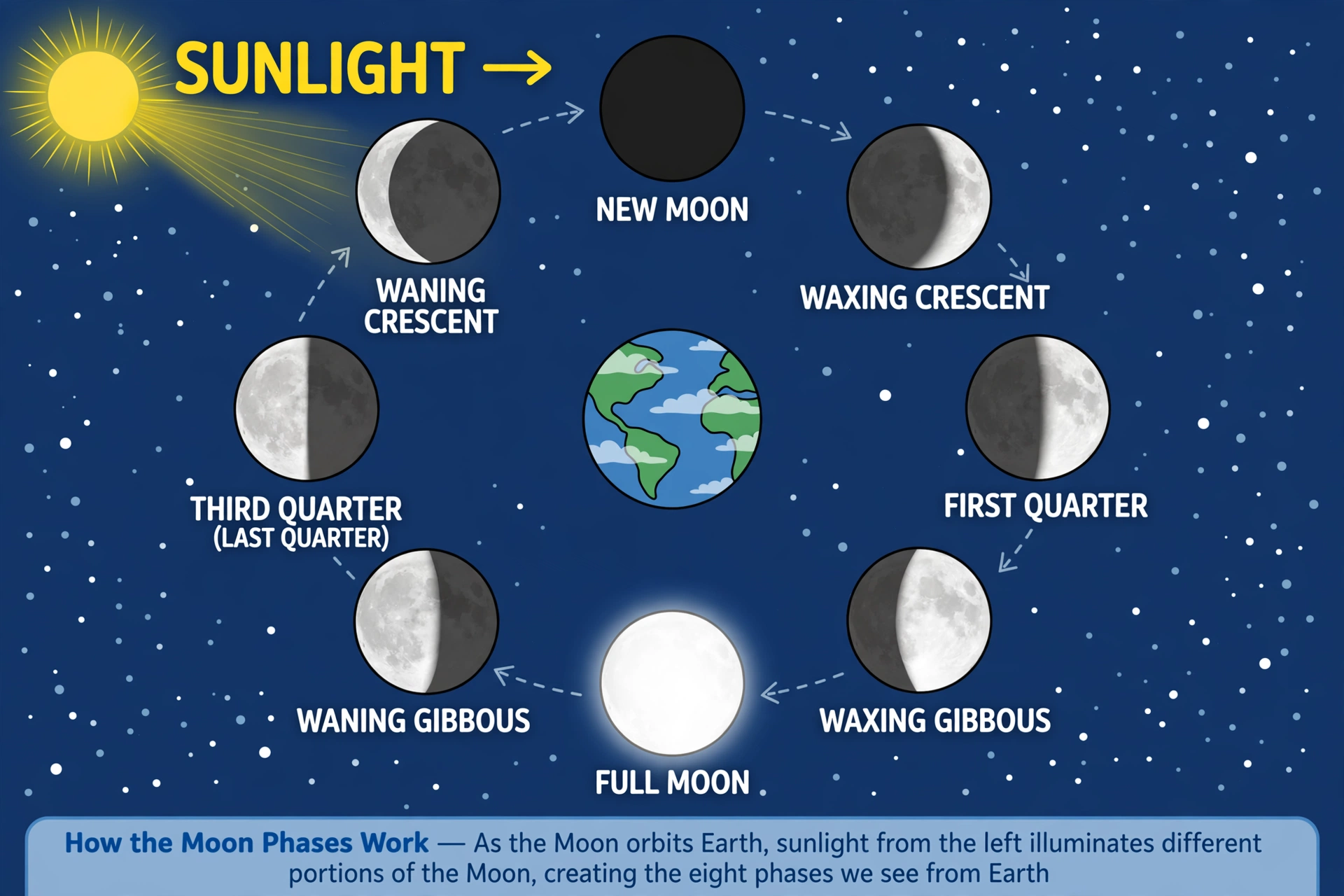
When the Moon is on the far side of the Earth from the Sun, the whole lit half faces us, and we see a full Moon. When the Moon is between the Earth and the Sun, the lit half faces away from us, and we see almost nothing at all. That is the new Moon. And when the Moon is off to one side or the other, we see part lit and part dark, in every shape from a thin sliver to a fat bulge.
During a new Moon, the Moon has not gone away. It is still there, travelling on its path. We simply cannot see it, because the side facing us is its dark side, and the bright side is turned away from us, facing the Sun.
Try It Yourself: The Torch and the Orange
The best way to understand the phases is to try them with your hands. You need a torch and an orange, or any round fruit, and a dim room.
Put the torch on a table at one end of the room and switch it on, pointing it across the room. The torch is the Sun. Now stand in the middle of the room, holding the orange out in front of you at arm’s length. You are the Earth, and the orange is the Moon. Keep the torch still. All you have to do is turn slowly in a circle, holding the orange out in front of you the whole time, and watch what happens to the lit part.
Start with your back to the torch. The torch lights the far side of the orange, so from where you stand you see only the dark side. That is the new Moon.
Now turn a little to your left, about an eighth of a full turn. A thin sliver of light creeps around the edge of the orange. That is the waxing crescent. Turn a little more, and the sliver grows wider. Keep turning until you have turned a quarter of the way around. Now you see half the orange lit and half dark, a clean half circle. That is the first quarter Moon.
Turn another eighth and the lit part grows past half, a fat bulge. That is the waxing gibbous. Turn until you face the torch, and the whole round face glows. That is the full Moon.
Keep turning, and the light shrinks again, back through half and crescent to dark. You have acted out a whole month in thirty seconds, and the orange never changed shape once.
The Eight Phases, in Order: The Moon Grows Brighter
Now let us walk through the eight phases properly, one by one, in the order they happen. The Moon takes about 29.5 days to go through all eight and come back to where it started, and each phase lasts about three or four days. Two words will help you remember the order. Waxing means growing, like wax building up on a candle. Waning means shrinking, like a puddle drying up in the sun.
The first phase is the new Moon. The Moon sits between the Earth and the Sun, and the side facing us is completely dark. We see nothing, or almost nothing. The sky looks empty where the Moon should be. The new Moon rises in the morning and sets in the evening, travelling across the sky with the Sun, but it is too dark and too close to the Sun’s glare to spot.
A day or two later comes the waxing crescent. A thin sliver of light appears on the right-hand edge of the Moon, if you live in the northern half of the world. It looks like a fingernail, or a smile, or the curve of a banana. Each night the sliver grows a little wider. The waxing crescent is easiest to see just after sunset, low in the western sky, and it sets not long after the Sun goes down, so you have to be quick.
Next comes the first quarter. The name means the Moon has travelled a quarter of the way around its monthly journey, not that it is a quarter of its usual size. We see exactly half of the Moon lit, the right half in the northern hemisphere, with a straight edge down the middle like a clean cut.
After the first quarter comes the waxing gibbous. Gibbous is an old word that means humped, or bulging, and it fits. More than half of the Moon is lit now, a big fat bulge of light, with only a small dark piece left on the left edge.
The Eight Phases, in Order: The Moon Fades Away
The fifth phase is the one everyone knows: the full Moon. The Moon is now on the far side of the Earth from the Sun, and the whole face that looks toward us is lit. It rises just as the Sun sets, climbs high in the sky in the middle of the night, and sets just as the Sun comes up. A full Moon is bright enough to read by on a clear night, or nearly, and it turns the whole landscape silver.
After the full Moon, the light starts to shrink, and we move into the waning half of the month. The sixth phase is the waning gibbous. The Moon is still mostly lit, but now a dark bite is growing on the right-hand edge, where the light used to be. It rises later each night, a few hours after sunset, and it is still up in the morning when the Sun comes up.
The seventh phase is the last quarter, sometimes called the third quarter. Once again we see exactly half the Moon lit, but this time it is the left half, the mirror image of the first quarter. The Moon has travelled three quarters of the way around its journey.
The eighth and final phase is the waning crescent. Only a thin sliver of light is left, now on the left edge, and it grows thinner every morning. Then the sliver vanishes, the Moon is new again, and the whole round begins once more.
How Long Does One Full Cycle Take?
One complete round of phases, from one new Moon to the next new Moon, takes about 29.5 days. Scientists call this a lunar month, but you can just think of it as a Moon month. It is a little longer than the time the Moon takes to travel once around the Earth, which is about 27.3 days, and the reason for the difference is a nice piece of thinking to follow.
The Moon goes around the Earth, but the Earth is also moving, travelling around the Sun. So by the time the Moon has finished one lap around the Earth, the Earth has moved a little way along its own path, and the Sun is shining from a slightly different direction. The Moon has to travel a little bit further, about two more days, to get back to the same position relative to the Sun and the Earth, and to show us the same phase again. That is why the phase cycle is 29.5 days rather than 27.3.
The word month comes from the word Moon, and long ago many peoples started a new month each time the thin crescent appeared after the new Moon.
It Is Not Earth’s Shadow
Now we come to the mistake that almost everyone makes at least once, so if you have made it, you are in very good company. Many people think the phases of the Moon are caused by Earth’s shadow falling on the Moon, covering it up a little more each night like a curtain sliding across. It sounds sensible. The Earth is big, the Moon is close by, and shadows do fall on things. But it is not true.
Earth’s shadow is a long cone of darkness stretching out behind the Earth, away from the Sun. For that shadow to fall on the Moon, the Moon would have to pass through it. But the Moon travels on a path tilted about five degrees, so most months it passes just above the shadow or just below it, and misses it completely. That is why we can have a full Moon almost every month without any shadow getting in the way.
There is a second proof. If a shadow caused the phases, the dark part would always be curved the same way, because Earth’s shadow is round. But the dark part of a crescent is simply the night side of the Moon, the half the Sun is not lighting. The shape comes from the angle we see, not from a shadow.
What a Lunar Eclipse Really Is
A lunar eclipse happens when the Moon does pass through Earth’s shadow. It only happens at full Moon, because that is the only time the Moon is on the far side of the Earth, where the shadow lies. And even then, it only happens a few times a year, when the Moon’s tilted path carries it straight through the shadow.
When a lunar eclipse happens, the Moon’s bright face darkens from one edge as Earth’s shadow slides across it. Then, fully inside the shadow, the Moon turns a deep red or copper colour, and people often call it a blood Moon. That red light is sunlight that has passed through Earth’s atmosphere, which has filtered out the blue and left only the red and orange, and then bent around the Earth to fall on the Moon.
The important thing to remember is the difference in how often the two things happen. The phases happen every night, all month, every month. A lunar eclipse happens only a few times a year, and only when the geometry lines up just right. If Earth’s shadow caused the phases, we would see an eclipse every month. We do not, and that is the proof.
Why We Can Sometimes See the Moon During the Day
There is another question that follows naturally from all of this, and it is one children ask almost as often as the shape question. If the Moon is a night-time thing, why can we sometimes see it in the middle of the day, pale and ghostly against the blue sky?
The short answer is that the Moon is not a night-time thing at all. It is in the sky for about twelve hours out of every twenty-four, just like the Sun, and those twelve hours are sometimes mostly at night, sometimes mostly during the day, and sometimes split between the two. The Moon does not switch off when the Sun comes up. It is always there, reflecting sunlight, whether we notice it or not.
Which hours those are depends on the phase. Around the full Moon, it rises at sunset and sets at sunrise. Around the new Moon, it rises in the morning and sets in the evening, but it is dark and close to the Sun, so it is almost impossible to see. In between, around the quarters, it is up for part of the day and part of the night.
The reason the daytime Moon looks pale and washed out is that it has to compete with a bright blue sky. At night, the sky is dark, and even a faint Moon stands out clearly. During the day, sunlight scatters in the air and turns the whole sky bright blue, and the Moon must shine through that brightness to reach your eyes.
Why the Full Moon Looks So Big Near the Horizon
There is one more Moon puzzle, and it is the one that fools almost everyone, including people who know all about the phases. Have you ever seen a full Moon rising over the rooftops or over the sea, huge and orange, looking twice as big as it does when it is high in the sky later that night? A few hours later, high overhead, the same Moon looks small again.
The strange truth is that the Moon does not change size at all. It is exactly the same size, high in the sky or low on the horizon, and if you measured it with your thumb held out at arm’s length, or with a camera, you would find it takes up exactly the same amount of sky in both places. The change is not in the Moon. It is in your brain.
Scientists call this the Moon illusion: your brain judges the size of things by what is around them. When the Moon is low, you see it next to houses, trees, hills, and rooftops, and your brain compares it with those familiar things and decides it must be huge. When the Moon is high in the sky, there is nothing near it to compare it with, just empty blackness, and your brain has no reference point, so it judges the Moon as smaller.
The orange colour is a separate effect, and it has a simple cause. When the Moon is low, its light has to travel through much more air to reach your eyes than when it is high. The air scatters the blue part of the light away, just as it does at sunset, and leaves the red, orange, and yellow behind. That is why a low Moon looks warm and golden, and a high Moon looks white and silver.
Frequently Asked Questions
Does the Moon really change shape?
No, never. The Moon is always a round ball. What changes is how much of its sunlit half we can see from Earth as it travels around us. The shape you see is the lit part, not the Moon itself.
Why can we not see the Moon during a new Moon?
During a new Moon, the Moon sits between the Earth and the Sun, so the side facing us is its dark side. The bright side is turned away from us, facing the Sun. The Moon is still there. We just cannot see it.
How long does it take the Moon to go through all its phases?
About 29.5 days, from one new Moon to the next. Each phase lasts about three or four days. The word month comes from the word Moon, because long ago people counted time by this cycle.
Is the dark part of the Moon Earth’s shadow?
No. The dark part is simply the half of the Moon that the Sun is not lighting. Earth’s shadow only falls on the Moon during a lunar eclipse, which happens a few times a year, not every month.
Why can we see the Moon during the day?
The Moon is in the sky for about twelve hours a day, just like the Sun, and those hours are sometimes mostly during the day. It is easiest to spot in the afternoon around the first quarter, or in the morning around the last quarter.
Why does the full Moon look bigger near the horizon?
It does not really get bigger. It only looks bigger because your brain compares it with houses, trees, and rooftops near the horizon. High in the sky, with nothing to compare it with, the same Moon looks smaller.
More from Zorium Daily
- Why Is the Sky Dark at Night?
- Why Is the Sky Blue?
- Why Can We Sometimes See the Moon During the Day?
- Why Do We Have Four Seasons? Explained Simply
The next time you look up and see a thin crescent, or a half Moon, or a great round full Moon filling the sky, remember what is really happening. Nothing up there has broken or changed. The same round Moon is travelling on its path, the Sun is lighting half of it as it always does, and you are simply seeing a different share of the light. Watch it for a month, night by night, and you will see the whole story play out above your own rooftop.