How Does a Farm Make Money? Explained Simply
SUMMARY OF THIS ARTICLE
- A farm makes money by growing or raising things people need, then selling them for more than they cost to produce.
- The main income comes from selling crops, milk, eggs, meat, and wool.
- Farmers also earn from farm shops, markets, visits, and renting land or buildings.
- Farming costs a lot up front: seeds, feed, fuel, machines, workers, and land.
- Weather, prices, and seasons make farm income rise and fall, so good farmers plan carefully.
A Farm Is a Business, Just With Mud on Its Boots
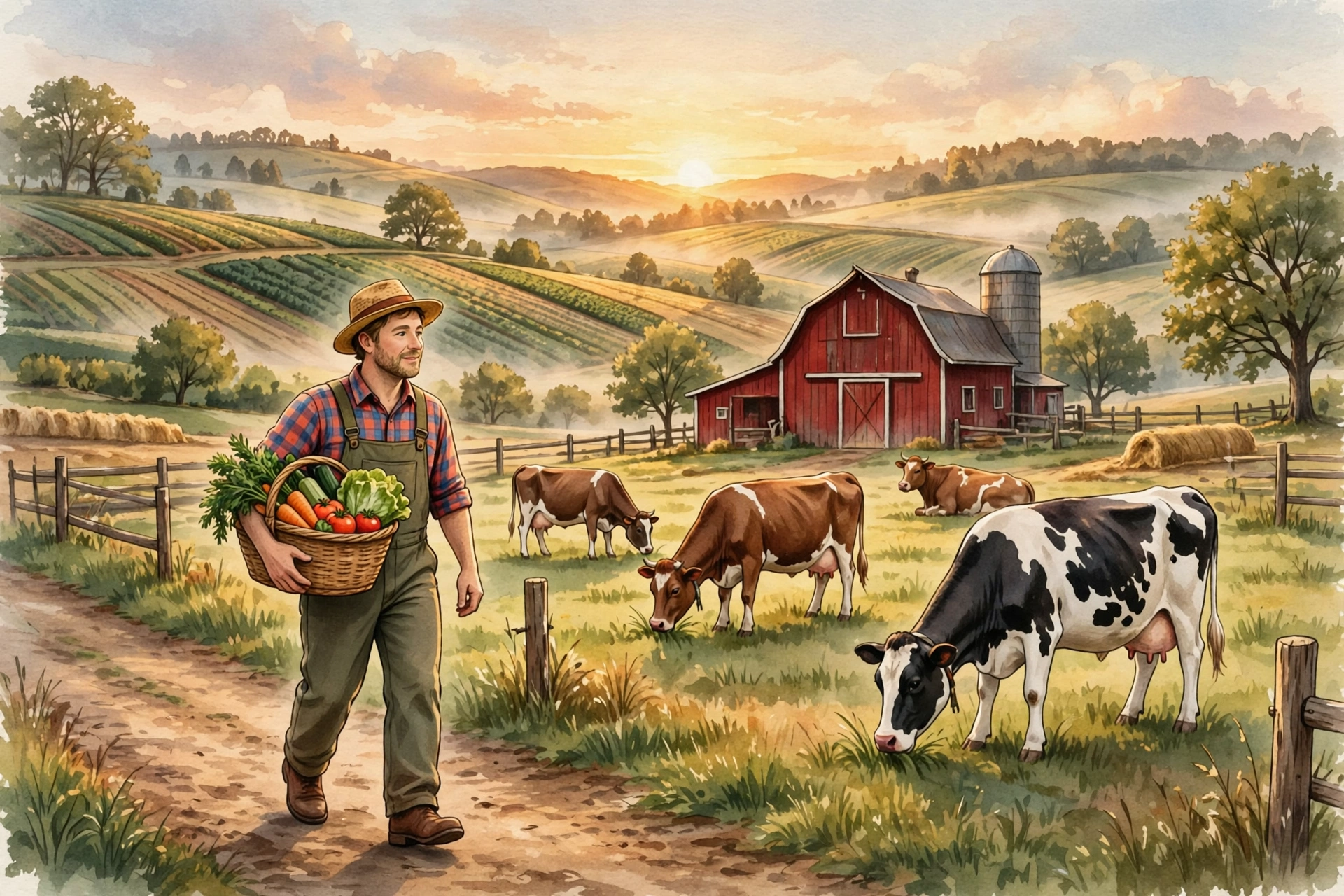
When you picture a farm, what do you see? Green fields, a red barn, cows chewing grass, a farmer in a hat. It looks peaceful. It looks simple. But under that peaceful picture, a farm is a business, just like a shop or a café. It has to earn more money than it spends, or it cannot keep going.
Think of it like this. A farmer spends money all year: on seeds, on animal feed, on fuel for tractors, on fixing fences, on paying workers. Then, at certain times of year, money comes back in: when the wheat is sold, when the milk is collected, when the eggs are packed and sold. If the money coming in is bigger than the money going out, the farm makes a profit. Profit is the money left over after all the bills are paid. If the money going out is bigger, the farm loses money, and that is a hard year.
That is the simple heart of it. A farm grows or raises things people need, and sells them. But the details are full of surprises. Farms earn money in more ways than most people realise, and they face risks that a normal shop never faces — like a summer with no rain, or a winter that kills the crop. Let us walk through it together, field by field.
A quick note before we begin: this is a simple explainer about how farm businesses work. It is not financial advice, and it does not promise that farming will make anyone rich. Farming is hard work with real risks, and many farms earn modest incomes.
Selling Crops: The Oldest Farm Business
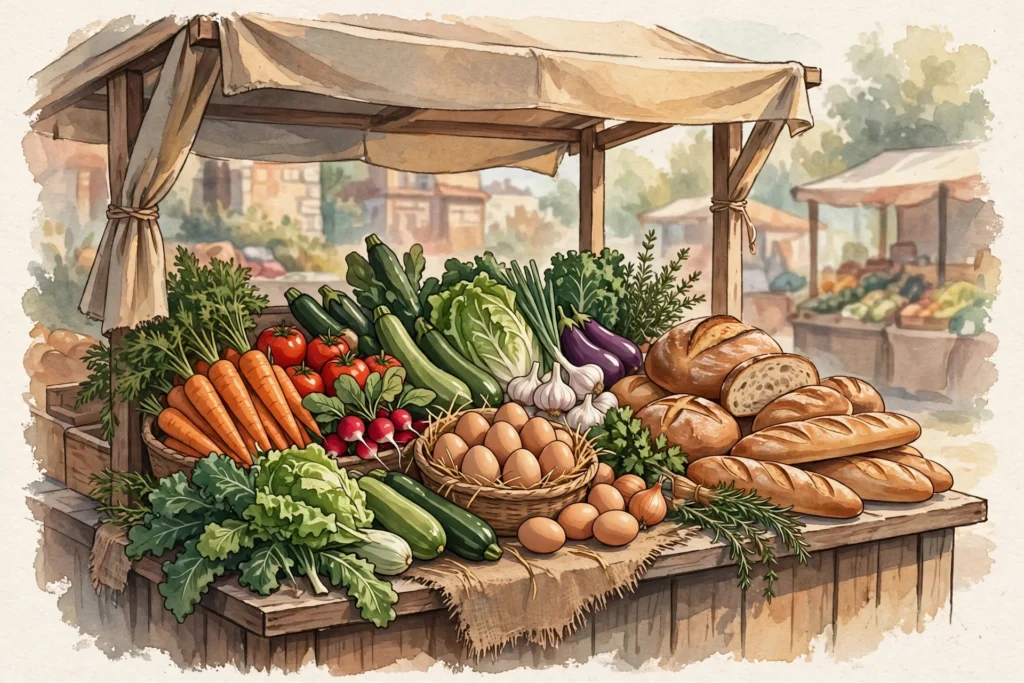
The oldest way a farm makes money is also the most obvious: grow plants, sell plants. Wheat, corn, rice, potatoes, carrots, apples, grapes — whatever grows well in that place. The farmer plants seeds, tends the crop, harvests it, and sells it.
But here is what most people do not see: the farmer rarely sells to you directly. Most crops go to a middle step. A wheat farmer sells to a mill, which turns wheat into flour. The mill sells flour to a bakery, which makes bread. You buy the bread. Each step adds a little cost and takes a little profit. The farmer gets the smallest slice of the bread’s price, because so many hands touch it along the way.
That is why some farmers sell directly. They set up a stall at a farmers’ market, or open a farm shop by the road, or offer boxes of vegetables delivered to homes. When a farmer sells you a bag of carrots directly, there is no mill and no shop in the middle. The farmer keeps more of the price, and you get fresher food. It is more work — someone has to stand at the stall, pack the boxes, and talk to customers — but it can pay better.
Timing matters too. A crop is worth more when it is fresh and in season, and worth less when everyone has too much of it at once. If every farm in the area harvests tomatoes in the same week, the price drops, because there are too many tomatoes and not enough buyers. Farmers who can store a crop, or grow something that ripens a little earlier or later, can sometimes get a better price. It is a bit like selling ice cream: everyone wants it on the hottest day, and nobody wants it in a snowstorm.
Animals That Pay Their Way
Animals are the second big earner on many farms, and they pay in more ways than one.
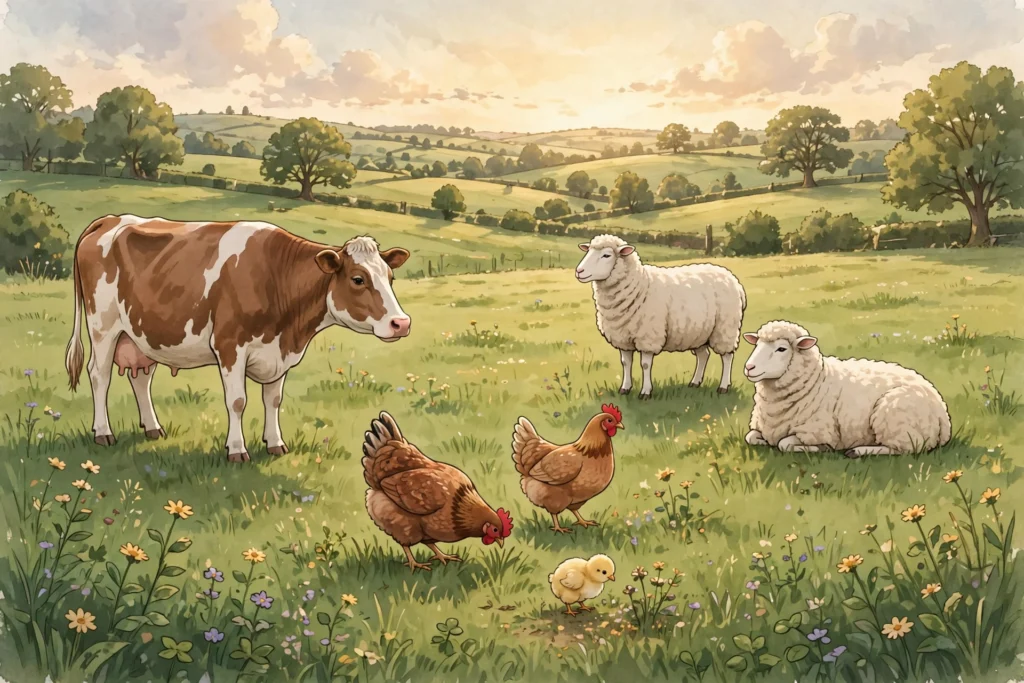
Dairy cows are a good example. A dairy cow is a cow kept for milk. She is milked once or twice a day, every day, and the milk is collected by a tanker and taken to a dairy, where it is turned into milk, cheese, butter, and yoghurt. Milk is steady money: it comes in every day, not just once a year like a wheat harvest. But cows are costly too. They eat a lot, need a vet when they are sick, and need a warm, dry barn in winter. A dairy farmer works every single day, including Christmas, because cows do not take holidays.
Chickens pay in eggs. A laying hen, a female chicken kept for eggs, lays an egg almost every day. Eggs are sold in boxes to shops or directly to neighbours. Some farms keep chickens free-range, which means the birds wander outside in the grass, and those eggs often sell for a higher price because customers like the idea of happy chickens.
Sheep pay in two ways: wool and meat. Wool is the thick, soft hair of a sheep, sheared off once a year and sold to make jumpers and carpets. Lambs, young sheep, are raised for meat. Goats give milk, which makes cheese. Pigs give meat. Bees give honey. Every animal on a farm is part of the money puzzle, and a good farmer knows exactly what each animal costs to keep and what it earns back.
There is a catch, though. Animals get sick. A disease can sweep through a flock of chickens or a herd of cows and cost a farmer dearly. Feed prices can jump. Milk prices can fall. That is why many farmers keep more than one kind of animal, or mix animals and crops together. If one thing goes wrong, the other can carry the farm through. Farmers call this diversification, a fancy word for not putting all your eggs in one basket — which, on a farm, is a very literal piece of advice.
More Than Crops and Cows
Here is the part that surprises people: many farms earn money from things that have nothing to do with food. A farm is a big piece of land with buildings, and clever farmers find ways to make that land work harder.
Farm shops and cafés are one way. A farm shop sells the farm’s own vegetables, eggs, jam, and bread, plus a few things from nearby farms. A café serves tea and cake to visitors. People love visiting farms, especially families with children, and they happily spend money on a day out. It is the same idea behind how a coffee shop makes money and how a restaurant makes money — good food, a nice place, and customers who come back — only with a farm view and fresh eggs on the menu.
Farm visits and holidays are another earner. Some farms let visitors stay in a cottage, or camp in a field, or come for a day to pick their own strawberries. Pick-your-own is a lovely deal: visitors pay to pick fruit themselves, the farmer saves the cost of picking, and everyone goes home happy with a punnet of berries.
Some farms rent out old barns as workshops, storage, or wedding venues. A big empty barn makes a beautiful wedding hall, with fairy lights and long tables. Others rent land to phone companies for a mast, or to energy companies for solar panels or a wind turbine. The farm still farms, but a corner of the land earns rent as well.
And some farms sell things you would never guess: Christmas trees, flowers, firewood, compost, even farm tours for school children. A farm is a business with many small streams of money, not one big river. The more streams, the safer the farm is when one stream runs dry.
What a Farm Spends Money On
It is easy to look at a farm and see only the money coming in. The money going out is quieter, but it is big. Farming is one of those businesses where you spend a lot before you earn a penny.
Seeds and feed come first. Seeds for the fields, feed for the animals, fertiliser to help crops grow. Fertiliser is food for plants, added to the soil to make crops grow bigger and faster. These costs come every year, and they go up when prices rise.
Fuel and machines come next. A tractor is a farm’s most important tool, and it is not cheap. A new tractor can cost as much as a house. Then there is fuel to run it, oil, tyres, and repairs. Harvesters, ploughs, milking machines — every machine needs care, and every breakdown costs money and time, often at the worst moment, like the middle of harvest.
Workers cost money too. Big farms hire people to plant, pick, milk, and drive. Even small farms hire help at busy times, like harvest. Wages, which are the pay workers receive, must be paid whether the harvest is good or bad.
Land is the biggest cost of all. Some farmers own their land, passed down through their family. Others rent it, paying the owner every year. Either way, land is costly, and it is the one thing a farmer cannot make more of.
Then there are the quiet costs: insurance, which is money paid to protect against big losses like fire or flood; vet bills for sick animals; electricity for barns and cold storage; and the cost of following rules, like keeping records and testing milk. Add it all up, and a farm can spend most of what it earns just keeping going. The profit that is left is often smaller than people think.
Seasons: Feast, Then Famine, Then Feast Again
Farming runs on seasons, and money does too. This is the part of farming that is hardest for people used to a monthly pay cheque.
A crop farmer spends money in spring: seeds, fuel, workers to plant. Then they wait. All summer, the crop grows, and money keeps going out for water, weeding, and care. Then, in autumn, harvest comes, and the crop is sold. Money rushes in, all at once. Then winter comes, quiet and cold, and the money must stretch until spring again.
That is a long wait between paydays. A farmer must be good at planning, saving the autumn money to cover the spring bills. It is a bit like getting paid once a year and having to make it last twelve months. If the harvest is bad, the wait is even harder, because there is less money to stretch.
Dairy and egg farmers have it a little easier, because milk and eggs bring money in every week. But even they have seasons. Cows give more milk in spring when grass is rich. Chickens lay fewer eggs in dark winter days. And every farm has a time of year when the bills pile up: new seeds, new feed, repairs after winter.
This is why farmers talk about cash flow. Cash flow means the movement of money in and out over time. A farm can be healthy on paper — owning land, machines, and animals worth a lot — but still struggle if the cash is not there at the right moment. A good farmer watches the calendar as closely as the weather.
When Things Go Wrong
If farming were easy, everyone would do it. The truth is that farming is one of the riskiest small businesses there is, and the risks are mostly out of the farmer’s hands.
Weather is the biggest risk. Too little rain and the crops dry up. Too much rain and the fields flood, or the crop rots. A late frost can kill young plants overnight. A hailstorm can smash a whole field of fruit in ten minutes. A farmer can do everything right and still lose a harvest to the sky.
Prices are the second risk. The price of wheat, milk, or eggs goes up and down with the market. A farmer might spend a year growing a crop, only to find the price has fallen by harvest time. Or the price of animal feed might jump, squeezing the profit out of every litre of milk. Farmers cannot control the market, any more than they can control the rain.
Disease is the third risk. A sickness can spread through animals or crops fast. Whole flocks and herds have been lost to disease. Plant diseases can wipe out a field. Farmers work hard to keep animals healthy and crops clean, but nature does not always cooperate.
That is why many farmers save money in good years, keep more than one kind of crop or animal, and buy insurance. It is also why governments in many countries give farmers some support, like payments to protect the environment, or help after a disaster. Farming feeds everyone, and most countries want to keep their farms alive, even in bad years.
Small Farms and Big Farms
Not all farms are the same. A small family farm and a huge farm run by a company work in very different ways, and they make money in different ways too.
A small farm might have a few dozen cows, or a few fields of vegetables, or a mix of both. The family does most of the work themselves. They might sell at a local market, run a farm shop, and know their customers by name. Their income is modest, but their costs are lower, and they can change direction quickly — grow something new, try a farm café, open a pick-your-own field. Small farms often compete by being special: rare breeds, organic food, or a personal touch that a big farm cannot match. It is a bit like how small shops compete with big supermarkets — not by being cheaper, but by being different and closer to the customer.
A big farm works on scale. Scale means doing something in large amounts, so each item costs less to produce. A big farm might grow wheat on thousands of acres, with giant machines and a small team of workers. It sells in bulk to big buyers. The profit on each tonne of wheat is small, but there are many tonnes, so it adds up. Big farms can afford better machines and can weather a bad year more easily, because they have more money saved.
Both kinds have their place. Big farms grow much of the food that fills supermarket shelves. Small farms keep local food, rare breeds, and farming traditions alive. And many farms sit in between: big enough to be efficient, small enough to care. The basic rule is the same for all of them, and it is the same rule behind any small business. If you want the simple version, our explainer on how a small business makes money tells that story in plain words, and a farm follows the same idea: earn more than you spend, and keep a little back for hard times.
How Technology Is Changing the Farm
Farming may look old-fashioned, but modern farms use more technology than most people realise. And that technology is changing how farms earn money.
Tractors now have GPS, the same satellite system that guides your phone, to drive in perfectly straight lines, so no seed or fertiliser is wasted. Drones, small flying machines with cameras, fly over fields and spot dry patches or sick plants before a farmer could see them from the ground. Sensors in the soil tell the farmer when the ground is dry and needs water, so water is not wasted.
Robots milk cows on some dairy farms. The cow walks in when she likes, the robot cleans her, milks her, and records how much milk she gave. It sounds like science fiction, but it is real, and it frees the farmer to do other work.
All of this costs money, and it does not suit every farm. A small farm may not need a drone. But for bigger farms, technology can save fuel, save water, and grow more food from the same land. And in a business where the profit is often thin, saving a little on every acre adds up to a lot by the end of the year.
Frequently Asked Questions
How does a farm make money?
A farm makes money by growing crops or raising animals and selling what it produces for more than it cost to grow or raise. The main income comes from selling crops, milk, eggs, meat, and wool. Many farms also earn from farm shops, markets, visits, holidays, and renting out land or buildings. Profit is what is left after paying for seeds, feed, fuel, machines, workers, and land.
What is the most profitable thing a farm can grow or raise?
There is no single answer, because it depends on the land, the weather, and the market. Vegetables sold directly to customers can earn well, because there is no middleman. Dairy gives steady weekly income. Some farms earn well from special things, like organic food, rare breeds, or farm holidays. The farms that do best usually mix several kinds of income, so one bad year does not ruin them.
Why do farmers get paid so little for food?
Because many hands touch food between the farm and your plate. A wheat farmer sells to a mill, the mill sells flour to a bakery, the bakery sells bread to a shop, and the shop sells it to you. Each step adds costs and takes a profit. The farmer’s share is often small. Farmers who sell directly at markets or farm shops keep a bigger share, but they do more work to earn it.
Do farmers get money from the government?
In many countries, yes. Governments often pay farmers to protect the environment, look after wildlife, keep hedges and trees, or farm in ways that are kinder to the land. Some also give help after floods, droughts, or disease. The rules change from country to country, and the payments rarely make a farmer rich. They are more of a safety net than a salary.
Is farming a good business to start?
It can be, but it is hard. Farming needs land, machines, and knowledge, and it costs a lot to start. The income is uncertain, because weather and prices change. Many new farmers start small, perhaps with vegetables, chickens, or a farm shop, and grow slowly. It is a life that suits people who love the outdoors, do not mind early mornings, and can handle a bad year without giving up.
How do farms survive a bad year?
By planning ahead. Good farmers save money in good years, keep more than one kind of income, and buy insurance against fire, flood, and disease. Some store crops to sell later at a better price. Others take on extra work, like farm visits or renting out a barn. A bad year is painful, but a farm with savings and more than one income stream has a far better chance of surviving it.
The Farm Behind Your Dinner
The next time you sit down to dinner, think about the farm behind it for a moment. The bread came from wheat someone planted and harvested. The milk came from a cow someone milked at dawn. The eggs came from hens someone fed and collected from, day after day. Behind every meal is a business, run by people who work with weather they cannot control, prices they cannot set, and animals that need them every single day.
A farm makes money the same way any good business does: by making something people need, selling it for a fair price, watching its costs, and planning for hard times. The difference is that a farm does it outdoors, in all weathers, with living things that cannot wait. It is hard work, and it is honest work. And without it, there would be no dinner at all.