How Does an Electric Car Work?
SUMMARY OF THIS ARTICLE
- An electric car runs on electricity stored in a big battery pack under the floor, not on petrol or diesel.
- The battery sends out direct current, an inverter turns it into alternating current, and an electric motor turns that power into movement.
- An electric motor gives its full pulling power from a standstill, so the car moves off quickly and needs no gearbox or clutch.
- When you slow down, the motor works in reverse as a generator and puts some energy back into the battery — this is called regenerative braking.
- You can charge at home overnight from a wall box, or use a fast public charger that can add most of a charge in about 20 to 30 minutes in warm weather.
The Car That Makes No Noise
Picture a quiet street early in the morning. The shops are still shut, a dog is asleep on a doorstep, and then a car glides past — and you hear almost nothing. No engine roar. No rattling exhaust. Just a soft hum of tyres, and then it is gone.
Electric cars are everywhere now: on school runs, in taxi ranks, plugged in at charging points that did not exist ten years ago. But under the skin, they work in a completely different way.
So what is going on inside one? Where does the power come from, and what makes the wheels turn, if there is no engine burning fuel? This article answers all of that in plain words.
What Is an Electric Car, in Simple Words?
An electric car — people often just say EV, short for electric vehicle — is a car powered entirely by electricity. A fully electric car, also called a battery electric vehicle, has no petrol or diesel engine at all. It carries its energy in a battery, the same way your phone does, only on a much, much bigger scale.
A petrol car is a bit like a campfire on wheels: it burns fuel, makes heat and little explosions, and turns that heat into movement. An electric car skips the fire altogether. It takes electricity that was stored earlier and turns it straight into movement — which is why it is so quiet, and feels so smooth when it pulls away.
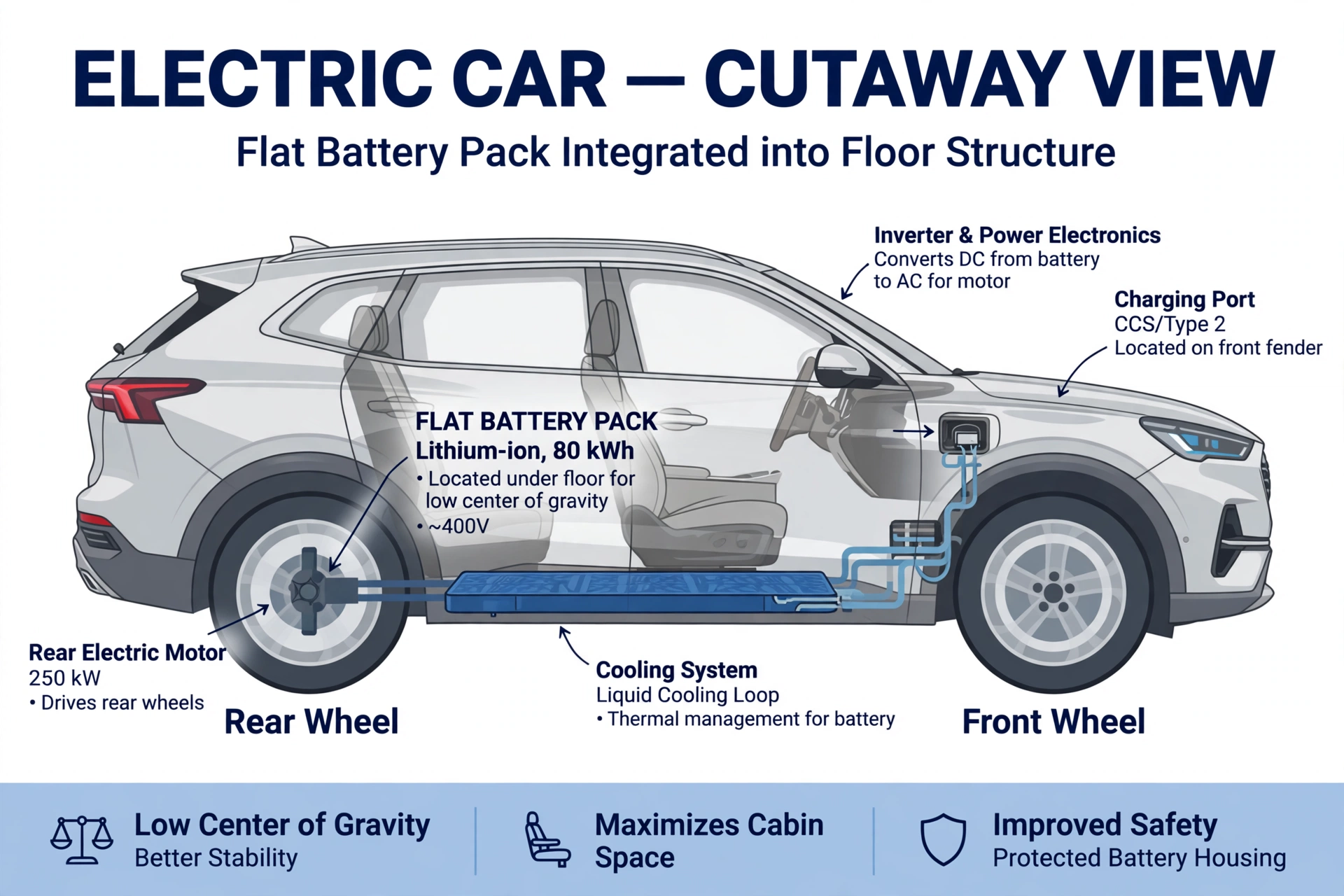
Inside a fully electric car, the team of parts is small: the battery pack is the fuel tank, the inverter is the translator, the motor is the muscle, and a single reduction gear connects the motor to the wheels. A small computer called the battery management system watches over the battery. A petrol car, by comparison, has hundreds of moving parts in its engine and gearbox alone. An electric motor has only a few dozen.
The Battery Pack: A Giant Phone Battery Under Your Feet
Let us start with the biggest part, because everything else depends on it. The battery pack is the heart of an electric car. It is a wide, flat slab that sits under the floor, between the front and back wheels, stretching from one side of the car to the other. Engineers call this shape a skateboard, because the whole car is built on top of it, like a rider standing on a board.
Inside that slab are thousands of small lithium-ion cells, the same kind of battery chemistry that powers your phone and your laptop. Each cell is small, about the size of a finger, but wired together, they add up to something enormous. A typical family electric car today carries a battery of around 50 to 80 kilowatt-hours — just a way of measuring how much energy it can hold, like the size of a fuel tank. A bigger number means the car can drive further before it needs charging.
Why put the battery under the floor? Two good reasons. First, it is heavy — often 400 to 500 kilograms, about the weight of a small piano — and putting that weight low down keeps the car steady, like carrying a heavy bag low in a rucksack instead of on your shoulders. Second, it leaves the rest of the car free. With no engine in front and no fuel tank at the back, there is more room for people and luggage.
The battery sits inside a strong metal case, cooled by liquid running through thin channels, and the battery management system watches every cell, stepping in if one gets too hot or too full.
One more thing: the battery stores its electricity as direct current, or DC. That matters, because the motor needs a different kind of current. And that brings us to the next part of the team.
The Inverter: The Translator in the Middle
Between the battery and the motor sits a box of electronics about the size of a shoebox. It does not look like much. But without it, the car would not move at all. Its name is the inverter, and its job is to translate.
Here is the problem it solves. The battery stores electricity as direct current, DC, which flows steadily in one direction, like water flowing down a straight pipe. But most electric car motors need alternating current, AC, which changes direction many times a second, like waves rolling back and forth on a beach. The two kinds of current do not match, so the inverter changes one into the other.
It does this with tiny electronic switches that flick on and off thousands of times every second, chopping the steady DC into a rippling AC wave. By changing how fast the wave ripples and how strong it is, the inverter controls exactly how fast the motor spins and how hard it pulls.
The inverter is also the car’s dimmer switch: a trickle of power for crawling through a car park, the full tap for joining a fast motorway. And when you brake, it runs the whole process in reverse, turning the AC coming back from the motor into DC to refill the battery.
The Motor: Small, Strong, and Almost Silent
Now we come to the muscle. The electric motor in a car is not much bigger than a watermelon, and it usually sits between the wheels, low down in the car. Some cars have one motor. Some have two, one for the front wheels and one for the back. But the idea is the same in every case.
Inside the motor there are two main parts. The outer part, called the stator, stays still. The inner part, called the rotor, spins. Around the stator are coils of copper wire. When the inverter sends its rippling AC through those coils, they become electromagnets — magnets made by electricity. Those magnets pull on the rotor, which has strong permanent magnets of its own, and the rotor turns. The turning rotor is connected to the wheels, and the car moves.
The most common kind is called a permanent-magnet synchronous motor, though some cars use an induction motor instead. Either way, just remember the picture: magnets pulling magnets around in a circle, faster and faster, with no fire and no smoke.
An electric motor has two talents that a petrol engine can only dream of. The first is that it gives its full pulling power, its full torque, from the very first moment it starts turning. A petrol engine has to rev up, like a singer warming up before the big note. An electric motor hits the big note at once — which is why electric cars leap away from traffic lights so quickly.
The second talent is that the motor can spin very fast — up to around 15,000 turns a minute — and still work well, which is why an electric car needs no gearbox at all.
Electric motors are not only in cars, either. The little motors that spin the propellers of a flying drone work on the same principle, just smaller. If you want to see the same idea in the sky, read our simple guide to how a drone flies.
Why There Is No Gearbox, No Clutch, and No Exhaust
Open the bonnet of a petrol car and you will find a crowded mess: an engine block, pipes, belts, a gearbox, a clutch, and an exhaust system snaking underneath. Open the bonnet of an electric car and you will mostly find empty space, a small motor, and some electronics. The difference follows from how the motor works.
A petrol engine only makes good power at certain speeds, so it needs a gearbox to keep it in its happy range, and a clutch to connect and disconnect it from the wheels. All of that adds weight, noise, and things that can break.
An electric motor has no such problem. It pulls hard from zero speed all the way up to high speed, so one single gear is enough. Engineers call it a reduction gear: it simply slows the motor’s very fast spin down to a speed that suits the wheels, a bit like the gears on a bicycle. There is nothing to shift, nothing to slip, and no clutch pedal for the driver to press. You just press the accelerator and go.
And the exhaust? There is none, because there is nothing to exhaust. A petrol engine burns fuel, and burning makes smoke and gases that have to go somewhere — out of a tailpipe. An electric car burns nothing, so it makes no smoke and no exhaust gases from the car itself. That is also why there is no oil to change, no spark plugs, and no fuel filter. The list of things that can wear out is much shorter.
It is also why the car is so quiet: most of a petrol car’s noise comes from hundreds of little explosions inside its engine. Electric cars are so quiet at low speed that many make a gentle artificial hum, just to warn people on foot that a car is coming.
Regenerative Braking: Slowing Down Puts Power Back
Here is the part that surprises almost everyone. When a petrol car brakes, all the energy of the moving car turns into heat and floats away into the air. It is gone forever. An electric car can catch some of that energy and keep it.
The trick is that an electric motor can run backwards. When you lift your foot off the accelerator, or press the brake gently, the car’s computer tells the motor to stop pushing and start resisting instead. The wheels, still turning, now turn the motor. The motor becomes a generator — a machine that makes electricity from movement — and the electricity it makes flows back through the inverter and into the battery. The car slows down, and the battery gains a little charge. Two good things at once.
This is called regenerative braking, and it is most useful in town driving, where you are always slowing down for traffic lights, corners, and crossings. In stop-start traffic, it can recover a fifth or more of the energy that would otherwise be lost, which stretches how far the car can go on one charge. Down a long hill, the effect is even stronger: the car rolls downhill, the motor keeps generating, and the battery quietly fills up while gravity does the work.
Many electric cars offer one-pedal driving: lift your foot off the accelerator, and the car slows down firmly all by itself. The ordinary friction brakes are still there for sudden or hard stops, but because they are used less, their pads last much longer than in a petrol car.
That is a big part of why electric cars are so efficient. The United States Department of Energy says a typical electric vehicle turns about 87 to 91 percent of its energy into movement, once regenerative braking is counted. A typical petrol car manages only about 30 percent. The rest goes out as heat, noise, and exhaust.
Charging: At Home Overnight, or Fast on the Road
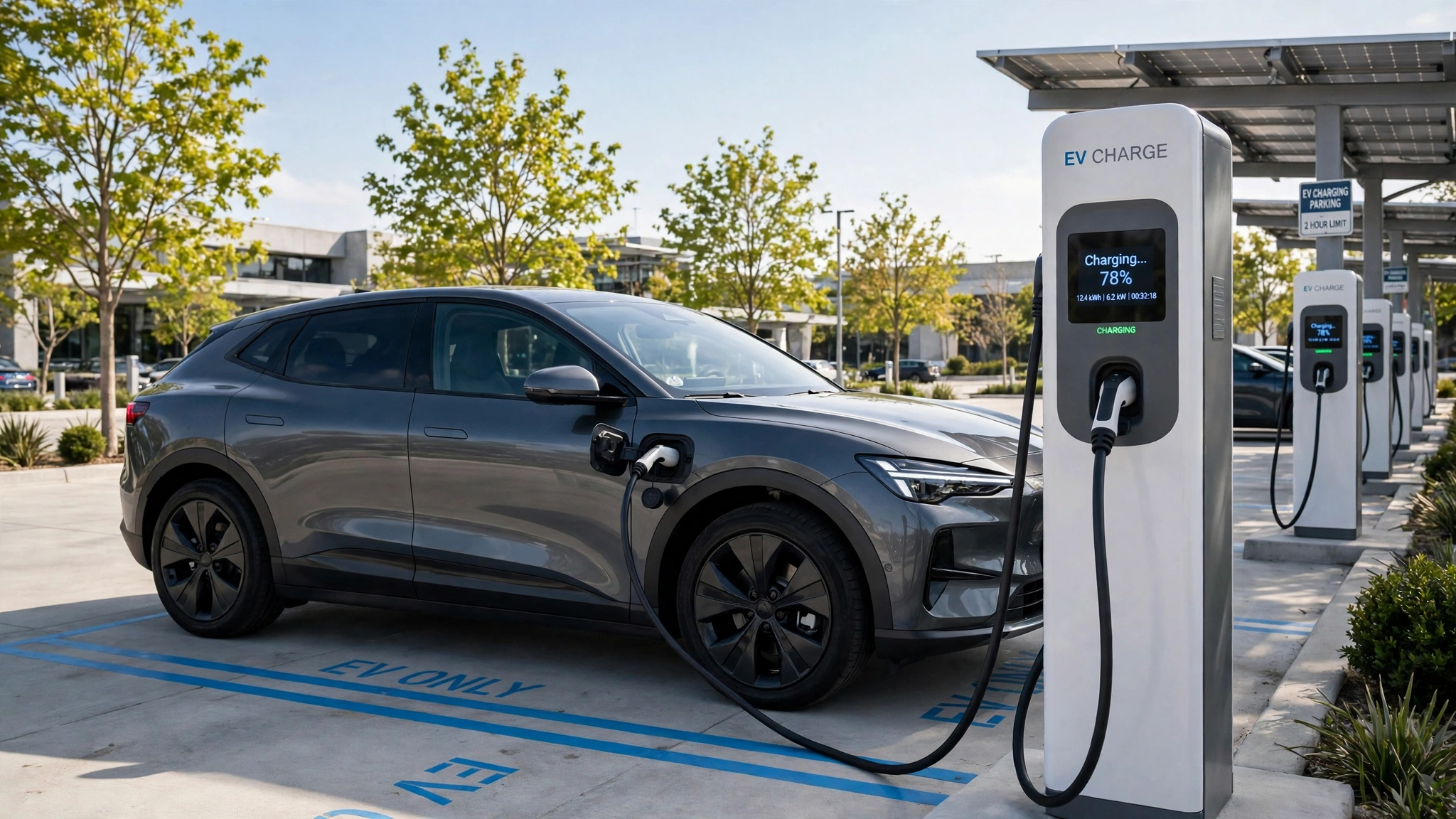
If the battery is the fuel tank, then charging is the filling station — except the filling station can be your own driveway. There are three speeds of charging, and it helps to know them all.
The slowest is a normal household socket, called Level 1 charging. You plug the car in like a phone, and it trickles power in — so slowly it can take a day or more to fill a big battery. It is a backup, not a plan.
The everyday way is Level 2 charging: a dedicated wall box at home, or a charger at work or in a car park, running on a stronger 240-volt supply, similar to what powers an electric cooker. A Level 2 charger usually fills a car in about 4 to 10 hours — but you are asleep for most of it. You plug in when you get home, and the car is full by morning, the way your phone is full by morning. For most owners, this is how nearly all charging happens.
The fastest way is DC fast charging, the big chargers at motorway services and public charging stations. These pour direct current straight into the battery at high power. In warm weather, a fast charger can take a battery from about 20 percent to about 80 percent in roughly 20 to 30 minutes — about the time it takes to buy a coffee. Past 80 percent, the car slows the charge down on purpose, to protect the battery, so experienced drivers on long trips usually stop at about 80 percent and drive on.
How do you find a charger on a long trip? The car’s sat-nav usually plans the stops for you, and it knows where the chargers are because it knows where you are — using the same satellite signals that guide your phone. We explained that system in our simple guide to how GPS knows where you are.
Range and Cold Weather: What Really Happens in Winter
The question everyone asks about an electric car is simple: how far can it go? The answer is that it depends, and the honest version is worth knowing before you buy one.
Range means how far the car can drive on one full charge. It depends on the size of the battery, how fast you drive, how hilly the road is, and the weather. A typical modern family electric car can go roughly 300 to 450 kilometres on a full charge in mild weather. Motorway driving at high speed uses more energy than gentle town driving, because pushing through the air gets harder the faster you go — and in town, regenerative braking keeps giving energy back.
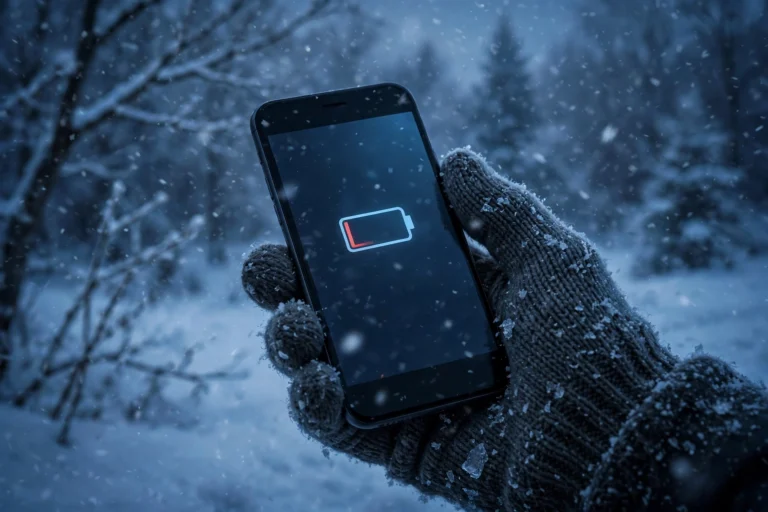
Cold weather is the part people worry about most, and it is real, though it is often exaggerated. Lithium-ion batteries do not like the cold. The chemical reactions inside them slow down when temperatures fall, so the battery holds less usable energy and charges more slowly. In freezing weather, most electric cars lose roughly 20 to 30 percent of their range. A car that goes 350 kilometres in summer might go about 250 kilometres on a freezing winter day. Heating the cabin makes it worse, because the heater draws its power from the same battery that drives the wheels.
There are good fixes. The best one is called preconditioning: while the car is still plugged in at home, it warms up its own battery and cabin using power from the wall, not from the battery. Seat heaters help too, because warming your seat uses far less energy than warming the whole cabin. And fast charging in deep cold takes longer — sometimes twice as long — because the battery management system warms the cold cells first before it lets the full power in.
None of this is permanent. When spring comes, the range comes back, and the car behaves exactly as it did before.
A Short History: Electric Cars Are Older Than You Think
Here is a twist that surprises people: the electric car is not new at all. Small electric carriages were built in the 1830s, and by the late 1890s, electric taxis were already carrying passengers through the streets of New York and London. They were quiet, clean, and easy to drive, and for a while, many people thought electricity would win the race.
Petrol won instead, because petrol cars could drive much further before refuelling, and petrol was cheap and easy to find. Petrol stations spread, roads improved, and the electric car faded away for most of the twentieth century. The story of how the petrol car itself began is told in our article about who invented the first car.
What brought the electric car back was the battery. For decades, batteries were too heavy and too weak to power a useful car. Then lithium-ion batteries, the kind first made for phones and laptops, got better and cheaper, year after year. By the 2010s, an electric car could finally go far enough and charge fast enough for ordinary families, and the quiet car that had lost the race a hundred years earlier came back to win the next one.
Myths, and a Few Simple Tips
A few myths about electric cars still float around, so let us clear them up quickly.
Myth one: electric cars catch fire all the time. Not true. Fires can happen in any car, usually after a serious crash, and electric cars catch fire less often per mile driven than petrol cars — though a battery fire is harder to put out. It is a real risk, but a small one.
Myth two: the battery dies after a few years and costs a fortune to replace. Not true either. Modern batteries are built to last the life of the car, and most makers guarantee them for eight years or more. They do lose a little capacity over many years, the way a phone battery does, but slowly.
Myth three: electric cars are useless in the rain. Not true. The battery and all the high-voltage parts are sealed against water, and electric cars drive through rain, puddles, and car washes every day.
A few simple tips, if you ever drive one: learn one-pedal driving in a quiet street first, charge to about 80 percent for daily use, and precondition the car while it is plugged in on cold mornings.
Frequently Asked Questions
How does an electric car work in simple words?
An electric car stores electricity in a big battery pack under the floor. When you press the accelerator, the battery sends power to the inverter, which changes it into the kind of current the motor needs, and the motor turns that power into spinning movement. There is no petrol engine, no gearbox, and no exhaust pipe.
What is the difference between an electric car and a hybrid?
A fully electric car runs on a battery alone and has no petrol engine. A hybrid has both a petrol engine and a small electric motor, and it switches between them. A plug-in hybrid has a bigger battery you can charge from a socket, but it still has a petrol engine. Only the fully electric car never needs petrol at all.
How long does it take to charge an electric car?
A home wall box usually takes about 4 to 10 hours, which is fine because it happens overnight while you sleep. A public DC fast charger can take a battery from about 20 percent to about 80 percent in roughly 20 to 30 minutes in warm weather. A normal household socket is much slower and is best kept as a backup.
How far can an electric car go on one charge?
A typical modern family electric car can go roughly 300 to 450 kilometres on a full charge in mild weather, though it varies a lot by model. Driving fast on a motorway uses more energy, while gentle town driving uses less, because regenerative braking keeps putting energy back. Cold weather can cut the range by roughly 20 to 30 percent, though preconditioning while plugged in helps a lot.
What is regenerative braking?
Regenerative braking is the electric car’s way of catching energy when it slows down. When you lift your foot off the accelerator or press the brake gently, the motor runs in reverse and acts like a generator, turning the car’s movement back into electricity for the battery. In town driving, it can recover a fifth or more of the energy a petrol car would waste as heat.
Do electric cars need oil changes or a gearbox?
No. An electric car has no engine oil to change, no spark plugs, and no exhaust system. Its motor gives full pulling power from a standstill and spins well across a wide range of speeds, so it needs only a single reduction gear instead of a multi-speed gearbox, and there is no clutch pedal. That is why servicing one is usually simpler and cheaper.
More from Zorium Daily
- Who Invented the First Car?
- How Does a Drone Fly?
- How Does GPS Know Where You Are?
- How Does a Radio Work?
The next time a car glides past you in near silence, you will know what is happening under its skin: a flat pack of batteries under the floor, quietly holding the energy, an inverter translating thousands of times a second, and a small motor pulling hard with magnets instead of fire. It took more than a hundred years, a few false starts, and a much better battery — but the quiet car has finally arrived, and it is here to stay.