
What Is a Loan and How Does It Work?
SUMMARY OF THIS ARTICLE
- A loan is money you borrow from a lender and pay back over time, with extra money called interest.
- The principal is the amount you borrow, the interest rate is the price of borrowing, and the APR shows the fuller yearly cost, including most fees.
- Most loans are paid back in fixed monthly payments that cover both interest and part of the principal.
- Common types are personal loans, home loans, car loans, and student loans, and each one fits a different need.
- Your credit record, income, and other debts help a lender decide whether to say yes and what rate to offer.
Imagine you want to buy a car, but it costs more than you have saved. You could wait for years and save a little each month, or borrow the money now and pay it back bit by bit. That is what a loan is for: it lets you use money today and pay for it over time.
Loans are a normal part of adult life. People use them to buy homes, cars, and an education. Used with care, a loan can open a door that would stay shut for years. Used without care, it can become a heavy weight. This article is general information only, not personal financial advice. All dollar amounts and rates below are examples only, not real offers. Rules change from country to country, so check the rules where you live and read any loan agreement in full before you sign it.
What Is a Loan?
A loan is a simple deal between two sides. One side is the lender, usually a bank, a credit union, or another licensed firm that lends money. The other side is the borrower, the person who takes the money and promises to pay it back.
The lender gives the borrower a sum of money now. The borrower agrees to pay it back over a set time, usually in monthly payments, plus extra money for the use of the money. That extra money is called interest. It is the price of borrowing, and how the lender earns money from the deal.
A loan is a legal agreement, written down in a document that lists how much you borrow, the rate, the term, the monthly payment, and the fees. It also lists what happens if you pay late. Both sides sign it and must follow it. Always read it before you sign. If a word is unclear, ask the lender to explain it in plain words.
A loan is different from your own savings. Money from a savings account is your own money, and you owe nothing to anyone. A loan is someone else’s money, and you must pay it back with interest. A loan is not free money. It is money you pay for, over time.
The Four Parts of Every Loan
Every loan has four main parts: the principal, the interest rate, the term, and the monthly payment. Learn these four, and you can understand almost any loan offer.
The principal is the amount of money you borrow. If you borrow 10,000 dollars, the principal is 10,000 dollars. Interest is worked out on the principal, so a bigger principal means more interest in total. Part of each payment pays the interest, and part cuts the principal. As the principal shrinks, the interest shrinks too.
The interest rate is the price of borrowing, shown as a yearly percentage. If a loan has a rate of 10 percent a year, it costs about 10 dollars a year for every 100 dollars you still owe. The rate can be fixed or variable. A fixed rate stays the same for the whole life of the loan, so your payment stays the same. A variable rate can go up or down, so your payment can change. A fixed rate is easier to plan around. A variable rate may start lower, but it can rise later.
The term is how long you have to pay the loan back. A personal loan often runs for two to seven years, a car loan for three to seven years, and a home loan for 15 or 30 years. A longer term means smaller monthly payments, but more interest in total. A shorter term means bigger monthly payments, but less interest in total.
The monthly payment is worked out from the principal, the interest rate, and the term. Most loans have a fixed monthly payment. Part of each payment goes to interest, and part goes to the principal. At the start, most goes to interest, because the principal is still large. Near the end, most goes to the principal. For example, borrowing 1,000 dollars at 10 percent a year for one year would mean a monthly payment of about 88 dollars, and about 1,055 dollars paid in total.
What Is APR, and Why Does It Matter?
When you compare loans, you will see two numbers that look alike: the interest rate and the APR. APR stands for Annual Percentage Rate. It is the yearly cost of borrowing, shown as a percentage, and it includes the interest rate plus most of the fees the lender charges. That makes APR the better number for comparing.
The interest rate tells you the rate used to work out the interest. The APR tells you the fuller yearly cost. Because APR includes fees, it is usually a little higher than the interest rate. If the APR is much higher, the fees are large, and the offer deserves a closer look.
Fees can take many forms: a fee for setting up the loan, a fee for late payments, or a fee for paying off early, called a prepayment fee. Not every loan has all of these. In many countries, the law says lenders must show the APR clearly before you sign. When you shop for a loan, ask for the APR, the term, the monthly payment, the total amount you will pay back, and the full list of fees. Then compare the totals, not just the monthly payments.
How Repayment Works, Month by Month
Most loans are paid back in monthly instalments: one regular payment, made on the same date each month. Each payment is made of two parts, interest and principal. This is called an amortising loan, a long word for a simple idea. Each payment slowly eats away at the debt until nothing is left.
At the start, the balance is at its highest, so the interest part of each payment is also at its highest. Imagine you borrow 10,000 dollars. In the first month, a large part of your payment goes to interest, and a smaller part cuts the principal. The balance falls a little, so next month the interest is a little smaller, and a little more of your payment cuts the debt. Month by month, the balance falls, the interest falls, and more of each payment cuts the debt itself.
On a 30-year home loan, the balance falls very slowly at first, because most of each early payment is interest. That is normal. Your lender will give you a repayment schedule, a table that shows how much of each payment goes to interest and to the principal. Ask for it before you sign.
If you pay late, the lender may charge a late fee, and the late payment may be noted on your credit record, which can hurt your credit score and make future borrowing dearer. If you think you will be late, contact the lender early. Many lenders will talk about a short delay or a new plan. Hiding and saying nothing is almost always the worst choice.
The Main Types of Loans
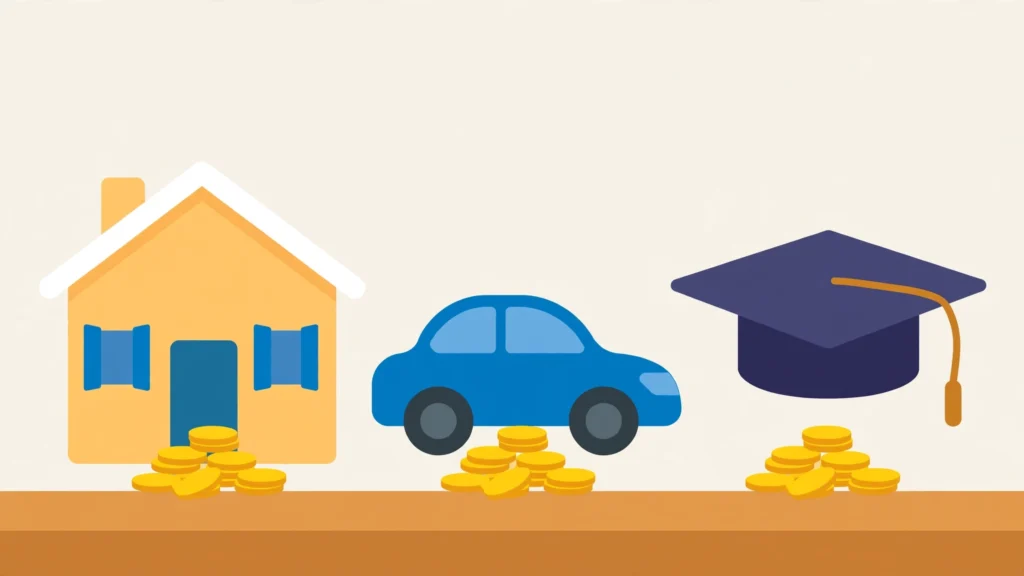
The four most common types are personal loans, home loans, car loans, and student loans. Each one works in a slightly different way, and each one fits a different need.
A personal loan is a loan you can use for almost any purpose. People use them for a wedding, home repairs, or to bring several small debts into one loan. The amount is often from a few hundred to tens of thousands of dollars, and the term is often two to seven years. The money is usually paid into your bank account in one sum, to be paid back in fixed monthly payments. Because a personal loan is often unsecured, the interest rate is often higher than on a home loan or a car loan.
A home loan, also called a mortgage, is a loan to buy a home or land. It is usually the biggest loan a person ever takes. The amount can be hundreds of thousands of dollars, and the term is often 15 or 30 years. The home itself is the security. If the borrower stops paying, the lender can sell the home to get its money back. Because the loan is secured, the rate is often lower than on a personal loan. The borrower usually pays a deposit first, from their own savings, and borrows the rest.
A car loan, also called an auto loan, is a loan to buy a car or another vehicle. The term is often three to seven years, and the car itself is usually the security. If the borrower stops paying, the lender can take the car back. Car loans can come from a bank or from the car seller, so compare both. A shorter loan costs less in interest, but the monthly payment is higher. A longer one has a lower payment, but you may still be paying for a car that has lost much of its value.
A student loan is a loan to pay for education, such as university fees and living costs while you study. In many countries, student loans have special rules. The rate may be lower, and repayment may not start until after you finish studying and earn above a set income. Some come from the government, and others from banks. Check the exact terms in your country, because the rules differ a great deal from place to place.
Secured Loans and Unsecured Loans
Loans are also split into two groups: secured and unsecured. A secured loan has something of value backing it. An unsecured loan does not.
In a secured loan, you offer an asset as security. An asset is something valuable you own, such as a house or a car. This is also called collateral. If you stop paying, the lender has the legal right to take the asset and sell it to recover the money. A home loan is secured by the home, and a car loan by the car. Because the lender has this safety net, the rate is usually lower. The risk for you is clear. If you cannot pay, you can lose the asset.
In an unsecured loan, there is no asset backing the loan. A personal loan is often unsecured. The lender cannot take your home or car, because nothing was offered as security. But it can still chase the debt, charge fees, take the matter to court, and note missed payments on your credit record. Because the lender takes more risk, the rate on an unsecured loan is usually higher. A secured loan is often cheaper, but it puts an asset at risk. An unsecured loan is often dearer, but it does not put your home or car on the line.
How Lenders Decide Whether to Say Yes
Before a lender says yes, it checks whether you are likely to pay the money back. This check is called a credit assessment.
The first thing it looks at is your credit record and your credit score. Your credit record is a file that lists the money you have borrowed in the past and how you paid it back. Did you pay on time? Did you miss payments? Your credit score turns those facts into one number. A higher score usually means a yes, a lower rate, and more choice. A lower score can mean a no, a higher rate, or a smaller loan.
The second is your income. The lender wants to see that you earn enough to make the payments after your other costs. It will usually ask for pay slips or bank statements. A steady income helps. Income that changes a lot each month can make a lender more careful.
The third is your other debts. The lender adds up what you already owe each month, such as other loans, card payments, and rent. Then it compares that total with your income. If your debts already take a large share of your pay, a new loan may be too much. This is called the debt-to-income ratio, a long name for a simple sum: after your must-pay costs, is there enough left for this new payment?
The lender may also ask what the loan is for, and whether you have savings. Having a small emergency fund can work in your favour, because it shows you can handle a sudden bill without missing a payment. These checks are a practical test of whether the loan is affordable for you right now.
How to Apply for a Loan, Step by Step
First, work out how much you truly need. Do not borrow more than the job requires. If a car costs 8,000 dollars and you have 2,000 dollars saved, you need to borrow 6,000 dollars, not 10,000.
Second, check your credit record. In many countries you can get a free copy of your credit report. If you find a mistake, ask for it to be fixed before you apply. A fixed mistake can improve your score and your offer.
Third, compare at least three offers. Look at the APR, the term, the monthly payment, the total amount you will pay back, and the fees. Do not pick a loan by the monthly payment alone. A low payment over a very long term can cost far more in total.
Fourth, gather your documents. The lender will usually ask for a photo ID, proof of your address, and proof of your income, such as recent pay slips or bank statements.
Fifth, fill in the application and read the agreement before you sign. Check the principal, the rate, the APR, the term, the monthly payment, and the fees. Check what happens if you pay late, and whether there is a fee for paying early. Do not sign a document you have not read.
Sixth, once the loan is approved, the money is usually paid into your bank account, or straight to the seller. Your first payment is usually due about a month later. Set up an automatic payment on or before the due date, so you never miss one by accident. Then keep the agreement somewhere safe, and check your statements each month.
The Good Side of Borrowing
Loans have a bad name in some homes, but they also have a good side when they are used with care. First, a loan lets you buy something important now, instead of waiting many years. A home, a car to get to work, or an education can change your life. Second, a loan can help you build a credit record. Each on-time payment adds a good mark to your file, and over time a steady record can raise your credit score, which can lead to better offers in the future. Third, a loan can bring many small debts into one. One loan with a lower rate and one monthly payment can be simpler and cheaper, as long as you do not run up the old debts again. Fourth, a fixed-rate loan has the same monthly payment every month, which makes it easy to plan. A simple monthly budget can hold the loan payment as one steady line, with no surprises.
The Risks You Must Understand
A loan is a promise, and promises have weight. The biggest risk is borrowing more than you can afford. If your income drops or a sudden bill arrives, a large monthly payment can become very hard. Ask yourself: could I still pay if my pay fell a little? The second risk is the total cost. The monthly payment looks small, but the interest over many years can be large, so always look at the total you will pay back. The third risk is a variable rate, which can rise and push your payment up. The fourth is fees and late payments, which can hurt your credit score. The fifth is losing security. On a secured loan, you can lose your home or your car if you cannot pay. Never borrow against your home for a want. If you do get into trouble, contact the lender early. Many lenders will talk about a short break or a new plan. Hiding is almost always the worst choice.

Common Mistakes to Avoid
The first mistake is borrowing for a want, not a need. A loan for a home, a car to get to work, or an education is a need for most people. A loan for a holiday or a new phone is a want. Wants fade fast, but the loan stays for years. The second mistake is looking only at the monthly payment. A low payment over a long term often means far more interest in total. Always compare the total amount you will pay back. The third mistake is taking the first offer. Comparing three offers can save a large sum. The fourth is ignoring the fees. Read the fee list and ask for the APR. The fifth mistake is borrowing without a safety net. Even a small emergency fund can keep a surprise bill from turning into a missed payment. The sixth mistake is missing payments. Set up automatic payments and put the due date in your calendar.
Five Questions to Ask Before You Borrow
One: do I truly need this loan now, or can I wait and save? Two: how much will I pay back in total, and can I afford the payment every month? Three: is the rate fixed or variable, and what is the APR? Four: what are the fees, including fees for paying early or late? Five: what happens if my income drops? If your answers are clear and calm, you are ready to choose. If they are rushed or unclear, take more time.
Frequently Asked Questions
What is the difference between a loan and a credit card?
A loan gives you a fixed sum at once, paid back in set monthly payments over a fixed term. A credit card gives you a limit you can borrow up to, pay back, and borrow again. A loan fits one big cost with a clear plan. A card fits small, short borrowing you can pay off fast.
How much can I borrow?
It depends on your income, your other debts, your credit record, and the lender’s rules. The lender works out what you can afford each month, then offers a loan that fits. Borrow only what you need, and only what you can pay back even in a hard month.
Does applying for a loan hurt my credit score?
Applying usually causes a hard check on your credit file, which can lower your score by a small amount for a short time. One check is a small effect. Many checks in a short time can have a bigger effect. Compare offers first, then apply to one or two lenders.
Can I pay off a loan early?
In many cases, yes. Paying early cuts the balance faster and saves future interest. But some loans charge a fee for early repayment, so check your agreement first.
What happens if I miss a loan payment?
You may be charged a late fee, and the missed payment may be noted on your credit record, which can lower your credit score. If you miss many payments, the lender may take further steps, and on a secured loan, it may move to take the asset. Contact the lender early if you think you will miss a payment.
Is it better to save up or to take a loan?
If you can wait, saving is almost always cheaper, because you pay no interest. If you need the thing now, such as a car to get to work or a repair that cannot wait, a loan can be the right tool. Often the best choice is a mix: save a deposit first, then borrow a smaller sum.
More from Zorium Daily
- What Is a Credit Score and Why Does It Matter?
- How Does Credit Card Interest Work?
- How to Make a Simple Monthly Budget That Actually Works
- How Do Banks Make Money?
A loan is a tool. Like any tool, it can build or it can hurt, and the difference is in how you use it. Learn the four parts: the principal, the interest rate, the term, and the monthly payment. Compare the APR, not just the interest rate. Look at the total cost, not just the monthly figure. Borrow only for needs that matter, only what you can afford, and only after you have read the agreement in full. Do that, and a loan can help you buy a home, a car, or an education, and pay for it calmly, month by month, until the balance reads zero.