How Does a Fridge Keep Food Cold? Explained Simply
SUMMARY OF THIS ARTICLE
- A fridge does not make cold. It moves heat out of the food and out of the box.
- A special liquid called refrigerant soaks up heat inside the fridge and lets it go outside at the back.
- A pump called a compressor squeezes that liquid and keeps it moving around in a loop.
- Cold slows down the tiny germs that spoil food, so your milk and vegetables last longer.
- Keeping the door shut, not overfilling it, and cleaning the coils help your fridge work better.
Open the Door and Feel That Cold Air
You have done it a thousand times. You open the fridge, cold air washes over your face, and you stare inside wondering what to eat. Then you shut the door and forget about it. It just sits there in the kitchen, humming away, keeping your milk fresh and your leftovers safe.
But how does it actually do that? Here is the first surprise: a fridge does not make cold. There is no such thing as a cold-making machine hiding in the back. Cold is not a thing you can make, like heat from a fire. Cold is just the absence of heat. So what a fridge really does is steal heat from inside the box and dump it outside the box. Take the heat away, and what is left feels cold.
Think of it like this. Imagine your fridge is a small room, and heat is a crowd of noisy guests inside it. The fridge’s job is to keep escorting those guests out of the door, one group at a time, so the room stays quiet and cool. It never stops, because heat keeps sneaking back in through the walls and every time you open the door.
That is the big idea. Everything else in this article is just the clever way engineers built a machine to do that job, day and night, without you ever noticing.
Why Food Goes Bad Without a Fridge
Before we look inside the machine, it helps to know why cold matters at all. Why does milk go sour on a warm counter but stay fine in the fridge for days?
The answer is tiny living things. Bacteria are microscopic germs, far too small to see, that live everywhere — on food, in the air, on your hands. Some of them are harmless. Some of them spoil food. And a few can make you sick. Bacteria love warm food. At room temperature, they eat, grow, and split into two, then four, then eight, doubling again and again. Warm milk is a feast for them.
Cold does not kill most bacteria, but it slows them right down. It is like pressing a pause button. In a fridge, at around 4 degrees Celsius, bacteria grow so slowly that your food stays fresh for days instead of hours. In a freezer, at minus 18 degrees, they stop growing almost entirely. That is why frozen food can last for months.
Mould is another troublemaker. Mould is the fuzzy green or white stuff that grows on old bread and fruit. It is a kind of fungus, a tiny plant-like living thing. Cold slows mould down too, though it does not stop it completely. That is why even fridge food goes bad in the end. The fridge buys you time. It does not buy you forever.
People knew this long before fridges existed. They kept food in cool cellars, in streams, in ice houses packed with winter ice. A fridge is just the modern, automatic version of that old idea: keep food cold, keep the germs sleepy, and dinner stays safe.
The Clever Liquid That Carries Heat Away
So how does the fridge move heat out? It uses a helper: a special liquid called a refrigerant. Refrigerant is a chemical that can turn from a liquid into a gas and back again very easily, at temperatures that suit a fridge. You never see it, because it runs in sealed pipes, a bit like blood running in veins, hidden inside the machine.
Here is the loop, step by step, in plain words.
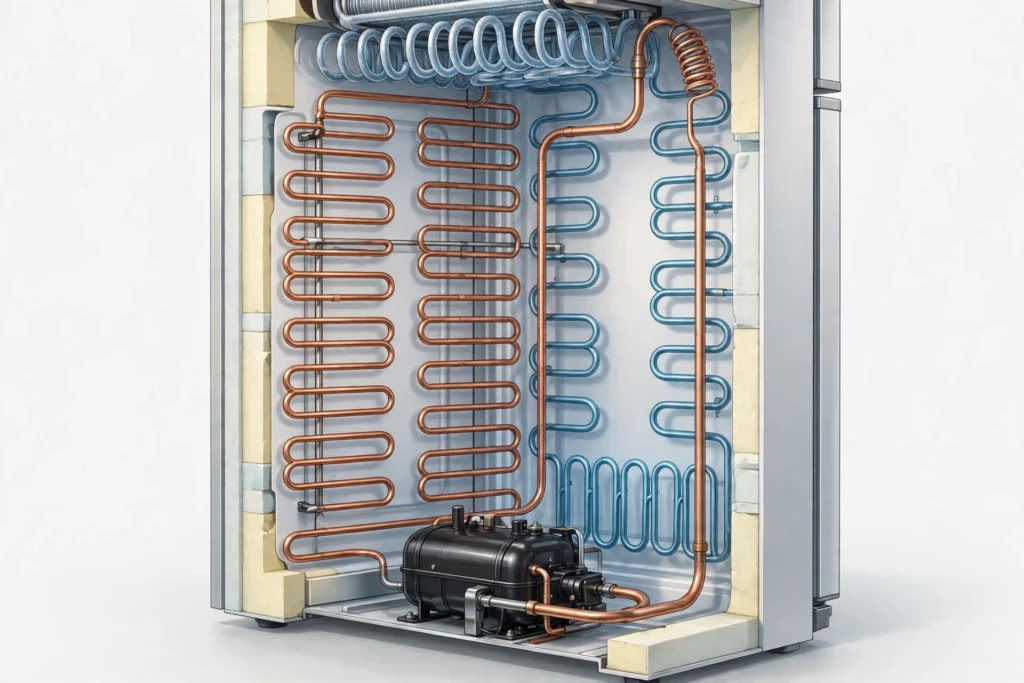
First, the cold liquid refrigerant flows through pipes inside the fridge, in a part called the evaporator. Evaporator is a fancy name for the pipes where the liquid evaporates — that is, turns into a gas. As it turns into a gas, it soaks up heat from the food and the air inside the fridge. Think of it like a sponge soaking up water. The sponge here soaks up heat. The inside of the fridge gets colder, and the refrigerant gas gets warmer.
Second, that warm gas travels to the back of the fridge, to a pump called the compressor. The compressor squeezes the gas hard, like squeezing a sponge. Squeezing makes the gas hotter and pushes it into a new set of pipes, called the condenser, which sits at the back of the fridge. Condenser is where the gas condenses, or turns back into a liquid.
Third, in those back pipes, the hot gas lets go of its heat into the air of your kitchen. That is why the back of a fridge feels warm. The gas cools down, turns back into a liquid, and the loop starts again. Round and round, hour after hour, heat is carried from inside the box to outside the box.
That is the whole trick. No cold is made. Heat is just moved, like carrying buckets of water out of a boat so it does not sink. The refrigerant is the bucket. The compressor is the person doing the carrying. And your kitchen air is where the buckets get emptied.
Why Your Fridge Hums and Gets Warm at the Back
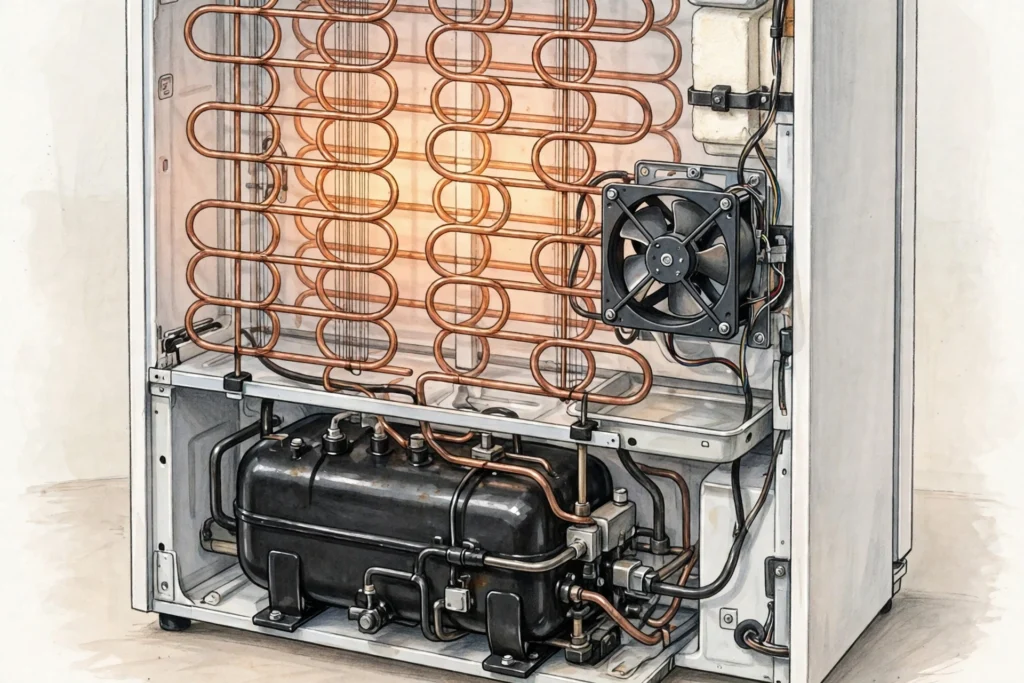
If you have ever pressed your hand against the back of a fridge, you probably pulled it away in surprise. It is warm. Sometimes it is quite hot. And that is exactly how it should be. Remember: the heat from inside the fridge has to go somewhere. It goes out the back, into your kitchen.
That warm feeling is the condenser coils doing their job. The coils are the long, winding pipes at the back. They give the hot gas lots of surface to touch the air, so the heat can escape. Some fridges have a small fan that blows air over the coils to help the heat escape faster. That fan, plus the compressor, is what makes the humming sound.
You have probably noticed the hum comes and goes. The fridge hums, then goes quiet, then hums again. That is the thermostat at work. A thermostat is a small device that watches the temperature inside the fridge, like a guard with a thermometer. When the inside warms up a little — because you opened the door, or put in warm leftovers — the thermostat switches the compressor on. When the inside is cold enough again, it switches it off. On, off, on, off, all day and night. Your fridge is not lazy. It is resting between shifts.
The freezer works the same way, only colder. The same loop runs, but the refrigerant gets even colder in the freezer pipes, cold enough to turn water to ice and keep your frozen peas solid for months.
One more thing you might have noticed: the outside of a fridge can feel warm on the sides, too. In many modern fridges, the condenser pipes run inside the walls, so the sides give off heat. It is normal. It means the machine is working. But it also means your fridge needs space to breathe. Push it right against a wall with no gap, and the heat cannot escape properly. The fridge has to work harder, uses more electricity, and your food may not stay as cold. A little gap behind the fridge is a kindness to the machine.
A Short History of Keeping Food Cold
Fridges were not always humming in every kitchen. They are a recent guest in human history, and the story of how they arrived is a good one.
Long ago, people kept food cold with ice and snow. In winter, they cut blocks of ice from frozen lakes and stored them in ice houses, buildings dug into the ground and packed with straw for insulation. Insulation is material that slows heat down, like a thick blanket. The ice lasted for months, and people used it to chill food through the summer. Rich families had ice boxes in their kitchens: wooden boxes lined with metal, with a block of ice at the top and food below. Every few days, the ice man came round with a fresh block.
The first real electric fridges appeared in the early 1900s. They were big, noisy, and costly, and only rich people could afford them. Early ones used dangerous chemicals as refrigerants, and a few leaked and harmed people. Engineers worked for years to find safer refrigerants, and by the 1930s and 1940s, fridges were getting safer, smaller, and cheaper.
After the Second World War, fridges became common in homes across America, Britain, and other countries. They changed daily life in a quiet, huge way. People could shop once a week instead of every day. They could keep milk, meat, and vegetables without rushing to eat them. Leftovers became a normal thing. The weekly shop, the packed lunch, the midnight snack — all of them lean on the fridge.
Today, fridges are cleverer still. Some have screens, cameras, and Wi-Fi. Some tell you when the milk is running out. But underneath all the gadgets, the heart of the machine is still the same loop that was invented a hundred years ago: a liquid that soaks up heat inside and lets it go outside. The gadgets change. The physics does not.
How to Help Your Fridge Do Its Job
Your fridge works hard for you, and a little help goes a long way. You do not need to be an engineer. Just a few small habits make a real difference.
First, shut the door. It sounds obvious, but every time the door stands open, warm air rushes in, and the fridge has to work to push that heat back out again. You know the feeling: you open the door, stare at the shelves, and think about what you want. We all do it. But a quick look and a quick shut saves electricity and keeps the food colder. Some fridges even beep at you if the door stays open too long, like a polite little reminder.
Second, do not overfill it. A fridge needs air to move around inside. If you pack every shelf tight, cold air cannot flow, and some corners stay warmer than others. A full fridge is good — food itself holds the cold — but a stuffed fridge is not. Leave a little space between things so the air can wander.
Third, let hot food cool down before you put it in. A steaming pot of soup will warm up the whole fridge, and the fridge will have to work overtime. Let it cool on the counter for a while first, then put it in. Just do not leave it out for hours, because bacteria wake up fast in warm food. An hour or so is fine. Overnight on the counter is not.
Fourth, keep the back coils clean. Dust gathers on those pipes at the back, and dust acts like a blanket, trapping heat. A gentle brush or a vacuum cleaner with a soft brush, once or twice a year, helps the heat escape. Unplug the fridge first, just to be safe, and be gentle with the pipes.
Fifth, check the seal. The seal is the rubber strip around the door that keeps the cold air in. If it is cracked or loose, cold air leaks out all day. A simple test: shut the door on a piece of paper. If the paper slides out easily, the seal may need cleaning or replacing. A clean seal grips the paper. It is a small thing, but it saves money over a year.
Where Things Should Live Inside
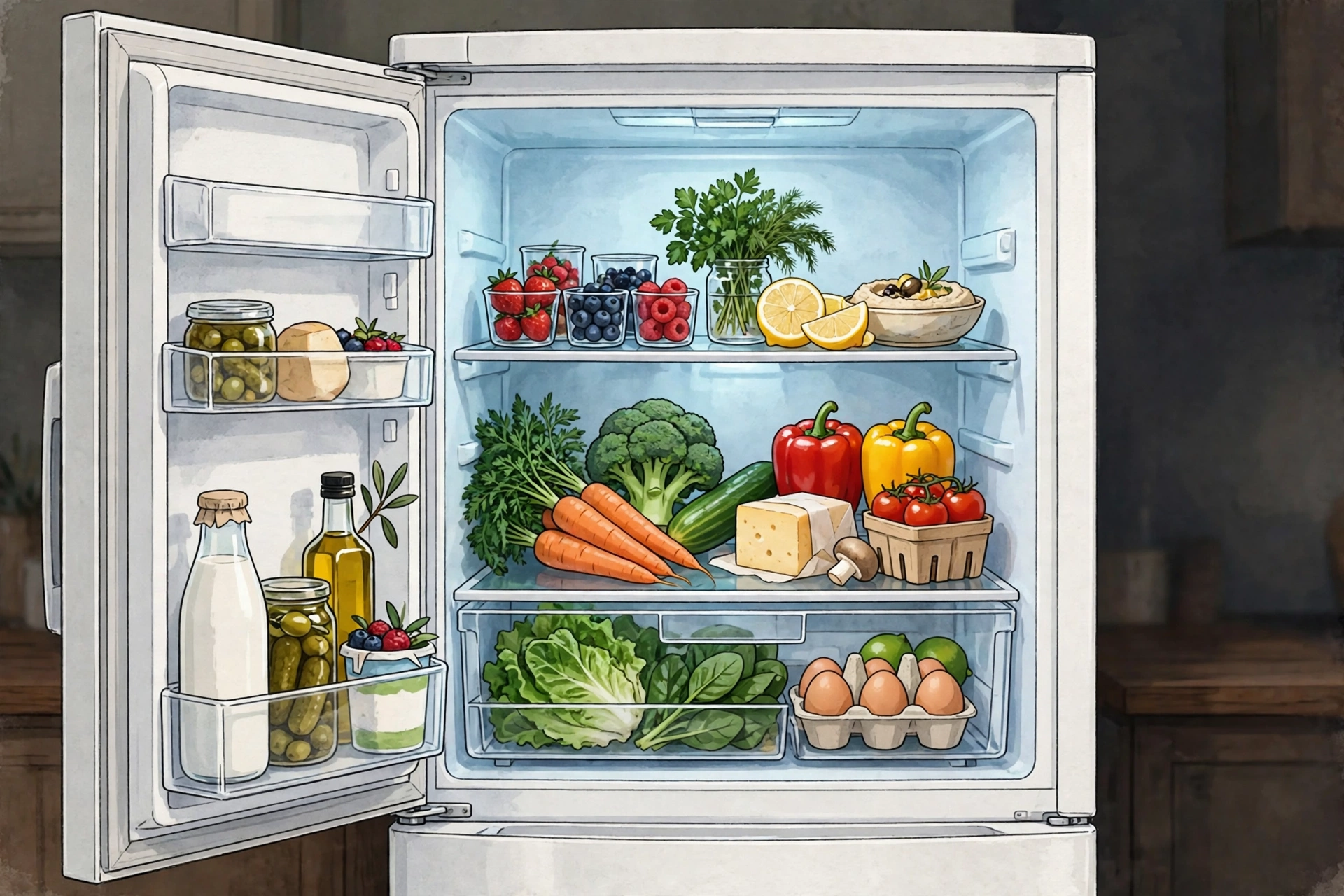
Not every shelf in a fridge is the same temperature. Cold air sinks, so the bottom is usually colder than the top. The door is the warmest part, because it opens and closes all day. Knowing this helps you store food in the right place.
Milk, meat, and fish like the coldest spots, usually the bottom shelf or the back of the fridge, where the air is coldest and steadiest. Eggs and butter are fine in the middle. Sauces, jams, and drinks can live in the door, because they do not spoil as fast. That is why the door has those little shelves shaped for bottles.
Vegetables like the crisper drawer, the big drawer at the bottom. A crisper keeps the air a little more humid, which is a fancy word for damp, and that stops lettuce and carrots from drying out. Some drawers have a little slider to control the air. Leafy greens like it more humid. Fruit likes it a little drier. You do not have to memorise all of this. Just remember: cold and steady at the back and bottom, warmer and busier in the door.
One mistake people make is putting tomatoes in the fridge. Tomatoes lose their flavour and go mealy — soft and grainy — when they get too cold. They are happier on the counter. Onions, potatoes, and bread are also better outside the fridge. Bread goes stale faster in the fridge, and potatoes can turn sweet and strange. The fridge is a wonderful tool, but it is not the right home for everything.
When Your Fridge Starts Acting Strange
Even a good fridge can have a bad day. Here are a few common problems, and what they usually mean.
If your fridge feels warm inside, check the easy things first. Is the door shutting properly? Is the seal dirty? Is the fridge pushed so close to the wall that the back coils cannot breathe? Is the thermostat set too warm? The thermostat dial is usually inside, with numbers from 1 to 5. A middle setting is right for most fridges, around 4 degrees Celsius. If the dial was knocked by a jar, it might be set too low.
If there is frost building up in the freezer, that is frozen water from the air. Every time you open the door, damp air gets in, and the damp turns to frost. A little frost is normal. A thick layer of ice is a sign the door seal is leaking, or the door is being left open too long. Most modern fridges defrost themselves, which means they melt the frost away on their own. Older ones need you to switch them off and let the ice melt. It is a boring job, but your freezer works better without a thick coat of ice.
Bad smells are another common complaint. A fridge smell usually comes from food that has gone bad, or from a spill that was never cleaned. Take everything out, wipe the shelves with warm water and a little baking soda, and check the dates on jars and tubs. A small open box of baking soda inside the fridge can soak up smells. And remember, strong-smelling food like onions should be wrapped up, or everything else will taste of onion by morning.
If the fridge makes a loud banging or rattling noise, it may just be standing on an uneven floor. Fridges have little feet that you can twist to level them. A wobbly fridge rattles. A level fridge hums quietly. If the noise is loud and new, and the fridge is not cooling, it may need a repair person. Do not try to fix the gas pipes yourself. The refrigerant is sealed for a reason, and it needs a trained person to handle it safely.
Your Fridge, Your Money, and Wasted Food
Here is a part people forget: the fridge is not just a machine. It is a money saver. Every time food goes bad and gets thrown away, that is money in the bin. Around the world, households throw away a huge amount of food each year, and much of it could have been saved by storing it properly.
A fridge that works well keeps vegetables crisp for a week, milk fresh for days, and leftovers safe for tomorrow’s lunch. That means fewer trips to the shop, less food thrown away, and more money left in your pocket. If you want to stretch your food budget further, good storage is one of the easiest places to start. We have a simple guide to how to save money on groceries without eating less that pairs well with this — a tidy fridge and a smart shop go together.
It also helps to know what you have. How many times have you bought a second tub of yoghurt because you forgot the first one hiding at the back? A quick tidy-up once a week, bringing older food to the front, saves that kind of waste. Some people call it “shopping your fridge first” — look inside before you go to the shop, and plan a meal around what is already there.
The fridge also uses electricity all day and night, so it is one of the bigger users of power in a home. An old, struggling fridge can cost a lot to run. A modern fridge with a good energy rating uses far less. If your fridge is very old, noisy, and warm, replacing it might save you money over a few years, even though a new one costs money up front. Keep the door shut, keep the coils clean, and your fridge will thank you with lower bills.
Frequently Asked Questions
How does a fridge keep food cold?
A fridge does not make cold. It moves heat out. A liquid called refrigerant soaks up heat from inside the fridge as it turns into a gas, then carries that heat to the back, where it lets the heat go into your kitchen air and turns back into a liquid. A pump called a compressor keeps the liquid moving round in a loop, and a thermostat switches the pump on and off to hold the right temperature.
Why is the back of my fridge warm?
Because that is where the heat goes. The heat taken from inside the fridge has to leave somewhere, and it leaves through the coils at the back. Warm coils mean the fridge is working properly. If the back is cold and the inside is warm, something may be wrong, and you should check the settings and the door seal first.
What temperature should a fridge be?
Around 4 degrees Celsius is right for most fridges. That is cold enough to slow bacteria down, but not so cold that your lettuce freezes. A freezer should be around minus 18 degrees Celsius. A cheap fridge thermometer, placed on a shelf, tells you the real temperature, because the dial numbers do not always match.
Why does my fridge hum and then go quiet?
The hum is the compressor and fan working. The thermostat switches them on when the inside warms up, and off again when it is cold enough. This on-and-off cycle is normal. A constant loud noise, or a fridge that never hums at all while food goes warm, is worth checking.
How long does food last in the fridge?
It depends on the food. Milk usually lasts several days after opening. Cooked leftovers are best eaten within two to three days. Fresh meat and fish should be used within a day or two. Vegetables can last a week or more if stored well. Always trust your nose and eyes too — if it smells off or looks strange, it is safer not to eat it.
Should I put hot food straight into the fridge?
No, let it cool down first for a while. Hot food warms up the whole fridge and makes the machine work hard. Let it sit on the counter until it stops steaming, then put it in the fridge. Do not leave it out for hours, though, because bacteria grow fast in warm food. An hour or so is a good rule.
The Quiet Hero in Your Kitchen
A fridge is not glamorous. It does not sing or dance or win prizes. It just stands in the corner, humming, keeping your food cold, day after day, year after year. But think about what it gives you. Fresh milk in the morning. Leftovers for lunch. Vegetables that last the week. Ice for a hot day. A little less food wasted, a little more money saved.
The next time you open the door and feel that cool air on your face, you will know what is really going on. A clever liquid is soaking up heat inside. A small pump is squeezing it and sending it round in a loop. Warm coils at the back are breathing that heat into your kitchen. No cold is made, only heat moved — and that simple move keeps your food safe.
It is a quiet hero, your fridge. Give it a clean coil, a shut door, and a little space to breathe, and it will keep doing its job for years.