How Does a Radio Work?
By Zorium Daily News Desk
SUMMARY OF THIS ARTICLE
- A radio works by sending sound through the air on invisible waves called radio waves, and then turning those waves back into sound.
- At the radio station, a microphone turns a voice or a song into electricity, and a transmitter puts that signal onto a radio wave.
- A tall antenna sends the wave out in all directions at the speed of light, and your radio catches a tiny piece of it with its own antenna.
- You tune your radio to one station, and the tuner picks that station out from all the other waves in the air.
- AM radio changes the strength of its wave to carry sound, while FM radio changes the speed of its wave, which is why FM usually sounds clearer.
Turn the Dial and Music Appears
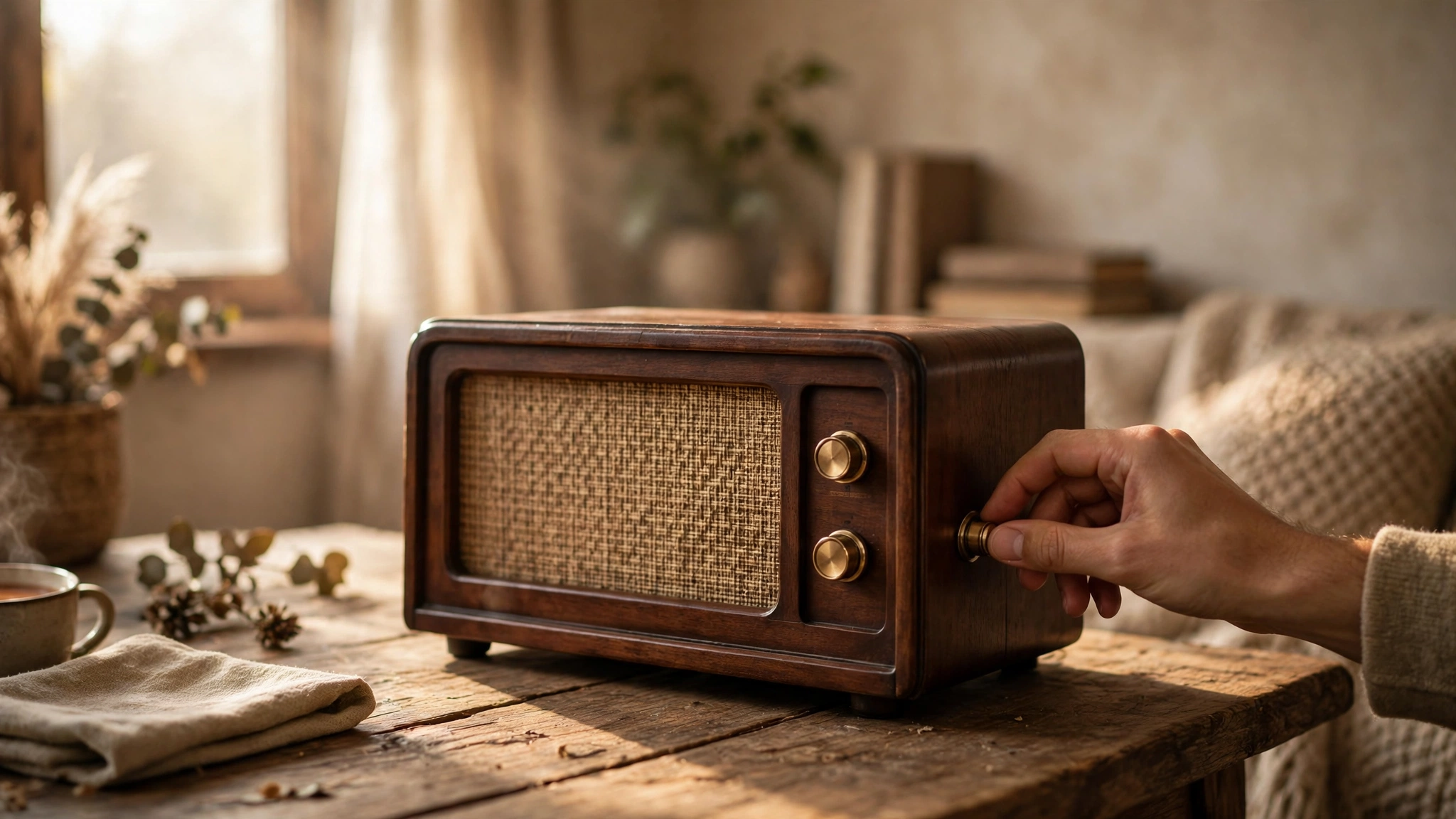
You are in the kitchen in the morning. Someone reaches out, turns a small dial on an old radio, and music fills the room. No wire runs from the radio to the singer. No cable connects it to the band. The singer might be miles away, in a studio you will never see. Yet there is the voice, clear as if the singer were standing next to the kettle.
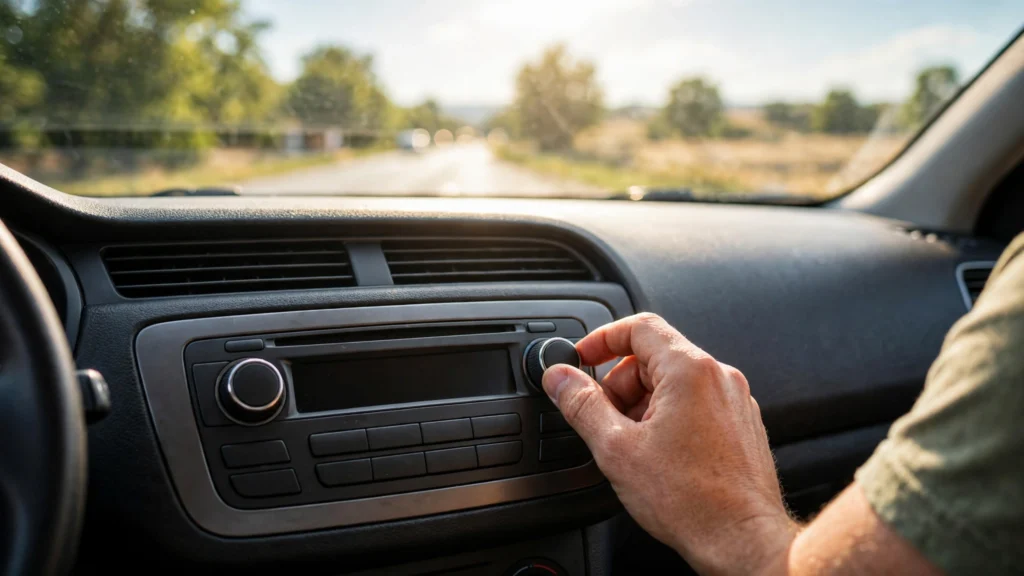
Or think of a car on a long drive. The driver twists a knob, and a newsreader starts talking. The car is moving fast, past fields and petrol stations, and the voice stays with it.
How is that possible? How can a voice travel through thin air, with nothing to carry it, and land in a small box on your table?
The short answer is waves. Not sea waves. Invisible waves that move through the air all the time, right now, all around you. This article will explain them in the simplest words we can, step by step, from the singer’s lips to your ears.
The Short Answer, in One Paragraph
A radio station takes a sound, like a voice or a song, and turns it into a pattern of electricity. Then it stamps that pattern onto a radio wave, which is a kind of invisible energy that can travel through the air at the speed of light. A tall antenna throws that wave out in every direction. Your radio has its own small antenna, and it catches a tiny piece of the wave. Inside your radio, a tuner picks out the one station you want, and a speaker turns the pattern back into sound. That is the whole trick. Sound becomes a wave, the wave crosses the air, and the wave becomes sound again.
What Is a Radio Wave?
First, we need to understand the wave itself, because everything else follows from it.
A radio wave is a kind of energy that moves through the air, and through space, in the shape of a wave. You cannot see it. You cannot hear it. You cannot feel it on your skin. But it is real, and it is all around you right now. Radio waves from dozens of stations are passing through your room as you read this. They pass through walls, through windows, and through you, and you notice nothing at all.
Radio stations each use their own frequency, like their own spot on a dial. That is how your radio can tell them apart. One station might broadcast on a frequency of 98 megahertz. Another might use 101 megahertz. Your tuner listens for one frequency and ignores the rest, the way you can pick out your friend’s voice in a crowded room.
Radio waves move at the speed of light. That is about 300,000 kilometres per second, the fastest speed we know. A wave can cross a whole city in less time than it takes you to blink. That is why the news sounds live, even when the studio is far away. The wave barely takes any time at all to reach you.
What Happens Inside a Radio Station?
A radio station is not just a room with a microphone. It is a small factory that turns sound into waves. Let us walk through it, one part at a time.
First, there is the sound itself. A singer sings into a microphone. A microphone listens to sound in the air and turns it into electricity. When the voice is loud, the electricity is strong. When the voice is soft, the electricity is weak. The pattern of the electricity matches the pattern of the sound.
But that electricity is weak, and it cannot travel far on its own. It needs a ride. That ride is called a carrier wave, a steady radio wave the station makes with a machine called an oscillator. On its own, a carrier wave carries no music and no words. It is like a blank page. Its job is to carry something else.
Next comes the part that puts the sound onto the carrier wave. This is called modulation, which is just a fancy word for stamping a pattern onto a wave. One way changes how strong the wave is. The other way changes how fast the wave wiggles.
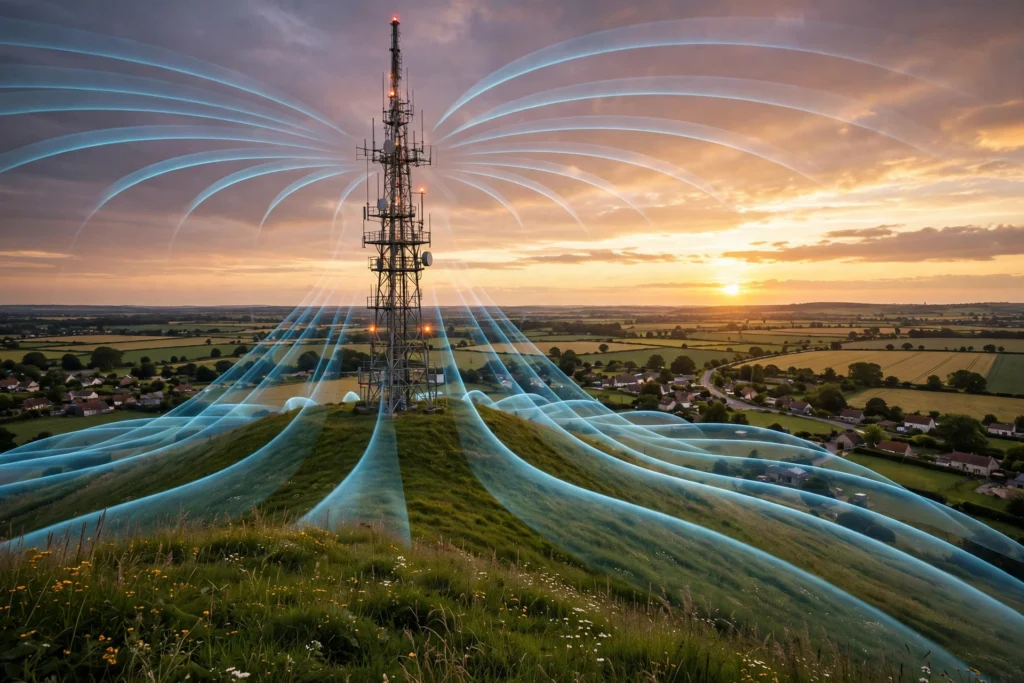
Finally, the strong wave goes to the antenna. The antenna is usually a tall metal tower, sometimes as tall as a skyscraper, standing on a hill or on top of a building. When the electricity rushes up and down the metal of the antenna, it throws radio waves out into the air in all directions, like ripples spreading out when you drop a stone in a pond. Those ripples are the broadcast. Anyone with a radio inside the area can catch them.
The Antenna: The Part That Throws and Catches
An antenna is a simple idea with a big job. It is usually just a piece of metal, a rod or a tall tower, but it does two things. At the station, it throws waves into the air. At your home, it catches them.
When electricity moves quickly back and forth in a metal rod, it makes waves. That is what the station’s antenna does. The electricity rushes up and down the tower, hundreds of thousands or millions of times a second, and each rush sends out a little piece of a wave. Together, those pieces make the broadcast.
Your radio’s antenna does the same thing in reverse. When a radio wave passes by, it makes the tiny bits of electricity inside your radio’s antenna move up and down in the same pattern. The wave is too weak to hear on its own, far too weak, but it is there, a tiny copy of the pattern the station sent out.
The Journey Through the Air
Once the wave leaves the tower, it travels outward in every direction. It does not need a wire. It does not need the internet. It just moves through the air at the speed of light, getting weaker as it spreads out, the way the light from a candle gets weaker the farther you walk from it.
Why does the wave get weaker? Because it spreads. Imagine you pour a jug of water onto a table. Near the jug, the water is deep. Farther out, it spreads thin. A radio wave does the same. Close to the tower, it is strong. Far away, it is thin and faint. That is why a station in your town sounds loud and clear, while a station in a faraway city sounds faint, or does not come in at all.
Hills, buildings, and weather can also get in the way. A tall hill between you and the tower can block part of the wave. A big metal building can bounce the wave around. Heavy rain can weaken it a little. That is why your radio sometimes sounds better by the window than in the middle of the house, and why the sound can change when you walk from one room to another.
What Happens Inside Your Radio?
Now let us follow the wave into your radio. Your radio has four main parts, and each one has a clear job. Together, they turn a faint wave back into a voice.
The first part is the antenna, which we have already met. It catches the wave and turns it into a tiny electric signal. That signal is very weak. It carries the pattern of every station at once, all mixed together, like a room full of people talking at the same time.
The second part is the tuner, the part you control when you turn the dial or press a button. Its job is to pick out one station and ignore all the rest. You set it to one frequency, say 98 megahertz, and it lets that station through while blocking the others. Old radios had a dial with numbers on it, and you turned it slowly until the music came in clear. New radios have buttons, and you just press a number.
The third part is the amplifier. The signal from the antenna is far too weak to drive a speaker. The amplifier makes it stronger, many times over, until it is strong enough to move the speaker. If you turn up the volume on your radio, you are telling the amplifier to work harder.
The fourth part is the speaker. The speaker is a cone of paper or plastic with a magnet behind it. When the electric signal pushes and pulls the cone, the cone pushes and pulls the air, and that moving air is sound. The cone moves in exactly the same pattern as the singer’s voice did in the studio. Your ear hears that moving air as music, or news, or a football match.
AM vs FM: Two Ways to Carry Sound
Every radio listener meets the letters AM and FM, usually on the dial or on a car dashboard. They are the two main ways of stamping sound onto a radio wave. They sound alike in a shop, but they work very differently, and that difference explains why FM sounds clearer and why AM reaches farther.
AM stands for amplitude modulation. Amplitude is just a word for how strong a wave is, how tall its peaks are. In AM, the station changes the strength of the wave to match the sound. A loud note makes a tall wave. A quiet note makes a short wave. The speed of the wave stays the same. Only its height goes up and down.
The trouble with AM is that many things can change the strength of a wave. Lightning can do it. A passing car can do it. A fridge switching on can do it. Your radio cannot tell the difference between a change made by the singer and a change made by lightning, so it plays both, and you hear a crackle. FM avoids this, because lightning and engines mostly change the strength of a wave, not its speed. An FM radio only listens to the speed, and the speed is clean. That is why FM music sounds clear and full, while AM can sound thin and crackly.
There is a trade-off, though. FM stations usually broadcast on much higher frequencies than AM stations, between about 87.5 and 108 megahertz, while AM stations use much lower frequencies. FM waves travel in straight lines and do not bounce off the sky at night, so they cover a smaller area, often about 50 to 100 miles from a big tower. AM waves travel farther, especially at night, but they carry less detail. That is why most music stations use FM, while many talk, news, and sports stations still use AM.
Why Does a Radio Sometimes Crackle or Fade?
If you have ever listened to a radio, you have heard static. That harsh, hissing sound is what you hear when the radio cannot find a clean signal. There are a few common reasons for it.
The first reason is distance. If you are too far from the station, the wave is too weak by the time it reaches you. Your radio tries its best, but it has to amplify a lot of noise along with the music. The result is a faint voice under a hiss.
The third reason is the place you are standing. Radio waves pass through wood and glass quite easily, but thick concrete, metal, and earth block them. That is why a radio can sound fine in the kitchen and terrible in a basement. It is also why a car radio can fade when you drive into a tunnel. Inside the tunnel, the rock above you blocks the sky, and the waves cannot reach the car. When you come out the other side, the music comes back.
If your radio sounds bad, try the simple fixes first. Move it near a window. Pull out the antenna and point it a different way. Move it away from other machines. Try a different station. Often, that is enough.
A Short History: From Sparks to Songs
Radio did not appear all at once. It grew slowly, over many years, from a science experiment into a machine in every home.
In the 1880s, a German scientist named Heinrich Hertz showed in his laboratory that invisible waves could be made and caught. He did not think they would be useful for much. He was wrong, but he gave the waves their name. Today we still measure radio frequency in hertz, named after him.
Then an Italian inventor named Guglielmo Marconi asked a simple question: could these waves carry a message over a long distance, with no wire at all? In 1895, he sent a wireless Morse code message, a code of dots and dashes, over a short distance. In December 1901, he sent a signal across the Atlantic Ocean, from England to Canada. It was only the letter S, three dots in Morse code, but it proved that a message could cross an ocean without a wire.
At first, radio could only carry dots and dashes, not voices. Ships used it to send distress calls, and that saved lives at sea. But on Christmas Eve in 1906, an inventor named Reginald Fessenden played music and spoke into a microphone from a station in Massachusetts, in the United States. Ships at sea heard a voice and a violin for the first time. It was the first voice broadcast.
Then came regular broadcasting for everyone. On 2 November 1920, a station called KDKA in Pittsburgh, in the United States, broadcast the results of the presidential election. It was the first regular public broadcast. People could sit at home and hear the news as it happened. Within a few years, stations opened all over the world. Families gathered around the radio in the evening, the way families later gathered around the television. Radio became the first way to speak to millions of people at once.
In the 1950s, a new device called the transistor made radios small and cheap. Suddenly a radio could fit in a pocket and run on a small battery. Teenagers carried radios to the beach. Workers carried them to building sites. Drivers put them in cars. Radio went everywhere.
Radio in Everyday Life
Radio is easy to forget now, because phones do so much. But it is still part of daily life in ways we barely notice.
In the car, radio is still king. Drivers listen to music, news, and traffic reports. A traffic report can save a driver from a long jam. A weather report can warn of rain on the road ahead. And a familiar voice on a long, dark road can keep a tired driver awake. That is why almost every car still has a radio built into the dashboard, even now, when phones can play anything.
In a workshop or on a building site, a radio keeps workers company. In a shop, it fills the quiet between customers. In a hospital waiting room, it softens the wait. In many parts of the world, where the internet is weak or costly, radio is still the main way people get news. A small battery radio can work where there is no power, no Wi-Fi, and no phone signal. When a storm knocks out the power, radio is often the first thing that comes back, because a station can run on a generator and a listener only needs batteries.
Radio also keeps people safe. Ships and planes use it to talk to each other and to the shore, and weather stations use it to warn of storms. Your phone’s GPS also listens to radio signals, this time from satellites high above the Earth. If you want to know how that works, read our simple guide to how GPS knows where you are.
Radio Today: Internet Radio and Podcasts
You might think radio is old and dying. It is not. It has changed its clothes, but it is still here.
Today, many stations also broadcast over the internet. This is called internet radio. Instead of sending waves through the air, the station sends its sound as data over the internet, the same way a video reaches your phone. You can listen to a station in London while sitting in Dhaka, or to a station in New York while sitting in a village. The distance does not matter anymore. Podcasts are radio’s younger cousin: shows you can download and hear whenever you like. If you want to know how Wi-Fi carries the internet to your phone, read our simple guide to what Wi-Fi is and how it reaches your phone.
And the old-fashioned radio is still with us. People still buy radios for the kitchen, the car, and the bedside table. Some people love the simple act of turning a dial and finding a station by accident, a song they did not expect, a voice from far away. A phone can play any song you ask for. A radio can surprise you. That surprise is part of its charm.
The same waves turn up in other things too. Bluetooth, the short-range link that connects your phone to your earbuds or your car speakers, also uses radio waves, just over a very short distance. If you want to know how that link works, read our simple guide to what Bluetooth is and how it works. Your smartwatch sends its readings to your phone over the same kind of link. If you want to know how a smartwatch reads your heart, read our simple guide to how a smartwatch knows your heart rate. And the earbuds you use to listen to radio on your phone block outside noise with clever sound tricks of their own. If you want to know how they do it, read our simple guide to how noise-cancelling earbuds work.
So radio is not one machine. It is a whole family of machines, all using the same invisible waves, in different ways, for different jobs.
Frequently Asked Questions
How does a radio work in simple words?
A radio station turns sound into a pattern on an invisible wave called a radio wave, and sends that wave out from a tall antenna. Your radio catches the wave with its own antenna, picks out one station with its tuner, and turns the pattern back into sound through a speaker.
What are radio waves?
Radio waves are a kind of invisible energy that travels through the air at the speed of light. They are part of the same family as light, Wi-Fi, and microwaves. You cannot see, hear, or feel them, but they can carry information, like music or a voice, from one place to another.
What is the difference between AM and FM radio?
AM changes the strength of its radio wave to carry sound, while FM changes the speed of the wave. FM usually sounds clearer because it ignores most of the crackle from lightning and machines. AM reaches farther, especially at night, but it sounds noisier and carries less detail.
Why does my radio sound better near a window?
Walls, especially thick concrete and metal, can block or weaken radio waves. Near a window, the waves have a clearer path to your radio, so the signal is stronger and the sound is cleaner. Moving the antenna or turning the radio can also help.
Who invented the radio?
No single person invented the radio alone. Heinrich Hertz proved radio waves were real in the 1880s. Guglielmo Marconi sent the first long-distance wireless messages in the 1890s and across the Atlantic in 1901. Reginald Fessenden made the first voice broadcast in 1906, and KDKA in Pittsburgh made the first regular public broadcast in 1920.
Is radio still used today?
Yes, radio is still widely used. People listen in cars, kitchens, and workplaces, and many stations also broadcast over the internet, so they can be heard anywhere in the world. Podcasts, Bluetooth, Wi-Fi, and GPS all use radio waves too, in different ways, so the same basic idea is now part of daily life.
More from Zorium Daily
- What Is Wi-Fi and How Does It Reach Your Phone?
- What Is Bluetooth and How Does It Work?
- How Does GPS Know Where You Are?
- How Does a Microwave Oven Work?
The next time a song comes out of a small box on your kitchen table, remember what is really happening. A voice became a wave, the wave crossed the air, and the wave became a voice again. It has been happening for more than a hundred years, and it still feels a little like magic, even when you know how it works.