How Does a Piggy Bank Help Kids Save Money?
SUMMARY OF THIS ARTICLE
- A piggy bank makes saving real for kids, because they can see, hear, and feel their money grow.
- It teaches patience: small coins added often turn into enough for something big.
- It helps children learn to wait, choose, and plan instead of spending everything at once.
- Simple habits, like saving a little from every bit of money they get, build a skill for life.
- A piggy bank is a first step, not a bank account, and it works best when parents talk about money openly.
That Little Clink Is Worth More Than You Think
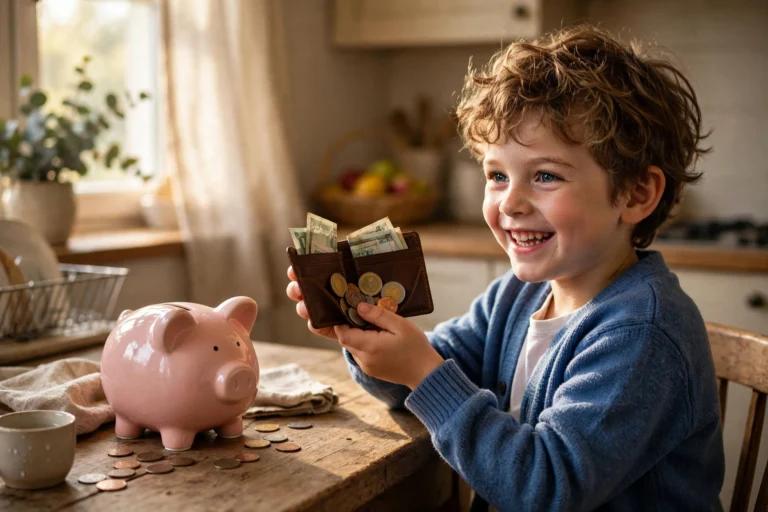
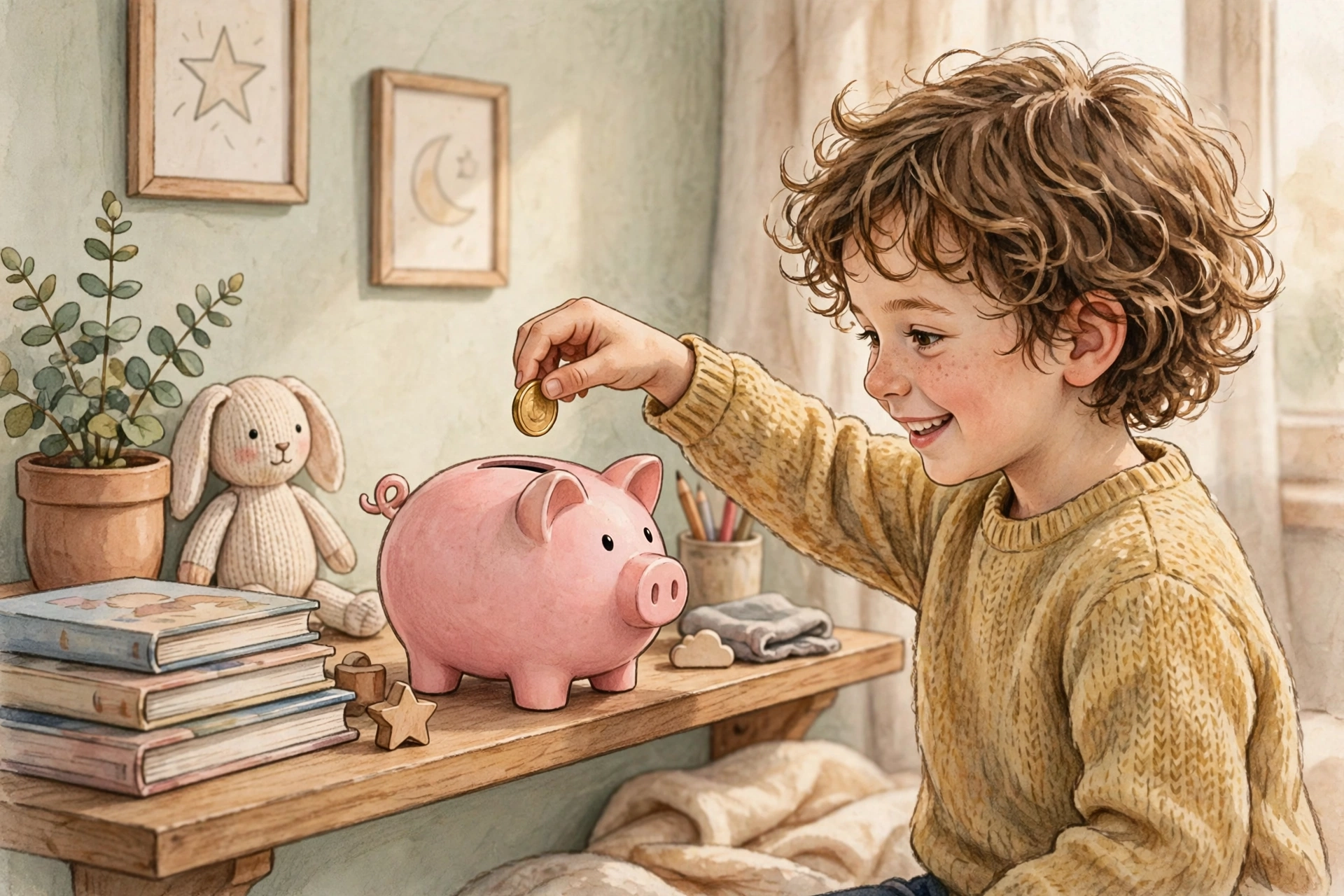
Do you remember your first piggy bank? Maybe it was a pink pig, or a tin shaped like a robot, or a jar on a shelf. You dropped a coin in, and it went clink. Then another. Clink. And after a while, you shook it, heard all those coins rattling around, and felt rich.
That feeling is the whole point. For a child, money is a strange idea. It is invisible half the time — numbers on a screen, a card tapped on a machine. A piggy bank makes it real. You can hold it. You can hear it. You can watch it get heavier. And that is how a child first learns what saving actually means.
This article is for parents, grandparents, and anyone who wants to help a child learn about money in a gentle, simple way. No lectures. No big words. Just a small pig, a few coins, and a habit that can last a lifetime.
A quick note before we start: this is a simple explainer about a children’s money habit. It is not financial advice, and it does not promise that saving will make anyone rich. It is about learning to wait, to choose, and to plan — skills that help at every age.
Why Saving Feels Hard for Children
Let us be honest: saving is hard for grown-ups, so it is no surprise that it is hard for children. A child’s brain is wired for now. They see a toy, they want the toy. They see sweets, they want the sweets. Waiting weeks for something bigger feels like forever, because to a seven-year-old, two weeks really is a long time. Their whole life so far is only a few hundred weeks long.
That is why telling a child to “save your money” rarely works on its own. The words are too abstract. Abstract means hard to picture or touch. A child needs something they can see and feel. They need the clink of a coin, the weight of a full bank, the moment they tip it over and count a pile of coins on the bed.
A piggy bank turns an abstract idea into a thing. Saving stops being a rule and becomes a game. Each coin is a small win. Each week the bank gets a little heavier. And when the child finally has enough for the toy they wanted, they learn the most important money lesson there is: waiting can feel even better than buying right away.
Why Seeing and Hearing Money Matters
Think of it like this. If you put money in a bank account, the numbers go up on a screen, but nothing in your hands changes. For an adult, that is fine. We understand numbers. For a child, numbers on a screen mean very little. A piggy bank speaks a language children understand: sight, sound, and weight.
Seeing matters. A clear jar or a piggy bank with a little window lets a child watch the pile grow. Each coin added is visible proof that saving works. It is like watching a plant grow, a little bit each day, until one morning there is a flower.
Hearing matters too. That clink when a coin drops in is a tiny reward. It tells the brain, “Well done. You did a good thing.” It is the same reason video games make a happy sound when you win a point. Our brains love little sounds that say we did well.
Weight matters as well. Pick up an empty piggy bank, then pick up a full one. The difference is startling. A child can feel their progress in their hands. It is heavy with effort, not just coins.
This is why many money experts say a physical piggy bank is still one of the best first tools for children, even in a world of cards and phones. It is slow, simple, and real. And real is what a child needs first. Later, when they are older, a bank account makes sense. But the piggy bank is where the habit begins.
A Short History of the Piggy Bank
Piggy banks have been around for a long time, and their name comes from a funny accident of language.
Hundreds of years ago, in England, people kept money in jars made from a kind of clay called pygg. Pygg was a cheap orange clay, and a pygg jar was just a pot for keeping coins. Over time, people started calling the jar a piggy bank, because pygg sounded like pig. Potters, the people who make pots from clay, began shaping the jars like pigs, probably as a joke at first. The joke stuck. The pig became the shape of saving.
By the 1800s, pig-shaped money boxes were common in homes across Europe and America. Banks even gave them away to children, hoping the children would grow up and open real accounts. It worked, too. A child who saved coins in a pig often became an adult who saved money in a bank.
Today, piggy banks come in every shape: pigs, of course, but also robots, dinosaurs, rockets, and houses. Some are made of plastic, some of ceramic, some of tin. Some are clear so you can see inside. The shape does not matter much. What matters is the habit: money goes in, and it stays in until there is a good reason to take it out.
The Big Lesson: Waiting Feels Good
Here is the heart of it. A piggy bank teaches a child to wait. And waiting is the hardest and most useful money skill there is.
Psychologists, people who study how minds work, have studied this for years. In one famous test, children were offered one sweet now, or two sweets if they waited a few minutes. The children who could wait tended to do better later in life, not because sweets made them clever, but because waiting is a skill that helps with everything: school, work, money, health. The children who learned to pause, think, and wait had a head start.
A piggy bank is a gentle way to practise waiting. A child wants a toy that costs more than they have. The piggy bank says, “Not yet, but soon.” Each week, they add a coin. The goal gets closer. When they finally buy the toy, it feels different from a toy that was just handed to them. They earned it. They waited for it. They chose it. That feeling is worth more than the toy itself.
It also teaches a quiet truth: small amounts add up. One coin is nothing. One coin a week for a year is a real pile. A child who sees that happen learns something many adults forget: you do not need a lot of money at once. You need a little, often, and the patience to let it grow.
Three Jars: Spend, Save, Share
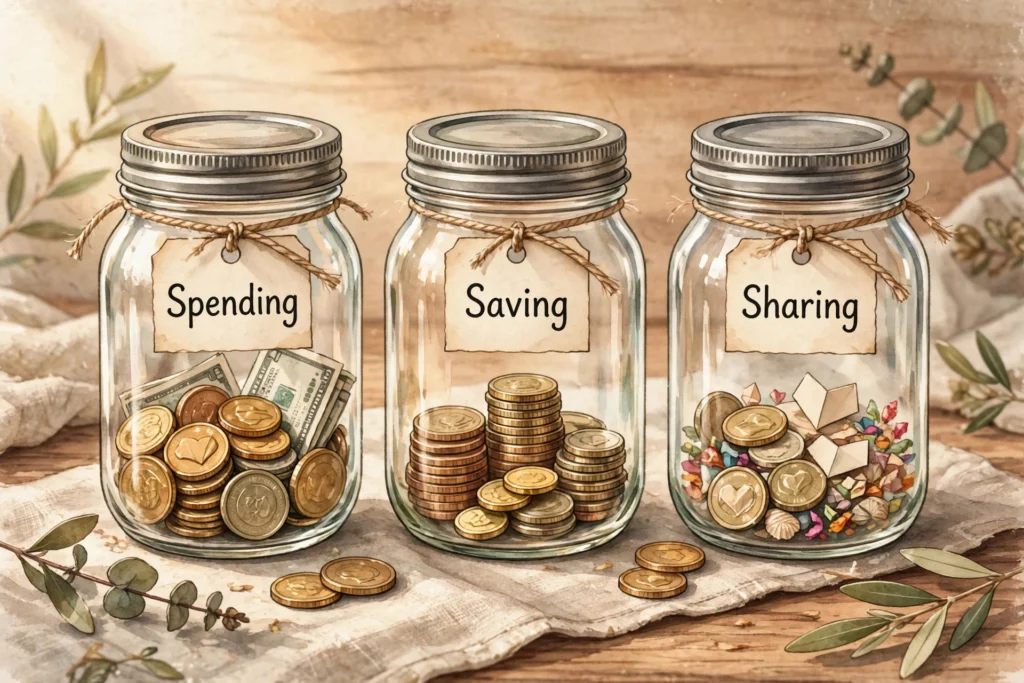
Here is a trick many families love. Instead of one piggy bank, use three jars. Label them Spend, Save, and Share. It is simple, and it teaches a child that money has more than one job.
The Spend jar is for small treats now: sweets, a sticker, a little toy. It is the fun money, and it is fine to use it. Children need to enjoy money too, or saving feels like a punishment.
The Save jar is for a bigger goal later: a bike, a game, a special trip. This jar is the piggy bank in its truest form. Money goes in and stays in until the goal is reached. Watching this jar fill is the best part.
The Share jar is for giving: money for a charity box, a gift for a friend, or a donation to help someone. This teaches a child that money is not only for themselves. Giving feels good, and it is a habit worth building early.
When a child gets money — birthday money, pocket money, a coin found in a coat pocket — they split it between the jars. A simple split could be: half for spending, a big part for saving, and a little for sharing. The exact split does not matter. What matters is the habit of thinking before spending, and of giving every coin a job before it disappears.
You can make the jars together. Decorate them with stickers and coloured paper. Write the labels in big letters. Let the child choose the goal for the Save jar and draw a picture of it on the jar. A picture of a red bike on the jar is a daily reminder of what the waiting is for.
Picking a Goal That Actually Works
A piggy bank without a goal is just a box of coins. A goal is what makes it exciting. But the goal has to be right, or the child will give up.
The best first goal is small and close. A toy that costs a few weeks of saving, not a few months. A child who saves for three weeks and gets their prize learns that saving works. A child who saves for six months and still cannot afford the prize learns that saving is boring and hopeless. Start small. Let them win early. Bigger goals can come later, once they trust the process.
Let the child pick the goal. It might not be the goal you would pick. It might be a plastic dinosaur when you think they should save for a book. That is fine. It is their money and their lesson. A goal they chose themselves is a goal they will stick with. A goal you forced on them is a chore.
Make the goal visible. Draw it, print a picture of it, stick it on the fridge or on the piggy bank itself. Every time the child drops a coin in, they see the picture and remember why they are waiting. Some families use a simple chart: a line of boxes, one for each coin or each week, coloured in as the money grows. A half-coloured chart is a lovely sight. It says, “Look how far you have come.”
And celebrate when they reach it. Not with more money, but with words. “You did it. You saved for that all by yourself.” Let them feel proud. Pride is the fuel that keeps the habit going next time.
Pocket Money: A Little, Often, and on Time
Pocket money is the allowance some children get each week from their parents. It is not a payment for being good, and it is not a wage. It is a small, safe way for a child to practise handling money. And a piggy bank is where pocket money earns its keep.
A little, often, works best. A small amount each week gives a child regular practice: a little money arrives, a little goes into the bank, a little is spent, and the cycle repeats. A big amount once in a blue moon does not build a habit. It just feels like a windfall, a lucky surprise, and it is usually spent in a day.
Being on time matters too. If pocket money comes every Saturday, the child learns to expect it and plan for it. If it comes whenever an adult remembers, the child learns that money is random. A simple routine — same day, same amount — turns money from a mystery into something a child can understand.
Should pocket money be tied to chores? Families disagree about this, and there is no single right answer. Some families pay for extra jobs beyond normal chores, like washing the car. Others keep pocket money separate from chores, because chores are part of being in a family, not a job. What matters most is being clear. If the rule is clear, the child can plan. If the rule keeps changing, the child gets confused, and the lesson gets lost.
And here is a gentle suggestion: when you give pocket money, give it in coins when you can, not just notes. Coins go clink into the bank. Notes are harder for a small child to picture. A handful of coins feels like real money in a way a note does not. It is a small thing, but small things matter when you are seven.
When to Break the Bank Open
Every child asks this sooner or later: when do I get to open it? The answer should be simple and agreed in advance. The bank opens when the goal is reached, or when there is a real need. Not every time the child fancies a sweet. If the bank opens for every small want, it stops being a savings bank and becomes a purse with a funny shape.
Counting day is a lovely family moment. Tip the coins out onto a table or a bed, sort them into piles, and count together. It is maths without a worksheet. A child who counts their own savings learns numbers in a way no textbook can match. They add, they group, they check. And at the end, they see the total. That total is theirs.
If the money is not quite enough for the goal, talk about it together. Can they wait one more week? Can they do an extra little job? Can they choose a slightly cheaper version? These are real money choices, the same ones adults make, just smaller. Let the child be part of the decision. It is their money, after all.
And if the child decides to change the goal halfway, that is fine too. Children change their minds. A toy they wanted last month may seem boring now. Let them switch, as long as they are switching to another goal, not just giving up and spending everything on sweets. The habit is what matters, not the toy.
One more thing: some piggy banks need to be smashed to open, and that is part of the fun for some children. Others have a little plug at the bottom. Either way, talk about it before you buy the bank, so the child knows what will happen on counting day. No surprises, no tears.
Mistakes That Undo the Lesson
Good intentions can go wrong. Here are a few common mistakes, and how to avoid them.
The first is borrowing from the bank. A parent dips into the piggy bank for change, promising to put it back later. The child sees it. And the child learns that the bank is not really theirs, and that savings can be raided whenever an adult needs coins. If you need change, use your own money. The child’s bank is sacred. It is theirs.
The second is forcing every penny into the bank. If a child never gets to spend anything, saving feels like a punishment, and they will hate it. Let them spend some of their money on small treats. The Spend jar exists for a reason. A child who enjoys money a little is a child who will keep saving.
The third is shaming a child for spending. “You wasted your money on that silly toy.” It stings, and it teaches the child to hide their choices instead of learning from them. A better line is, “Did you enjoy it? Was it worth it?” Let the child decide. A small regret now is a cheap lesson. It is far better to regret a five-pound toy at eight years old than a five-hundred-pound mistake at twenty-eight.
The fourth is making it too complicated. Charts, interest rates, reward systems with points and stars — all of it can help, but too much of it drowns the simple joy of dropping a coin in a bank and hearing it clink. Keep it simple. A bank, a goal, a coin a week. That is enough to start.
From Piggy Bank to Real Bank Account
A piggy bank is a first step, not the last one. As a child grows, their money world grows too. Birthday money gets bigger. They might earn money from a small job, like helping a neighbour. And one day, a real bank account starts to make sense.
The move to a bank account is a proud moment. It says, “You are old enough for the next step.” A children’s savings account keeps money safe, and in some countries it even earns a tiny bit of interest. Interest is money the bank pays you for keeping your money with them. It is usually very small, but it is a nice lesson: saved money can slowly grow on its own.
The habit stays the same, though. A little, often. A goal in mind. A pause before spending. Those are the same rules at eight and at eighty. Grown-ups use the same ideas, just with bigger numbers. A grown-up version of the piggy bank habit is an emergency fund — money set aside for surprises, like a broken car or a sudden bill. If you want to see how adults build on the same simple idea, our guide to how to build an emergency fund on a small income starts with the same small steps, just for bigger lives.
One honest note: money saved in a piggy bank does not grow on its own, and over many years, rising prices can make saved money buy a little less than it used to. That slow rise in prices is called inflation, and you can read a simple explanation of why prices go up. For a child’s short-term goal, this does not matter at all. For long-term grown-up saving, it is worth knowing. But for a child learning to save for a toy, the piggy bank is perfect just as it is.
Frequently Asked Questions
How does a piggy bank help kids save money?
It makes saving real. A child can see the coins pile up, hear them clink, and feel the bank get heavier. That turns saving from an abstract rule into something they can touch and enjoy. It also teaches patience, because the child watches small amounts grow into enough for a goal they chose themselves.
At what age should a child get a piggy bank?
Many children are ready around age four or five, when they start to understand that coins buy things. At that age, the bank is mostly a fun toy with a lesson hiding inside. By age seven or eight, a child can set a real goal, count their savings, and understand waiting. There is no rush. Start when the child shows interest in money.
How much pocket money should a child save?
There is no magic number. A simple habit is to save a little from every bit of money they get — for example, a few coins from each week’s pocket money. The amount matters less than the habit. A child who saves a little every week learns more than a child who saves a lot once and then forgets about it.
What if my child wants to spend everything at once?
That is normal, and it is a chance to talk, not to scold. Ask them what they want, how much it costs, and whether they have enough. If they spend it all and feel sad later, that small regret is a useful lesson. Let them feel it, gently, and help them plan better next time. The goal is a child who thinks before spending, not a child who is afraid to spend.
Are clear piggy banks better than pig-shaped ones?
Clear banks have one advantage: the child can see the money grow. Pig-shaped banks have a different charm: they are fun, and the surprise of opening day is bigger. Either one works. The best bank is the one the child loves and wants to use. Let them choose it, and they will use it more.
When should a child move to a real bank account?
Usually around age eight to eleven, when birthday money and savings grow too big for a piggy bank, or when the child starts earning a little money. A children’s savings account is a natural next step. Keep the piggy bank habits, though: a goal, a little saved often, and a pause before spending. The container changes. The habit stays.
The Clink That Builds a Life Skill
A piggy bank will not make a child rich. It was never meant to. What it does is quieter and more important: it teaches a child that waiting is possible, that small amounts add up, and that money is a tool you control, not a mystery that controls you.
Years from now, your child may not remember the exact toy they saved for. But they may remember the weight of a full piggy bank in their hands, the sound of coins on counting day, and the pride of buying something with money they saved themselves. That memory is the real treasure. It is worth far more than the coins inside the pig.
So if there is a dusty piggy bank on a shelf somewhere, wipe it clean, hand it to a child, and drop in the first coin together. Clink. That small sound is the start of a skill that will serve them for the rest of their life.