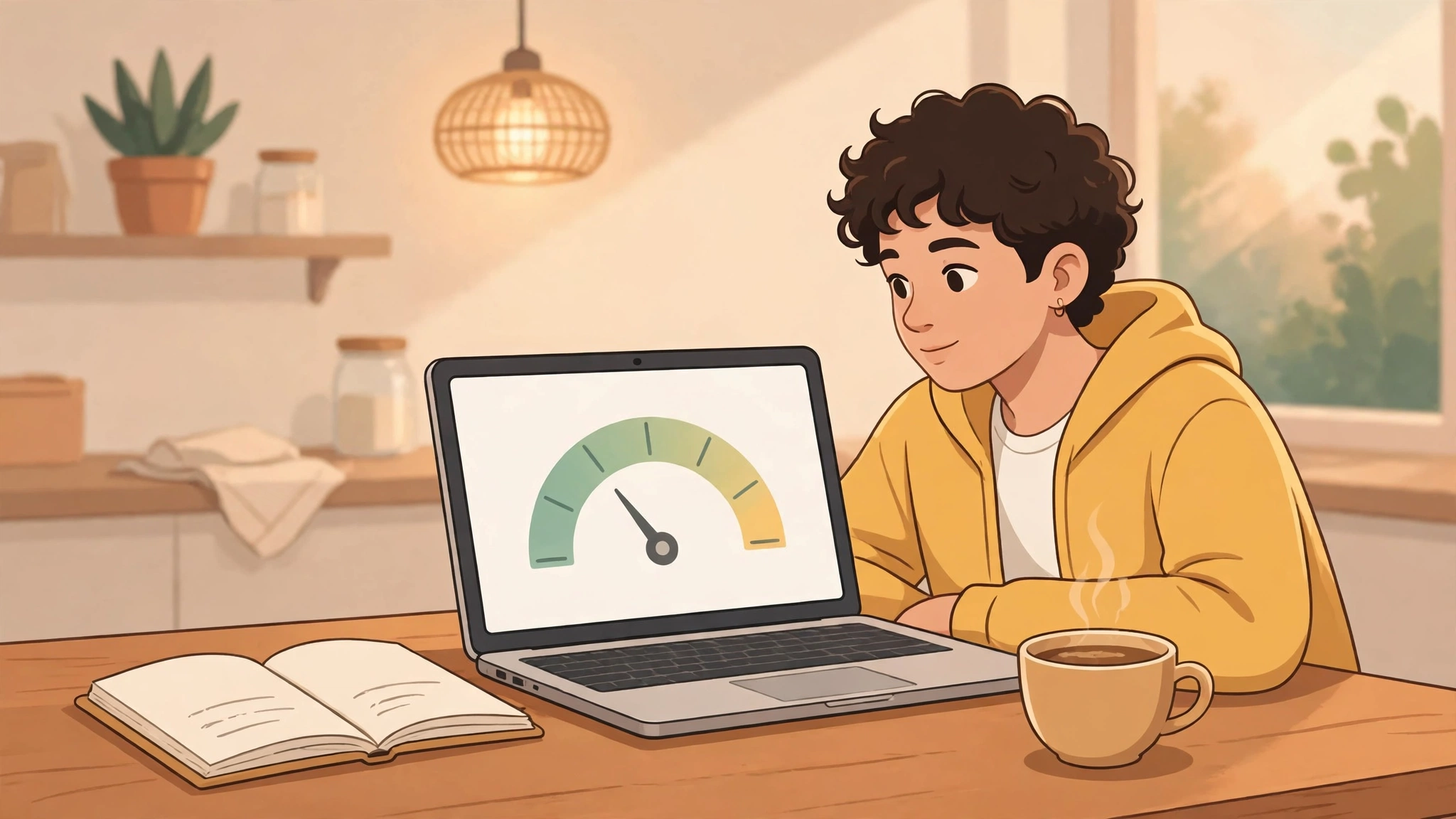
What Is a Credit Score and Why Does It Matter?
By Zorium Daily Money Desk
Imagine two people walk into the same bank on the same day. Both ask for the same loan. Both earn about the same pay. One walks out with a yes and a low interest rate. The other walks out with a no, or with a much higher rate. What made the difference? In many cases, the answer is a small three-digit number. That number is a credit score.
This article is general information only, not personal financial advice. Every home is different, so take the ideas that fit your life and change the rest. All dollar and pound amounts in the examples below are examples only, not real offers. Rules and free services change from country to country, so always check the rules where you live.
SUMMARY OF THIS ARTICLE
- A credit score is a three-digit number, often from 300 to 850, that sums up how you have handled borrowed money in the past.
- A higher score usually means better loan offers, lower interest rates, and more choice, while a lower score can mean higher costs or a refusal.
- Five main factors build your score: paying on time, how much of your credit you use, how long you have had credit, how often you apply for new credit, and the mix of credit types you hold.
- You can check your credit report for free in many countries, and fixing a mistake on it can help your score.
- Small, steady habits, like paying on time and keeping card balances low, build a strong score over months and years, not in a single day.
What Is a Credit Score?
A credit score is a number that tells lenders how risky it is to lend you money. Lenders are banks, card companies, and other firms that lend money. When you ask to borrow, they want to know one thing: will this person pay the money back on time?
Your score gives them a quick answer. It is based on your credit history, the record of the money you have borrowed and how you paid it back. Did you pay on time? Did you miss payments? How much do you still owe? The score turns all those facts into one simple number.
A credit score is not the same as your income. A person with a high income can have a low score if they miss payments. A person with a modest income can have a high score if they pay on time and keep debts low. The score is about habits, not about how rich you are.
In the United States, the most widely used scores come from a company called FICO. Another common model is called VantageScore. In the United Kingdom, Canada, Ireland, and New Zealand, other bureaus and models are used, but the core idea is the same. The names change. The rules change a little. The basic question stays the same: do you pay back what you borrow, on time?
Your Credit Score and Your Credit Report: What Is the Difference?
People often mix up two things: a credit score and a credit report. They are linked, but they are not the same.
Your credit score is the short summary. It is one number, worked out from the facts in your report. If the report is the whole book, the score is the mark on the cover.
Three big credit bureaus keep these files in the United States: Equifax, Experian, and TransUnion. In other countries, the names are different, but the job is the same: collect facts from lenders, keep them in a file, and share them when a lender asks, with your permission.
The Score Ranges: What the Numbers Mean
Most credit scores run from 300 to 850. The higher the number, the better. But what do the numbers mean in real life? Here is a simple guide based on the ranges commonly used for FICO scores in the United States. Other models use slightly different bands, so treat these as a rough map, not an exact law.
A score from 800 to 850 is often called exceptional. This is the top group. Lenders see these people as very low risk. They often get the best rates and the widest choice. Only a small share of people sit in this top band, and it usually takes many years of steady habits to reach it.
A score from 740 to 799 is often called very good. This is a strong score. Most lenders are happy to lend to people in this band, and they often get good rates too, close to the best.
A score from 670 to 739 is often called good. This is the middle ground, and it is where many people sit. Lenders will often say yes, but the rate may not be the lowest. A good score opens most doors. It just may not open them at the very best price.
A score from 580 to 669 is often called fair. This is below the middle. Lenders may still say yes, but they may charge more. They may ask for a larger deposit or offer a smaller loan. Some lenders may say no. A fair score is a sign to start building, not a reason to give up.
A score from 300 to 579 is often called poor. This is the lowest band. Lenders see a higher risk here. Many may say no. Those who say yes may charge high rates. A poor score is not a life sentence. It can be rebuilt with time and steady habits, as this guide will show.
The 5 Main Factors That Build Your Score
No one knows the exact secret formula, but the main factors are known, and some count more than others. Here they are, from biggest to smallest.
1. Payment History: The Biggest Slice
Payment history is the largest factor, often about 35 percent of a FICO score. It asks a simple question: do you pay your bills on time?
Every on-time payment adds a small brick to your record. Every late payment takes bricks away. A payment that is 30 days late can hurt. A payment that is 60 or 90 days late can hurt more. A debt sent to collection can hurt for years.
This is the factor you can control most directly. You cannot change the past, but you can start a fresh run of on-time payments today. Over time, new good payments start to outweigh old late ones. The hurt fades, slowly, as your good record grows longer.
2. Amounts Owed: How Much of Your Credit You Use
This factor is often about 30 percent of a FICO score. It looks at how much you owe, and how much of your available credit you are using. The key idea here is called credit utilisation, a long word for a simple idea.
Imagine your card limit is 1,000 dollars. If you owe 900 dollars, you are using 90 percent of your limit. That looks risky to a lender. It suggests you may be short of money. If you owe 100 dollars, you are using only 10 percent. That looks calmer and safer.
Many experts suggest keeping your use below 30 percent of your limit as a rough guide. Lower is often better, if you can manage it. You do not need to hit zero. Using a card a little, and paying it off, shows you can handle credit well.
This factor is also why paying down a card balance can help your score fairly fast. When the balance drops, your utilisation drops too. The next time the card company reports your balance, often once a month, your score may move up. It is one of the fastest levers you have.
3. Length of Credit History: How Long You Have Had Credit
This factor is often about 15 percent of a FICO score. It asks: how long have you been borrowing and paying back?
A long history helps, because it gives lenders more proof. If you have paid on time for ten years, that is strong proof. If you have only had a card for three months, there is less proof. The score is not judging your age. It is judging the age of your accounts.
Three things count here: the age of your oldest account, the age of your newest account, and the average age of all your accounts. That is why closing your oldest card can hurt. It can shorten your average history in one move.
4. New Credit: How Often You Apply
This factor is often about 10 percent of a FICO score. It looks at how many new credit accounts you have opened, and how many times lenders have checked your file, in recent months.
When you apply for a loan or a card, the lender usually does a hard check on your credit file. One hard check has a small effect. Many hard checks in a short time can have a bigger effect. To a lender, it can look like you are in a rush to borrow, or that other lenders have said no.
5. Credit Mix: The Types of Credit You Hold
This factor is often about 10 percent of a FICO score. It looks at the mix of credit types you have. There are two main types. Revolving credit, like a credit card, lets you borrow, pay back, and borrow again, up to a limit. Instalment credit, like a home loan, a car loan, or a student loan, gives you a fixed sum that you pay back in set monthly payments over time.
Together, these five factors tell a story. Pay on time, keep balances low, keep old accounts open, apply with care, and let your mix grow slowly. That is the whole recipe, in one sentence.

How Lenders, Banks, and Landlords Use Your Score
First, banks and card companies use it to decide whether to lend, and at what price. A higher score often means a yes, and a lower interest rate. A lower score can mean a no, or a higher rate. Over a long loan, like a home loan, even a small rate difference can add up to a large sum. That is why a good score can save you real money over years. Our guide to how banks work explains why banks charge interest in the first place, and how they decide who is safe to lend to.
Second, it affects credit cards. Your score helps decide whether you get a card, what your limit will be, and what rate you pay. A low score may mean a card with a low limit and a high rate. A high score may mean a card with a higher limit and a lower rate. The interest on cards can be high, so it is worth learning how credit card interest is charged, and how paying in full can keep that cost at zero.
Third, landlords may check it when you apply to rent a home. A landlord wants to know if you will pay rent on time. A strong score can help your application stand out, especially when many people want the same home. A weak score does not always mean a no, but the landlord may ask for a larger deposit or a guarantor, a person who agrees to pay if you cannot.
Fourth, some phone and internet companies check it before they give you a monthly plan. A phone on a monthly plan is a form of credit. You get the phone now and pay over time. A low score may mean you need to pay more up front, or take a pay-as-you-go plan instead.
How to Check Your Credit Score and Report
You cannot fix what you cannot see. Checking your score and report is the first real step. It is also easier than most people think.
In the United States, you can get a free copy of your credit report from each of the three big bureaus at AnnualCreditReport.com, the official site set up by law. You can check each bureau, and many people check one bureau every few months, so they keep an eye on their file through the year. Your bank or card company may also show you a free score each month. That score is often a good guide, even if it is not the exact score a lender will use.
When you get your report, read it slowly. Check your name, address, and date of birth. Check each account. Is the balance right? Is the payment history right? Is there an account you do not know? Is there a late payment you did pay on time? Write down anything that looks wrong.
If you find a mistake, dispute it. You can do this online with the bureau, and with the lender that sent the wrong facts. Explain the mistake in plain words. Send any proof you have, like a payment receipt or a bank statement. The bureau usually has a set time to look into it, often about 30 days in the United States. If the facts are wrong, they must fix them. A fixed mistake can lift your score.
Check your report at least once a year. Check it before you apply for a big loan, like a home loan. That way, you have time to fix mistakes before a lender sees them. Checking your own report is a soft check. It does not hurt your score. You can look as often as you need to.
How to Improve Your Credit Score, Step by Step
There is no overnight fix for a credit score. Anyone who promises one is not telling the truth. But there is a clear, steady path. First, check your report and fix any mistakes, as shown above. Then follow these steps, in order.
Step one: pay every bill on time, starting now. This is the biggest factor, so it is the biggest win. Set up automatic payments for at least the minimum amount on every card and loan. Then pay extra by hand when you can. Put due dates in your calendar. If money is tight in a month, pay the minimum on time rather than missing the payment. A minimum payment on time is far better than a missed payment.
Step two: bring your card balances down. Aim to use less than 30 percent of each card limit, and less than 30 percent in total, as a rough guide. If you can get below 10 percent before a big application, even better. Pay a little extra each month. Pay early in the month, before the card company reports your balance, if you can. Even a small extra payment helps, because interest is charged on the balance you still owe. A simple monthly budget can help you find that extra money, by showing where your pay goes each month.
Step three: build a small safety net, so a surprise bill does not push you into debt. An emergency fund is money kept aside for sudden costs, like a broken phone or a car repair. Even a small fund can stop you from missing a payment when life goes wrong. Start tiny, save on pay day, and let it grow.
Common Mistakes and Myths
Mistake one: missing a payment because you forgot. Life is busy. A payment slips your mind. The fix is simple: set up automatic payments and calendar alerts. Do not rely on memory alone.
Mistake two: paying only the minimum on a card, month after month. The minimum keeps you out of trouble, but it barely cuts the debt. Interest eats most of the payment. Pay more when you can, even a little more.
Mistake three: using most of your card limit every month. A card that is always near its limit looks risky, even if you pay on time. Try to keep the balance low, and pay it down before the statement date if you can.
Now, some myths to clear up. Myth one: checking your own score hurts it. This is not true. Checking your own score or report is a soft check. It does not hurt your score at all. Only hard checks from lenders, when you apply, can have a small effect.
Myth two: carrying a balance helps your score. This is not true. You do not need to carry a balance and pay interest to build credit. Paying in full each month is better, and it costs you nothing in interest.
Myth three: you can pay a company to fix your score overnight. This is not true. No company can legally erase true facts. Only time, on-time payments, and fixed mistakes can rebuild a score. Be wary of any firm that promises a fast fix for a fee.

Frequently Asked Questions
What is a good credit score?
A good credit score is often seen as 670 to 739 on the FICO scale of 300 to 850, which is widely used in the United States. Scores from 740 and above are often seen as very good or exceptional. In other countries, the scales are different, so a good score in the United Kingdom or Canada will have a different number. Whatever the scale, a good score usually means you pay on time, keep balances low, and have a steady history.
How long does it take to improve a credit score?
It depends on where you start and what you change. Cutting a high card balance can help in one or two billing cycles, because your utilisation drops. Building a record of on-time payments takes longer, often six to twelve months to see a clear move. Old late payments fade slowly, and their effect lessens over time. There is no fixed date. Steady habits are the fastest honest path.
Does checking my own credit score lower it?
No. Checking your own score or report does not lower it. This is a soft check. It is safe to check as often as you need to. Hard checks happen when a lender checks your file after you apply for credit. Those can have a small, short effect. Your own checks do not count against you.
Can I have a credit score with no credit history?
Not really. A score needs facts to work with. If you have never borrowed, there may be too little history to build a score. In that case, your file may show no score at all. This is sometimes called a thin file. The fix is to start small: one card or small loan, used lightly and paid on time, month after month. Over time, a score will appear and grow.
Does paying off a loan early help my credit score?
It can help in some ways and hurt in others. Paying off a loan cuts your debt, which is good. But closing the loan can shorten your history and change your credit mix. In many cases, the effect is small. The best rule is simple: pay your loans on time, and do not rush to close an account just for the score. If you can pay a loan off early without a fee, and it saves you interest, that is usually a good choice for your money, even if the score moves a little either way.
What should I do if I find a mistake on my credit report?
Dispute it as soon as you can. Contact the credit bureau that shows the mistake, and the lender that sent the wrong facts. Explain the error in plain words, and send any proof you have, such as a payment receipt or a statement. The bureau usually has a set time to check, often about 30 days in the United States. If the facts are wrong, they must correct them. Check the file again after the fix, to make sure it is right.
More from Zorium Daily
- How Does Credit Card Interest Work? — learn what APR means, why interest is charged only on the part you do not pay, and how paying in full can keep your interest at zero.
- How Do Banks Make Money? — a plain guide to how banks earn from loans, fees, and safe investments, and why they check borrowers with care.
- How to Make a Simple Monthly Budget That Actually Works — a step-by-step plan for your pay, your spending, and your savings, with a simple rule of thumb to start from.
- How to Build an Emergency Fund on a Small Income — how to start a small safety net for sudden costs, even when money is tight.
A credit score is not a judgment on your worth. It is a record of your habits with borrowed money. Habits can change. Records can improve. Start with one small step today: check your report, set up one automatic payment, or pay a little extra toward a card balance. Then do it again next month. Small steps, done again and again, are how a strong score is built. Your future self, the one who rents a home, buys a car, or starts a business with a fair rate, will thank you for starting now.