How Does an Airline Make Money? Explained Simply
SUMMARY OF THIS ARTICLE
- Airlines earn money from ticket sales, but tickets are only the start of the story.
- Extra charges for bags, seats, food and Wi-Fi bring in a lot of money, especially for low-cost airlines.
- Airlines also earn from cargo in the belly of the plane and from selling miles to banks.
- A full plane can still lose money because fuel, plane leasing and crew pay stay high even when every seat is taken.
- This article explains the whole business in simple words, with a worked example and everyday stories.
The Ticket Is Only the Start
Maya stood at the airport with her boarding pass in one hand and her phone in the other. She had found a cheap flight to visit her sister, costing less than a nice dinner out. She smiled. Then she paid extra for her suitcase, extra to sit by the window, and bought a sandwich on the plane because she was hungry. By the time she landed, the cheap ticket had not stayed cheap at all.
That is how airlines work. The ticket gets you on the plane. Almost everything else costs extra. And those extras are where a lot of the money lives.
Think of a shop for a moment. A shop buys a toy for five dollars and sells it for eight dollars. The difference is the profit. Simple. An airline does something a little different. It sells you a seat. Then it sells you everything around that seat. The bag. The legroom. The meal. The Wi-Fi. The chance to board early. Each small sale adds up.
In this article we will walk through each one, step by step: tickets, extras, cargo, air miles and the costs that eat the money away. We will use a simple made-up example with round numbers so you can see the maths clearly.
How Ticket Prices Really Work
A ticket price is not fixed like the price of a loaf of bread. It moves up and down. Sometimes the same seat on the same flight costs fifty dollars. Sometimes it costs three hundred dollars. That is not a mistake. It is the plan.
Airlines change prices based on demand. When many people want a Friday evening flight, prices go up. When few want a Tuesday morning flight, prices go down. Early buyers often get the lower price, while late buyers often pay much more.
The person in seat 12A might have paid half of what the person in seat 12B paid. One booked months ahead. The other booked last night. Airlines sell the same plane in many ways, at many prices, to many people. An empty seat is lost money. Once the plane takes off, that seat can never be sold again, so airlines would rather sell it cheap than leave it empty.
But tickets alone do not pay all the bills. That is the surprise at the heart of this story. For many airlines, and especially for low-cost airlines, the ticket is the hook. The real profit often comes after you have bought it.
The Extras That Add Up Fast
Low-cost airlines are famous for cheap tickets. Their secret is not magic. It is extras. They charge for things that used to be free. A bag in the hold. A chosen seat. A meal. A drink. Priority boarding. Even printing a boarding pass at the airport can cost money on some airlines.
Each charge looks small on its own: twenty-five dollars for a suitcase, fifteen for a window seat, ten for Wi-Fi. But multiply that by 180 passengers, then by hundreds of flights a day, and the numbers become enormous. Experts call this money ancillary revenue, a fancy word for money earned from things other than the ticket itself.
For low-cost carriers, ancillary revenue is roughly 30 to 40 percent of their income. Read that again. Nearly a third or more of the money they bring in does not come from tickets at all. It comes from bags, seats, food and the rest. That is why a ticket can cost so little. The airline plans to earn the rest after you buy it.
Let us go back to Maya. She paid for one suitcase. Her brother, travelling with her, paid for two. Their friend paid to sit next to them. None of those payments were for the flight itself. They were for comfort and convenience. And the airline collected all of it, on top of the ticket price.
Families feel this most. A family of four might pay for three suitcases, four chosen seats together, and snacks for the children. Suddenly the family has spent almost as much on extras as on the tickets. The airline does not mind. It planned for exactly that.
Traditional airlines do this too, just more quietly: a bag may be included, then a second bag, extra legroom or a better meal costs more. The seat is the base. Everything around it is a chance to earn more.
A Family, Three Suitcases and a Window Seat
Sara was flying with her two children to see their grandparents. She booked early and got a good ticket price. She felt clever. Then the extras began.
First came the bags. Three suitcases, one for each of them. The airline charged for each bag that went in the hold. Then came the seats. Sara wanted to sit with her children, not scattered across the plane. Choosing three seats together cost extra. Then came the food. The children were hungry halfway through the flight. Two sandwiches and two juices later, the bill had grown again.
Sara was not angry. She understood. She had paid for a service, and she had chosen the extras she wanted. But her story shows how the airline business really works. The ticket bought the ride. The extras bought the comfort.
Now think about that flight from the airline’s side. One family, three bags, three chosen seats, food and drinks. Multiply that by dozens of families on the plane, then by every plane the airline flies that day. The extras stop looking small. That is why booking websites ask about bags, show a seat map with the good seats highlighted, and offer food and Wi-Fi with one click. Every step is a small, friendly offer, and each one is a sale.
Some people skip every extra, travelling with one small bag and their own sandwich. Airlines expect that too. They just need enough passengers who do pay to make the maths work.
Cargo in the Belly of the Plane
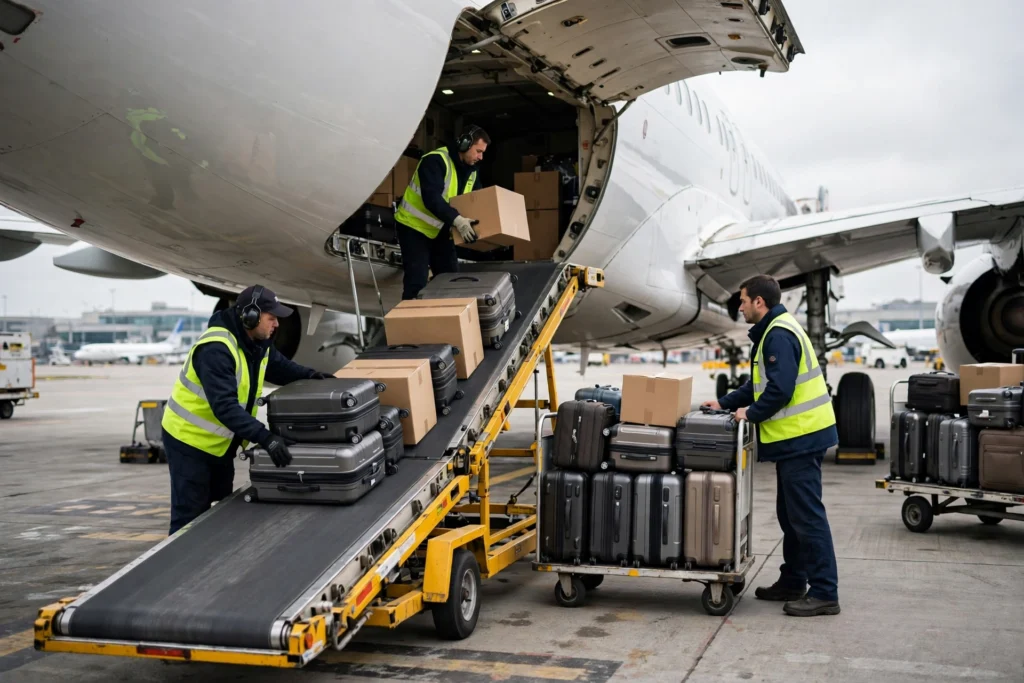
Here is something most passengers never think about. Under your feet, in the belly of the plane, there is cargo. Boxes. Parcels. Flowers. Medicine. Spare parts. Even fresh fish, flying to a market far away.
Passenger planes carry more than people. The space below the cabin is used to carry freight, and companies pay good money for that space. A plane flying from one country to another might carry mail, online shopping orders, and urgent parts for a factory. That cargo earns money on a flight that was already going anyway.
This is clever business. The plane has to fly whether the belly is full or empty. The fuel is already being burned. The crew is already being paid. So any money earned from cargo is almost pure extra income. It helps pay for the flight.
Cargo also helps on routes where few passengers fly. A flight might have only half its seats filled, but a full cargo hold can still make the trip worth flying. A plane is not just a bus in the sky. It is a delivery van too.
Selling Miles to Banks
You have probably heard of air miles, or points. You fly, you earn miles. You collect enough miles, you get a free flight or an upgrade. That sounds like the airline giving something away. In a way, it is. But the miles business is also a big earner, and the trick is who pays for the miles.
Airlines sell miles to banks. Yes, they sell them. Banks buy huge amounts of miles from airlines, then give those miles to their own customers as a reward for using a co-branded credit card. Every time you use that card, you earn miles. The bank has already paid the airline for them.
This is a very good deal for the airline. It gets paid in cash, up front, for miles that may never be used. Many miles sit in accounts for years. Some expire. Some people forget them. The airline keeps the money either way. And when people do use miles for a free seat, the airline usually gives them a seat that would otherwise have stayed empty.
Banks like the deal too. Miles make their credit cards more attractive, so people choose a card because it earns miles for their next holiday. The bank pays the airline, the customer gets miles, and the airline gets cash without flying an extra mile. Selling miles is steady, high-profit income. Flying planes is costly and uncertain. Miles help balance the two.
Why a Full Plane Can Still Lose Money
Here is the puzzle that surprises most people. A plane can be completely full, every seat taken, and the airline can still lose money on that flight. How is that possible?
The answer is cost. Flying a plane costs a lot, and most of that cost does not change with the number of passengers. The fuel costs the same whether the plane carries 10 people or 180 people. The pilots are paid the same. The cabin crew are paid the same. The rent for the plane, called leasing, is the same. The fee to land at the airport is the same.
So if the tickets were sold very cheaply, and few people bought extras, the total money coming in can be less than the total money going out. A full plane of cheap tickets can still be a losing flight.
Imagine a plane that costs 20,000 dollars to fly from one city to another. That covers fuel, crew, landing fees and the lease. If it carries 180 passengers who each paid 100 dollars, the airline takes in 18,000 dollars from tickets. That is 2,000 dollars short, even with every seat full. The airline needs the extras, the cargo and the miles money to close the gap and make a profit. Without them, the flight loses money.
This is why airlines watch their costs so carefully. Fuel is the biggest one. When oil prices rise, flying gets more expensive overnight. Airlines try to buy fuel in advance at a fixed price, but they cannot control the world market. A sudden rise in fuel can turn a profitable route into a losing one in weeks.
Most airlines do not own all their planes. They rent them, paying every month whether the plane flies or sits on the ground. Maintenance, insurance and airport charges add more, and all of it must be paid before the airline sees a dollar of profit.
So a full plane is good, but it is not enough on its own. The price of each ticket matters. The extras matter. The cargo matters. The whole mix has to cover the huge fixed cost of getting that metal tube into the sky.
A Worked Example With Round Numbers
Let us make the maths easy. This is a made-up example, with small round numbers, just to show how the pieces fit together. Real airlines deal in much bigger numbers, but the idea is the same.
Imagine a plane with 180 seats flying one trip. The ticket price is 100 dollars per person, and every seat is full. Ticket money is 180 times 100, which is 18,000 dollars.
Now add the extras. Half the passengers pay 25 dollars for a checked bag. That is 90 people times 25, which is 2,250 dollars. A third of the passengers pay 15 dollars to choose a seat. That is 60 people times 15, which is 900 dollars. Food, drinks and Wi-Fi bring in another 1,000 dollars across the whole plane. Add those together, and the extras come to 4,150 dollars.
Now add cargo. The belly of the plane carries parcels and mail, and the airline earns 2,000 dollars for that space on this trip. Add a share of miles sold to banks, say 850 dollars for this flight. The total money coming in is now 18,000 plus 4,150 plus 2,000 plus 850, which is 25,000 dollars.
Now the costs. Fuel costs 9,000 dollars. Crew pay, for pilots and cabin crew, costs 4,000 dollars. Leasing the plane for this trip costs 3,000 dollars. Landing fees, airport charges and maintenance come to 4,000 dollars. Insurance and other costs add 2,000 dollars. Total costs are 22,000 dollars.
Take the money in, 25,000 dollars, and take away the costs, 22,000 dollars. The airline is left with 3,000 dollars of profit on this flight. Not bad. But look what happens if you remove the extras, the cargo and the miles money. Ticket money alone, 18,000 dollars, is 4,000 dollars less than the costs. The same full plane would lose money.
That is the whole business in one small example. Tickets pay for a large part of the flight. Extras, cargo and miles pay for the rest, and leave a little profit behind. Change one number, and the result changes fast. If fuel rises by 3,000 dollars, the profit disappears.
What Happens When Things Go Wrong
Airlines do not control everything. Bad weather can delay a flight for hours, a storm can close an airport, and a technical fault can keep a plane on the ground. Each delay costs money: the crew must be paid for longer, and passengers may need food, hotel rooms or a new flight. One late flight can cause a chain of delays all day, because planes are used again and again, like buses that never stop.
Competition makes it harder. If one airline cuts its ticket price, others often follow, or they lose passengers. If a new low-cost airline starts flying the same route, prices can fall for everyone. That is good for travellers. It is tough for airlines. Their margins are thin, often just a few dollars per passenger. A small change in fuel price or demand can wipe out the profit on a whole route.
This is also why airlines stop routes that lose money month after month, and add flights on routes that fill up.
How Airlines Compare With a Shop
A shop and an airline both need to buy low and sell higher, but they do it in very different ways. A shop buys a product, puts it on a shelf, and sells it for more than it paid. If the product does not sell today, it can often sell tomorrow. The shelf is patient.
An airline cannot do that. Its product is a seat on a flight at a fixed time. Once the plane leaves, the unsold seat is worthless. There is no shelf. There is no tomorrow for that seat. That is why airlines work so hard to fill every flight, and why prices drop when a flight is half empty.
A shop also has one main sale per customer: you buy a cake, you pay, you leave. An airline has many small sales per customer. The ticket is the first sale, the bag the second, the seat the third, the sandwich the fourth.
You can see the same idea in other small businesses. A coffee shop sells the coffee, then sells a cake to go with it, and that is how a coffee shop makes money beyond the cup alone. A supermarket sells groceries at a small margin and earns more from its own brands, which is part of how a supermarket makes money. The pattern repeats everywhere: the first sale brings the customer in, and the extras build the profit.
The difference is scale and risk. A shop that has a quiet day loses a little money. An airline that has a quiet day still has to pay for fuel, crew and the plane itself. The costs are huge and fixed, while the income is uncertain and spread across many small payments.
Why Cheap Tickets Are Not Always Cheap
A cheap ticket is a good deal if you travel light and need nothing extra. If you have one small bag, do not mind where you sit, and bring your own food, you can fly for very little. The airline is happy, because your seat would otherwise have been empty, and you are happy, because you paid almost nothing.
But a cheap ticket can become expensive if you need a lot of extras. Three bags, chosen seats, food and Wi-Fi can double the cost of the trip. That is not a trick. The airline shows the prices as you book. The trick, if there is one, is that we often look only at the ticket price and forget to add the rest.
Smart travellers compare the total cost, not just the ticket. Add the bag, the seat and the food before you decide which airline is cheapest. Sometimes the airline with the slightly dearer ticket is cheaper in the end, because it includes a bag and a meal. Sometimes the low-cost airline still wins, because you need nothing extra at all.
Airlines know this. The low headline price catches your eye, and the extras are offered step by step, each one small and easy to accept. So the next time you see a flight for almost nothing, smile, but count the extras before you celebrate. The ticket is the start of the price, not the end of it.

Frequently Asked Questions
How do airlines make most of their money?
Airlines make most of their money from ticket sales, but tickets are only part of the picture. They also earn a lot from extras like baggage fees, seat choice, food and Wi-Fi, which is called ancillary revenue. On top of that, they earn from cargo in the belly of the plane and from selling air miles to banks. For low-cost airlines, the extras alone can be roughly 30 to 40 percent of their income.
Why are some plane tickets so cheap?
Some tickets are cheap because the airline would rather sell a seat for a low price than leave it empty. Once the plane takes off, an empty seat earns nothing, so a low price is better than no price at all. Cheap tickets also attract passengers who will then pay for extras like bags, seats and food, and the airline plans to earn more after the ticket is sold.
What is ancillary revenue for an airline?
Ancillary revenue is money an airline earns from things other than the ticket itself. It includes charges for checked bags, choosing a seat, extra legroom, food, drinks, Wi-Fi and priority boarding. For low-cost carriers, this money is roughly 30 to 40 percent of total income, which is a very large share. Each charge looks small, but across hundreds of passengers and hundreds of flights, it adds up fast. That is why airlines offer so many extras during booking.
How do airlines make money from cargo?
Airlines make money from cargo by selling the empty space in the belly of a passenger plane to companies that need to move goods quickly. This cargo can include parcels, mail, flowers, medicine and spare parts. The plane is already flying, and the fuel and crew are already paid for, so cargo income is valuable extra money. It can also help a route stay profitable even when few passengers are on board. Some planes carry only cargo and no passengers at all.
Can an airline lose money on a full flight?
Yes, an airline can lose money even when every seat is full. Most flight costs stay the same no matter how many passengers are on board: fuel, crew pay, plane leasing and landing fees cost the same for a half-empty plane and a full one. If tickets were sold very cheaply and few passengers bought extras, total income can be lower than total cost.
How do airlines make money from air miles?
Airlines make money from air miles by selling them to banks, which then give the miles to people who use a co-branded credit card. The bank pays the airline in cash, up front, for a large number of miles. Many of those miles are never used, or they expire, so the airline keeps the money either way. When people do use miles for a free flight, the airline usually gives them a seat that would have stayed empty. This makes selling miles a steady and profitable part of the business.
More from Zorium Daily
- How Does a Coffee Shop Make Money?
- How Does a Bakery Make Money?
- How Does a Supermarket Make Money?
- How Does a Sweet Shop Make Money?
An airline is not just a company that sells tickets. It is a business that sells a seat, then sells everything around that seat, fills the space below the cabin with cargo, and sells miles to banks, all while paying huge fixed costs for fuel, planes and crew. The next time you fly, look at the price of your ticket, then count the extras, and you will see the whole business working quietly around you, from take-off to landing.