What Is Pocket Money and How Does It Work? Explained Simply
SUMMARY OF THIS ARTICLE
- Pocket money is a small amount of money given to a child on a regular basis, usually once a week, for the child to spend, save, or share as they choose.
- In the United States it is often called an allowance, and in many families it is linked to small jobs around the house, though some families give it with no strings attached.
- The simple save–spend–give split stops the money from vanishing all at once: part is saved for something bigger, part is spent on small treats, and part is given to help someone else.
- Children can earn extra money through paid chores, helping neighbours, a lemonade stand, or babysitting when they are older, but the extra money still needs the same careful plan.
- A piggy bank is a tool for holding money, while pocket money is the money itself, and learning to manage small amounts now is the best practice for managing bigger amounts later.
The Saturday Morning Coins
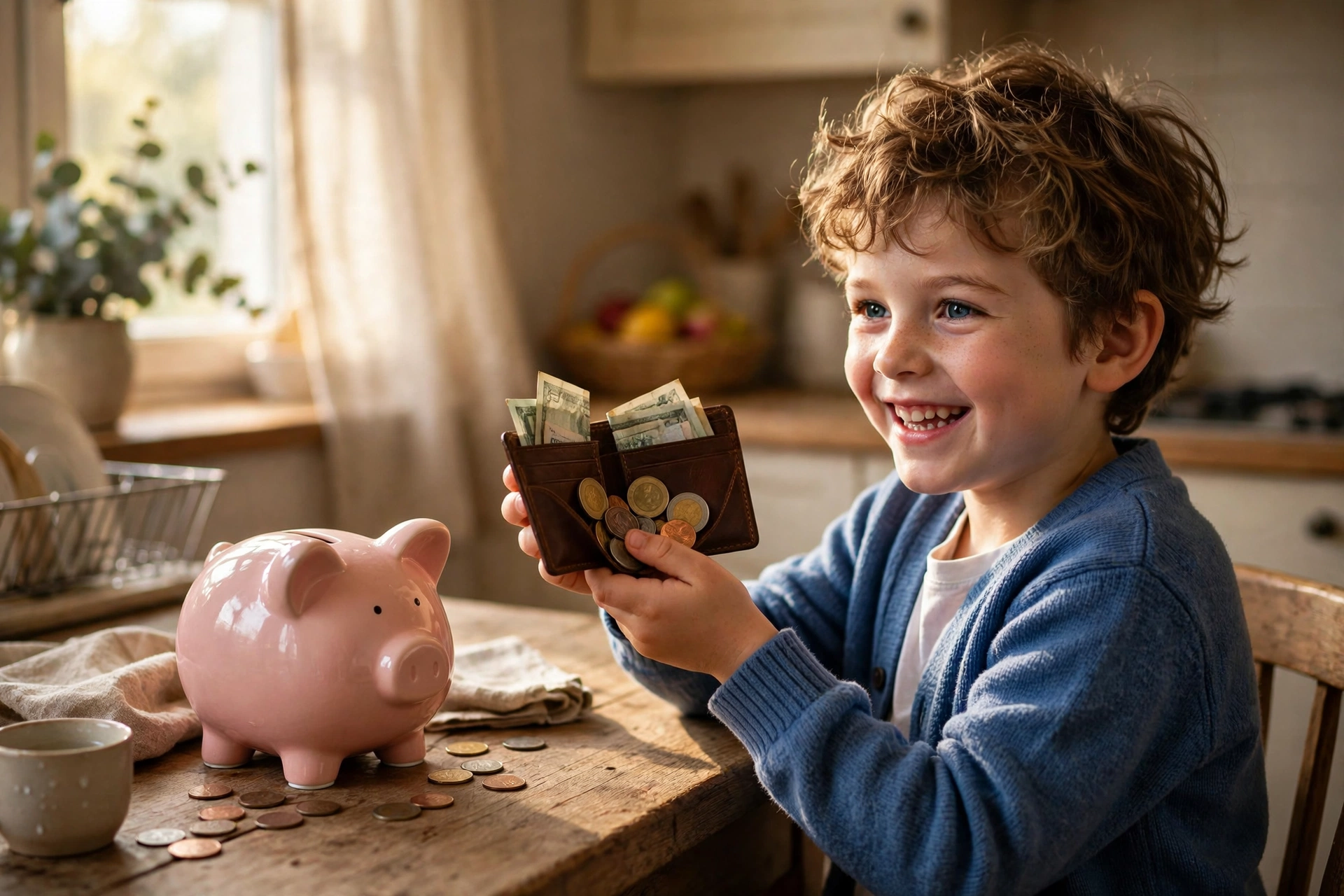
Every Saturday morning, nine-year-old Mia heard the same sound: her mum opening the kitchen drawer and counting out coins. Two pound coins, a fifty pence piece, and a handful of smaller coins. Mum placed them in Mia’s hand, one by one, and Mia closed her fingers around them as if they were treasure. Three pounds. It was not a fortune. But it was hers. She could keep it, spend it, or save it, and nobody would take the choice away from her.
That Saturday, Mia walked to the corner shop with her best friend, Lily. The shop had a shelf of sweets that seemed to glow under the lights. By the time she got home, the three pounds were gone, and all she had to show for it was a half-eaten chocolate bar and a pencil she did not really need.
Her mum did not scold her. She simply asked one question: “Did you enjoy spending it?” Mia nodded and looked at the empty pocket of her jeans. “But now I have nothing left,” she said. Mum smiled. “That is exactly what pocket money teaches you. It is yours to spend, but once it is gone, it is gone until next Saturday. Next week, you get to choose differently.”
That small weekly moment is how millions of children first learn about money: not from a lesson, but from a few coins and the freedom to decide. This guide explains it all in plain words.
So What Is Pocket Money, Really?
Pocket money is a small amount of money that a parent or carer gives a child on a regular basis, usually once a week. It is the child’s own money to manage. The child decides what to buy, what to keep, and what to share, and the parent steps back and lets the child learn from those choices, including the mistakes.
The idea is simple, but the word itself can cause confusion, because different countries call it by different names. In Britain, people say pocket money. In the United States, the same thing is usually called an allowance. If you hear an American child talk about their allowance, they mean exactly what a British child means by pocket money: a regular small amount of money from their parents.
Pocket money is not the same as a birthday present or money from a kind relative. Pocket money is regular. It arrives on the same day each week, like clockwork, and because it is regular, a child can plan around it. If something costs six pounds and pocket money is three pounds a week, a child can work out that two weeks of waiting will buy it. That simple bit of planning is the heart of what pocket money teaches.
It is also not a wage. A child is not an employee, and pocket money is not a salary for being a child. Some families do link it to small jobs around the house, and some do not, and both ways are normal. The point of the money is not to pay a child for existing. The point is to give a child a small, safe amount of money to practise with, so that the big money decisions of adult life do not arrive as a complete surprise. Think of it like a training ground: a footballer starts on a small pitch, making mistakes where it does not matter much. A child who spends all three pounds on sweets learns a lesson that cost three pounds. An adult who makes the same mistake with a whole month’s pay learns a lesson that costs far more. Small money, small mistakes, big lessons.
Why Do Parents Give Pocket Money?
Parents give pocket money for one main reason: so their children can learn about money while the stakes are still low. Reading about money is one thing. Holding it, choosing with it, and living with the choice is quite another. Pocket money creates that choice every week, in a gentle way.
The first lesson it teaches is that money runs out. This sounds obvious to an adult, but to a child it is a new idea. When a child holds three pounds and watches it turn into a chocolate bar and then into nothing, the idea becomes real. Money is limited. Once you spend it, it is gone, and more does not appear until next week. That is a lesson no lecture can teach as well as an empty pocket can.
The second lesson is about choosing. A child with three pounds and ten things they want must decide. Pocket money lets children practise choosing in a small way, so that choosing feels normal rather than frightening when the amounts grow up.
The third lesson is about waiting. Some things cost more than one week’s pocket money, and the only way to buy them is to save for a few weeks. A child who wants a toy that costs nine pounds, and gets three pounds a week, must wait three weeks. Those three weeks teach patience: the toy feels earned when it finally arrives.
How Much Pocket Money, and How Often?
There is no single right amount, because every family is different. Some children get one pound a week. Some get five. Some get ten. The amount often grows as the child grows older, A common pattern is a small amount at age six or seven, a little more at nine or ten, and a larger amount in the early teenage years.
What matters more than the amount is the regularity. Pocket money almost always arrives on the same day each week, and that rhythm is part of the lesson. If your family gives pocket money on a Friday, keep it on a Friday. If it is a Sunday, keep it a Sunday. The day does not matter. The habit does.
Some families give pocket money in cash, in coins and notes that a child can hold and count. Others transfer it into a bank account or onto a card made for children, and the child can see the balance on a phone. Both ways work, but cash has one special advantage for younger children: it is real in a way that numbers on a screen are not. A child can see three pound coins leave their hand and feel the pocket go light. A number on a screen does not feel the same.
How Children Can Earn a Little Extra
Pocket money is a starting point, not a ceiling. Many children want more than their weekly amount, and that is a healthy sign. There are plenty of safe, simple ways for a child to earn a little extra, and each one teaches something different.
The simplest way is paid chores beyond the usual ones. Every family has jobs that are bigger than the everyday tidying: washing the car, helping clear out the garage, weeding the garden, or helping paint a fence. A parent might offer a pound or two for one of these bigger jobs. The child learns that extra effort earns extra money, which is a fair and useful lesson.
Helping neighbours is another good way. A child who earns money by helping a neighbour learns that their time and kindness have value in the wider world, not just inside their own house.
Then there is the classic lemonade stand. On a warm day, a child can set up a small table outside their home with a jug of lemonade, some paper cups, and a cheerful sign. This is a tiny business, and it teaches more about money than almost anything else: you buy lemons and sugar, you make the drink, you set a price, and you learn very quickly whether people think the price is fair. It is a whole economics lesson in a single afternoon, and it is fun as well.
When children are older, babysitting becomes an option. A teenager who looks after a younger child for an evening earns real money, and earns it by being responsible for another person. That is a serious job, and parents should only let an older child do it when they are ready and the family knows the people involved.
Whatever the extra work is, one rule stays the same: the extra money needs the same plan as the pocket money. Extra money that is earned and then spent in one afternoon teaches nothing. Extra money that is split, saved, and spent with thought teaches everything. Which brings us to the simplest plan of all.
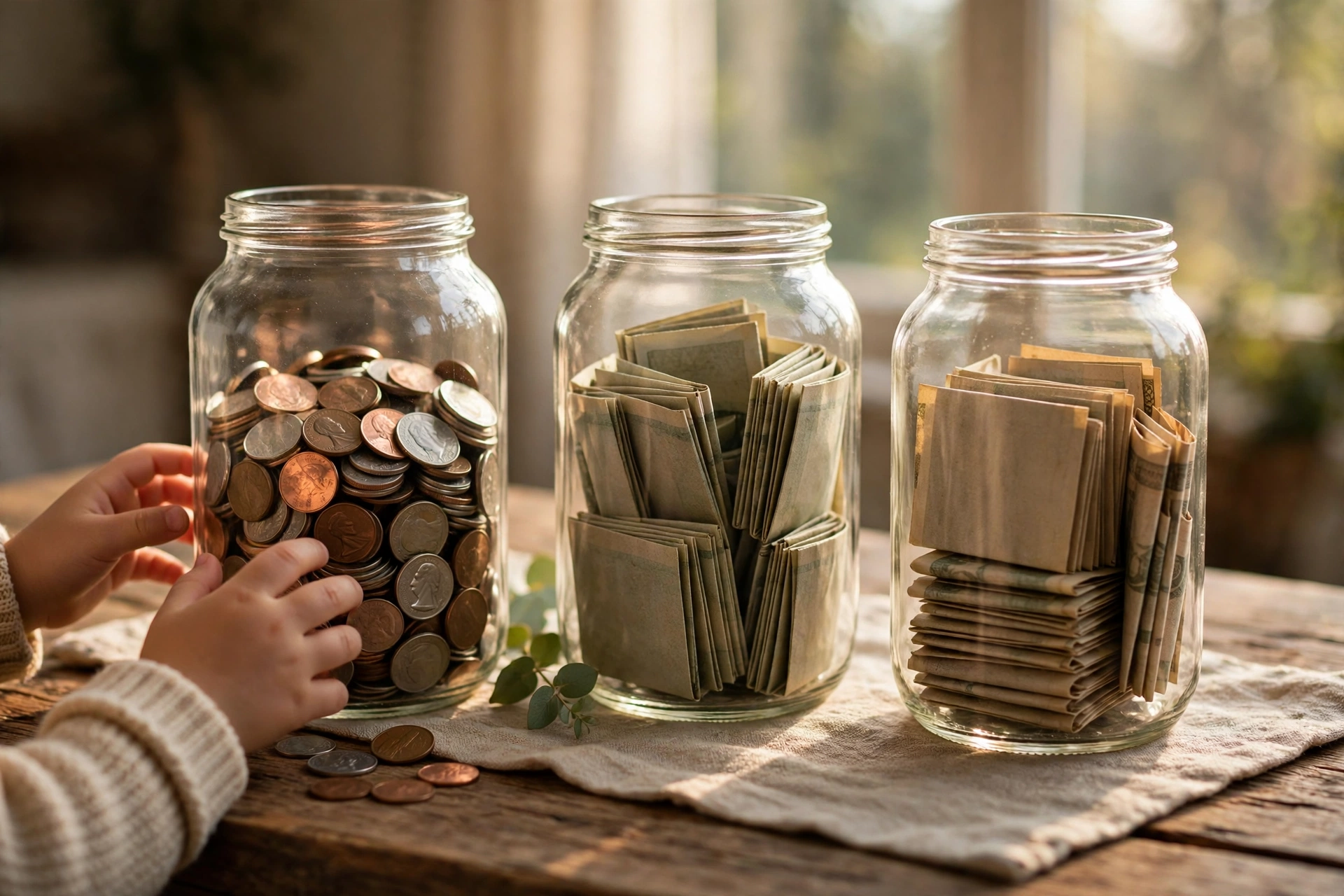
The Simple Save–Spend–Give Split
If pocket money had one golden rule, it would be this: do not spend it all at once. The easiest way to follow that rule is a simple split into three parts. Save some, spend some, and give some. Three jars, three jobs, one small habit that can last a lifetime.
The save jar is for the future. Money in this jar is not for today. It is for something bigger later: a toy, a book, a game, or a birthday present for a friend. A child who puts money in the save jar every week learns the most powerful money habit there is, which is paying yourself first. The money goes into the jar before anything is spent, not after.
The spend jar is for fun right now. This jar matters just as much as the save jar, because a plan with no fun in it never lasts. A child who saves every penny and never buys a sweet or a sticker will soon stop bothering with the whole plan. The spend jar is permission to enjoy money. It is the ice cream on a hot day, the comic from the corner shop, the small treat that makes the week feel good.
The give jar is for someone else. A child might give to a charity box, or buy a small gift for a friend, or put money towards a collection at school. The amount can be tiny. What matters is the habit of thinking about other people when money arrives.
How much goes in each jar? A simple split that works for many families is half to save, and the rest divided between spend and give. But the exact numbers matter less than the habit itself. What should not change is that there are always three jars, and the money is always split the moment it arrives, before the spending starts.
A Worked Example: Three Pounds a Week
Numbers make pocket money easy to understand, so here is one clear example. Imagine a made-up example: a child called Tom gets three pounds of pocket money every Saturday morning. Let us see what happens to Tom’s money over four weeks if he uses the save–spend–give split.
Each Saturday, Tom splits his three pounds straight away. One pound goes into the save jar. One pound goes into the spend jar. One pound goes into the give jar. He does this before he goes anywhere near a shop.
After four weeks, the save jar holds four pounds. Tom has also spent one pound a week on small treats and given one pound a week to help others. Nothing was wasted, and nothing was missed.
Now Tom sees a small football in a shop window. It costs four pounds. Because he has been saving one pound a week for four weeks, he has exactly four pounds in his save jar. He can buy the football today, and he still has his spend money and his give money untouched. If he had spent all three pounds each week on sweets, he would have no football, no savings, and nothing to show for a whole month of pocket money. The difference between the two Toms is not luck. It is the split.
The same maths works with any amount. A child who gets five pounds a week could save two pounds, spend two pounds, and give one pound. A child who gets two pounds a week could save one pound, spend fifty pence, and give fifty pence. The amounts are small, but the habit is enormous, because the habit is the same one adults use when they save for a holiday, a car, or a house. Only the numbers are bigger.
Pocket Money Is Not the Same as a Piggy Bank
Here is a mix-up that catches many people out, so it is worth clearing up early. Pocket money is the money itself. A piggy bank is a tool for holding the money. They are not the same thing, even though they often appear together on a child’s bedroom shelf.
Think of it this way. Pocket money is like water. A piggy bank is like a jug. You need the water, and the jug helps you keep it in one place, but the jug is not the water.
This matters because some children think that putting money in a piggy bank is the same as saving it, and it is not quite. Dropping coins into a piggy bank and forgetting about them is not saving. Saving means putting money aside for a purpose, knowing what the purpose is, and leaving the money alone until the purpose arrives. A piggy bank helps with that, because it keeps the money out of sight and out of reach, but the bank does the holding, not the deciding. The child does the deciding.
The money is the point. The bank is the helper. That said, a piggy bank is a wonderful helper, especially for younger children. A guide to how a piggy bank helps kids save money explains this in more detail, and it is worth a read if your child is just starting out. The key point is simple: use the piggy bank as a tool, not as a hiding place, and always know what the money inside it is for.
The Mistakes That Make Pocket Money Disappear
Every child makes mistakes with pocket money. That is the whole point of it: the mistakes are small, the lessons are big, and nobody gets hurt.
The first mistake is spending it all on the first day. The money arrives on Saturday morning, and by Saturday afternoon it is gone. Then comes the long week of wanting things and having nothing to buy them with. This mistake is so common that almost every child makes it at least once. The fix is simple: split the money the moment it arrives, before the shops get a chance to tempt you, and keep the save jar out of reach for the rest of the week.
The second mistake is buying something just because a friend has it. A friend arrives at school with a new toy, and suddenly every child wants the same toy. The toy is bought in a rush, played with once, and then forgotten in a drawer. The fix is a simple waiting rule: if you still want something after a whole week, it is probably worth buying. If you have forgotten about it by next Saturday, it never was.
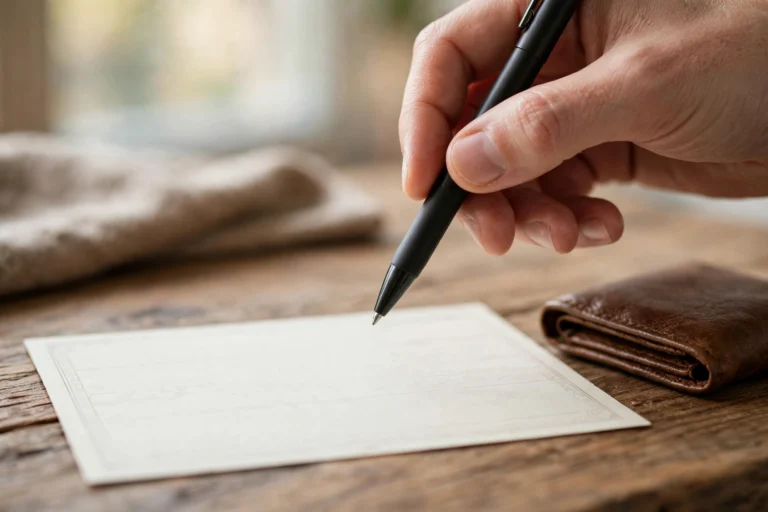
The third mistake is keeping no track at all. Money comes in, money goes out, and the child has no idea where it went. A small notebook, or a piece of paper on the bedroom wall, can change this completely. Each week, the child writes down what came in and what went out. Three pounds in, one pound saved, one pound spent on sweets, one pound given away. After a month, the notebook tells a story, and the child can see their own habits clearly for the first time.
Good Habits That Grow With the Money
Pocket money is the beginning of money skills, not the end of them. The habits a child builds with three pounds a week are the same habits that will one day manage a salary, a rent payment, and a savings account.
The first good habit is the weekly split, done the moment the money arrives. Save, spend, give, in that order, every single week, without fail. Done fifty times a year, the split soon feels as natural as brushing your teeth.
The second good habit is setting a goal and writing it down. A child who wants a ten-pound toy and writes “Toy: £10” on a piece of paper has made the goal real. Each week, they can cross off the pounds as they save them, and the paper shows the progress. A goal that is only in your head is easy to forget. A goal on paper stares back at you every day.
The third good habit is learning to make a simple plan for the week ahead: a friend’s birthday, a school trip, a book they want. A tiny plan, written on a scrap of paper, turns random spending into chosen spending. As children grow older, this turns into a proper monthly budget, and a simple guide to how to make a monthly budget that actually works shows the same ideas in grown-up form.
The last habit is the simplest of all: enjoying the money without guilt. Pocket money is not a test, and a child who spends their spend jar on an ice cream has done nothing wrong. Money is meant to be enjoyed as well as saved. The balance is the point. Save some, spend some, give some, and enjoy all three.

Frequently Asked Questions
What is pocket money in simple words?
Pocket money is a small amount of money that parents give their child every week for the child to manage. The child can spend it, save it, or give some of it away. In the United States it is usually called an allowance. It is a safe way for children to practise handling money while the amounts are still small.
How much pocket money should a child get?
There is no single right amount, because every family is different. Some children get one pound a week, and some get five or ten. The amount often grows as the child gets older. What matters more than the amount is that it arrives on the same day every week, so the child can plan around it.
Should pocket money be linked to chores?
It depends on the family, and both ways are normal. Some families link it to small jobs around the house, and others give it with no strings attached and expect chores to be done anyway as part of family life. What matters most is that the rule is clear and stays the same, so the child always knows where they stand.
What is the save–spend–give split?
It is a simple way to divide pocket money into three parts the moment it arrives. Part goes into a save jar for something bigger later, part goes into a spend jar for small treats now, and part goes into a give jar to help someone else. Splitting the money first stops it from all disappearing in one afternoon.
Can children earn extra money as well as pocket money?
Yes, and many do. Children can earn extra through bigger paid chores, helping neighbours, running a lemonade stand, or babysitting when they are older. The extra money should still be split in the same way, so the habit stays strong even when the amount grows.
Is a piggy bank the same as pocket money?
No. Pocket money is the money itself, while a piggy bank is a tool for holding the money. A child can have pocket money without a piggy bank, keeping it in a wallet or a bank account instead. The piggy bank helps by keeping the saved money out of sight, but the child still has to decide what the money is for.
More from Zorium Daily
- What Is a Savings Account and How Does It Work?
- How to Make a Simple Monthly Budget That Actually Works
- How to Build an Emergency Fund on a Small Income: A Simple Beginners Guide
- How Does a Piggy Bank Help Kids Save Money?
Three pounds a week may not sound like much, but in Mia’s hands it was the beginning of something big. It was her first taste of choosing, waiting, saving, and sharing, and those small Saturday mornings were quietly teaching her how money works. Give a child a little money, a simple plan, and the freedom to make small mistakes, and the lessons will last far longer than the coins themselves.