Why Do We Have the Olympic Games? Explained Simply
Summary of This Article
- The Olympic Games began in Olympia, Greece, in 776 BC as a religious festival to honour Zeus, and at first there was only one race, a sprint of about 200 metres.
- The Games were held every four years for nearly 1,200 years, and a sacred truce let athletes travel safely through lands that were at war.
- The Roman emperor Theodosius banned the Games in the late 300s AD, and they were forgotten for about 1,500 years.
- A French teacher named Pierre de Coubertin brought the Games back, and the first modern Olympics were held in Athens in 1896.
- Today athletes from almost every country take part, and the five rings, the flame and the four-year rhythm all come from that long history.
The Night the Whole World Watches Together
Maya was nine years old, and she was supposed to be in bed. It was past ten o’clock on a school night, the house was quiet, and her mother had already said goodnight twice. But from the living room came the sound of music, low and grand. Maya crept to the doorway and peeked around the corner.
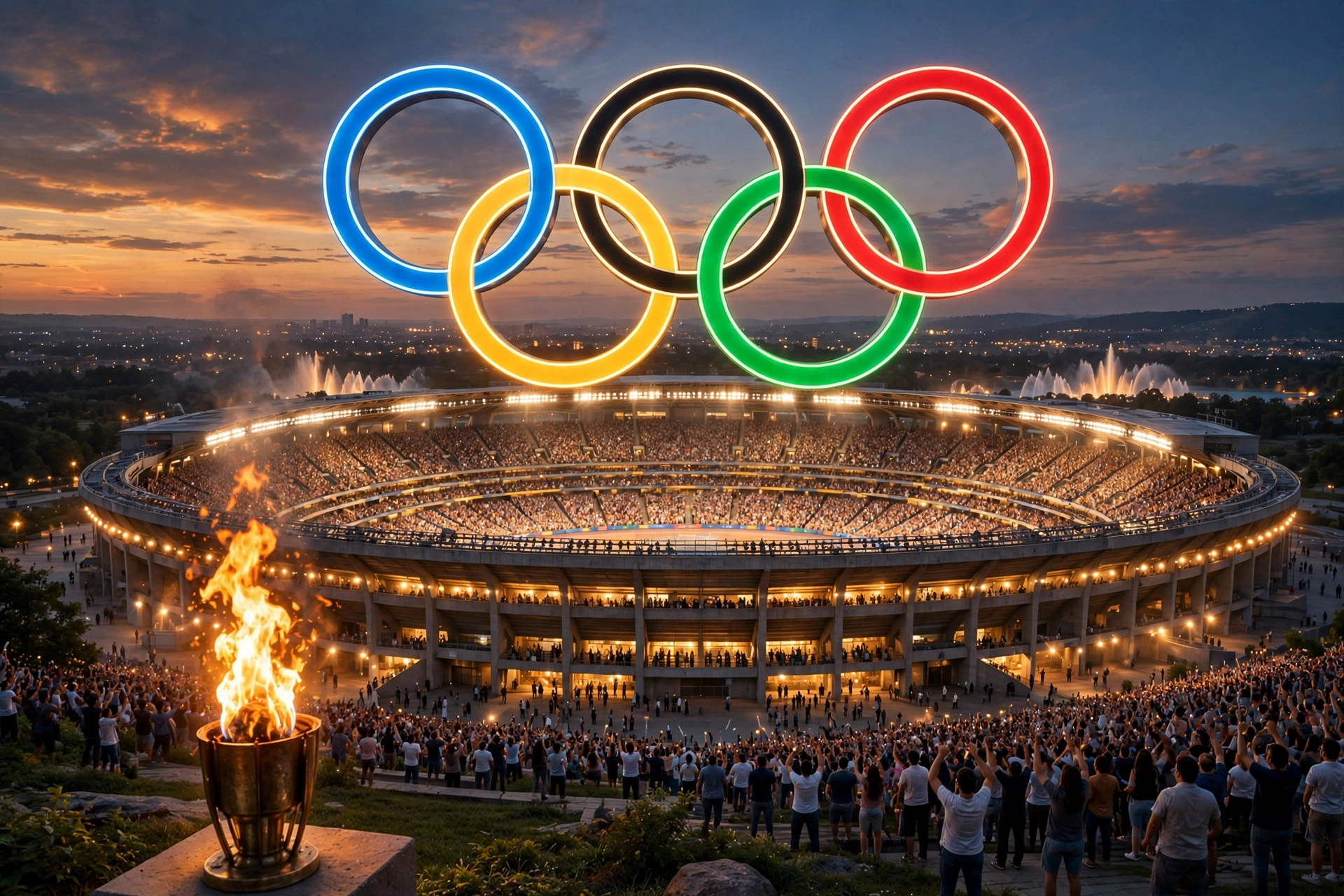
Her father was sitting on the sofa with the lights off, watching the television. On the screen, a stadium glowed like a bowl of light. Thousands of people were on their feet, waving flags. A line of athletes walked in behind their country’s flag, smiling and waving. Then a runner appeared with a burning torch, climbed the steps, and lit a giant bowl of fire. The crowd roared so loudly that Maya could feel it through the floor.
“Why does the whole world stop for this?” she whispered. Her father patted the sofa beside him. “Sit down,” he said. “It is a good question. And the answer is almost three thousand years old.”
The Honest Answer First
Before we go back in time, here is the honest answer in one paragraph. We have the Olympic Games because the ancient Greeks invented them as a religious festival, and the modern world fell in love with the idea all over again. The Greeks held them to honour their most powerful god, Zeus. The modern Games kept the old name, the old four-year rhythm and the old spirit of fair competition, and added something new: the whole world is invited.
That is why the Games feel different from a normal sports event. A football final belongs to two teams, and a world championship belongs to one sport. But the Olympics belong to everyone, or at least they try to. That idea, that the whole world can meet in one place and settle things by running faster instead of fighting, is nearly three thousand years old, and it is why the Games have survived wars, bans and fifteen hundred years of silence.
A Quiet Valley and a Race of About 200 Metres
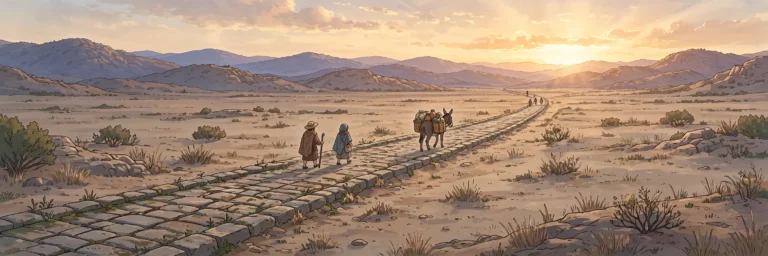
The story begins in Olympia, a green valley in the west of Greece. Olympia was not a big city. It was a sacred place, a quiet spot with temples and tall trees, where people came to worship Zeus, the king of the Greek gods. The Greeks believed Zeus watched over the world from Mount Olympus, the highest mountain in Greece, and Olympia was named after that holy mountain.
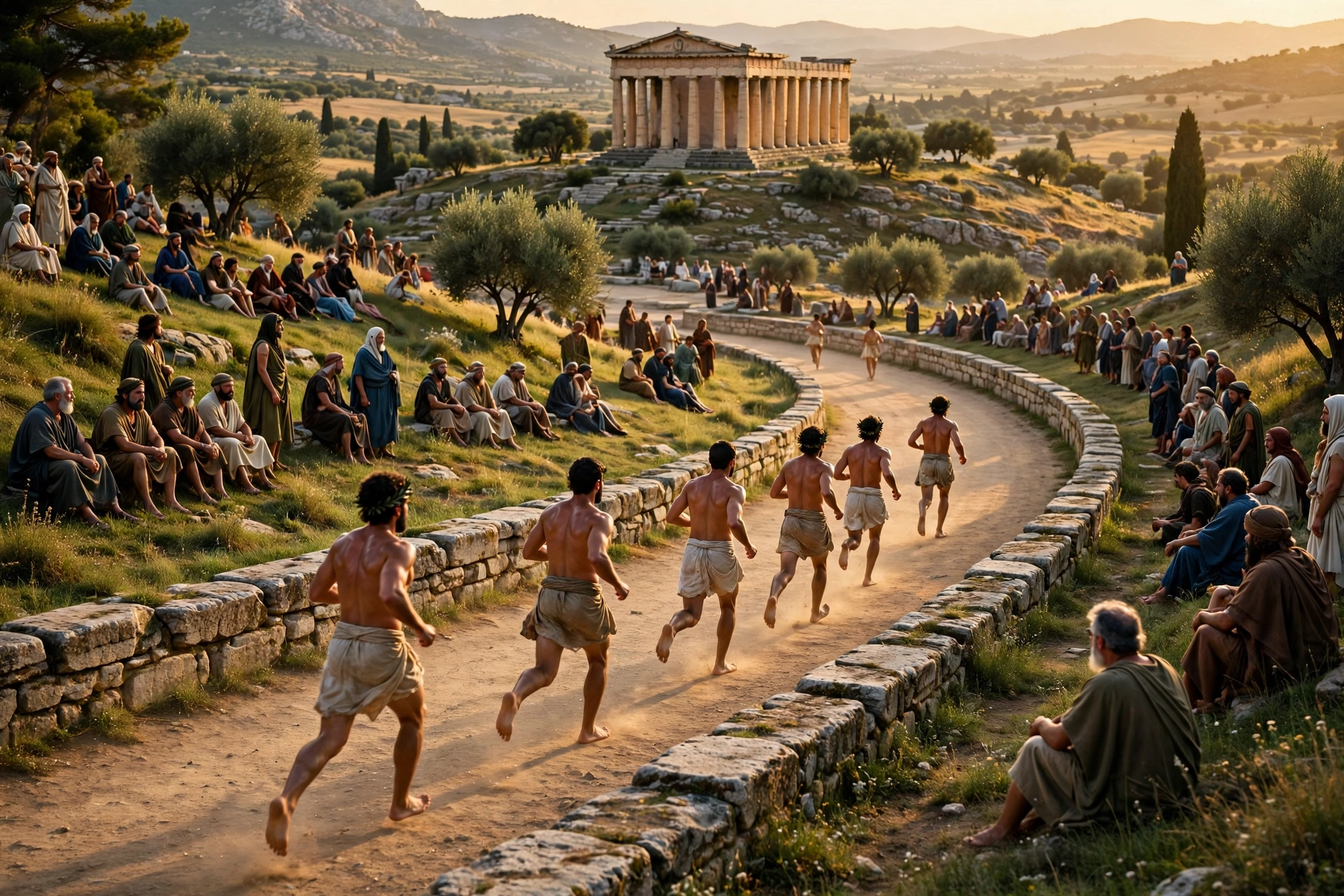
In 776 BC, nearly three thousand years ago, the people at Olympia held a festival for Zeus. It was part prayer, part party, and part sports day. And the sports day was very small. There was just one event, one single race. It was called the stadion, and it was a sprint of about 200 metres, roughly the length of two football pitches laid end to end. The runners started at one end of a straight track, ran as fast as they could, and the first person to reach the other end won.
We even know the name of that first winner. He was a cook named Coroebus, from a nearby town, and his name was written down because the Greeks used the winner of the stadion race to count the years. If you asked a Greek what year it was, he might say, “the third year after Coroebus won.” The winner’s name was the calendar. That tells you how much the race mattered, even when it was the only race there was.
Imagine it. No stadium full of seats, no television cameras, no medals, no national anthems. Just a strip of packed earth, a crowd standing in the grass, and a group of barefoot men waiting for someone to shout, “Go!” The winner did not get a gold medal. He got a crown woven from olive leaves, cut from a sacred tree near the temple of Zeus. An olive crown sounds small, but to a Greek it was worth more than gold.
From One Race to the Biggest Party in Greece
One race was only the beginning. As the years passed, the Games grew. New events were added, one by one, like rooms added to a house. There was a longer race, twice the length of the stadion, and then a very long race of about 5 kilometres, which is like running from your school to the far side of town and back again. There was wrestling, where two men tried to throw each other to the ground. There was boxing, with leather straps wrapped around the fists instead of soft gloves. There was the long jump, the discus throw and the javelin, a kind of spear thrown for distance.
The Truce That Let Enemies Travel in Peace
Now here is the most remarkable part of the ancient Games, and the part that explains why we still have them today. In those days, Greece was not one country. It was a patchwork of small city-states, like Athens and Sparta, and they were often at war with each other. Travelling from one city to another could be dangerous. Roads were rough, robbers hid in the hills, and an enemy army might be marching the other way.
So the Greeks made a rule, and they called it the Olympic Truce. For the month of the Games, all fighting had to stop. Athletes, judges and ordinary visitors were promised safe travel to Olympia and back home again. Nobody was allowed to attack them on the road, and no army was allowed to march through the sacred valley. Anyone who broke the truce was fined, and the whole Greek world would know their name in shame.
Think about that for a moment. Cities that were at war with each other agreed to put down their weapons so that a foot race could happen. The Greeks believed that sport could do something war could not. War decided who was stronger by hurting people. Sport decided who was faster or stronger by giving everyone the same track, the same starting line and the same rules. If you won, you won because you were the best that day, not because you had the bigger army.
Why Winning Mattered So Much
It is easy to wonder why the ancient Greeks cared so much about a race. After all, the winner only got a crown of leaves. There was no prize money, no gold medal, no sponsorship deal. So why did a whole city celebrate when one of its sons won at Olympia?
The answer is pride. In the ancient world, your city was your team. When an athlete from Athens won, it was not just his victory. It was Athens winning. When an athlete from Sparta won, Sparta won. The athlete carried the honour of his home on his shoulders, and his neighbours knew it. They would meet him at the city gates with music and flowers, the way a town today might welcome home a football team that has just won a cup.
The Long Silence: How the Games Vanished
Nothing lasts forever, and the ancient Games were no exception. As the centuries passed, Greece lost its freedom. The Romans took over, and the Games went on for a while under Roman rule, but the world around them was changing. The Roman Empire became Christian, and the old Greek gods, Zeus and the rest, were no longer worshipped. To the new rulers, a festival in honour of Zeus looked like an old pagan custom that should be left behind.
In the late 300s AD, about 1,170 years after that first race in 776 BC, the Roman emperor Theodosius I banned pagan festivals across the empire. The Games at Olympia stopped. The last recorded Games were held in AD 393. After that, the great festival that had run every four years for nearly 1,200 years simply ended. Nobody rang a bell to mark the end. The athletes went home, the crowds stopped coming, and the valley grew quiet.
The French Teacher Who Refused to Forget
That someone turned out to be a French schoolteacher named Pierre de Coubertin. Coubertin was born in 1863, and he cared deeply about two things: education and sport. He believed that young people should exercise their bodies as well as their minds, and that playing sport fairly taught lessons no classroom could teach. You learn to win without boasting, to lose without giving up, and to respect the person you are competing against. He thought those lessons mattered for the whole world.
As a young man, Coubertin visited the ruins at Olympia and read everything he could about the ancient Games. He fell in love with the idea. Here was a festival that had once brought warring cities together in peace, every four years, for more than a thousand years. What if it could be done again, but bigger? What if athletes from every country on earth could meet in one place, not to fight, but to compete fairly?
In 1894, Coubertin called a meeting in Paris and put his idea to the people who ran sport in different countries. Not everyone was convinced at first. Some thought it was a dream, a lovely idea that could never work in the real world. But Coubertin was stubborn, and he had a gift for persuading people. At the end of the meeting, the delegates voted to bring the Olympic Games back, and they set up a new organisation, the International Olympic Committee, to run them.
Two years later, in 1896, the first modern Olympic Games opened in Athens, Greece, the home of the ancient Games. It was a small event by today’s standards. A few hundred athletes from 14 countries took part, and there were only 43 events. There were no women athletes yet, which seems strange and unfair to us now, but that was the world of 1896. About 60,000 people filled the stadium, and when the Games began, the crowd cheered so loudly that the king of Greece stood up and smiled. A Greek runner named Spyridon Louis won the marathon, the longest race of all, and the whole stadium erupted. The Games were back, and this time they belonged to the world.
What the Five Rings Mean
If you have ever watched the Olympics on television, you have seen the symbol: five rings, blue, yellow, black, green and red, linked together on a white flag. Coubertin designed that symbol himself in 1913, and it is one of the most famous pictures in the world. Almost everyone recognises it, even people who never watch sport.
The five rings stand for the five inhabited parts of the world: Africa, the Americas, Asia, Europe and Oceania. The rings are linked together because the continents are linked together by the Games. The colours were chosen because, at the time Coubertin designed the flag, every national flag in the world contained at least one of those six colours, the five ring colours plus the white background. That was the point. The flag was meant to belong to everyone.
When the flag is raised at the opening ceremony and the athletes walk in behind it, it is the whole idea of the Olympics in one picture. Different countries, languages and religions, all walking into the same stadium together. The rings say, without any words at all, that we are one world, and that we can meet in peace to do something beautiful together.
The Flame That Travels Across the World
The other great symbol of the Games is the flame. Every Olympic Games begins with a fire that is lit in Olympia, in Greece, in front of the ruins of the temple where the ancient Games were held. The flame is lit the old way, using the rays of the sun and a curved mirror, without matches or lighters. A woman dressed in the style of an ancient Greek priestess holds the mirror up to the sun, and when the flame catches, the crowd cheers.
Then the flame begins a journey. Runners carry it in a torch, hand to hand, from one person to the next, across countries and over seas, until it reaches the stadium where the Games will be held. The journey can take months, and the torch can pass through the hands of thousands of people. Ordinary people, schoolchildren, old people, famous athletes, all take a turn. It is called the torch relay, and it is one of the most loved parts of the whole Games.
Why a flame? Because fire meant something special to the ancient Greeks. In their stories, fire was a gift from the gods, stolen for humans by a kind hero named Prometheus. The ancient Games had a sacred fire burning at Olympia. The flame is a reminder that the Games are connected to that ancient fire, burning in the same valley, nearly three thousand years later.
Why Every Four Years?
One question children always ask is why the Games only happen every four years. Why not every year, like a birthday? The answer goes back to the ancient Greeks, who counted time by the Games themselves. The four-year gap between one Games and the next was called an Olympiad, and it was their way of marking the years, the way we use the year number on a calendar. If you lived in ancient Greece, you knew what year it was because you knew how many Games had passed.
Coubertin kept the four-year rhythm when he brought the Games back, and there are good reasons why it still works today. Four years gives a host city time to build stadiums, swimming pools and athlete villages. It gives athletes time to train, to grow stronger, and to dream about the next Games. And it keeps the Games special. If the Olympics happened every year, they would start to feel ordinary, like a weekly football match. Because they only come every four years, they feel like a festival, something to wait for and count down to.
Today, athletes travel to the Games in a way the ancient Greeks could never have imagined. They fly across oceans in a single day, ride in coaches and trains, and arrive by who invented the first car to stadiums that the ancient athletes would have thought were palaces. The journey has changed completely, but the idea of the journey has not. Athletes still travel from far away to meet in one place, just as they did on foot and by horse along the dusty roads to Olympia.
The Modern Games: Bigger Than Anyone Dreamed
From that small start in Athens in 1896, the modern Games grew faster than anyone expected. Women were allowed to compete from 1900, and today women and men compete in almost equal numbers. New sports were added: swimming, gymnastics, cycling, basketball, and in recent years, skateboarding, surfing and climbing. The Winter Games began in 1924, for sports on snow and ice. The Paralympic Games, for athletes with disabilities, began in 1960 and now run alongside the Olympics in the same city, using the same stadiums.
Today, athletes from almost every country in the world take part, more than 200 teams marching into the stadium at the opening ceremony. Billions of people watch on television and on their phones, and the news of a world record spreads around the planet in seconds. The story of who invented the printing press shows how news began to travel faster, but even that seems slow beside a modern broadcast, which can show a race in London to a living room in Tokyo at the very moment it happens.
And yet, for all the size and the noise and the money, the heart of the Games has not changed. Athletes still train for four years for one race that lasts ten seconds. They still stand on the podium and cry when their country’s anthem plays. They still shake hands with the person who beat them. A gold medal today is heavier than an olive crown, but it means the same thing it meant in 776 BC: on this day, in this event, you were the best in the world.
Why the Games Still Matter
So why do we have the Olympic Games? We have them because they answer a need that has not gone away in three thousand years. People want to see what the human body can do. They want to see someone run faster than anyone has ever run, jump higher than anyone has ever jumped, and lift more than anyone has ever lifted. They want to feel that rush of watching a race that is decided by the width of a fingertip.
But there is a deeper reason, and it is the one Coubertin understood. The Games remind us that countries can meet without fighting. For two weeks every four years, the world agrees on one set of rules, and the strongest, fastest and most skilful athletes win, no matter how rich or powerful their country is. A small island nation can beat a huge one. A runner from a poor village can stand on the podium beside a runner from a wealthy city. On the track, nobody cares about your passport. They only care about how fast you can run.
Frequently Asked Questions
When did the Olympic Games begin?
The first recorded Olympic Games were held in Olympia, Greece, in 776 BC, nearly three thousand years ago. They began as a religious festival to honour Zeus, the king of the Greek gods, and at first there was only one event, a sprint of about 200 metres, held every four years for nearly 1,200 years.
Why were the ancient Games stopped?
The ancient Games were stopped in the late 300s AD, when the Roman emperor Theodosius I banned pagan festivals across the Roman Empire. The last recorded Games were held in AD 393. After that, Olympia fell into ruin, earthquakes and floods covered the stadium in mud, and the Games were forgotten for about 1,500 years.
Who brought the Olympic Games back?
A French teacher named Pierre de Coubertin brought the Games back. He believed sport taught young people fairness, respect and courage, and he wanted athletes from every country to meet in peace. In 1894 he called a meeting in Paris, the delegates voted for a revival, and the first modern Olympic Games were held in Athens in 1896.
What do the five Olympic rings mean?
The five rings stand for the five inhabited parts of the world: Africa, the Americas, Asia, Europe and Oceania. They are linked together to show that the continents are joined by the Games. Coubertin designed the symbol in 1913, and he chose the colours because every national flag in the world at that time contained at least one of them.
Why is the Olympic flame lit in Greece?
The flame is lit in Olympia, in Greece, using the rays of the sun and a curved mirror, in front of the ruins of the ancient temple. It is a link to the sacred fire of the ancient Games. Runners then carry the flame in a relay across countries to the host stadium, where the last runner lights a great bowl and the Games begin.
Why are the Olympic Games held every four years?
The four-year gap comes from the ancient Greeks, who counted time by the Games and called the gap between them an Olympiad. The modern Games kept that rhythm because it gives host cities time to build stadiums, gives athletes time to train, and keeps the Games feeling special, like a festival you wait for, instead of an ordinary event that happens every year.
More from Zorium Daily
- Why Do We Celebrate Birthdays?
- Why Do We Celebrate New Year’s Day on 1 January?
- Who Was the First Person to Walk on the Moon?
- Who Invented the First Train?
The next time the opening ceremony lights up your television, and the athletes walk into the stadium behind their flags, you will know the story behind it. It started with one race in a quiet valley in Greece, it slept for fifteen hundred years under the mud at Olympia, and it came back because one teacher believed the world could meet in peace. That is why we have the Olympic Games, and that is why, every four years, the whole world still stops to watch.