Who Built the Pyramids? Explained Simply
SUMMARY OF THIS ARTICLE
- The three Pyramids of Giza were built about 4,500 years ago as tombs for the kings Khufu, Khafre and Menkaure.
- They were NOT built by slaves. The workers were paid Egyptian builders, farmers and craftsmen who lived in a town beside the pyramids.
- The biggest pyramid, the Great Pyramid, was made of about 2.3 million stone blocks and was the tallest building in the world for more than 3,800 years.
- The stones were moved on wooden sledges, then pulled up ramps, by teams of men working together, and the builders used simple tools and clever maths to keep everything straight and level.
- Archaeologists know all this because they found the workers’ town, their bread ovens, their bones, their tools, and more than 100,000 pieces of writing about the building work.
The Picture on the Classroom Wall
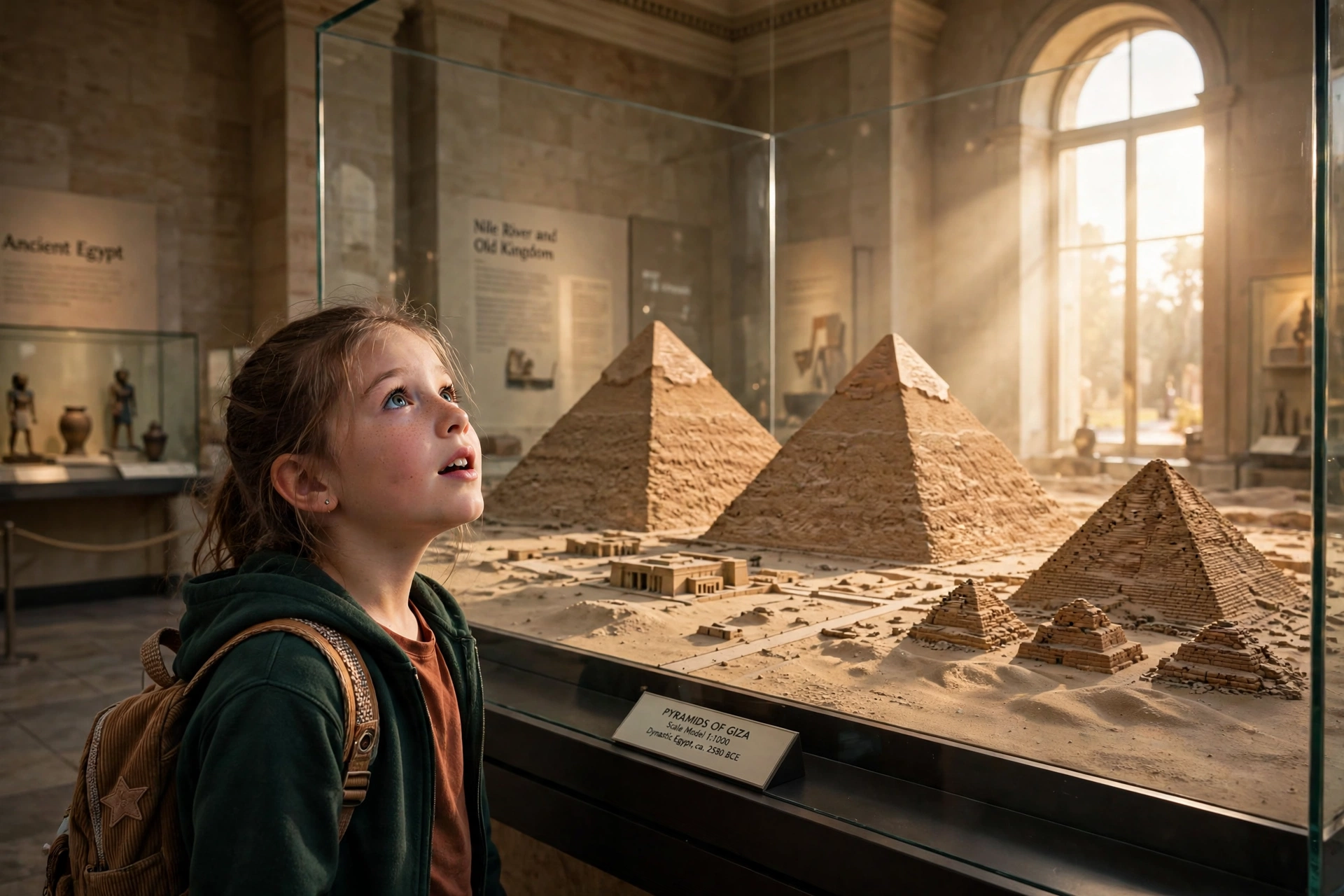
It was a Tuesday afternoon, and ten-year-old Maya was sitting in her history class, staring at a picture on the wall. The picture showed three huge stone triangles rising out of golden sand, with a bright blue sky behind them. They looked too big to be real.
“Miss,” Maya said, “who built the pyramids? Were they built by giants?”
Her teacher laughed, but not in a mean way. “Not giants,” she said. “People. Ordinary people, just like you and me. And the story of how they did it is one of the greatest building stories in the whole history of the world.”
Maya looked at the picture again. “But how? They are so big. And they were built so long ago. They did not even have trucks or cranes.”
“That is exactly what makes it so amazing,” her teacher said.
By the end of the lesson, Maya had learned that the pyramids were not built by magic, and not by giants, and not by aliens, as some people on the internet like to say. They were built by thousands of clever, hard-working Egyptians who knew how to plan, how to lift heavy stones, and how to work together for a very long time.
This is the story of who built the pyramids, and how they did it.
So What Are the Pyramids of Giza?
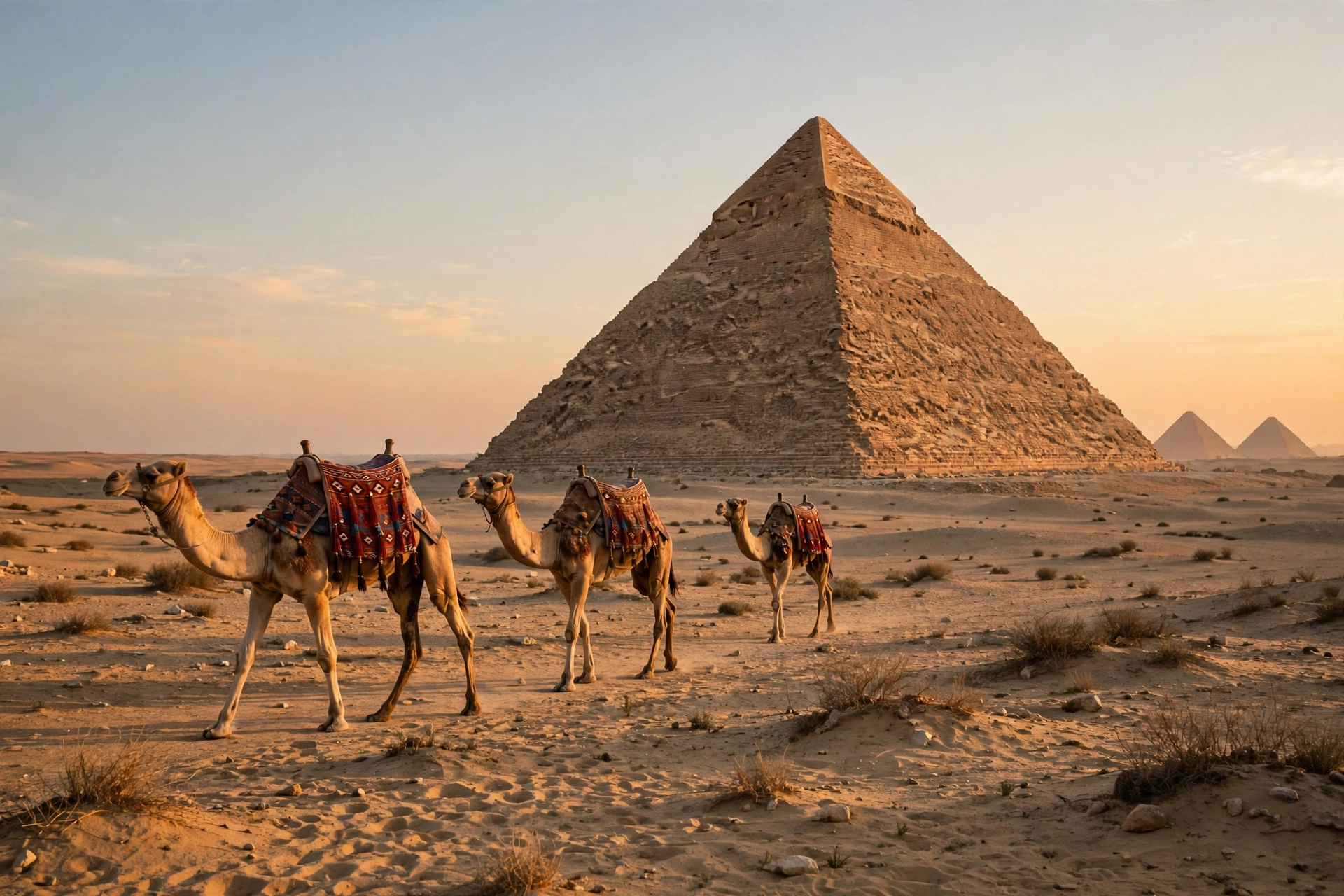
First, let us be clear about which pyramids we are talking about. Egypt has more than 100 pyramids, but when people say “the pyramids”, they almost always mean the three big ones at Giza, near the city of Cairo.
The three pyramids stand side by side in the desert, and they were built as tombs, which are places where a dead person is buried. They were made for three kings, one after another, about 4,500 years ago. That is hard to imagine. The pyramids are older than the first Olympic Games, older than the Roman Empire, and older than almost every building you have ever seen. They were already ancient when the first Romans were born.
The biggest one is called the Great Pyramid. It was built for a king named Khufu. Next to it stands the pyramid of his son, Khafre, and next to that, the smaller pyramid of his grandson, Menkaure. Three kings, three pyramids, one family, one desert.
The pyramids were not empty piles of stone. Each one had rooms inside, a small temple beside it, and a long road called a causeway running down to the River Nile. They were part of a much bigger place, with workshops, houses, bakeries, and even a small town where the builders lived. The pyramids were not just tombs. They were a whole building site, and a whole community, in the middle of the desert.
Three Kings, Three Pyramids
Let us meet the three kings, because the pyramids are really their story.
The first king was Khufu, and his pyramid is the biggest of all. He ruled Egypt about 4,500 years ago, when Egypt was rich and powerful, and he wanted a tomb that would show the whole world how great he was. The Great Pyramid was built in about 20 to 30 years, which is a very long time for one building. It is made of about 2.3 million stone blocks, and each one weighs about as much as a small car. The pyramid was once 146 metres tall, which is about as tall as a building with 40 floors.
The second king was Khafre, the son of Khufu. His pyramid is a little smaller, but it looks almost as tall because it was built on higher ground. Khafre’s pyramid is the one with the famous Sphinx beside it, a huge stone lion with a human head, which was carved out of the rock and placed to guard the pyramids.
The third king was Menkaure, the grandson of Khufu. His pyramid is much smaller than the other two, but it is still a huge building, about 65 metres tall, and it was finished with beautiful red granite on the outside.
Three kings, three pyramids, and each one took a whole generation of workers to build. The pyramids were not built in a hurry. They were the work of a lifetime.
The Big Surprise: It Was Not Slaves
Here is the biggest surprise in the whole story, and it is the one most people get wrong. The pyramids were not built by slaves.
For a long time, people believed that thousands of slaves were forced to build the pyramids under the whip. The idea came from an old Greek writer named Herodotus, who visited Egypt about 2,000 years after the pyramids were built, and wrote down what people told him. He said 100,000 slaves worked for 20 years to build the Great Pyramid. It is a good story, and it has been repeated in books, films, and school lessons ever since.
But it is not true, and modern archaeologists have found the proof.
The proof is buried in the sand beside the pyramids: a town where the builders lived. The town had houses, bakeries, and workshops. The builders ate well. Their bones show that they were given meat, bread, and beer, and that they were looked after when they were hurt. They were not prisoners. They were workers, and they were proud of what they were building.
The workers were mostly Egyptian farmers. During the flood season, when the River Nile covered their fields with water and they could not farm, they came to work on the pyramids instead. It was their job for part of the year, and they were paid for it, in food, drink, and a place to live. Some were skilled builders, stonecutters, and carpenters who worked on the pyramids all year round.
So the pyramids were not built by slaves, and they were not built by magic. They were built by ordinary Egyptians, working together, for a king they believed in.
Who Really Built Them?
So if it was not slaves, who was it? Let us look at the people who really built the pyramids.
The first group were the skilled workers. These were the stonecutters who cut the blocks out of the ground, the carpenters who built the wooden sledges and ramps, the engineers who planned the shape of the pyramid, and the scribes who wrote down everything that happened. They were the experts, and they worked on the pyramids all year.
The second group were the seasonal workers, the farmers who came for a few months each year when the Nile flooded their fields. They did the heavy lifting: pulling the stones, pushing the sledges, and building the ramps. They were not slaves. They were paid, fed, and housed, and many of them came back year after year.
The third group were the people who kept the whole building site running: bakers who made bread for thousands of workers, brewers who made beer, fishermen who caught fish from the Nile, and doctors who looked after anyone who was hurt. A building site this big needed a whole town behind it, and that town was right there in the sand.
One more thing is important: the workers left their names behind. Archaeologists have found graffiti on the stones inside the Great Pyramid, written by the gangs of workers who put the blocks in place. The gangs had names like “The Friends of Khufu” and “The Drunkards of Menkaure”. They were proud of their work, and they wanted people to know it. Slaves do not sign their work with jokes.
How Did They Move Such Heavy Stones?
This is the question everyone asks, and it is a good one. How do you move a stone block that weighs as much as a small car, with no trucks, no cranes, and no wheels? The answer is simple, and clever, and it took thousands of people working together.
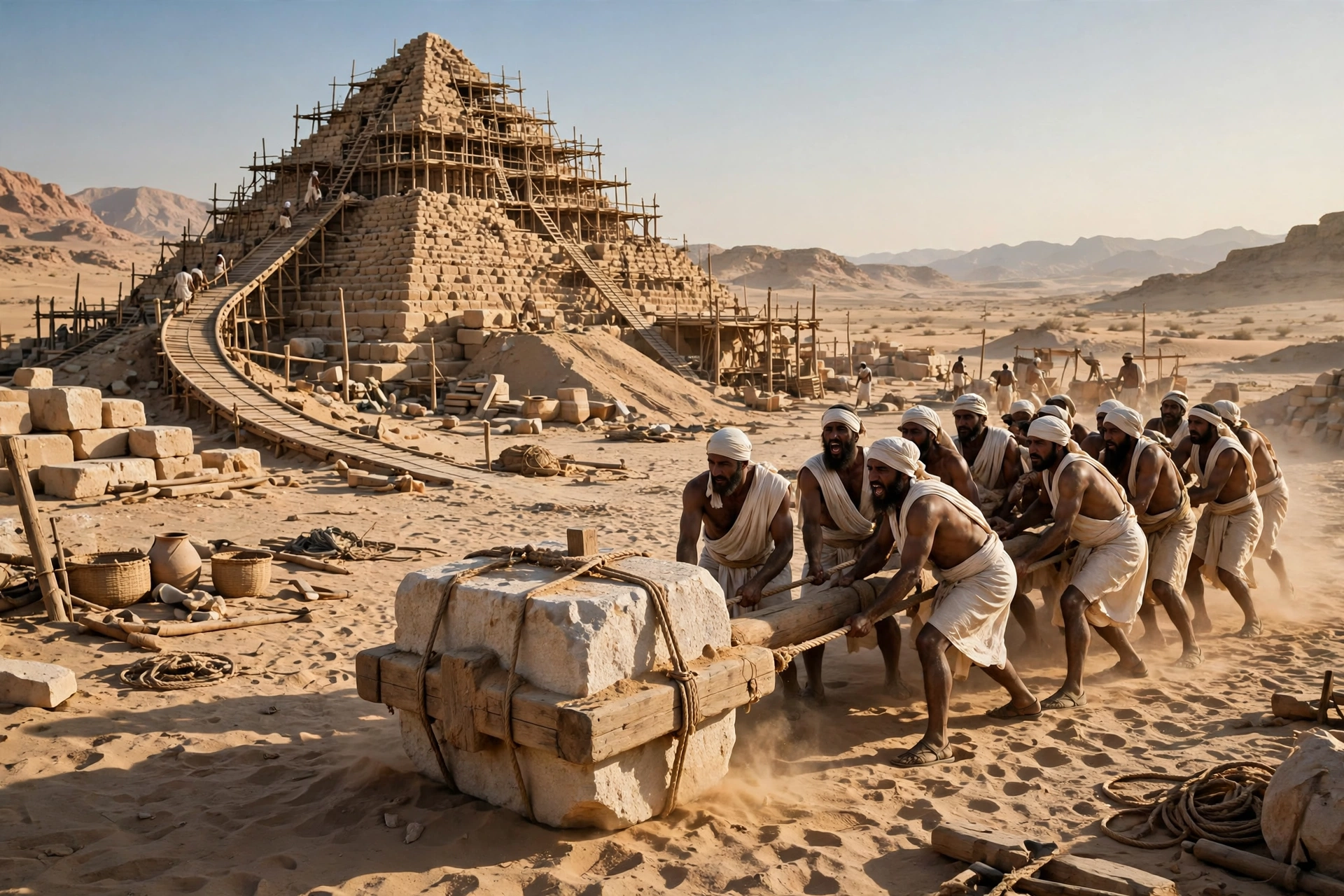
First, the builders cut the stone out of the ground in a quarry, a place where stone is dug out of the earth. The Great Pyramid was built mostly from limestone, which was cut from a quarry nearby. The stone was cut into blocks using copper tools and wooden wedges, which were soaked in water until they swelled and split the stone apart.
Then the block had to be moved. The builders put it on a wooden sledge, a flat platform with runners underneath, like a big sled. Then a team of men pulled the sledge along a path made of wet sand or mud, because wet sand is slippery and makes it easier to pull. Some experts think one team could pull a block of about 2.5 tonnes, and a big team of 20 men could pull a block of 10 tonnes, if they worked together and pulled in rhythm.
Once the block reached the building site, it had to be lifted up. The pyramid was built in layers, like a staircase, and the builders used ramps to get the stones up. The ramps were made of mud, brick, and rubble, and they were built up as the pyramid grew taller. The stones were pulled up the ramps on their sledges, then put into place by hand.
The last part was the hardest: making the pyramid smooth. The builders covered the outside of the pyramid with a layer of smooth white limestone, which was polished until it shone in the sun. From far away, the Great Pyramid would have looked like a white mountain, glowing in the desert. Most of that smooth layer is gone now. It was taken away long ago to build houses in Cairo, but the top of Khafre’s pyramid still has some of it left.
It was slow work. One block at a time, one layer at a time, year after year. But it worked, and the pyramid still stands, 4,500 years later.
The Numbers That Tell the Story
Numbers make the pyramids easier to understand, so here are the ones that matter most.
The Great Pyramid is about 146 metres tall, and each side of its base is about 230 metres long, which is about the same as two football fields. It is made of about 2.3 million stone blocks, and the whole pyramid weighs about 6 million tonnes. That is about the same as 1,000 elephants.
It took about 20 to 30 years to build, and at the busiest time, about 20,000 to 30,000 people worked on it. That sounds like a lot, but remember: Egypt had millions of people, and only a small part of them worked on the pyramid at any one time.
The builders were so careful that the Great Pyramid is almost perfectly level. The four corners are only a few centimetres different in height, and the sides point almost exactly north, south, east, and west. That is amazing for a building made 4,500 years ago, with no computers and no lasers.
Here is a small example to show how the numbers work. Imagine one team of 20 men pulling a stone block that weighs 2.5 tonnes. If each man pulls with a force of about 50 kilograms, the team can pull about 1,000 kilograms together. That is not enough to pull a 2.5-tonne block on dry sand, but on wet, slippery sand, it is just enough. That is why the builders wet the sand in front of the sledge. A simple trick, and it made the whole job possible.
The Tallest Building in the World for 3,800 Years
The Great Pyramid was the tallest building in the world for more than 3,800 years. That is a very long time. It was built about 4,500 years ago, and it stayed the tallest until a cathedral in England was built taller than it, in about the year 1311. That is nearly 4,000 years of being the tallest building on Earth.
Think about what that means. The pyramid was already 2,000 years old when the first Roman soldiers marched into Egypt. It was already 3,000 years old when the first ships sailed to America. It was already 4,000 years old when the first aeroplane flew. A simple story about who invented the first aeroplane shows how much the world changed in just one century.
The pyramid is still there, and it is still one of the tallest buildings in Egypt. It is a reminder that people 4,500 years ago could do things we still find hard to believe.
Why Build Something So Big?
Why would a king spend 20 years and the work of 20,000 people to build a tomb? The answer is in what the Egyptians believed.
The Egyptians believed that when a king died, he did not really die. He became a god, and he went to live with the other gods in the sky. The pyramid was his way of getting there. It was a staircase to the stars, a mountain of stone that would lift the king up to the heavens.
The pyramid was also a message. It said to everyone who saw it: this king was great, this king was powerful, and this kingdom was rich enough to build something that would last forever. It was a way of showing the world that Egypt was the greatest country on Earth.
And it worked. The pyramids are still standing, and people still travel from all over the world to see them. The kings are remembered, not because of their names, but because of the mountains they left behind.
How Do We Know All This Today?
How do we know all this, when the builders are long gone and the pyramids were built 4,500 years ago? The answer is archaeology, the science of digging up the past and reading what it tells us.
Archaeologists have dug up the workers’ town, the bakeries, the tools, the bones, and the writing. They have found the ramps, the quarries, and the sledges. They have read the graffiti left by the work gangs. They have even found a diary, written on papyrus, by a man named Merer, who led a team of men moving stones to the Great Pyramid. His diary tells us what they ate, where they slept, and how long the journey took.
That diary is one of the most amazing finds in the history of archaeology, and it was written by an ordinary worker, not a king. It shows that the pyramids were built by real people, with real names, real families, and real lives.
Today, scientists use computers to study the pyramids, and new discoveries are still being made. A simple guide to who invented the first computer shows how machines now help us read and sort those ancient records far faster than any person could by hand, and today computers help archaeologists map every stone of the pyramids in three dimensions.
Mistakes People Still Make About the Pyramids
Even today, with all this evidence, a few old mistakes keep coming back.
The first mistake is the idea that the pyramids were built by slaves. As we have seen, the builders were paid workers, and they were proud of what they did. The slave story came from a Greek writer who visited Egypt 2,000 years after the pyramids were built, and he got it wrong.
The second mistake is the idea that the pyramids were built by aliens. Some people like to say that the pyramids are too big and too perfect to have been built by people, so they must have been built by visitors from space. There is no evidence for this, and the evidence for human builders is everywhere: the tools, the ramps, the workers’ town, the diary, and the graffiti.
The third mistake is the idea that the pyramids were built all at once, in a few years, by a huge army of workers. In fact, each pyramid took 20 to 30 years to build, and the work was slow, steady, and careful. The pyramids were built by a whole generation of workers, not by a sudden burst of effort.
The fourth mistake is the idea that the pyramids are empty tombs, with nothing inside. In fact, the pyramids have rooms, passages, and small chambers, and archaeologists are still finding new ones today. In 2017, scientists found a huge empty space inside the Great Pyramid, using a kind of X-ray that can see through stone. It is called the Big Void, and nobody knows yet what it was for. The pyramids still have secrets.
Frequently Asked Questions
Who built the pyramids?
The pyramids of Giza were built by Egyptian workers about 4,500 years ago. The workers were paid builders, farmers and craftsmen, not slaves, and they lived in a town beside the pyramids, where they were given food, drink and a place to live.
Were the pyramids built by slaves?
No. Modern archaeologists have found the workers’ town, their bakeries, their bones and their tools, and the evidence shows that the builders were paid workers who were well fed and looked after. The slave story came from a Greek writer who visited Egypt 2,000 years after the pyramids were built, and he got it wrong.
How long did it take to build the pyramids?
The Great Pyramid took about 20 to 30 years to build, and at the busiest time about 20,000 to 30,000 people worked on it. Each of the three pyramids took a whole generation of workers to finish.
How did they move the heavy stones?
The stones were cut from a quarry, put on wooden sledges, and pulled by teams of men along paths of wet sand, which made the sledges slide more easily. Then the stones were pulled up ramps made of mud, brick and rubble, and put into place by hand.
What is the Great Pyramid made of?
The Great Pyramid is made of about 2.3 million stone blocks, mostly limestone, and it weighs about 6 million tonnes. It was once covered with a layer of smooth white limestone that made it shine in the sun, but most of that layer is gone now.
Why are the pyramids so famous?
The pyramids are famous because they are the oldest of the Seven Wonders of the Ancient World, and the only one still standing. The Great Pyramid was the tallest building in the world for more than 3,800 years, and it is still one of the greatest building achievements in history.
More from Zorium Daily
- Who Invented the First Car? Explained Simply
- Who Invented the First Train? Explained Simply
- Who Was the First Person to Walk on the Moon? Explained Simply
- Who Invented the Printing Press? Explained Simply
Maya left her history class that day with a new answer in her head, and it was better than the old one: the pyramids were not built by slaves under whips, but by ordinary people, fed and paid and proud, who spent a generation building a mountain of stone so their king could reach the stars, and so that we, 4,500 years later, would still look up and wonder.