Why Do We Celebrate New Year’s Day on 1 January?
Every year, on the night of 31 December, millions of people stay up late. They watch the clock, count down from ten, cheer, and watch fireworks light up the sky. Then, at midnight, a new year begins. The date changes to 1 January.
It feels natural to us now. But why 1 January? Why not 1 March, when spring begins? The answer is a long story. It is a story about Rome, a god with two faces, a calendar that did not work well, a pope who tried to fix it, and how one date slowly spread across the world. Some parts are known well. Other parts have debated evidence. Here we say what is known, what is likely, and what is tradition, and we do not present legend as settled fact.
SUMMARY OF THIS ARTICLE
- We mark New Year’s Day on 1 January because of the Roman calendar, later fixed by Pope Gregory in 1582.
- January was named after Janus, the Roman god of doors and new beginnings, who had two faces.
- Julius Caesar set 1 January as the start of the year in 45 BC, but the date moved around in the Middle Ages.
- The Gregorian calendar made 1 January the clear start of the year, and it spread through trade, rule, and shared public life.
- Many cultures still keep their own New Year days, such as the Lunar New Year and the Jewish New Year.
The Question
A new year means a fresh start. It means a new page. People make new plans, say sorry for old mistakes, and hope for a better year.
But a year is not a thing we can touch. It is a way to count time. The Earth goes around the Sun once in about 365 days. That trip is one year. We need to pick a day to say, “This is the start.” Any day could work in theory. We could start in spring, when plants grow again. We could start in autumn, when farmers bring in the harvest.
Long ago, many people did start the year on other days. Some started it in spring. Some started it in autumn. Some started it with the new moon. The choice of 1 January was one choice, made in Rome, that later won out over many other choices. To understand why, we need to go back more than 2,000 years, to a time when Rome was the most powerful city in the world.
Not Every Culture Starts the Year on 1 January
Not everyone starts the year on 1 January. Even today, many people mark a different New Year. That does not make their New Year wrong. It makes the world rich, with many ways to see time.
In China and in many other parts of Asia, people celebrate the Lunar New Year. It falls between late January and late February. The date changes each year because it follows the moon. Families come together, eat special food, and give red envelopes with money inside.
In the Jewish calendar, the New Year is called Rosh Hashanah. It falls in autumn, usually in September or early October. It is a time for thought, prayer, and fresh starts. People eat apples dipped in honey. The honey stands for a sweet year ahead.
In the Islamic calendar, the New Year is called the Hijri New Year. It moves through the seasons, because the Islamic year is shorter than the solar year. It is a quieter day for many people, a time to think and pray.
In Iran and in many places where Persian culture is strong, the New Year is called Nowruz. It falls on the spring equinox, around 20 or 21 March. Families clean their homes, set a special table, and welcome spring.
So 1 January is not the only New Year. It is the one that most of the world uses for business, school, and public life. It is the civil New Year. Many people also keep their own cultural or religious New Year at home. Both can be true at the same time.
Rome and Julius Caesar — the Julian Calendar
To understand 1 January, we need to look at Rome. Rome was a city in Italy. Over time, it grew into a huge empire. Its armies, laws, roads, and calendar spread across Europe, North Africa, and the Near East. What Rome chose mattered to millions of people.
At first, the Roman calendar was a mess. The early Roman calendar had only ten months, and it started in March. The month names still show this today. September comes from the Latin word for seven. October comes from the word for eight. November comes from the word for nine. December comes from the word for ten. December is the twelfth month now, but its name means ten. That is a clue. It tells us that the year once started in March.
Later, two more months were added: January and February. But the calendar still had problems. A year is about 365 and a quarter days long. The old Roman calendar had only 355 days. So the calendar drifted away from the seasons. After a few years, the months no longer matched the weather. Roman leaders added extra days from time to time, but not in a fair or regular way. Sometimes they did it for political reasons. Sometimes they forgot. The result was confusion.
Then came Julius Caesar, a Roman general and leader. He wanted a calendar that worked. He asked a scholar from Egypt, a man named Sosigenes, to help him. Together, they made a new calendar, called the Julian calendar, after Julius Caesar. It had 365 days, with one extra day every four years. That extra day is what we now call a leap day. You can read more about leap years and why we need them. The Julian calendar also had 12 months in a clear order. It was a big step forward.
Julius Caesar also set the start of the year. He chose 1 January. The new calendar began in 45 BC. From that time on, 1 January was the first day of the year in Rome. New consuls, the top Roman officials, took up their posts on 1 January. That gave the date a strong public meaning. It was the day when new leaders started work.
Why did Caesar pick 1 January? Tradition says it was linked to Janus, the god of beginnings. It made sense to start the year in the month of the god of beginnings. But the full story is not fully clear in the records we have today. What we know is that he picked it, and the choice stuck in Rome.
January Named After Janus, the Two-Faced God
January gets its name from Janus. Janus was a Roman god of doors and gates, of beginnings and endings. He watched over the moment when one thing ends and another begins. That is why his month sits at the start of the year.
Janus is easy to spot in Roman art. He is shown with two faces. One face looks forward. One face looks back. The two faces are on one head, back to back. At the start of a new year, we do the same thing. We look back at the old year and think about what went well and what went wrong. We look forward to the new year and think about what we hope to do.
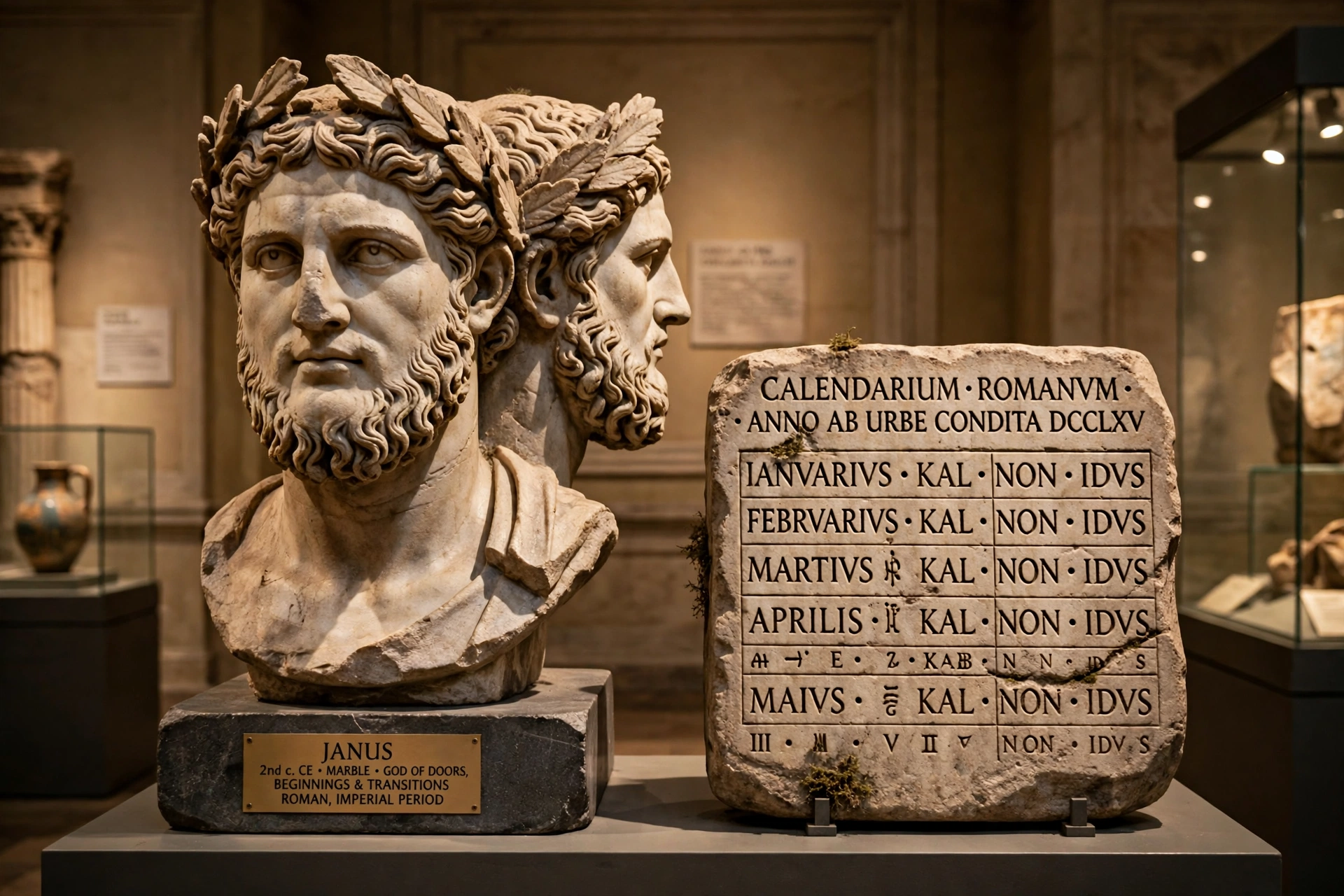
Janus was linked to doors because a door is a place of change. You are inside, then you step outside. You are in one room, then you are in another. A door is a start and an end at the same time. The first day of January is like a door. You step out of the old year and into the new year.
Romans honoured Janus in a special way. They made offerings to him first, before other gods, at the start of many events. They believed that a good beginning would lead to a good result. We still use the name January today. Most people do not think about Janus when they say it. But the name carries his story with it.
Why the Date Moved Around in the Middle Ages
If Julius Caesar set 1 January as the start of the year in 45 BC, why did the date move around? The answer is that the Roman Empire fell apart. After Rome lost power, Europe split into many small kingdoms and church lands. There was no single power to keep the calendar the same everywhere. The Church became very strong. Local customs became strong too.
In the Middle Ages, the period from about the year 500 to about the year 1500, there was no one New Year’s Day for all of Europe. In some places, the year started on 25 December, the day of Christmas. In other places, it started on 25 March, a day called the Annunciation. That is the day when, in Christian belief, the angel told Mary that she would have a child. It falls near the spring equinox, when day and night are about the same length.
In other places, the year started at Easter. Easter moves each year, so the start of the year moved too. In some places, the year started on 1 September, an old Roman date for tax and work. In some places, people kept 1 January. But it was not the same everywhere.
This was messy. A letter written in one town might have a date that meant a different year in another town. Traders and travellers had to ask, “Which year do you mean?” That is hard to imagine today, when we all use the same calendar. Through it all, people still counted seven days in a week.
Pope Gregory and the Gregorian Calendar
By the 1500s, the Julian calendar had a clear problem. It was too long by about 11 minutes each year. That sounds small, but over hundreds of years it added up to about ten days. The spring equinox was falling on 11 March instead of 21 March. That mattered to the Church, because Easter is fixed by the spring equinox. If the equinox moved, Easter moved too.
Pope Gregory XIII was the pope in 1582. He wanted to fix the calendar. He asked scholars to help. They made a new calendar, called the Gregorian calendar, after Pope Gregory. It is the calendar most of the world uses today.
The fix had two parts. First, ten days were skipped. In October 1582, people went to bed on 4 October and woke up on 15 October. Ten days were simply removed from the calendar. That must have felt very strange. But it put the calendar back in line with the sun.
Second, the leap year rule was changed. Under the old rule, every fourth year was a leap year. Under the new rule, most years that end in 00 are not leap years, unless they can be divided by 400. So 1700, 1800, and 1900 were not leap years. But 2000 was a leap year. This small change made the calendar much more exact. It still drifts by about one day in more than 3,000 years. But for our lives, it is good enough.
Pope Gregory also made 1 January the clear start of the year. The new calendar kept 1 January as New Year’s Day. Catholic countries took it up first: Italy, Spain, Portugal, Poland, and France changed in 1582 or soon after. Other countries took longer. England did not change until 1752. Russia did not change until 1918. Greece did not change until 1923. Some churches still use the old Julian calendar for religious feasts today. That is why some Orthodox Christians celebrate Christmas on 7 January. It is 25 December in the old Julian calendar.
How 1 January Spread Around the World
How did a Roman date become a world date? It spread in three main ways: through rule, through trade, and through shared public life.
First, through rule. When European powers built empires, they took their calendar with them. Spain and Portugal took it to the Americas. Britain took it to North America, India, Africa, and Australia. France took it to parts of Africa and Asia. The calendar came with laws, schools, and offices. If you wanted to work with the government or pay tax, you had to use its dates.
Second, through trade. Traders need shared dates. If a ship leaves London on 1 January and arrives in New York on 20 January, both ports need to agree on what those dates mean. Trade pushes people to use the same calendar. Over time, the Gregorian calendar became the calendar of world trade. Even countries that kept their own calendar for religious life used the Gregorian calendar for business.
Third, through shared public life. Schools, railways, post offices, and later radio, television, and the internet all used the Gregorian calendar. A train timetable uses Gregorian dates. A news report uses Gregorian dates. When the whole world uses one system for news and travel, it is hard to use a different one.
China is a good example. China has its own old calendar and its own Lunar New Year. But China also uses the Gregorian calendar for public life. 1 January is a public holiday in China, called Yuandan. Japan is another example. In 1873, Japan took up the Gregorian calendar. Now 1 January is the main New Year’s Day in Japan, called Shogatsu. Families eat special food, visit shrines, and send New Year cards.
New Year Traditions Today
Today, 1 January is a public holiday in most countries. People mark it in many ways. Some ways are old. Some ways are new. Some ways are local. Some ways are shared around the world.
The most famous tradition is the countdown. People gather in a city square or at home. They watch a clock and count down: ten, nine, eight, seven, six, five, four, three, two, one. Then they cheer and shout, “Happy New Year!” In New York, a big ball drops in Times Square at midnight. In London, fireworks light up the sky over the River Thames. In Sydney, fireworks light up the harbour.

Food is a big part of the New Year in many places. In Spain, people eat twelve grapes at midnight, one for each stroke of the clock. Each grape stands for one month of the new year. In Greece, people bake a special cake called vasilopita. A coin is hidden in the cake. The person who finds the coin is said to have good luck for the year. In the southern United States, people eat black-eyed peas and greens on New Year’s Day. The peas stand for coins. The greens stand for paper money. You can read about how paper money itself began, and how it changed trade and daily life.
In Scotland, the New Year is called Hogmanay. People sing a song called “Auld Lang Syne.” It is about old friends and old times. It is sung in many English-speaking countries at midnight. Many people do not know all the words, but they know the tune. They hold hands and sing it together.
Another tradition is the New Year resolution. A resolution is a promise you make to yourself. You say, “In the new year, I will exercise more,” or, “I will read more books,” or, “I will be kinder.” Many people make resolutions on 1 January. Many people break them by February. That is normal. The idea is not to be perfect. The idea is to try again.
Other New Years Around the World
Many cultures keep their own New Year. Each one has its own history and meaning. None of them is just a party. They are times for family, faith, and fresh starts.
The Lunar New Year is the biggest festival for many people in China, Vietnam, Korea, and other parts of Asia. In Vietnam, it is called Tet. In Korea, it is called Seollal. Families clean their homes, wear new clothes, give money in red envelopes, and honour their ancestors.
Rosh Hashanah, the Jewish New Year, is a time for thought. People go to synagogue and hear the sound of the shofar, a ram’s horn. They think about the past year, ask for forgiveness, and hope for a good year. The ten days after Rosh Hashanah lead to Yom Kippur, the Day of Atonement.
Nowruz, the Persian New Year, is about spring. It has been marked for a very long time, by tradition. Families set a table called a Haft-Seen, with seven items, each starting with the letter S in Persian. Each item stands for something good, like health, love, or new life.
Diwali is a festival of lights for many Hindus, Jains, and Sikhs. For some Hindus, it marks a new year. People light small oil lamps called diyas, clean their homes, share sweets, and pray for wealth and well-being. The lights stand for good winning over bad, and light winning over dark.
Songkran, the Thai New Year, falls in April. People splash water on each other. The water stands for washing away the old year and starting fresh. People also visit temples and honour their elders.
These festivals remind us that a new year is a human idea. We choose when to mark it and how to mark it. The choice of 1 January is one choice among many. It is the choice that most of the world uses for public life. But the other choices are still alive. They still matter to billions of people. We should respect them all.
Frequently Asked Questions
Why is New Year’s Day on 1 January and not on another day?
New Year’s Day is on 1 January because Julius Caesar set it as the start of the year in the Julian calendar in 45 BC, and Pope Gregory kept it in the Gregorian calendar in 1582. The date then spread around the world with trade, rule, and shared public life. It was a human choice, not a rule of nature.
Who was Janus, and why is January named after him?
Janus was a Roman god of doors, gates, and beginnings. He is shown with two faces, one looking back and one looking forward. January was named after him because it is the month of new beginnings. The two faces fit the way we look back at the old year and forward to the new year.
Did people always celebrate the New Year on 1 January?
No. In the Middle Ages, people in Europe started the year on different days, such as 25 December, 25 March, Easter, or 1 September. Even today, many cultures mark their own New Year on a different day, such as the Lunar New Year or Rosh Hashanah. 1 January became the shared date only slowly, over hundreds of years.
What is the difference between the Julian calendar and the Gregorian calendar?
The Julian calendar was made by Julius Caesar in 45 BC. It had 365 days, with a leap day every four years. It was a little too long, so it drifted by about 11 minutes each year. The Gregorian calendar, made by Pope Gregory in 1582, fixed this by skipping ten days and changing the leap year rule for years ending in 00. It is the calendar most of the world uses today.
Why did Pope Gregory skip ten days in 1582?
Pope Gregory skipped ten days to fix the drift of the Julian calendar. The calendar was ten days ahead of the sun. People went to bed on 4 October 1582 and woke up on 15 October 1582. The skip put the spring equinox back on 21 March, which mattered for fixing the date of Easter.
Do all countries use 1 January as New Year’s Day today?
Most countries use 1 January as the start of the civil year, for schools, offices, and business. Many countries also keep their own cultural or religious New Year. For example, China marks both 1 January and the Lunar New Year. People can mark both, and both are real and meaningful.
More from Zorium Daily
If you liked this story about time and calendars, you may like these stories too. Read more about 12 months — Why do we have 12 months in a year. Read more about seven days — Why do we have seven days in a week. Read more about leap years — Why do we add an extra day in February in leap years. You can also explore more stories in History