Why Do Wedding Rings Go on the Left Hand?
SUMMARY OF THIS ARTICLE
- In many countries, people wear a wedding ring on the fourth finger of the left hand.
- The old story of a “vein of love” that runs straight from that finger to the heart is a myth, not a fact.
- The custom comes from very old ideas in Egypt and Rome, and later from church weddings in Europe.
- In some countries, people wear the wedding ring on the right hand instead.
- In the end, the ring is a sign of love and promise, and the hand you choose is a matter of custom.
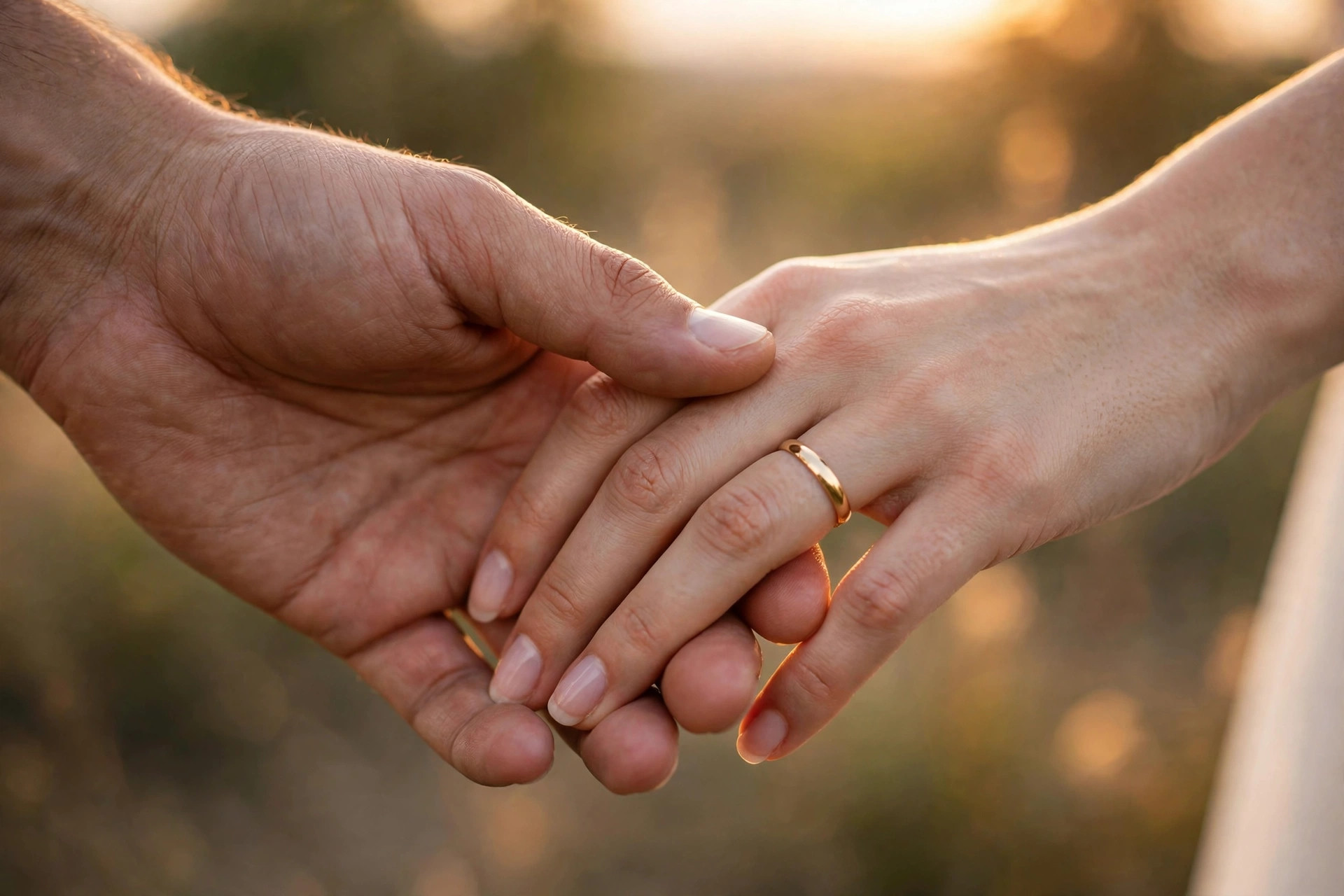
Look at the left hand of a married person in many countries. You will often see a small ring on the fourth finger. That finger is next to the little finger. People call it the ring finger.
Why that hand? Why that finger? The answer is a mix of old stories, old customs, and habit. It is not a rule of nature. It is a choice that people made long ago, and then kept making.
A wedding ring is a small circle of metal. It is often made of gold. It can also be made of silver or another metal. A couple gives these rings to each other on their wedding day. The ring has no end. The circle goes round and round. For many people, that circle stands for love that does not end.
But why does the ring sit on the left hand in so many places? To find out, we need to go back in time. We need to look at Egypt, Rome, and Europe. We also need to look at one famous story that is not true.
A Wedding Ring Is a Sign
When two people get married, they make a promise. They promise to love each other and to stay together. A ring is a sign of that promise. People can see it. The person who wears it can feel it.
Rings are easy to wear every day. You can work with a ring on. You can eat, walk, and sleep with a ring on. That is why a ring is a good sign. It stays with you all day.
Long ago, rings were not always made of gold. In very old times, people made rings from grass, reeds, or bone. Later, they used metal. Rich people used gold. Other people used iron or copper. The material changed, but the idea stayed the same. The ring said, “I am married.”
Today, many couples still trade rings at the wedding. The two people put the rings on each other’s fingers. Guests watch. It is a big moment. Then the couple wears the rings every day after that.
The Left Hand in Many Countries
In the United States, the United Kingdom, Canada, and many other countries, the wedding ring goes on the left hand. It goes on the fourth finger. That finger is called the ring finger for this very reason.
Most people are right-handed. That means they use the right hand more. They write with it. They lift things with it. The left hand does a bit less hard work. So a ring on the left hand may get less damage. That is one simple, practical reason.
But the real story is older than that. The custom did not start because of practical reasons alone. It started with old beliefs about the body and the heart.
The Engagement Ring Is Different
Many people mix up two rings. The first is the engagement ring. The second is the wedding ring. They are not the same.
An engagement ring is given when one person asks the other to marry them. If the answer is yes, the couple is engaged. That means they plan to get married. The engagement ring often has a jewel, like a diamond. It is often bigger and more showy.
The wedding ring is given at the wedding itself. It is often a plain band with no jewel. It is simple. It is made to be worn every day.
In many Western countries, a woman wears the engagement ring on the left fourth finger first. Then, at the wedding, the wedding ring goes on the same finger. The wedding ring sits closer to the hand. The engagement ring sits outside it. Some people say the wedding ring sits closer to the heart that way. It is a sweet idea, even if it is just a story.
In some countries, the order is different. In Germany, for example, the engagement ring goes on the left hand. After the wedding, it moves to the right hand with the wedding ring. In other places, people wear only one ring. The customs change from place to place, but the meaning stays the same.
Old Egypt and the Circle
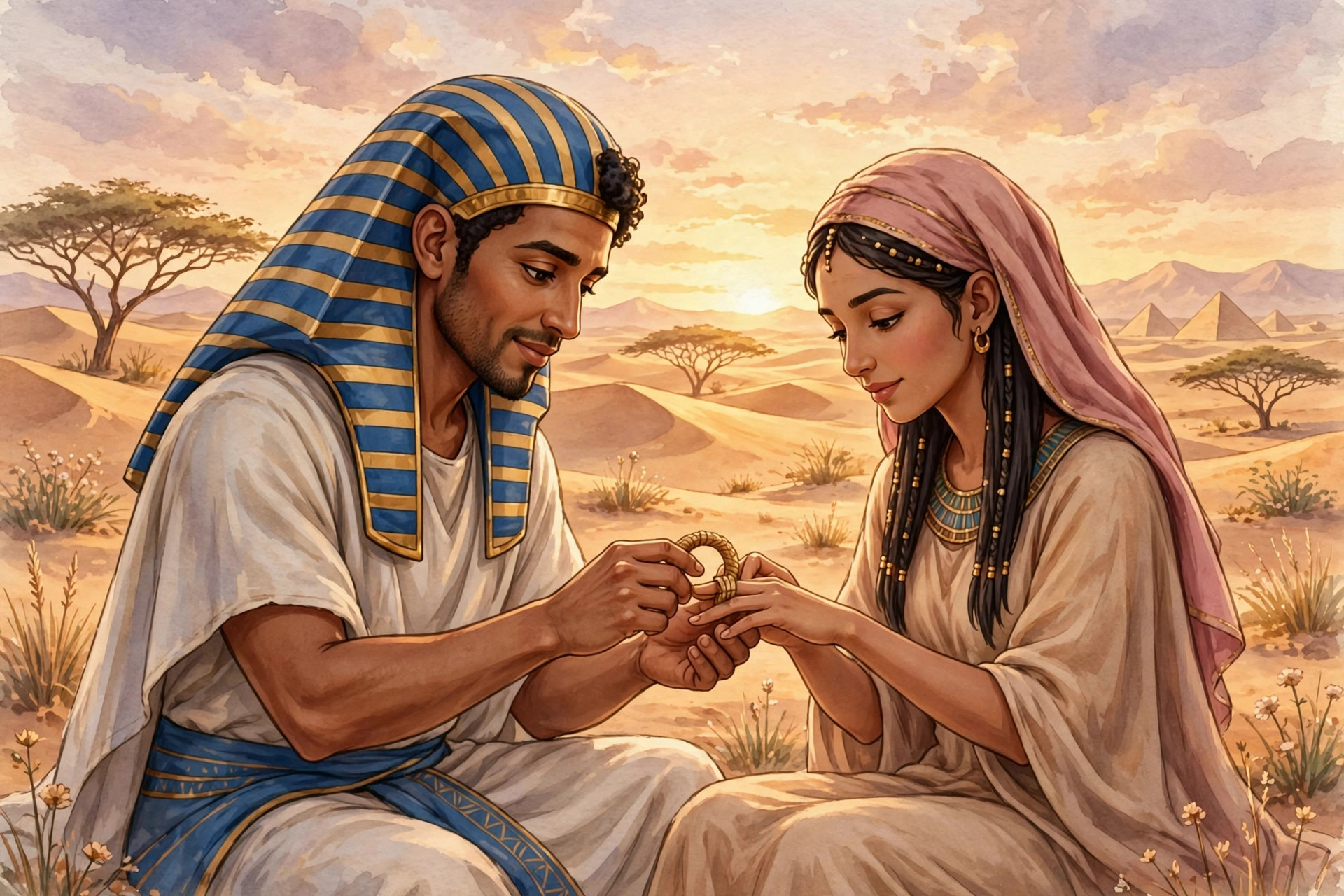
The story starts in ancient Egypt, more than 4,000 years ago. The people of Egypt loved the circle. They saw the sun and the moon. Both are round. They saw the circle as a sign of life that goes on and on.
Egyptians made rings from reeds and other plants. A husband gave a ring to his wife. The ring was a sign of his love. It was also a sign that he would take care of her.
Egyptians also had ideas about the hands. They believed that a special vein ran from the fourth finger of the left hand straight to the heart. A vein is a small tube in the body that carries blood. The heart is the part of the body that we link with love.
That idea was sweet and romantic. But it was not true. We will come back to that in a moment.
Ancient Rome and the “Vein of Love”
The Romans took many ideas from Egypt. They also wore rings. For Romans, a ring was more like a sign of a deal. When a man gave a ring to a woman, it showed that they were promised to each other.
The Romans also believed the story about the vein. They called it the “vena amoris.” That is Latin, the language of Rome. It means “vein of love.”
The story said this: there is a vein that runs from the fourth finger of the left hand straight to the heart. No other finger has such a vein. So that finger was the best place for a wedding ring. The ring sat on the path to the heart.
It is a lovely story. Many people still tell it today. But we must be honest here. It is a myth. A myth is a story that people believe, but it is not a fact.
Doctors today know the truth. All fingers have veins. Blood from every finger finds its way back to the heart. There is no single special vein from one finger to the heart. The left fourth finger is not different from the other fingers in this way.
So the “vein of love” is not real. But the story lived on for thousands of years. People liked it. It made the ring feel more special. And so the custom stayed.
Why the Fourth Finger?
You may ask: why the fourth finger, and not the thumb or the first finger? Part of the answer is the old vein story. People thought that finger had a direct line to the heart.
There is another old idea too. In some old church customs, the priest touched three fingers during a wedding prayer. He touched the thumb, the first finger, and the second finger. Then he put the ring on the fourth finger. That made the fourth finger feel holy and special.
Also, the fourth finger is easy to see, but it is not in the way as much as the thumb or the first finger. You use your thumb and first finger a lot when you pick things up. The fourth finger moves less. So a ring there feels more comfortable.
Over time, the fourth finger became “the ring finger” in many languages and cultures. The name itself kept the custom alive. When people hear “ring finger,” they think of the left hand.
The Church and Weddings in Europe
In Europe, during the Middle Ages, weddings became church events. A priest led the wedding. The couple traded rings as part of the service.
At first, not every country used the left hand. Some people wore the ring on the right hand. Some wore it on the thumb. Customs were different from place to place.
But slowly, in many parts of Western Europe, the left hand won. Books about weddings said to use the left hand. Priests taught it. Parents taught it to their children. Soon, most people in England, France, and other Western countries wore the ring on the left hand.
When people from Europe moved to America, Canada, and Australia, they took the custom with them. That is why the left hand is common in those countries today.
Old customs can last a very long time. Think of how people still shake hands when they meet. That is also an old custom from long ago. Like the wedding ring, it started for a reason, and then it just stayed.
The Right Hand in Other Countries
But the left hand is not the rule everywhere. In many countries, people wear the wedding ring on the right hand.
In Russia, Greece, and parts of Eastern Europe, the right hand is the common choice. In India, many people also wear the ring on the right hand. In some countries, like Germany and Norway, couples wear the engagement ring on the left hand and move it to the right hand after the wedding.
Why the right hand? In some cultures, the right hand is seen as the good hand. It is the hand of honor. It is the hand people use to make promises and oaths. So a wedding promise on the right hand makes sense to them.
Religion also plays a part. In the Orthodox Church, which is common in Greece and Russia, the right hand is used in blessings. So the ring goes on the right hand.
This shows us something important. There is no one right answer. Countries do things in different ways. Just as some countries drive on the left side of the road while others drive on the right, some countries wear the ring on the left and others on the right. Both are normal. Both are fine.
Other Customs Around the World
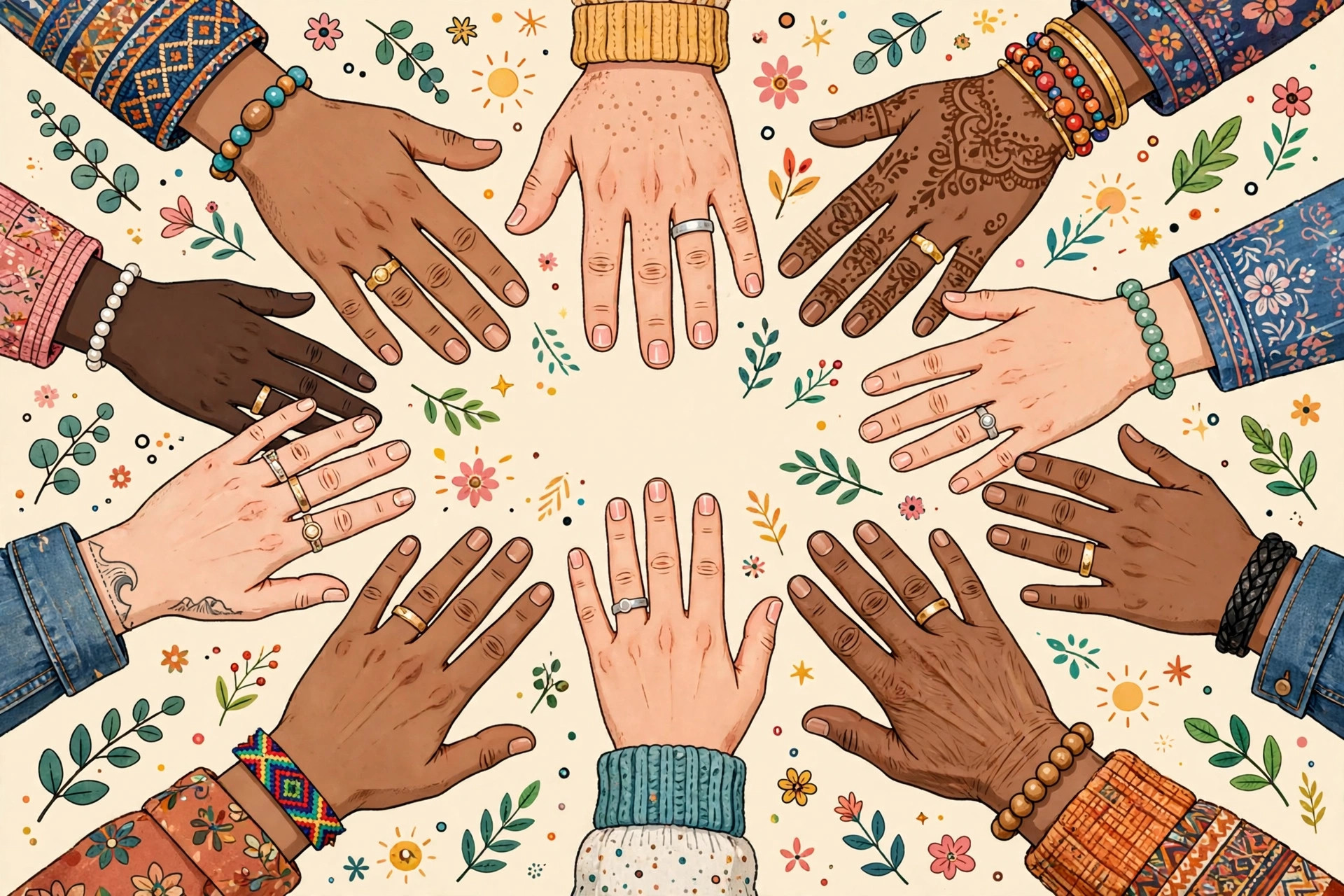
The world is full of wedding customs. The ring is only one part of the story.
In some cultures, both the man and the woman wear a ring. In other cultures, only the woman wears a ring. In the past, in many Western countries, only the wife wore a wedding ring. The husband did not. That changed in the 1900s. During the world wars, soldiers wore rings to think of their wives back home. After that, it became normal for men to wear a wedding ring too.
In some places, people wear the ring on a chain around the neck when they work. This is common for people who work with machines or with their hands. A ring can get caught in a machine. That is dangerous. So they keep the ring safe on a chain.
In some cultures, people do not wear rings at all. They may wear a bracelet, a necklace, or a special mark. The sign is different, but the meaning is the same. It says, “I am married. I made a promise.”
Wedding customs are like other old customs. People counted seven days in a week for thousands of years. People added a leap year day to keep the calendar right. People found ways to measure time long before clocks existed. These old habits stay because people pass them down from parents to children.
Why the Left Hand Still Wins in Many Places
Today, most people do not believe in the “vein of love.” They know it is a myth. So why do they still wear the ring on the left hand?
First, habit is strong. When everyone around you wears the ring on the left hand, you do the same. It feels normal. It feels right.
Second, movies and books show it. When you see a wedding in a film, the ring goes on the left hand. Young people copy what they see.
Third, shops sell rings for the left hand. Jewelers ask, “Which hand?” But most people just say the left hand without thinking.
Fourth, for right-handed people, the left hand is a bit safer for a ring. It does less hard work. The ring stays shiny longer.
None of these reasons is about a magic vein. They are about habit, culture, and comfort. And that is fine. A custom does not need a magic story to be meaningful.
What Rings Are Made Of
Gold is the most common metal for wedding rings. Gold does not rust. It keeps its shine for a long time. That makes it a good sign of love that lasts.
But gold is soft. It can get scratched. So many rings mix gold with other metals. This makes the ring harder. White gold is gold mixed with other metals to give it a pale color. Rose gold has a pink tint.
Some people choose platinum. Platinum is a strong, rare metal. It is heavy and bright. It costs more than gold. Other people choose silver, which costs less. Some choose titanium or steel. These are very hard metals. They are good for people who work with their hands.
A few couples choose wood or stone rings. These are less common. They can break more easily. But some people like them because they feel natural and simple.
The metal does not change the promise. A cheap ring and a costly ring can mean the same thing. What matters is the love behind it, not the price tag.
When People Take the Ring Off
Most married people wear the ring every day. But there are times when they take it off.
Doctors and nurses may take off their rings at work. They wash their hands many times a day. A ring can hold germs. It can also get in the way of gloves. So they keep the ring safe and put it back on later.
Cooks may take off their rings too. Food can get stuck under a ring. Builders and factory workers may take off their rings for safety. A ring can catch on a machine and hurt the finger badly. For these workers, safety comes first.
Some people take off the ring when they play sports. A ball or a fall can bend a ring. It can also hurt the finger. So they leave the ring at home during the game.
Taking the ring off for work or safety does not mean the marriage is over. It is just common sense. The ring is a sign, but it is not the marriage itself. The marriage lives in how two people treat each other every day.
What If You Wear It on the Other Hand?
Some people ask: is it wrong to wear a wedding ring on the right hand? The answer is no. It is not wrong at all.
If you move to a new country, you may see people wearing the ring on the other hand. That does not mean they are less married. It just means their custom is different.
Some couples choose the right hand on purpose. Some choose it because of their faith. Some choose it because it feels better. Some people switch hands during their life. The promise does not change when the ring moves.
What matters is what the ring means to you and your partner. The hand is a detail. The promise is the main thing.
A Small Ring With a Big Meaning
A wedding ring is small. You can hold it between two fingers. But it carries a big meaning. It stands for love, trust, and a promise.
The story of the ring on the left hand shows how customs grow. It started with old ideas in Egypt. It grew with a Roman myth about a vein of love. It spread through church weddings in Europe. Then it traveled around the world.
The myth is not true. There is no special vein from one finger to the heart. But the custom is still beautiful. People like to think of the ring as close to the heart. Even if the science is wrong, the feeling is real.
So the next time you see a wedding ring on a left hand, you will know the story. It is not about a magic vein. It is about thousands of years of love, habit, and human history. And in other parts of the world, the same love sits on the right hand. Both hands tell the same story.
Rings Passed Down in Families
Some wedding rings are brand new. The couple buys them just before the wedding. But some rings are very old. They belonged to a mother, a grandmother, or a great-grandmother. The ring passes from one generation to the next.
A family ring carries extra meaning. It is not just a sign of one marriage. It is a sign of many marriages in one family. It says, “Our family has loved like this before, and now it is your turn.”
These old rings may look worn. The gold may be thin. The shine may be soft. But many people love them even more because of that. The wear shows a long life of love.
Sometimes a family ring does not fit the new finger. A jeweler can make it bigger or smaller. The ring changes size, but its story stays the same. For many couples, wearing a family ring is one of the most special parts of the wedding day.
FREQUENTLY ASKED QUESTIONS
Q1: Is there really a vein of love from the ring finger to the heart?
A: No. This is a myth. All fingers have veins, and blood from every finger goes back to the heart. There is no special vein from the fourth finger alone.
Q2: Why is the fourth finger called the ring finger?
A: Because in many cultures, the wedding ring goes on that finger. The name comes from the custom. It is the finger next to the little finger.
Q3: Which countries wear the wedding ring on the right hand?
A: Many countries do, such as Russia, Greece, India, Germany, and Norway. In some of these countries, the right hand is seen as the hand of honor and promise.
Q4: Did people in ancient times wear wedding rings?
A: Yes. Egyptians made rings from reeds and plants more than 4,000 years ago. Romans later made rings from metal. The materials changed, but the idea of a ring as a sign of marriage stayed.
Q5: Do both men and women wear wedding rings today?
A: In many countries, yes. In the past, often only the wife wore one. That changed in the 1900s, when soldiers started to wear rings too. Today, most couples both wear a ring.
Q6: Is it wrong to wear a wedding ring on the right hand?
A: No, it is not wrong. It is just a different custom. What matters is the promise behind the ring, not which hand it sits on.
Q7: Why do some people wear their wedding ring on a chain around the neck?
A: Some jobs are not safe for rings. A ring can catch on a machine or get damaged at work. Wearing it on a chain keeps the ring close and safe.
More from Zorium Daily
- Why do we shake hands when we meet? Read about another old custom that people still keep today: https://zoriumdaily.com/why-do-we-shake-hands-when-we-meet/
- Why do some countries drive on the left side of the road? See how customs can differ from country to country: https://zoriumdaily.com/why-some-countries-drive-left-side-road/
- Why do we have seven days in a week? Find out how another very old habit still shapes our lives: https://zoriumdaily.com/why-do-we-have-seven-days-in-a-week/