Who Invented the First Car?
By Zorium Daily News Desk
SUMMARY OF THIS ARTICLE
- There was no single inventor of the car. It was built step by step, by many people, over more than 100 years.
- The first self-moving road vehicle was a steam wagon built by Nicolas-Joseph Cugnot in France in 1769, but it was slow, heavy, and hard to steer.
- Karl Benz built the first practical petrol car in 1885, the three-wheeled Benz Patent-Motorwagen, and he received a patent for it on 29 January 1886.
- In 1888, his wife Bertha Benz drove the little car about 106 kilometres from Mannheim to Pforzheim, and that brave trip proved the car could really work.
- Henry Ford did not invent the car, but his Model T, first built in 1908, made cars cheap enough for ordinary families, and that changed the whole world.
A Question With No Simple Answer
Picture a quiet street in your town. Cars roll past all day: buses, taxis, delivery vans, family cars. You barely notice them. They are just part of life, like the pavement under your feet.
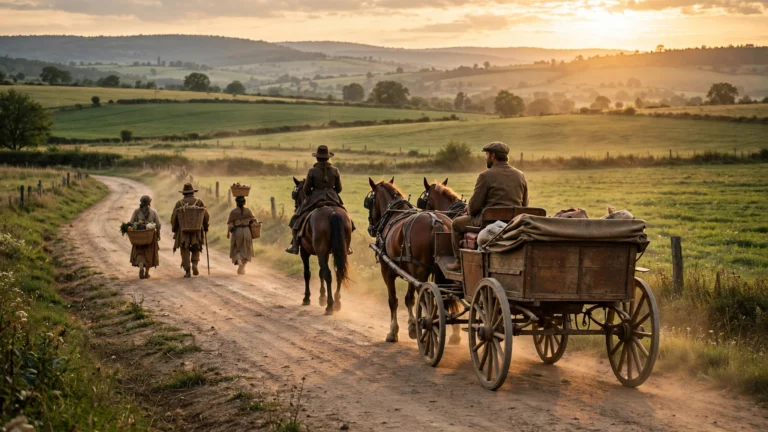
Now picture that same street about 140 years ago. No cars at all. No hum of engines. No smell of petrol. Just horses’ hooves on stone, the creak of wooden wheels, and people walking everywhere. That was normal life for most of human history.
So who changed it? Who invented the first car?
Ask ten people and you may get ten different answers: Karl Benz, Henry Ford, or a Frenchman you have never heard of. All of them are partly right, and none is fully right. The car was not born in one moment, from one bright idea. It grew slowly, like a tree, one person planting a seed, another watering it, until cars covered the world.
The Short Answer
Most historians say Karl Benz invented the first true car. In 1885, in the German town of Mannheim, Benz finished a small three-wheeled vehicle with a petrol engine. He called it the Patent-Motorwagen. On 29 January 1886, he received a patent for it, an official paper that says, “This idea belongs to this person.” That patent is often called the birth certificate of the car.
But that is only the short answer. Before Benz, other people had already built vehicles that moved without horses. A French army officer built a steam wagon in 1769, more than 100 years earlier. After Benz, other inventors made cars with four wheels and better engines. And it was Henry Ford, more than 20 years after Benz, who made cars cheap enough for ordinary people to buy.
Cugnot showed that movement without a horse was possible. Benz added the petrol engine. Daimler added four wheels. Ford added a low price. No one person did it all. Each one took the idea a step further.
Before the Car: A World That Moved Slowly
For thousands of years, people walked, rode horses, or sat in carts pulled by animals. A horse was the fastest thing most people would ever ride, and a horse gets tired. It needs food, water, and rest. A long trip by carriage could take days, and it was cold in winter, dusty in summer, and bumpy all year round.
Most people never travelled far. They were born in one village, worked nearby, and married someone from the next village. A trip 30 kilometres away took a full day on foot. A trip of 150 kilometres could take a week.
If you want to picture that old world in more detail, you can read our story about how people travelled before cars were invented. It is a world of walking feet, tired horses, muddy roads, and slow stagecoaches. It is hard to imagine now, when a car can cover 150 kilometres before lunch, but for most of history, slow was normal.
This slow world is why people dreamed of a faster way to move: anything faster than a horse, that never got tired and never needed to eat or sleep. That dream is where our story begins, with fire, water, and a very strange wagon in France.
The Steam Dream: A Wagon That Moved by Itself
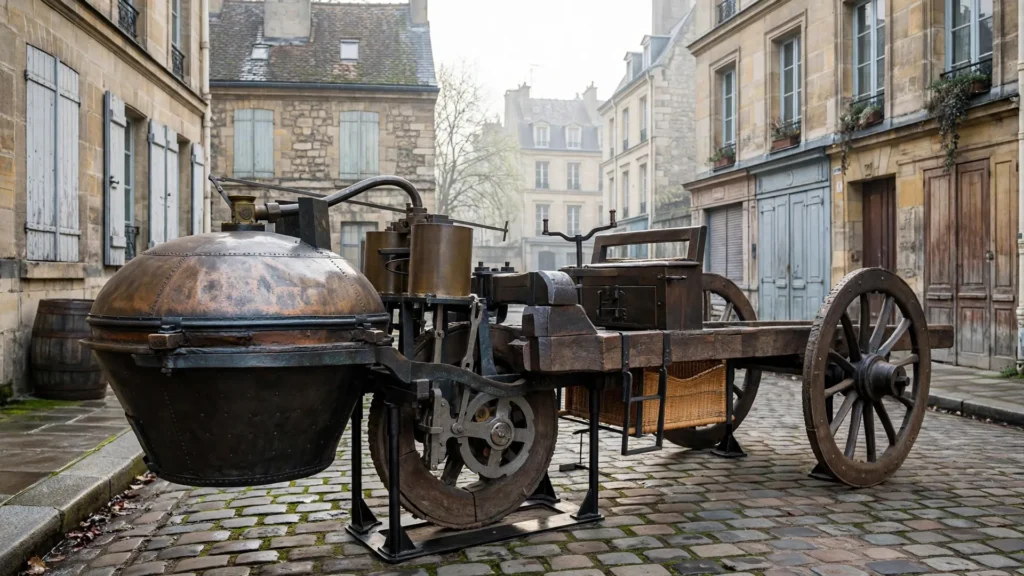
The first person to build a full-size vehicle that moved without a horse was a French army captain named Nicolas-Joseph Cugnot. Cannons were huge and heavy, and moving them with horses was slow and hard. People already used steam engines to pump water out of mines, so Cugnot asked: why not use steam to push a wagon?
In 1769, Cugnot built a full-size machine called the fardier à vapeur, or “steam dray”: three wheels, a huge boiler at the front, and a steam engine that turned the front wheel.
It worked, after a fashion. The wagon moved at about 4 kilometres per hour, slower than a brisk walk, and the boiler needed refilling every 15 minutes or so. It was hard to steer, with all the heavy parts over the single front wheel. In 1771, one machine ran out of control and crashed into a stone wall, often called the first car crash in history.
The French Army soon lost interest. The steam wagon was too slow, too thirsty for water and coal, and too unstable for real work. Cugnot received a small pension from the king, and his machine was put away. One of his vehicles still exists today in a museum in Paris, the Musée des Arts et Métiers.
Was Cugnot the inventor of the first car? Some historians say yes, because his machine was the first self-moving road vehicle ever built. Others say no, because it was a military machine, built to haul cannons, not to carry people. It was never sold to the public.
Cugnot proved a vehicle could move without a horse, but it would take more than 100 years, and a new kind of engine, before a car could be useful in daily life. Steam found its home on rails instead: by 1825, passenger trains were running in England. The car would have to wait for a smaller, lighter engine.
The Engine That Changed Everything
The heart of a modern car is its engine. It burns fuel and turns that energy into movement. Without a good engine, there is no car, only a cart with a heavy machine on top.
The engine that made the car possible was the four-stroke petrol engine, built on ideas from a German inventor named Nikolaus Otto, who patented it in 1876. “Four-stroke” means the four steps the engine repeats: take in fuel and air, squeeze them, burn them, push the waste out. Each little explosion pushes a piston, and the piston turns the wheels.
Otto’s engine was too big and heavy to put in a small car. It was made for factories, not for roads. But it showed the way. If someone could make a smaller, lighter version, a car might finally work.
That someone was Gottlieb Daimler, who worked with his partner Wilhelm Maybach in Cannstatt, near Stuttgart. In 1885, the same year Benz finished his Motorwagen, they built a small, light, fast petrol engine, called the “grandfather clock” engine because it was tall and narrow, like an old floor clock.
Daimler first put this engine on a wooden bicycle in 1885, a machine often called the first motorcycle. It chugged along at about 12 kilometres per hour, and it proved his small engine worked.
Then, in 1886, Daimler fitted his engine to a horse-drawn carriage, making the world’s first four-wheeled petrol car. It reached about 16 kilometres per hour. It was a carriage with an engine added, not designed from scratch like Benz’s, but it showed that four wheels worked well, and they soon became the normal shape for cars.
Benz and Daimler lived only about 100 kilometres apart, worked on the same problem at the same time, and never met. Years later, their companies joined to form Mercedes-Benz.
Karl Benz and His Three-Wheeled Machine
Karl Benz was born in 1844 in Germany. He grew up poor: his father, a railway worker, died when Karl was two. His mother worked hard to educate him, and Karl grew into a clever, stubborn young man who loved machines.
Benz owned a small workshop in Mannheim, on the River Rhine. He built engines for a living, and spent his spare hours on his dream: a vehicle powered by a small petrol engine, built from the ground up as a car.
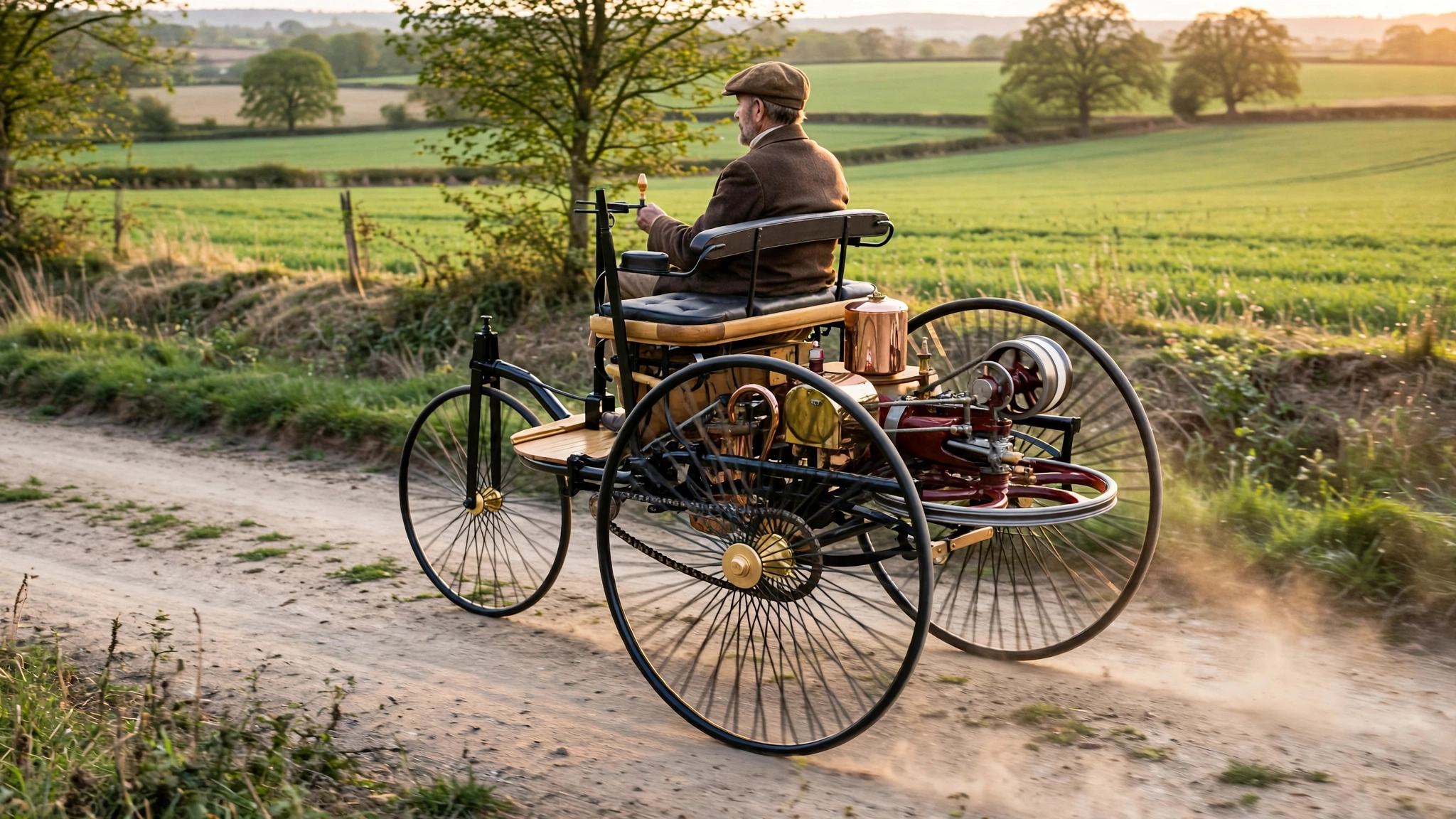
Benz designed every part to fit together: engine, frame, wheels, steering, and brakes. The result was light and simple, with just three wheels: two big ones at the back, one small one at the front for steering. The driver sat on a bench seat and held a tiller, a kind of steering handle, while the engine chugged behind him.
The engine was a single-cylinder four-stroke petrol engine. It was small, with about one horsepower at first, less power than a strong horse. But it was enough for the light little machine. Later versions had a little more power, about two horsepower.
Benz finished his first working Motorwagen in 1885. It looked like a baby carriage crossed with a bicycle, and people who saw it laughed. A machine with no horse looked silly to them.
Then, on 29 January 1886, Benz filed his patent, number DRP 37435, for a “vehicle powered by a gas engine.” It was granted on 2 November 1886. That paper is why so many books say the car was invented in 1886: the car became a real, protected invention, not just a workshop experiment.
Benz drove his car in public for the first time on 3 July 1886, in Mannheim. It reached about 16 kilometres per hour, was loud, shook, and smoked, but it moved under its own power, could be steered, and could be stopped.
Benz kept improving it, and by 1888 he was selling the Patent-Motorwagen, the first car ever offered for sale to the public. Only about 25 were sold before production ended in 1893, mostly to rich buyers, but the car was real now, not a dream in a workshop.
Still, almost nobody took it seriously. A horse is cheaper, people said, and reliable, and it knows the way home. Why want a noisy little machine that breaks down and scares horses? The answer came not from Karl Benz, but from his wife.
Bertha Benz: The Drive That Proved the Car Could Work
Bertha Benz was far more than a bystander. She had believed in Karl’s work from the start, had used her own money to save his business, sat beside him on test drives, and understood engines. By the summer of 1888, she was losing patience with his caution.
Karl kept improving the Motorwagen but was afraid to show it to the world. He worried about breakdowns and about people laughing. Bertha thought the only proof was a long drive, in real life, on real roads.
So early one morning in August 1888, while Karl was still asleep, Bertha took the newest Motorwagen, model number 3, and set off with her two teenage sons, Eugen and Richard, leaving Karl a note. Her plan: drive to Pforzheim, her home town, to visit her mother, about 106 kilometres away.
That may not sound far today, but in 1888, on dirt roads, in a machine with about two horsepower, it was a huge adventure. The car carried little petrol, had no proper brakes for steep hills, and its iron-tyred wooden wheels slipped on dusty roads.
Bertha drove, and her sons pushed the car up steep hills. When the fuel line blocked, she cleared it with a hatpin. When a wire came loose, she fixed it with part of her garter, the band that held up her stocking. When the brake blocks wore thin, she had a cobbler nail leather onto them.
She also needed fuel, and with no petrol stations in 1888, she stopped at a pharmacy in Wiesloch and bought ligroin, a kind of petrol sold as a cleaning liquid. That stop is often called the world’s first filling station.
The trip took about 15 hours of driving, spread over the day, and Bertha and her sons reached Pforzheim by evening. She sent Karl a telegram to tell him they had arrived safely. A few days later, they drove back home again.
The news spread fast. People began to take the car seriously, orders came in, and Karl finally had the proof he needed, thanks to his wife.
Today, the route she drove is marked as the Bertha Benz Memorial Route. Without her drive, the car might have stayed in Karl’s workshop for years longer. Bertha turned a patent into a product, and a product into a story people could believe in.
From a Rich Man’s Toy to a Machine for Everyone
Even after Bertha’s famous drive, cars stayed rare and costly for many years. They were toys for rich people, not tools for ordinary families.
In the 1890s and early 1900s, small car makers sprang up across Europe and America. In Germany, Benz built his first four-wheeled car, called the Victoria, in 1893. In France, companies like Peugeot and Panhard built cars with petrol engines. In America, Ransom Olds built the Oldsmobile Curved Dash, a small, simple car that sold in larger numbers from 1901 onwards.
But cars were still built mostly by hand. A team of skilled workers built one car at a time, fitting each part by hand, which took a long time and cost a lot of money. A car in 1908 cost about 850 dollars in America. That sounds cheap today, but at the time, it was more than a year’s pay for many workers. Most families could never dream of owning one. The roads were terrible too. Most roads outside towns were dirt tracks that turned to mud in rain and dust in summer, and petrol was hard to find.
Still, the car kept improving, year by year. Engines got stronger. Steering wheels replaced tillers. Tyres filled with air made rides softer. Headlights let people drive at night. And in America, a man named Henry Ford was about to change the price of cars forever.
Henry Ford and the Model T: The Car for Everyone
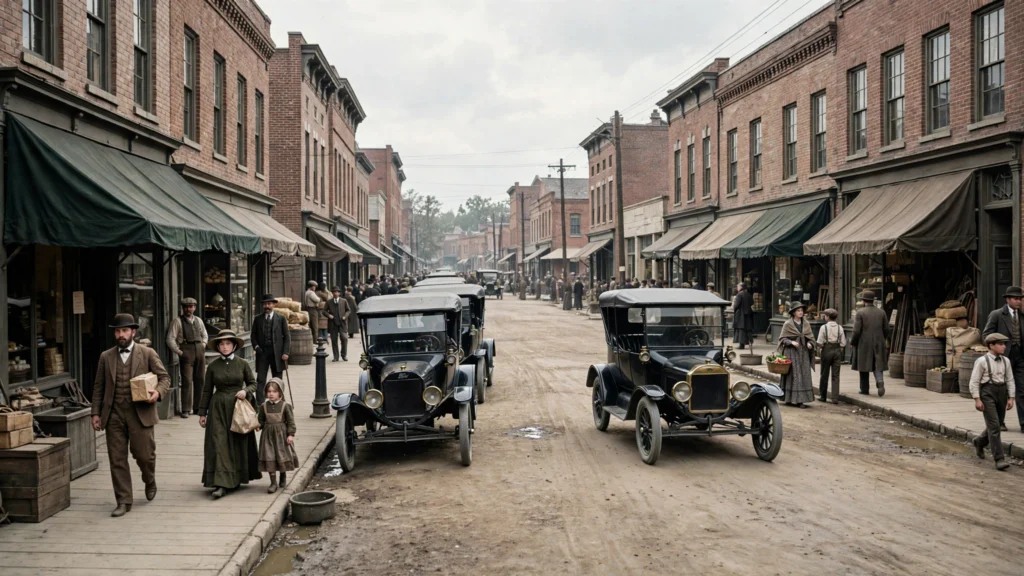
Henry Ford did not invent the car. What he did was just as important: he made the car cheap.
Ford was born in 1863 on a farm in Michigan. He built his first small car in 1896, and his big idea was a car for ordinary people: large enough for a family, simple enough to look after, and cheap enough for a worker to afford.
In 1908, Ford launched the Model T. The first one was built on 12 August 1908, and the car went on sale on 1 October 1908. It cost about 850 dollars at first. It had about 20 horsepower, and it could reach about 72 kilometres per hour. It was simple, strong, and easy to repair, and it could handle rough dirt roads.
The answer was the moving assembly line. Ford did not invent the idea, but he perfected it: the car moved slowly along a line, and each worker did one small job as it passed. At his Highland Park factory in 1913, build time fell from about 12 and a half hours to about 93 minutes, and by 1914 the factory made about 1,000 cars a day.
Prices fell fast: about 550 dollars in 1913, about 440 dollars in 1915, and about 260 dollars by the 1920s, around two and a half months’ wages for an average worker. In 1914, Ford also doubled his workers’ pay to 5 dollars a day, so the people who built the cars could afford to buy them. From 1908 to 1927, Ford built more than 15 million Model Ts. It was not the first car, but it was the car that put the world on wheels.
How Cars Changed the World
Once cars became cheap, the world changed fast. People could live further from work, so towns spread out into suburbs. Countries built smooth, hard roads of tar and concrete, and you can read how road building began in our article on who built the first roads in the world. Fast travel also forced towns to agree on one standard time, a story we tell in our articles about why we have time zones and how people told time before clocks were invented.
New jobs appeared everywhere: mechanics, petrol station workers, road builders, and driving teachers. Families could drive to the beach on a Sunday or visit relatives far away. The road trip was born. Of course, cars brought problems too: crowded roads, accidents, traffic rules, and smoke in city air. But in the early 1900s, the excitement was stronger than the worry. For the first time, ordinary people could move fast, far, and freely, whenever they liked.
So, Who Really Invented the First Car?
If the question means, “Who built the first vehicle that moved without a horse?” the answer is Nicolas-Joseph Cugnot, in France, in 1769. If it means, “Who built the first car with a petrol engine, designed as a car from the start?” the answer is Karl Benz, in 1885, with a patent dated 29 January 1886. If it means, “Who built the first four-wheeled petrol car?” the answer is Gottlieb Daimler, also in 1886. If it means, “Who made cars cheap enough for ordinary people?” the answer is Henry Ford, with the Model T in 1908. And part of the answer belongs to Bertha Benz, who proved the car could travel 106 kilometres on real roads in 1888.
Frequently Asked Questions
Who is officially credited with inventing the first car?
Karl Benz is the person most often credited with inventing the first true car. He built the Benz Patent-Motorwagen in 1885 and received a patent for it on 29 January 1886. It had a petrol engine and three wheels, and it was designed from the start as a car.
What was the first car ever made?
It depends on what you mean by “car.” The first self-moving road vehicle was Cugnot’s steam wagon, built in France in 1769. The first practical petrol car was the Benz Patent-Motorwagen, built in 1885. The first four-wheeled petrol car was Daimler’s motorised carriage, built in 1886.
Did Henry Ford invent the car?
No. Cars had existed for more than 20 years before the Model T. Ford’s achievement was making cars cheap: his assembly line cut build time from about 12 and a half hours to about 93 minutes, and the price fell from about 850 dollars to about 260 dollars.
How fast was the first car?
The Benz Patent-Motorwagen could reach about 16 kilometres per hour, about the speed of a bicycle ridden hard. Cugnot’s steam wagon was even slower, at about 4 kilometres per hour, slower than a brisk walk.
Who was Bertha Benz, and why does she matter?
Bertha Benz was Karl Benz’s wife. In August 1888, she drove the Patent-Motorwagen about 106 kilometres from Mannheim to Pforzheim with her two teenage sons, without telling Karl in advance. The trip proved the car could travel a long distance on real roads.
Why did it take so long for cars to become common?
Early cars were costly, slow, and hard to repair, and the roads were poor. Most cars were built by hand, one at a time. Only when Ford’s assembly line made cars fast and cheap to build, and countries built better roads, could ordinary families afford one.
More from Zorium Daily
If you liked the story of the first car, you may enjoy these other simple history guides from Zorium Daily. Read about how people travelled before cars were invented and see how slow life was when horses did all the work. Read about who built the first roads in the world and learn how ancient roads made travel possible long before cars. Read about why we have time zones and find out how fast trains, and later cars, forced the whole world to agree on time. And read about how people told time before clocks were invented to see how people measured their days when there were no cars, no trains, and no clocks on the wall.
A Machine Built by Many Hands
The next time you sit in a car, look at it for a moment before the journey starts. The engine grew out of Otto’s work and Daimler’s small, light design. The car itself grew out of Benz’s machine. The long drive that proved it all grew out of Bertha’s courage. And the low price grew out of Ford’s factory line. No one person built that car. Many people did, over more than a hundred years. That is how the first car was really invented: not in a single flash, but step by step, by many hands. You can find more simple history stories like this one in our History section.