Who Invented the Umbrella? Explained Simply
SUMMARY OF THIS ARTICLE
- No single person invented the umbrella. It grew up slowly, in many places, over thousands of years.
- The first umbrellas were sunshades, called parasols, used in Egypt, China, and India more than 3,000 years ago.
- Early parasols were a sign of wealth and power, carried by servants over kings and nobles.
- The umbrella reached Europe as a sunshade for rich women, and only later became a rain shield for everyone.
- Modern folding umbrellas, waterproof cloth, and metal frames made it cheap, light, and easy to carry.
A Question With No Single Answer
Who invented the umbrella? It is a good question, and it has a slightly cheeky answer: nobody did. Not one person, anyway.
The umbrella was not invented in a flash, the way the light bulb was. It grew up slowly, in different countries, over thousands of years. One place made a sunshade from leaves. Another made one from silk. Another added a folding frame. Another made the cloth waterproof. Put all those small steps together, and you get the umbrella in your hallway today.
That is how many old inventions work. They are not born. They grow, piece by piece, hand by hand, century by century. The umbrella is one of the best examples. So instead of looking for one inventor, let us follow the umbrella on its long journey — from a royal sunshade in ancient Egypt, to a silk canopy in China, to a rainy street in London, to the little folding umbrella in your bag.
It Started With the Sun, Not the Rain
Here is the first surprise: the umbrella was not invented for rain. It was invented for sun.
The word umbrella comes from the Latin word umbra, which means shade or shadow. And the older word parasol comes from the French for “against the sun.” The first umbrellas were sunshades, made to protect people from the hot sun, not from rain.
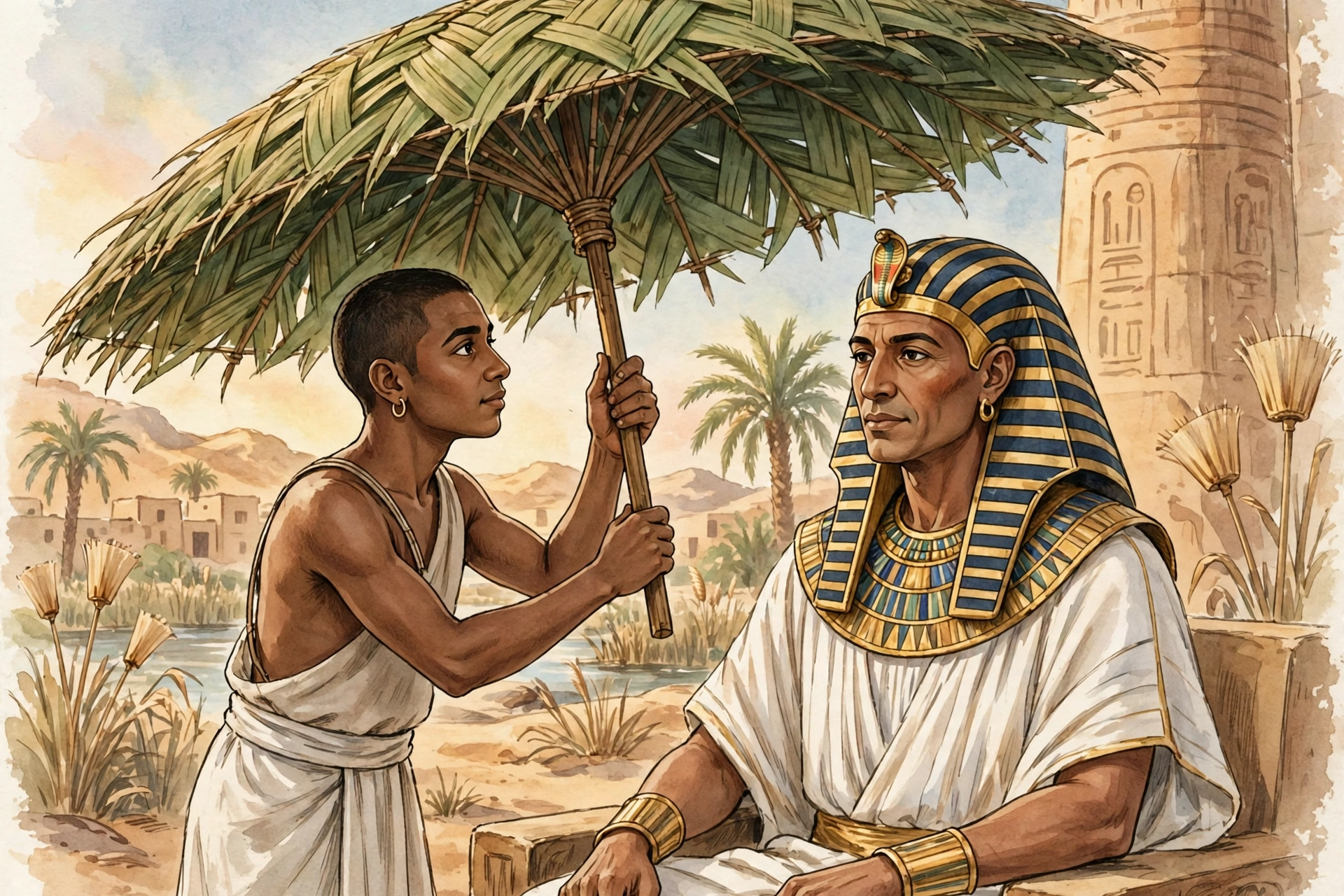
In ancient Egypt, more than 3,000 years ago, nobles were shaded by servants holding large fans made from palm leaves or feathers. The shade was a sign of importance. If someone held a shade over you, it meant you mattered. The bigger the shade, the more important you were. Ordinary people walked in the sun. Important people walked in shade.
In China, the parasol appeared around the same time, or even earlier. Early Chinese parasols were made from silk stretched over a frame of bamboo, and later from oiled paper that could keep out rain as well as sun. Chinese legend says the wife of a carpenter, a person who makes things from wood, invented the first folding umbrella, so it could be carried easily and opened when needed. We do not know if that story is true, but it is a lovely one, and it shows how long people have wanted a shade they could fold up and carry.
In India, the parasol was also a royal symbol. Kings and holy people were shaded by beautiful parasols made from palm leaves, silk, and feathers. The parasol was so important that it became a symbol of kingship itself — a king without his parasol was like a king without his crown.
So the first umbrellas were not about staying dry. They were about staying cool, and about showing the world that you were somebody. Rain came later. Much later.
The Umbrella Travels the World
From Egypt, China, and India, the idea of a sunshade spread slowly across the world, changing a little in each place it reached.
In Greece and Rome, parasols were used by wealthy women to protect their skin from the sun. Pale skin was fashionable then, a sign that a woman did not work outdoors in the fields. A parasol kept the sun off and kept the skin pale. Men rarely used them. A man with a parasol would have been laughed at. The parasol was, for a long time, a woman’s thing, and a rich woman’s thing at that.
In Japan, the parasol became a work of art. Japanese oil-paper umbrellas, called janome, were made from bamboo and paper coated with oil to keep out rain. They were light, strong, and beautiful, often painted with flowers and patterns. They were used for sun and rain alike, and they became a part of everyday life, carried by men and women, rich and poor.
In Southeast Asia, parasols were used in temples and royal courts, made from silk and gold thread, and carried in grand processions. In Africa, large parasols shaded chiefs and kings. Everywhere the umbrella went, it carried the same two meanings: shade from the sun, and a sign that the person underneath mattered.
And all the while, ordinary people in rainy places were solving the rain problem in their own way: wide hats, cloaks, and coats made from oiled cloth. It took a long time for the two ideas — the fancy sunshade and the practical rain cover — to join together into the umbrella we know today.
How the Umbrella Came to Europe
The umbrella arrived in Europe slowly, and it was not welcomed with open arms. At first, it was a luxury, a pretty thing for rich women to carry on sunny days. It was made of silk, lace, and fine wood, and it cost a lot of money. A working person could not afford one, and would not have wanted to be seen with one anyway.
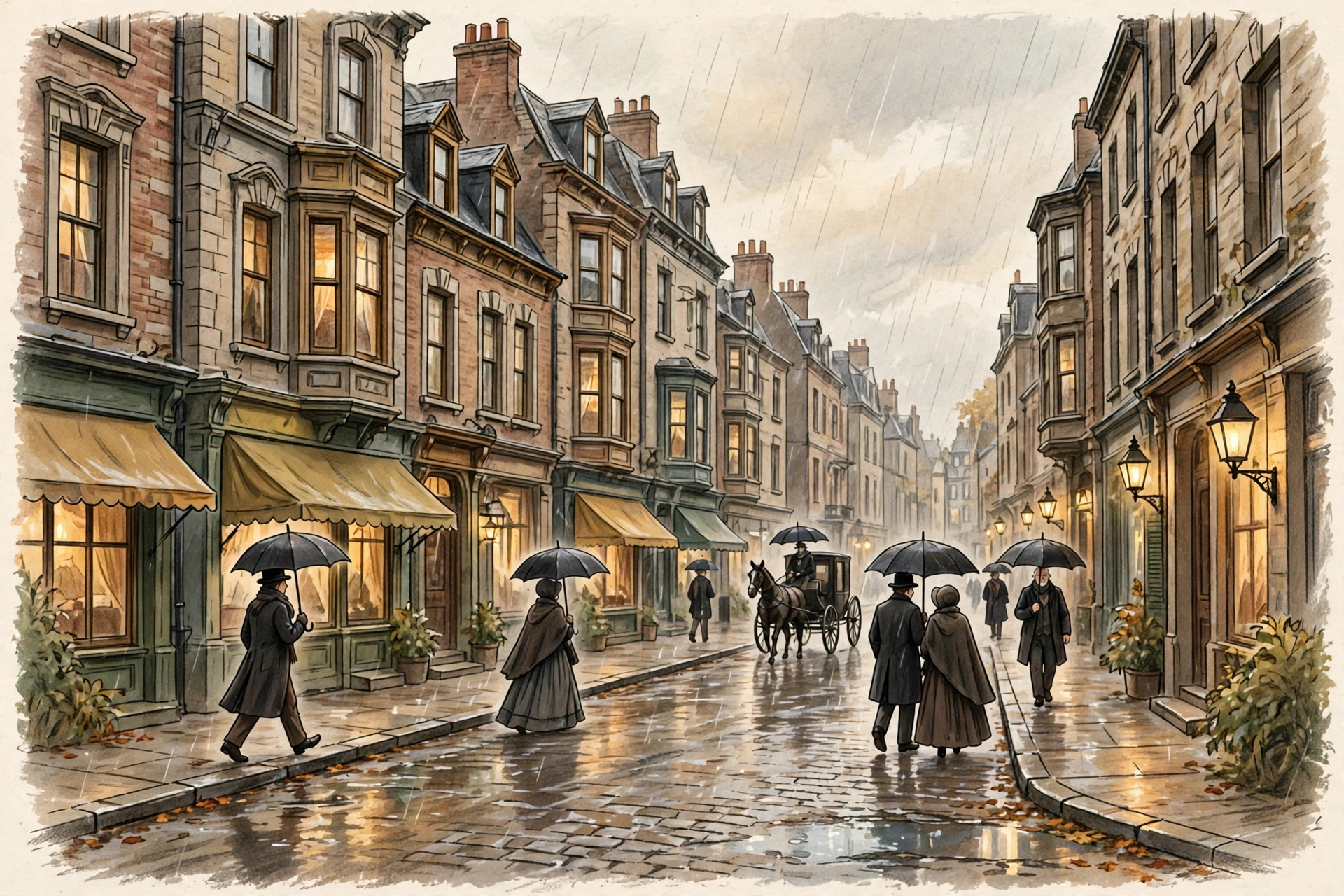
In France in the 1600s, parasols became fashionable among noblewomen. They were small, delicate, and often matched the dress. In England, the first umbrellas were also sunshades, carried by ladies in summer. Rain umbrellas were a different matter. Many people thought it was silly, even unmanly, for a man to carry an umbrella in the rain. A real man, people said, should just get wet, or wear a coat.
One man helped change that. His name was Jonas Hanway, an English traveller who lived in the 1700s. Hanway had travelled in places where umbrellas were common, and he started carrying one in London, in the rain, every day. People laughed at him. Cab drivers shouted at him, because an umbrella meant fewer fares for them. Boys threw things at him. But Hanway did not care. He kept carrying his umbrella for thirty years, until people got used to it, and then started doing it themselves. He is often called the first man in London to carry an umbrella, and he deserves a little credit for making it normal.
By the 1800s, the umbrella was changing fast. Steel frames replaced wood and whalebone, making umbrellas stronger and lighter. Waterproof cloth replaced silk. Prices fell. The umbrella stopped being a luxury and became a practical tool for everyone. A clerk, a shopkeeper, a schoolchild — all of them could own one. The umbrella had gone from a royal sunshade to an everyday rain shield, and it had taken about three thousand years to get there.
The Folding Umbrella Changes Everything
The biggest change of all came when the umbrella learned to fold. An open umbrella is big and awkward. It catches the wind, it drips everywhere, and it is hard to carry. A folding umbrella is small, light, and fits in a bag. That one idea — make it fold — turned the umbrella from something you carried on purpose into something you could carry just in case.
Early folding umbrellas existed in China long ago, but the modern folding umbrella was developed in the 1900s and 1920s. Engineers made frames that folded in two or three places, with a sliding runner that locked the umbrella open. The cloth became nylon, a light, strong, waterproof fabric. The handle became short and neat. Suddenly, an umbrella could fit in a handbag, a pocket, or a school bag.
The folding umbrella also changed how we think about rain. Before, rain meant planning: you took an umbrella if you thought it might rain. After folding umbrellas became cheap, rain became a minor annoyance. You kept a small umbrella in your bag all the time, just in case, and you forgot about it until the sky went grey. It is a small freedom, and we take it for granted now.
Today, umbrellas come in every colour and shape: clear umbrellas, windproof umbrellas, golf umbrellas big enough for two people, tiny pocket umbrellas that weigh less than a phone. Some open with a button. Some close themselves. Some are so strong they can survive a storm that would have shredded a silk parasol in seconds. The idea is the same as it was three thousand years ago — a canopy over your head — but the engineering is a world away.
The Umbrella in Art, Stories, and Fashion
The umbrella has a life beyond keeping rain off. It has become a symbol, a fashion piece, and a character in stories.
Think of Mary Poppins, floating down from the sky with her umbrella, neat and magical. Think of the Beatles, walking in the rain. Think of a red umbrella in a black-and-white film, the only colour in the picture. Artists love umbrellas because they are simple shapes that say a lot: shelter, mystery, a little bit of magic.
In fashion, the umbrella has gone from a plain black rain shield to a statement piece. Bright colours, bold patterns, clear plastic, even umbrellas shaped like leaves or flowers. A beautiful umbrella can lift a grey day. It is one of the few fashion items that is also genuinely useful, which is a rare and lovely combination.
The umbrella has also become a symbol in its own right. In many cultures, it stands for protection, shelter, and care. A parent holding an umbrella over a child is a picture of love that needs no words. A couple sharing one umbrella in the rain is a picture of closeness. It is a simple object, but it carries a lot of feeling.
And in language, the umbrella has given us a useful idea. People talk about an “umbrella term,” a broad word that covers many smaller things, like an umbrella covers many people. They talk about an “umbrella organisation,” a big group that shelters smaller groups. The umbrella has become a way of thinking about protection, in words as well as in rain.
How an Umbrella Is Made
Have you ever looked closely at an umbrella and wondered how it works? It is a clever little machine, and it is worth a closer look.
At the top is the tip, a small cap that protects the cloth when the umbrella is closed. Below it is the canopy, the cloth part that catches the rain. The canopy is made from panels of fabric, usually eight, stitched together. The fabric is waterproof, which means water runs off it instead of soaking through.
Under the canopy are the ribs, thin arms that hold the cloth out. The ribs are joined to a central stick, called the shaft, by small joints. A sliding piece, called the runner, moves up and down the shaft. Push the runner up, and the ribs spread out, opening the umbrella. Pull it down, and the ribs fold in, closing it. A small spring catches the runner and locks it open. It is a simple, elegant piece of engineering, and it has barely changed in a hundred years.
The handle is where the hand goes, and it comes in every shape: straight, curved like a walking stick, or short and stubby for a folding umbrella. A curved handle is handy, because you can hook it over your arm when you are not using it. A good handle feels comfortable in the hand, even when it is wet.
Making an umbrella takes many small steps: cutting the cloth, stitching the panels, fitting the ribs, testing the frame. A cheap umbrella may have thin ribs that bend in the wind. A good umbrella has stronger ribs, often made from fibreglass, a light, bendy material that flexes instead of snapping. That is why a good windproof umbrella can survive a gust that would turn a cheap one inside out.
The Umbrella’s Enemies: Wind and Manners
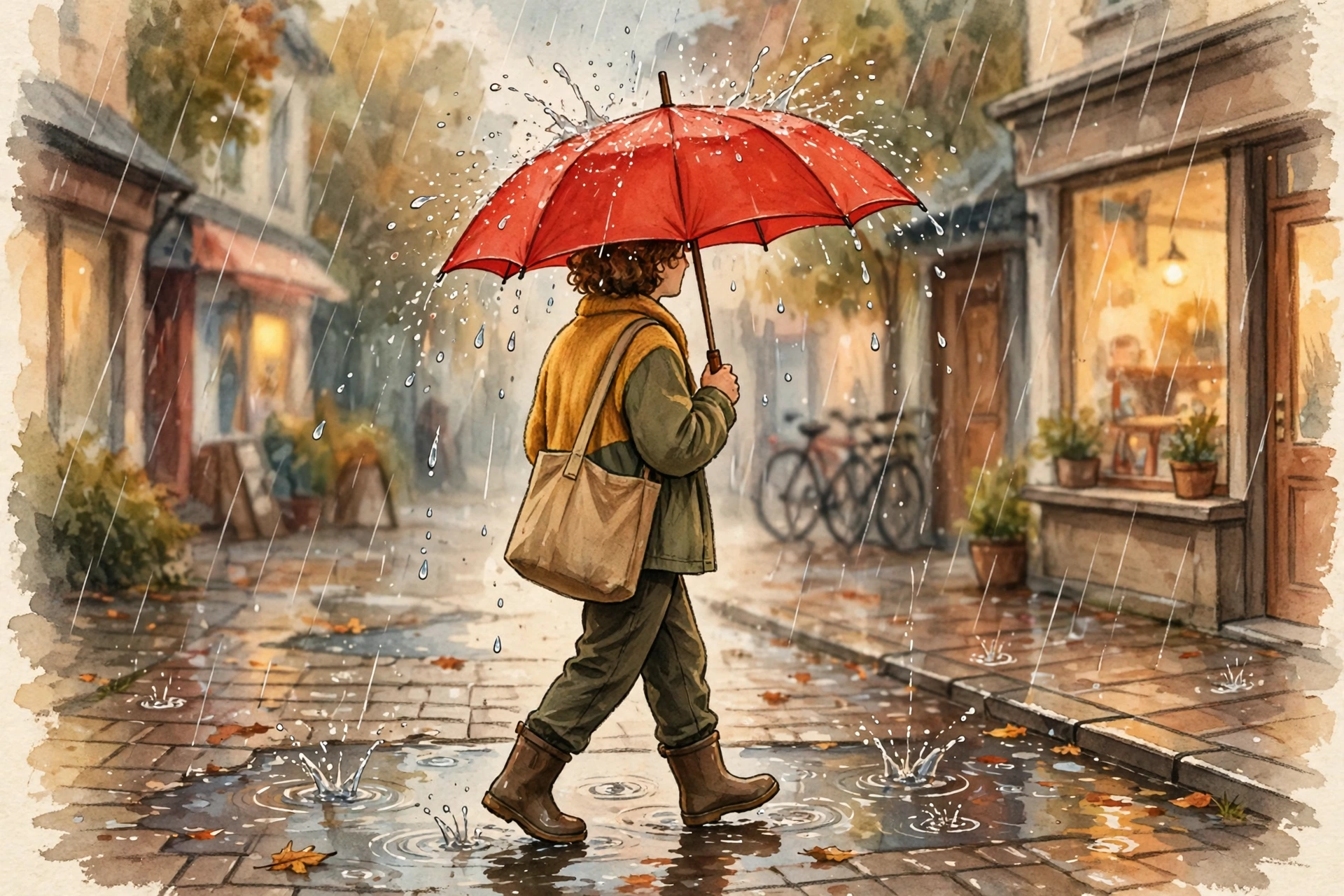
Every umbrella has an enemy, and its name is wind. A strong gust can catch the canopy from below and flip the umbrella inside out, snapping ribs and leaving you soaked and embarrassed. It has happened to all of us, usually at the worst moment, like crossing a busy street.
Windproof umbrellas help. They have vents, small openings in the canopy that let wind pass through instead of catching it, and flexible ribs that bend instead of breaking. They are not perfect — no umbrella can beat a real storm — but they last longer than a cheap one.
The other enemy is manners. Or rather, the lack of them. A crowded street in the rain is a forest of umbrellas, and they poke, drip, and collide. There is an unwritten code: hold your umbrella high enough not to poke anyone in the eye, tilt it towards the taller person when you pass, and shake it off before you go inside, so you do not leave a puddle on the floor. It is a small kindness, and it makes rainy days a little easier for everyone.
And there is the lost umbrella. We have all left one behind: on a bus, in a café, at a friend’s house. Umbrellas are among the most lost and found objects in the world. Some cities have boxes full of them. It is a funny thing about an object we use so often: we love it when it rains, and we forget it the moment the sun comes out.
People have walked in the rain for thousands of years, on paths and roads of every kind, and the umbrella has walked with them for much of that time. If you are curious about the roads themselves, and who first built them for travellers, our piece on who built the first roads in the world follows that story from muddy tracks to paved highways. Roads and umbrellas grew up together, in a way: better roads meant more walking, and more walking meant more need for shelter from sun and rain.
Umbrellas Around the World Today
The umbrella is everywhere now, but it still wears different clothes in different places.
In Japan, the oil-paper umbrella is still made by hand, a beautiful craft that takes years to learn. It is used for festivals, tea ceremonies, and special days, and it is as much art as shelter. In China, silk parasols are still made for weddings and celebrations, bright and delicate. In India, colourful parasols shade temple processions and weddings, a link to a tradition thousands of years old.
In rainy cities like London, Bergen, and Seattle, the umbrella is a daily tool, as normal as a coat. In sunny places like Australia and the Middle East, the parasol is making a comeback, as people look for shade from strong sun. A sun umbrella, or parasol, is not just for the beach anymore. People carry them on hot streets, hold them over prams, and use them in gardens. The old sunshade is finding a new life.
And in the world of design, umbrellas keep evolving. There are umbrellas that open backwards, so the wet side folds inwards and does not drip on you. There are umbrellas with lights built in, for walking at night. There are umbrellas made from recycled plastic bottles. The idea is old, but the imagination is fresh.
Why It Matters That No One Person Invented It
Here is a thought to end the history part. We love stories about single inventors: one clever person, one bright idea, one moment of genius. But the umbrella reminds us that most inventions are not like that. They are team efforts, spread across centuries and continents.
An Egyptian servant holding a palm leaf. A Chinese carpenter’s wife folding silk. A Japanese craftsman oiling paper. An English traveller walking through London in the rain. A factory worker stitching nylon panels. None of them invented the umbrella alone. All of them added a piece.
That is a hopeful way to think about invention. You do not have to be a genius to add something to the world. You just have to see a problem — sun, rain, a long walk — and make a small improvement. Someone else will add the next piece. And one day, a thousand small improvements later, you have an umbrella that fits in your pocket and keeps you dry in a storm.
Frequently Asked Questions
Who invented the umbrella?
No single person invented it. The umbrella grew up over thousands of years, in many places. The first sunshades appeared in Egypt, China, and India more than 3,000 years ago. Later, people in different countries added folding frames, waterproof cloth, and steel ribs. The modern umbrella is the result of many small inventions, not one big one.
Was the umbrella first used for rain or sun?
For sun. The first umbrellas were parasols, which means “against the sun.” They were used to shade kings, nobles, and wealthy women from the hot sun, and they were also a sign of importance. The umbrella only became a common rain shield much later, when waterproof cloth and cheap frames made it practical for everyone.
What were the first umbrellas made from?
Palm leaves, feathers, silk, bamboo, and oiled paper. In Egypt, servants held large fans of palm leaves or feathers over nobles. In China, parasols were made from silk stretched over bamboo, and later from oiled paper. In Japan, bamboo and oil-coated paper made light, strong umbrellas. Each place used what was close by and easy to work with.
Why was it once strange for a man to carry an umbrella?
In Europe in the 1600s and 1700s, umbrellas were seen as a luxury for wealthy women, and carrying one in the rain was thought to be unmanly. Men were expected to wear a coat and get wet, or stay indoors. Jonas Hanway, an English traveller, helped change this by carrying an umbrella in London every day for thirty years, until people got used to it and started doing the same.
When did umbrellas become cheap enough for everyone?
In the 1800s, when steel frames and waterproof cloth replaced wood, whalebone, and silk. Factories could make umbrellas faster and cheaper, and prices fell. The folding umbrella in the 1900s made them even smaller, lighter, and easier to carry. By the mid-1900s, almost everyone could afford one.
What makes a good umbrella?
A strong, flexible frame, waterproof cloth, and a comfortable handle. Windproof umbrellas have vents that let wind pass through, and ribs made from fibreglass that bend instead of snapping. A good umbrella costs a little more, but it lasts longer and survives gusts that would destroy a cheap one. It is worth spending a little more on something you use in a storm.
The Little Roof You Carry
The next time it rains, and you open your umbrella, take a second to think about it. You are holding three thousand years of history over your head. A palm leaf in Egypt. A silk canopy in China. An oil-paper umbrella in Japan. A stubborn Englishman walking through London while people laughed. A factory worker stitching nylon. All of them, in a small, folding roof that fits in your bag.
It is a simple thing, an umbrella. A stick, some cloth, a few thin ribs. But it keeps you dry, it keeps you cool, and it has been doing that job for longer than almost any other object you own. Not bad for something that started as a leaf held over a king.
So the next time the sky goes grey, do not groan. Open your umbrella, step out, and enjoy the rain. You are carrying a very old, very clever idea — and it is still working perfectly.