Who Invented the First Computer? Explained Simply
SUMMARY OF THIS ARTICLE
- There is no single inventor of the computer. It was built step by step, by different people, over more than a hundred years.
- Charles Babbage designed the first general-purpose computer idea in the 1830s, the Analytical Engine, but it was never built in his lifetime.
- Ada Lovelace wrote the first programme for Babbage’s machine, long before any computer existed to run it.
- Alan Turing set out the modern idea of a computer in 1936, showing that one machine could do any calculation if it followed simple rules.
- ENIAC, finished in 1945, was the first general-purpose electronic computer. It filled a whole room and weighed about 50 tons.
The Question That Stopped Liam
Liam was fourteen, and he was supposed to be doing his homework. The maths worksheet was open on his laptop, but his mind was somewhere else entirely. He stared at the screen, at the little cursor blinking back at him, and a question popped into his head out of nowhere: who actually invented this thing?
It was a simple question, the kind a child asks and an adult pretends to know the answer to. Liam typed it into a search box and got a list of names. Charles Babbage. Ada Lovelace. Alan Turing. ENIAC. None of them looked like a single, clean answer. He had expected one name, one person, one moment when somebody switched on the first computer and said, “There, it works.” What he found instead was a story with four heroes, spread across more than a hundred years, and a machine that started as an idea on paper long before it ever existed as a real thing.
That is the honest answer to the question, and it is worth saying right at the start. Nobody invented the computer on their own. It was not one flash of genius in one room on one day. It was a chain. One person dreamed up the idea, another person saw what the idea could really do, a third person worked out the rules that every computer still follows today, and then a team of engineers finally built a working machine big enough to fill a room. Each link in that chain mattered. Take any one of them away, and the computer on your desk, or in your pocket, would not exist in the way it does now.
So this is not a story about one inventor. It is a story about a chain of people, and about an idea that refused to die. It begins in the 1830s, with a man who was annoyed by mistakes in maths books.
The Honest Answer First
Before we meet the people, it helps to clear up the confusion. If you ask ten people who invented the first computer, you might get four or five different answers, and they would all be partly right. That is because the word “computer” can mean different things.
It can mean the first machine that could add and subtract. It can mean the first machine that could follow a set of instructions. It can mean the first machine that ran on electricity. And it can mean the first machine that looked anything like the computers we use today. Each of those firsts belongs to a different person, or a different team, at a different time.
So when someone asks, “Who invented the first computer?” the fair answer is, “Nobody did it alone.” The computer was not invented. It was built up, idea by idea, over a very long time. Big ideas do not arrive finished. They grow, they get passed from one person to the next, and they slowly turn from a sketch on paper into something you can touch.
Keep that in mind as we walk through the chain. There are four main links, and each one is a person — or in the last case, a whole team — who added something the others could not have added on their own.
What Is a Computer, Anyway?
It sounds like a silly question, but it matters, because the answer decides who counts as an inventor. A computer is not just a box with a screen. At its heart, a computer is a machine that takes in information, does something with it by following a set of instructions, and gives you an answer.
That is all. A machine that adds two numbers together is doing computing. A machine that follows a recipe, step by step, and produces a result is doing computing. Your phone, your laptop, the till at the supermarket, the screen that shows you the weather — they are all doing the same basic job, just faster and with more steps than the first machines ever could.
The instructions are the key part. A calculator is not really a computer, because it only does what you tell it to do, one button press at a time. A computer follows a list of instructions on its own, one after another, and it can even make simple choices along the way, like “if this number is bigger, do this; if it is smaller, do that.” That idea — a machine that follows instructions by itself — is what the whole story is about.
Once you know that, the story makes sense. The first person in our chain did not build a computer. He designed one, on paper, more than a hundred years before the technology existed to build it. And that is where our story begins.
The First Link: Charles Babbage and His Impossible Machine
Charles Babbage was an English mathematician who lived in the 1800s, and he had a problem that will sound familiar to anyone who has ever done long sums by hand. In his time, all the important maths tables — the books that sailors, engineers and scientists used to work out positions, build bridges and aim cannons — were worked out by hand, by people sitting at desks with pens. And people make mistakes.
Babbage hated those mistakes. He once said, in his own grumpy way, that he wished the sums could be done by steam, like a factory machine. And then, instead of just complaining, he decided to build a machine that would do it.
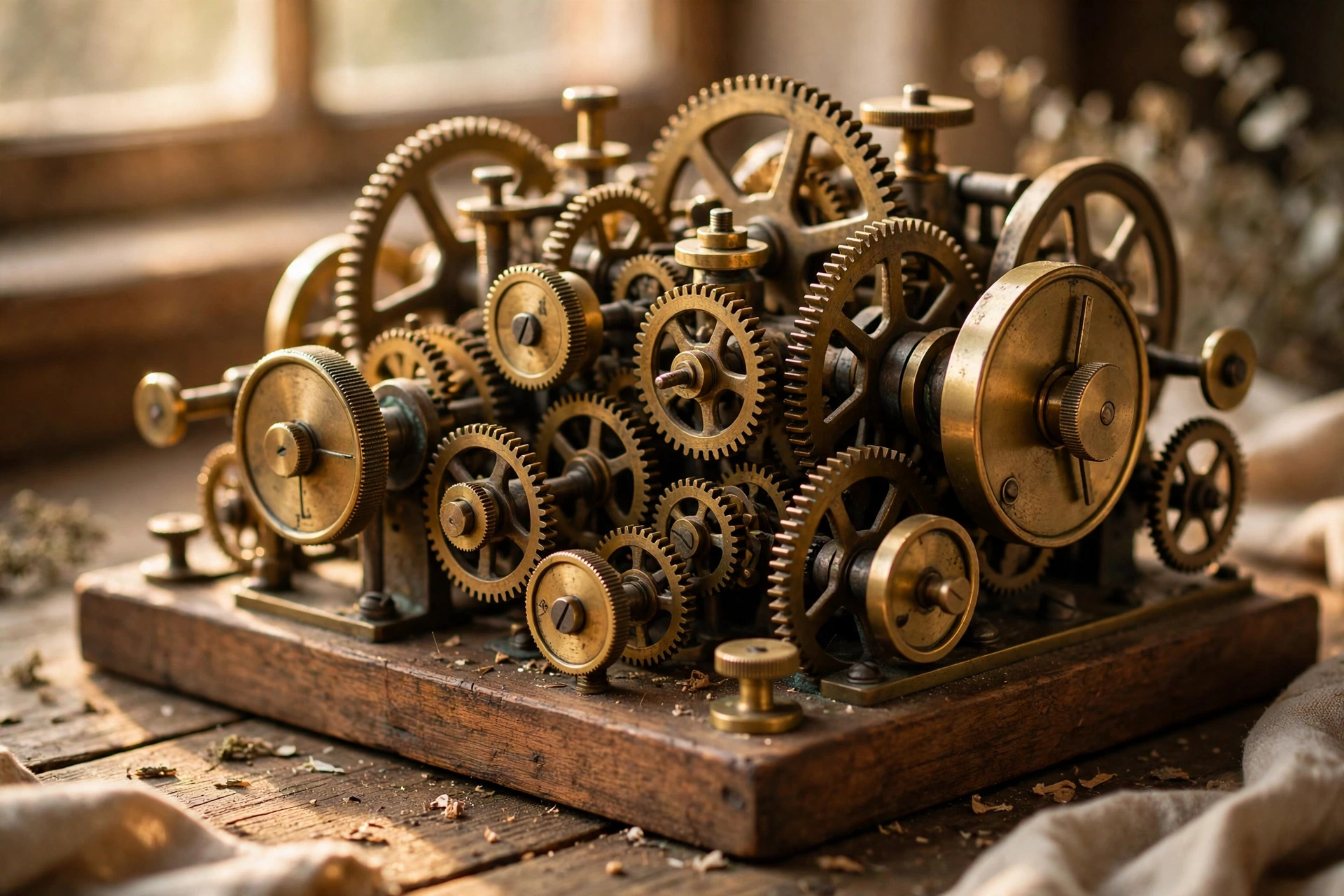
In the 1830s, Babbage drew up the plans for a machine he called the Analytical Engine. It was an extraordinary idea, and it was far ahead of its time. The machine would have a part for storing numbers, a part for doing the sums, and a part for following instructions — the same three jobs that every computer still has today. It would read its instructions from punched cards, stiff cards with holes in them, borrowed from the machines that wove patterned cloth. Each hole in the card would tell the machine to do one small thing.
The Analytical Engine was never built in Babbage’s lifetime. The parts were too fine and too precise for the workshops of the 1830s to make, and the money ran out. Babbage spent years arguing with the government for more funding, and he died in 1871 with his great machine still only a pile of drawings and a few small test pieces. But the idea was complete. He had designed the first general-purpose computer — a machine that could do any calculation, not just one kind — more than a hundred years before anyone managed to build one.
A man in the age of horse-drawn carriages and candlelight drew up a machine that works on the same basic plan as the laptop on your desk. That is why historians call Babbage the father of the computer. He did not build it, but he imagined it, and without his imagination there would have been nothing to build.
Ada Lovelace: The First Programmer
Babbage’s machine might have been forgotten entirely if it had not been for a remarkable woman named Ada Lovelace. She was the daughter of the poet Lord Byron, but she was a mathematician in her own right, and she understood Babbage’s machine better than almost anyone else alive — perhaps better than Babbage himself.
In the 1840s, Lovelace translated a paper about the Analytical Engine from French into English, and then she added her own notes. Her notes were three times longer than the paper itself, and they contained something extraordinary. She wrote out, step by step, how the machine could be told to work out a set of numbers called Bernoulli numbers. It was a list of instructions for a machine that did not exist yet. In other words, she wrote the first computer programme, almost a hundred years before the first computer was built.
But Lovelace did something even more important than writing a programme. She saw what Babbage had not fully seen: that his machine was not just a calculator. Babbage thought of it as a machine for sums. Lovelace saw that a machine which could follow instructions and work with symbols could do far more than add numbers. She wrote that it could compose music, draw pictures, and work with anything that could be turned into numbers. She imagined the computer as a creative tool, not just a counting tool.
Her ideas were so far ahead of their time that they were mostly ignored for a century. Today, she is remembered as the world’s first computer programmer, and the programming language Ada, used in serious engineering work, is named after her. She never saw a computer. She never even saw the machine she wrote for. But she saw its future more clearly than anyone else in the 1840s.
Alan Turing: A Simple Idea That Changed Everything
The next link in the chain came almost a hundred years later, in 1936, from a young English mathematician called Alan Turing. Turing was twenty-four years old, and he was thinking about a puzzle: what does it mean to work something out? When a person sits down with a pencil and follows the steps of a long sum, what exactly are they doing?
Turing’s answer was beautifully simple. He imagined a machine — not a real machine, just an idea of one — that could read symbols, write symbols, and follow a short list of rules. The machine would have a long strip of paper, like a never-ending roll of toilet paper, divided into little squares. It could look at one square at a time, read the symbol on it, and then, following its rules, either write a new symbol, move one square left, or move one square right. That was all it could do. Read, write, move left, move right.
Turing showed that this little imaginary machine, if you gave it the right set of rules, could work out anything that can be worked out at all. Any calculation, any problem that can be solved step by step, could be done by this simple machine. And — here was the clever part — the same machine could do different jobs just by changing the rules. You did not need a new machine for every problem. You needed one machine and many different sets of rules.
That is the idea at the heart of every computer you have ever used. Your phone does not have a separate machine inside it for photos, another for messages, and another for games. It has one machine, and it runs different sets of rules — different programmes — for each job. Turing worked that out in 1936, on paper, before any electronic computer existed. His imaginary machine is still called the Turing machine today, and computer scientists still use it to think about what computers can and cannot do.
Turing’s life had a sad ending. During the Second World War, he helped build real machines that cracked secret German codes, work that shortened the war and saved many lives. But after the war, he was treated cruelly by the country he had served, because of who he was, and he died young, in 1954, at the age of forty-one. It took many years for the world to recognise what he had done. Today, he is remembered as one of the founders of computer science, and the highest prize in computing, the Turing Award, carries his name.
ENIAC: A Computer the Size of a Room
The final link in our chain is not one person but a team, and not a paper design but a real, working, room-filling machine. Its name was ENIAC, which stood for Electronic Numerical Integrator and Computer, and it was switched on in 1945 at the University of Pennsylvania in America.
ENIAC was the first general-purpose electronic computer. That is a mouthful, so let us break it down. “General-purpose” means it could do many different jobs, not just one. “Electronic” means it ran on electricity and used electronic parts instead of gears and wheels. And “computer” means it could follow a set of instructions on its own.
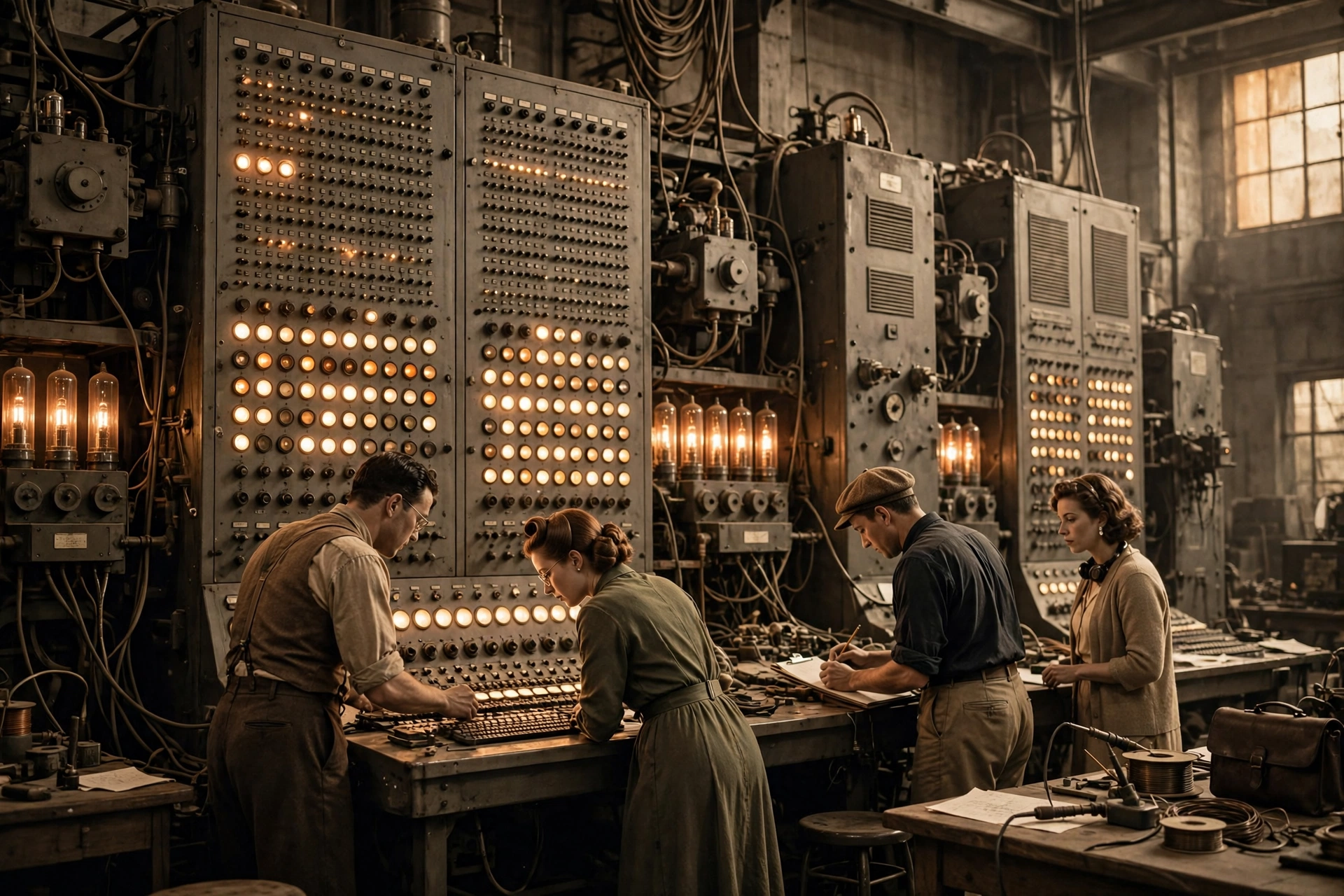
The machine was enormous. It filled a room about the size of a small classroom, and it weighed about 50 tons — as much as eight or nine elephants standing together. Inside it were around 18,000 glass tubes, called vacuum tubes, that glowed like tiny light bulbs and did the switching work that tiny chips do today. It had miles of wiring, and it used so much electricity that people joked the lights in the nearby town went dim when it was switched on.
ENIAC was built to help the American army work out firing tables — long lists of numbers that told soldiers where their shells would land. Doing those tables by hand took teams of people weeks. ENIAC could do in seconds what had taken a person twenty hours.
There was a catch, though. ENIAC was very hard to use. To give it a new job, engineers had to walk around the room plugging cables into different sockets and turning thousands of switches by hand. Setting up one problem could take days. The machine was powerful, but using it was slow, fiddly work, a bit like rewiring your whole house every time you wanted to turn on a different light. Later computers fixed this by storing their instructions inside the machine itself, so they could be changed without touching a single wire.
ENIAC was switched off in 1955, after ten years of work. By then, smaller and better machines were already taking its place. But it had proved something important: a general-purpose electronic computer could really be built, and it could really work. Babbage’s idea, Lovelace’s programme and Turing’s rules had finally become a real machine.
From a Room to Your Pocket
Here is the part of the story that still surprises people. The machine that filled a room in 1945 is now smaller than a postage stamp, and it sits inside your phone. The journey from ENIAC to the phone in your pocket took less than eighty years, and it happened because of one small invention after another.
The first big step came in 1947, just two years after ENIAC, when scientists invented the transistor. A transistor does the same job as one of ENIAC’s glowing glass tubes, but it is tiny, it uses far less electricity, and it almost never breaks. Soon, thousands of transistors could be squeezed onto a single small chip of silicon, and then millions, and then billions. Each step made computers smaller, cheaper and faster.
By the 1970s, a whole computer could fit on a desk, and by the 2000s, computers were in pockets, in the form of the smartphone. The machine that once weighed about 50 tons and needed a whole room now weighs less than a chocolate bar and runs on a battery you can hold in your hand.
And the funny thing is that the basic plan has not changed since Babbage’s drawings in the 1830s. A computer still takes in information, stores it, follows instructions, and gives you an answer. The parts have changed beyond recognition — brass gears became glass tubes, glass tubes became transistors, transistors became chips — but the idea is the same one Babbage sketched out, Lovelace wrote programmes for, and Turing described in his rules.
Of course, today’s computers do far more than sums. They play films, send messages, show maps, and hold whole libraries of books. They can also catch problems of their own. A computer virus is a small piece of harmful code that spreads from one machine to another, and it is one of the reasons we are careful about what we download. Babbage and Lovelace could never have imagined viruses, or video calls, or games with worlds inside them. But the machines that do all of those things still run on the ideas they started.
Why the Chain Matters More Than One Name
So, who invented the first computer? Now you know why the question has no single answer. Babbage invented the idea. Lovelace invented the programme. Turing invented the rules. And the ENIAC team built the first working electronic machine. Each of them needed the ones who came before, and none of them could have done it alone.
This is how most great inventions really happen. A new thing rarely appears in one sudden moment, fully formed, from one person’s head. It grows, slowly, as different people add their own piece. The first aeroplane is the same kind of story: the Wright brothers flew it, but they stood on the work of many people before them, and the story of who invented the first aeroplane is really a chain of its own, just like this one.
There is something hopeful in that. It means that a big idea does not need to be finished by the person who starts it. Babbage died without ever seeing his machine built. Lovelace wrote a programme for a computer that did not exist. Turing described a machine that lived only on paper. And yet their work was not wasted. It waited, sometimes for a hundred years, until the world caught up with it. An idea, once written down, can outlive the person who had it.
The next time you tap your phone and it answers in a blink, think of the chain. A grumpy mathematician in the 1830s who hated mistakes. A woman who saw music in a machine made for sums. A young man who imagined a machine so simple it could do anything. And a room full of glowing tubes in 1945 that proved them all right. None of them invented the computer on their own. Together, they did.

Frequently Asked Questions
Who invented the first computer?
No single person invented the computer. Charles Babbage designed the first general-purpose computer idea in the 1830s, Ada Lovelace wrote the first programme for it, Alan Turing set out the modern rules in 1936, and the ENIAC team built the first general-purpose electronic computer in 1945. It was a chain of people, not one inventor.
What did Charles Babbage invent?
Babbage designed the Analytical Engine in the 1830s, a machine that could follow instructions and do any calculation. It was never built in his lifetime because the parts were too precise for the workshops of the time, but its design used the same basic plan — storing numbers, doing sums and following instructions — that every computer still uses today.
Who was Ada Lovelace, and why is she important?
Ada Lovelace was an English mathematician who worked with Babbage in the 1840s. She wrote a step-by-step set of instructions for the Analytical Engine, which is often called the first computer programme. She also saw that such a machine could do more than sums — it could compose music and make pictures — long before any computer existed.
What is a Turing machine?
A Turing machine is an imaginary machine described by Alan Turing in 1936. It reads and writes symbols on a long strip of paper and follows a short list of rules. Turing showed that this simple machine could work out anything that can be worked out step by step, and that one machine could do many different jobs just by changing its rules. That idea sits at the heart of every computer today.
How big was ENIAC?
ENIAC filled a whole room and weighed about 50 tons. It had around 18,000 glowing glass tubes, called vacuum tubes, and miles of wiring. It was built at the University of Pennsylvania and switched on in 1945 to help the American army work out firing tables. It could do in seconds what had taken a person twenty hours by hand.
Why did it take so long to build the first computer?
The ideas came long before the technology. Babbage designed his machine in the 1830s, but the workshops of the time could not make parts fine enough, and the money ran out. It took the invention of electronics — first vacuum tubes, then transistors and chips — to make a working computer possible. The ideas waited more than a hundred years for the technology to catch up.
More from Zorium Daily
- Who Invented the First Car?
- Who Invented the First Train?
- Who Invented the Telephone?
- Who Invented the Printing Press?
The next time someone asks you who invented the first computer, you will have a better answer than a single name. You will have a chain — Babbage, Lovelace, Turing and ENIAC — and a story that starts with a man who hated mistakes in maths books and ends with the phone in your pocket.