How Does a Dishwasher Work? Explained Simply
SUMMARY OF THIS ARTICLE
- A dishwasher does not scrub your plates. It sprays them with hot, soapy water from spinning arms until the food comes off.
- The machine fills with a small amount of water, heats it to about 50 to 75 degrees, and pumps it through the spray arms again and again.
- Detergent lifts the grease, a filter catches the food bits, and fresh hot water rinses everything clean at the end.
- The dishes dry with heat, not with a towel, and a little rinse aid stops spots and streaks on glasses.
- A full load usually uses less water than washing the same pile of dishes by hand in the sink.
The Pile of Plates After Dinner
It was a Sunday evening, and the kitchen looked like it had been through a small storm. Sara had cooked for her whole family, and the sink was full of plates, bowls, glasses, and a big sticky pot. Her hands were already tired. She looked at the pile, then at the clock, and sighed. Washing all of this by hand would take half an hour, and the water would go cold halfway through.
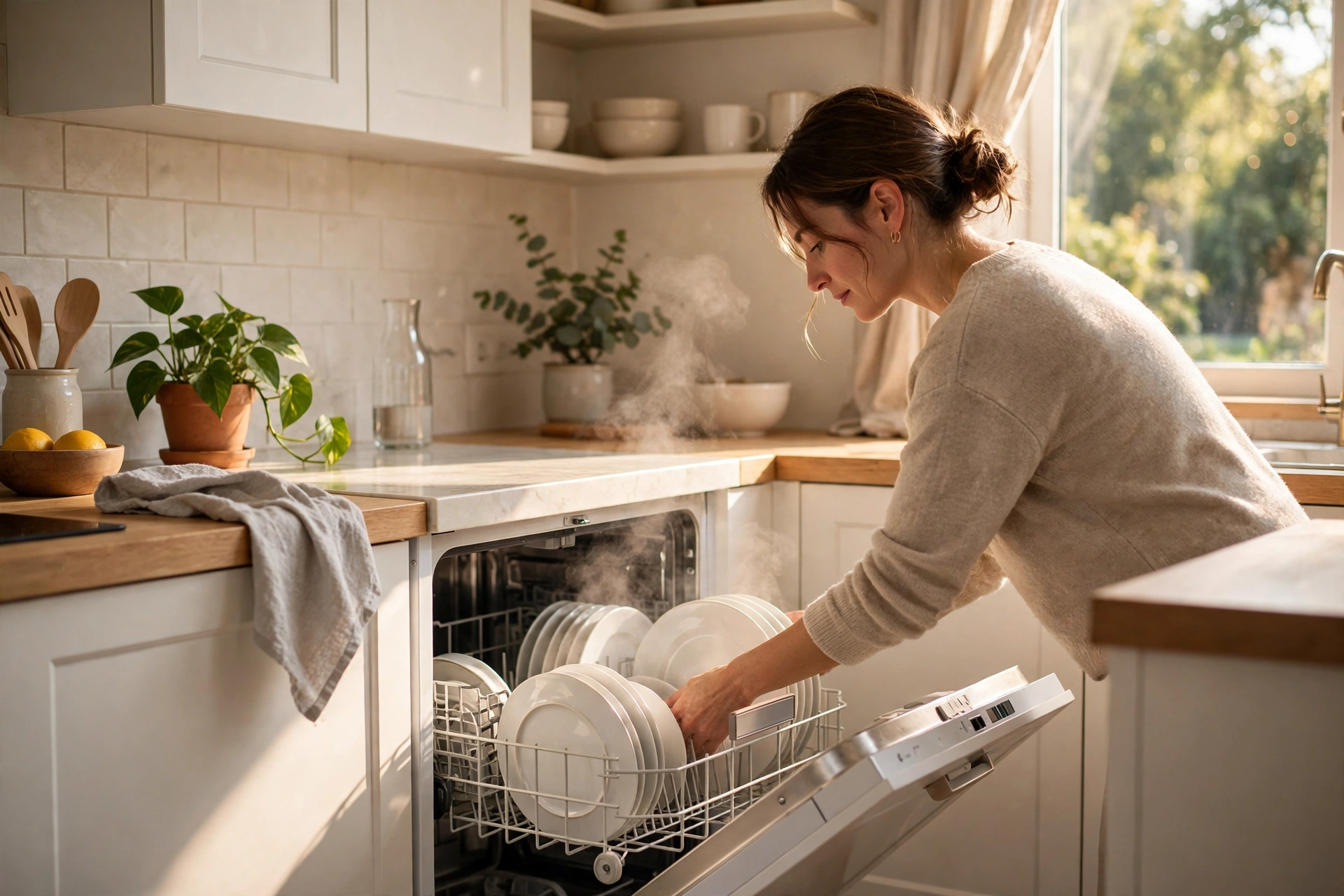
Then her husband opened a white box under the kitchen counter, pulled out two racks, and started sliding the dirty plates into the slots. He tucked the bowls in at an angle, put the glasses upside down on the top rack, and dropped the cutlery into a little basket. He closed the door, pressed a button, and the machine gave a quiet hum. Sara sat down with a cup of tea while the machine did the work.
An hour later, he opened the door. Steam floated out. The plates were clean. The glasses were shining. The sticky pot was clean too. Sara did not have to stand at the sink at all.
That white box is a dishwasher, and it looks like magic from the outside. But inside, there is no magic. There is hot water, a pump, two spinning arms, a little soap, and a simple cycle that repeats until everything is clean.
The Big Idea: It Sprays, It Does Not Scrub
When you wash a plate by hand, you scrub it. You take a sponge, you press it against the plate, and you rub until the food comes off. A dishwasher cannot do that. It has no hands, no sponge, and nothing inside it rubs a plate. So it solves the problem in a different way.
It sprays. It takes a small amount of water, heats it up, mixes it with detergent, and blasts it at the dishes from every side. The spray is strong, much stronger than the water from your tap. The dishes sit still in the racks, and the spray arms spin around them, so the water hits every plate, every bowl, and every glass from above and below.
Think of it like a heavy rainstorm, but inside a box. Rain does not scrub a roof. It hits the roof again and again, and the dirt slowly washes away. A dishwasher works the same way, only the rain is hot, soapy, and aimed very carefully. The heat loosens the grease. The detergent breaks the grease into tiny pieces that float away in the water. The pressure of the spray knocks the stuck bits of food loose.
Meet the Main Parts
Before we walk through the cycle step by step, it helps to meet the parts inside the box. There are not many, and each one has a clear job.
The first part is the tub, the big box itself. It is made of steel or tough plastic, and it holds the water, the racks, and the dishes. It has a door that seals tight so the hot spray stays inside and does not flood your kitchen floor.
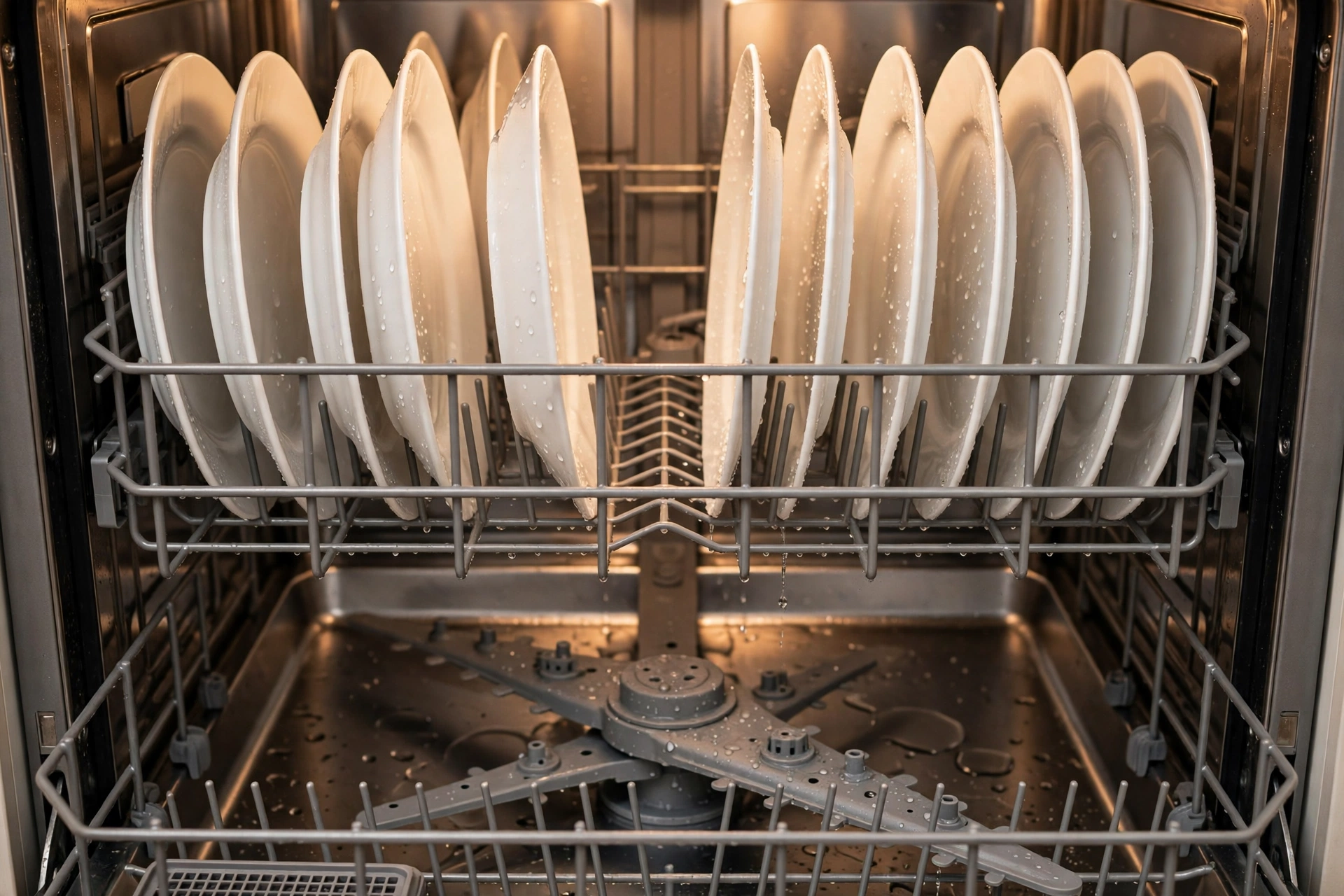
The second part is the racks, two sliding shelves, one on top and one below. The bottom rack holds the big, heavy things, like plates, pots, and pans. The top rack holds the lighter things, like glasses, cups, and small bowls. A small basket holds the forks, knives, and spoons.
The third part is the spray arms. There are usually two, one under the bottom rack and one under the top rack. Each one is a long flat bar with small holes along it, and it spins around like a slow windmill. The holes are angled, so when water rushes out of them, the push of the water turns the arm around.
The fourth part is the pump. It is the muscle of the machine. It pushes the water from the bottom of the tub up through the spray arms with real force. Without the pump, the water would just sit at the bottom and nothing would get clean. The fifth part is the heating element, a metal ring at the bottom of the tub, a bit like the heating element in a kettle. It heats the water and helps dry the dishes at the end. A filter at the bottom catches food bits so they do not get sprayed back onto clean plates.
Step One: Fill With a Little Water
When you press the button, the machine does something surprising. It does not fill up like a bath. It lets in only a small amount of water, just a few litres, enough to cover the bottom of the tub. The water comes in through a valve at the back, and it sits in a shallow pool at the bottom.
This small amount is part of the cleverness. A dishwasher does not need a full tub of water because it uses the same water again and again. It sprays it up, it falls back down, the pump picks it up, and it sprays it again. One small pool of water can be sprayed hundreds of times in a single wash. That is one reason a dishwasher can use less water than washing by hand, where the tap runs the whole time and most of the water goes straight down the drain. Once the water is in, the heating element warms it up to about 50 to 75 degrees, far hotter than your hands could bear in the sink. Hot water melts grease the way warm water melts butter, and that heat is doing real work.
Step Two: The Wash Cycle
Now the real work begins. Detergent drops into the water from a small door inside the machine, and the pump switches on. It pushes the hot, soapy water up through the spray arms, and the arms spin and spray the dishes from every side.
This is the loudest part of the cycle, and if you listen close to the door, you can hear it. It sounds like a steady shushing noise, like rain on a window. The arms turn slowly, and the jets of water hit the plates at different angles as they pass. A plate that is hit from below one moment is hit from above the next. The food softens, the grease lifts, and the water carries it all down to the bottom of the tub.
The water is filtered as it falls back down. The food bits that come off the plates get caught in the filter, so the pump does not spray them back up onto the dishes. Then the clean water is pumped up again. This goes on for twenty or thirty minutes, round after round, until the plates are clean. The machine is patient in a way a person at the sink is not. It does not get bored, it does not rush, and it does not stop early because its hands are cold.
The detergent matters here too. It is not the same soap you use for your hands. Dishwasher detergent is made to work in very hot water, and it has chemicals that break grease into tiny pieces and stop it from sticking back onto the plates. That is why you should never put washing-up liquid in a dishwasher. Washing-up liquid makes huge clouds of foam, and foam stops the spray arms from turning properly. The machine would fill with bubbles and leak foam all over the floor.
Step Three: Drain and Rinse
When the wash cycle is finished, the machine does something simple. It drains the dirty water away. A second pump, or the same pump running in reverse, pushes the soapy water out through a hose and into the drain under your sink. The food bits in the filter stay behind, and you can pull the filter out and rinse it under the tap every few weeks.
Then the machine fills again, this time with fresh water, and runs a rinse cycle. This water has no detergent in it. Its job is to wash away the soap and the last bits of grease from the wash cycle. The spray arms spin again, the clean water washes over every dish, and then it drains away too. Some machines rinse twice, to be sure nothing soapy is left behind. This rinse is why your dishes do not taste of soap when they come out.
The rinse is also where rinse aid comes in. Rinse aid is a small amount of liquid that the machine adds during the final rinse. It changes the way water behaves on a plate. Without it, water sits on a glass in little drops, and when those drops dry, they leave spots behind. With rinse aid, the water spreads out into a thin sheet and runs off the glass, so there are no drops left to dry into spots. If your glasses often come out cloudy or spotty, the first thing to check is whether the rinse aid compartment is empty.
Step Four: The Dry Cycle
After the last rinse, the dishes are clean, but they are wet. This is where the drying cycle comes in, and it works with heat, not with a towel.
The heating element at the bottom of the tub warms up again, and the air inside the machine gets hot. The dishes themselves are hot too, because they have just been rinsed with very hot water. Hot plates dry themselves, in a way. The thin film of water on a hot plate turns into steam and floats away. The steam then cools on the cooler walls of the tub and runs down to the bottom, away from the dishes.
Some machines add a small fan that blows the warm, damp air out of the machine and pulls in drier air from the kitchen. Others simply open the door a little at the end of the cycle to let the steam out. Either way, the result is the same. When the machine beeps and you open the door, most of the dishes are dry, and the ones that are not dry only need a quick wipe.
Plastic things are the exception, and it is worth knowing why. Plastic does not hold heat the way ceramic or glass does. A plate stays hot after the rinse, so the water on it dries fast. A plastic container cools down quickly, so the water on it stays as drops. That is why plastic lunch boxes often come out of a dishwasher still wet, even when everything else is dry. It is not a fault in the machine. It is just how plastic behaves.
The heat at the end also has a second job. It helps kill germs. Water at 70 degrees is hot enough to kill most of the germs that live on dirty plates, which is another reason the hot wash matters. A hand wash in lukewarm water with a sponge can leave germs behind, especially on a sponge that has been sitting damp by the sink for days. The dishwasher washes at a temperature your hands could never stand.
Why a Full Load Uses Less Water
Many people believe that a dishwasher wastes water. It sounds wasteful, a big machine running for an hour just to wash plates. But the numbers tell a different story, and the story depends on one thing, whether the machine is full.
A modern dishwasher uses roughly 10 to 15 litres of water for a full load, because it fills with a small amount and reuses it again and again through the cycle. Washing the same pile of dishes by hand under a running tap can use far more, because the tap keeps running while you scrub, rinse, and scrub again. A tap can pour out 6 to 10 litres every minute. If you wash for ten minutes with the tap running, you have already used more water than a whole dishwasher cycle.
The catch is the word full. Running a dishwasher half empty wastes the advantage. The machine uses almost the same amount of water and power whether it has six plates in it or sixty. So the smart habit is to wait until the racks are full, or at least mostly full, before pressing the button. If you live alone and it takes two days to fill the machine, that is fine. Dirty plates can sit in there with the door shut until there are enough to make the cycle worth it.
This is also why the eco cycle exists. The eco cycle uses cooler water and a longer wash, and it uses less water and power than the normal cycle. It takes more time, sometimes two hours or more, but it does the same job with less. If you are not in a hurry, the eco cycle is the kindest choice for the water bill and the power bill.
The Woman Who Was Tired of Chipped Plates
The dishwasher has a surprising history, and it starts with a woman who was tired of her servants chipping her best china. Her name was Josephine Cochran, and she lived in Illinois in the United States in the 1800s. She loved hosting dinner parties, and she owned beautiful hand-painted china. But after every party, the servants washed the dishes by hand, and every now and then a plate would chip or break.
Josephine decided she could build a better way. She had never built a machine before, but she had an idea and she would not let it go. She designed a machine with wire compartments that held the plates in place, and a wheel that turned the compartments while hot, soapy water sprayed over them. She filed a patent for it in 1886, and it was the first practical automatic dishwasher.
At first, her machine was too big and too costly for a normal home. It was bought by hotels and restaurants, places that washed hundreds of plates a day. For many years, the dishwasher was a machine for businesses, not for kitchens. It only became a common home appliance in the middle of the 1900s, when smaller and cheaper models were made. But the idea never changed. Josephine’s machine sprayed the dishes instead of scrubbing them, and every dishwasher since has done the same thing.
How to Load It Well
A dishwasher is a helpful machine, but it is not clever about how you load it. It washes whatever it can reach, and it misses whatever is hidden.
First, scrape the food off, but do not rinse the plates first. This sounds strange, but it is true. Modern detergent needs a little grease and food to work on, and a plate that is already rinsed clean can come out with a cloudy film because the detergent has nothing to grab. Scrape the big bits into the bin, then put the plate in. Let the machine do the rest.
Second, face the dirty side towards the spray. Plates go in the slots with the dirty side facing the middle, where the spray arm spins. Bowls go in at an angle, so the water can get inside them and drain out again. If a bowl sits flat, water pools in the bottom of it and it never drains, so it comes out full of dirty water.
Third, do not block the spray arms. Before you close the door, give the arms a quick spin with your hand. If a long knife handle or a big pan stops the arm from turning, move it. An arm that cannot turn cannot spray, and the dishes on that side will stay dirty. The how a microwave oven works guide explains another kitchen machine that also depends on the food sitting in the right place, and the dishwasher is no different in that way.
Fourth, keep the sharp things and the wooden things out. Sharp knives can damage the racks and can cut your hand when you unload. Wooden spoons and wooden chopping boards can crack and warp in the very hot water, so wash those by hand. The same goes for anything with gold trim, hand-painted designs, or thin plastic that is not marked dishwasher safe. When in doubt, wash it by hand.
Not the Same as a Washing Machine
People sometimes mix up a dishwasher and a washing machine because both are boxes that wash things with hot water and soap. But they do very different jobs, and it helps to keep them separate in your mind.
A washing machine washes clothes. It tumbles them around in a drum, soaking and spinning them so the soap can work through the fabric. A dishwasher washes dishes. It never tumbles anything. It holds the dishes still and sprays them. Put a shirt in a dishwasher and it would not get clean, because the spray cannot wash fabric the way tumbling can. Put a plate in a washing machine and it would break. Each machine was built for one job, and it does that job well. The same is true of the other machines in your home. A fridge keeps food cold. A microwave oven heats food fast with waves of energy. A hair dryer blows hot air to dry your hair. Each one has its own trick, and the dishwasher’s trick is simple and honest. Hot water, strong spray, and patience, repeated until the plates are clean.

Frequently Asked Questions
Does a dishwasher really clean better than washing by hand?
Yes, in most cases it does, because it washes with water far hotter than your hands can bear. Hot water melts grease and kills more germs than lukewarm water at the sink. It also rinses with fresh hot water and dries with heat, so the dishes come out cleaner and drier than a hand wash usually manages.
Why do my dishes sometimes come out still dirty?
The most common reason is loading. If a plate is hidden behind a big bowl, the spray cannot reach it, and it will stay dirty. It can also happen if the spray arm is blocked, the filter is clogged with food, or the detergent door did not open. Check the arms spin freely and clean the filter every few weeks.
Should I rinse my plates before putting them in the dishwasher?
No, you should only scrape the big bits of food off. Modern detergent works best when it has a little grease and food to work on, and a plate that is already rinsed can come out with a cloudy film. Let the machine do the washing. That is its job.
Why do my glasses come out with white spots?
White spots usually mean the rinse aid is empty or your water is hard, which means it has a lot of minerals in it. Rinse aid helps the water run off the glass in a thin sheet instead of drying in drops. Fill the rinse aid compartment, and the spots should fade away.
Is it safe to put wooden spoons in the dishwasher?
No, it is best to wash wooden things by hand. The very hot water and the long drying heat can crack wood, split it, and make it rough over time. The same goes for sharp knives, gold-trimmed china, and anything that is not marked dishwasher safe. Wash those by hand and they will last longer.
Who invented the first dishwasher?
Josephine Cochran invented the first practical automatic dishwasher in 1886. She built it because her servants kept chipping her beautiful china when they washed it by hand. Her machine held the plates in wire compartments and sprayed them with hot, soapy water, the same idea every dishwasher still uses today.
More from Zorium Daily
- How Does a Microwave Oven Work?
- How Does a Hair Dryer Work?
- How Does a Remote Control Work?
- How Does a Lift Work?
The next time you slide a dirty plate into the rack and press the button, you will know what is happening behind that closed door. A little water is heating up, a pump is pushing it through spinning arms, hot spray is knocking the food loose, and the same water is being used again and again until the plates are clean. Then comes the rinse, then the heat, and the door opens to steam and shining glasses. No scrubbing, no sponge, no tired hands. Just hot water, a clever spray, and a machine that does the work while you sit down with a cup of tea. That is how a dishwasher works, and it all began with a woman who was tired of chipped plates.