

How Does an Air Conditioner Work? Explained Simply
SUMMARY OF THIS ARTICLE
- An air conditioner does not make cold. It moves heat out of a room, just like a fridge moves heat out of a food box.
- A cold liquid called refrigerant soaks up heat inside, turns into a gas, gets squeezed by a compressor, and cools back into a liquid outside.
- The outdoor box feels hot because that is where the heat from your room is being let go.
- An air conditioner also dries the air, which is why a cooled room feels less sticky and more comfortable.
- Closing doors and windows, keeping the filter clean, and picking the right size all help an air conditioner work better and use less power.
A Hot Afternoon That Needed an Answer
It was one of those afternoons when the air felt thick. Maya came home from school, dropped her bag by the door, and stood in front of the fan for a whole minute. The fan moved the air around, but the air itself was still warm. Her shirt stuck to her back. The kitchen felt like an oven. Her mother was wiping the table with a damp cloth, and the cloth dried in seconds.
Then her father pressed a small button on a white box on the wall. A soft hum started. A flap opened. Cool air floated down into the room like a quiet river. Within ten minutes, the room felt different. Maya could think again. She could sit down and do her homework without fanning herself with a notebook.
That white box is an air conditioner, and most of us use one without ever asking how it works. We know it makes a room cool. We know the outdoor box gets hot. We know the bill goes up in summer. But the clever part is hidden inside the pipes and coils, and it is much simpler than it sounds.
The Big Idea: It Moves Heat, It Does Not Make Cold
Think of heat like water in a bucket. If you want the bucket empty, you do not need to destroy the water. You just need to carry it somewhere else and pour it out. An air conditioner does the same thing with heat. It picks up heat from the air inside your room and pours it out into the air outside your house.
This is why the outdoor part of an air conditioner feels hot. Stand next to it on a summer day and you will feel warm air blowing out of it. That warm air is the heat that used to be in your living room. The machine has moved it from inside to outside, the way you might carry a hot tray out of a kitchen and put it down in the garden.
A fridge works the same way, and that is the easiest comparison to keep in mind. A fridge does not fill itself with cold. It pulls heat out of the milk and the vegetables and lets that heat out at the back, which is why the back of a fridge feels warm. An air conditioner is like a fridge, but for a whole room instead of a small box. It pulls heat out of a much bigger space, so it needs bigger coils, a stronger pump, and a fan to push the cooled air around.
Meet the Four Main Parts
Before we walk through the loop step by step, it helps to meet the four main parts of the machine. You do not need to remember long technical names. You just need to know what each part does, because each one has one clear job.
The first part is the evaporator. That is a cold coil that sits inside your room, hidden in the indoor unit on the wall. Warm room air blows across this cold coil, and the coil takes the heat out of the air. The air that comes back into the room is cooler than before.
The second part is the compressor. Think of it as the heart of the machine, or a strong pump. It squeezes the gas that comes from the evaporator and pushes it along to the next part. Squeezing makes the gas hotter and puts it under high pressure, which is exactly what the next step needs.
The third part is the condenser. That is a coil that sits outside, in the outdoor box. Its job is the opposite of the evaporator. It lets heat go. Hot gas flows through it, a fan blows outdoor air across it, and the heat escapes into the outside air. As the heat leaves, the gas cools down and turns back into a liquid.
The fourth part is a small valve, often called the expansion valve. It is tiny, but it does a big job. It lets the liquid through in a careful, controlled way and drops its pressure suddenly. When the pressure drops, the liquid gets very cold again, ready to soak up more heat. Then the loop begins again.
Step One: The Cold Coil Soaks Up Heat
Let us follow one drop of the special liquid, called refrigerant, as it travels around the loop. The journey starts at the indoor coil, the evaporator, where the liquid is very cold.
Warm air from your room is pulled in by a fan and blown across this cold coil. Now, heat always moves from a warm place to a cold place, the way warmth from a hot cup moves into your hands. So the heat in the room air moves into the cold coil and into the refrigerant inside it. The air, now cooler, is blown back into the room through the flap on the front of the indoor unit.
As the refrigerant soaks up heat, something interesting happens. It warms up and changes from a liquid into a gas, the way water turns into steam when it gets hot.
This is the step that cools your room. Every time warm air passes over the cold coil, a little more heat is taken away. Do it again and again, and the whole room slowly cools down. It does not happen in one second. It happens bit by bit, pass by pass, until the air feels fresh and light.
Step Two: The Compressor Squeezes the Gas
Now the refrigerant has left the indoor coil as a cool gas, carrying the heat it picked up from your room. It travels through a copper pipe to the outdoor unit, where it meets the compressor.
The compressor is a strong pump, and its job is to squeeze. It takes the gas and presses it into a much smaller space. When you squeeze a gas, two things happen. Its pressure goes up, and its temperature goes up too.
Why make the gas hotter? That sounds strange when the whole goal is cooling. The reason is simple and clever. Heat only flows from a hot place to a cooler place. The air outside your house on a summer day might be 35 degrees, which is hot. If the gas were only 30 degrees, its heat would not flow out into 35-degree air. It would be like trying to pour water uphill. So the compressor heats the gas up to a temperature higher than the outdoor air, often 50 or 60 degrees. Now the heat has somewhere to go. It can flow out of the very hot gas into the merely hot outdoor air.
Step Three: The Outdoor Box Lets the Heat Go
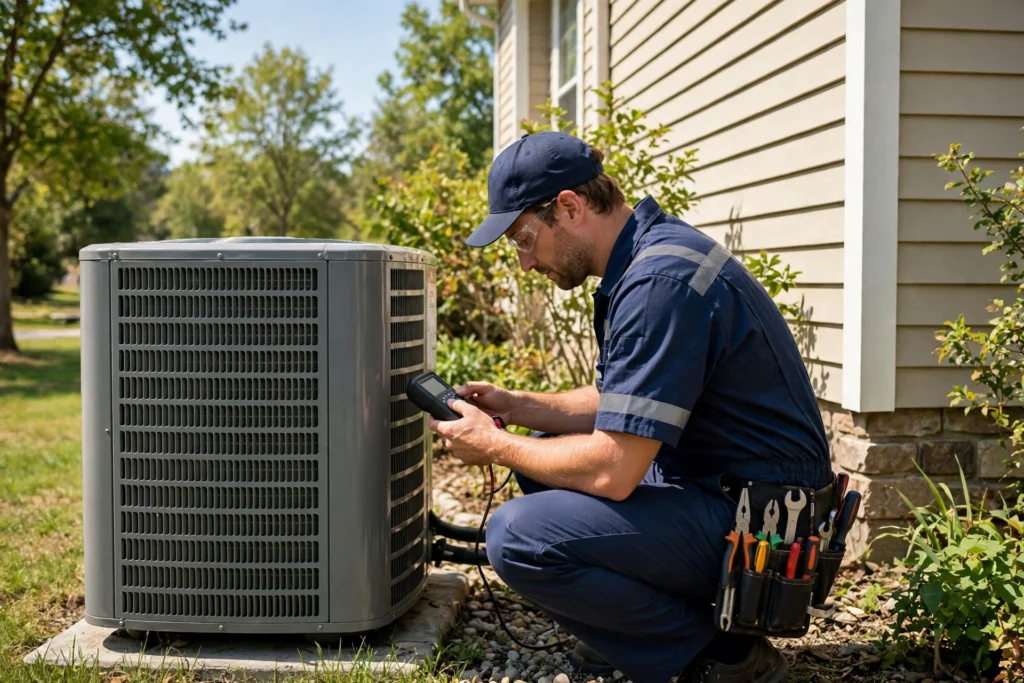
The hot, squeezed gas now flows into the condenser coil in the outdoor unit. This coil is a long, winding tube with thin metal fins around it, a bit like the radiator at the front of a car. A big fan blows outdoor air across these fins.
Here the opposite of step one happens. The gas is hotter than the air around it, so its heat flows out into the outdoor air. The fan helps by carrying that warm air away and bringing in fresh outdoor air, so the coil can keep letting heat go. If you stand near the outdoor unit, you will feel this warm air blowing out. On a hot day it can feel like standing in front of a hair dryer.
As the gas loses its heat, it cools down and changes back into a liquid. This is the reverse of what happened indoors. Indoors, the liquid turned into a gas by soaking up heat. Outdoors, the gas turns back into a liquid by giving heat away. The refrigerant itself is not used up. It is the same liquid going around and around, changing shape, carrying heat from one place to another.
Step Four: The Loop Starts Again
The refrigerant is now a warm liquid again, but it is still under high pressure. It cannot go straight back into the indoor coil like this. It needs to become cold again first, and that is where the small expansion valve comes in.
The valve is a narrow opening between the outdoor coil and the indoor coil. The warm liquid is pushed through this tiny gap, and on the other side the pressure drops suddenly. When the pressure drops, the liquid cools down fast, much like the cold feeling you get when you spray a can and the gas rushes out. The liquid becomes very cold, ready to soak up heat once more.
Now the cold liquid flows back into the indoor coil, and the whole loop repeats. Cold liquid soaks up heat indoors and turns to gas. The compressor squeezes the gas and makes it hotter. The outdoor coil lets the heat go and the gas turns back to liquid. The valve drops the pressure and makes the liquid cold again. Round and round it goes, hundreds of times an hour, as long as the machine is running.
The thermostat is the small brain that watches over this loop. You set it to a temperature, say 24 degrees, and a sensor in the room keeps checking the air. When the room is warmer than 24, the machine keeps running. When the room reaches 24, the machine slows down or rests. This stop and start, or slow down and speed up, is what keeps your room near the temperature you chose without wasting power all day.
Why the Air Also Feels Less Sticky
Cooling is only half the story. The other half is drying, and it matters more than most people think. On a humid day, the air feels heavy and sticky even when it is not that hot. Your skin feels damp. Your clothes cling. A fan does not help much, because the air it moves is still full of water vapour.
An air conditioner helps here too, and it does so without any extra effort. Remember the cold indoor coil. When warm, damp air touches that cold coil, the water vapour in the air turns into tiny drops of water on the coil, just like drops form on a cold bottle taken out of a fridge. Those drops drip off the coil into a small tray and run away through a drain pipe to the outside. Every drop that leaves is water that is no longer floating in your room air.
That is why a cooled room feels fresh in a way that a fanned room does not. The air is not only cooler, it is drier.
This drying is also the reason the first modern air conditioner was built at all. In 1902, a young engineer named Willis Carrier was asked to solve a problem at a printing plant in New York. The paper in the plant kept swelling and shrinking as the humidity changed, and the ink would not sit properly on the damp paper. The printed pages came out blurred and uneven. Carrier did not set out to cool people down. He set out to control the humidity in the air so the paper would behave. His machine cooled the air and pulled the water out of it, and the printing improved. People working there felt better too, and within a few years cinemas, shops, offices, and then homes began to use it. The printing plant problem gave the world the air conditioner.
Why Closing the Door Really Matters
Rahim is a schoolteacher, and his classroom has one air conditioner. On hot days, the children crowd in after lunch, red-faced and thirsty. One day, the door kept swinging open because a chair was in the way, and the room never seemed to get cool. The machine hummed and hummed, but the air stayed warm. Rahim moved the chair, closed the door, and shut the windows. Within fifteen minutes, the room felt cool, and the children settled down to their books.
The lesson is simple. An air conditioner cools the air in one room, not the whole world. Every time you open a door or a window, warm air rushes in from outside, and cool air slips out. The machine then has to cool that new warm air too, and it never catches up. It is like trying to fill a bucket that has a hole in it. You can pour water in all day, but the bucket never fills.
Closing doors and windows is not a small tip. It is the main thing that decides whether the machine works well or struggles. It also decides the electricity bill. A machine that cools a closed room reaches its target temperature and rests. A machine that cools an open room runs and runs without ever resting, and the meter keeps spinning.
If you use an air conditioner in a car, the same rule holds. On a summer drive, the car AC works best when the windows are up. Open a window at speed and the cool air rushes out in seconds. The how a remote control works guide explains another small household device the same plain way, but the AC in a car follows the same heat-moving loop, just in a smaller box built for a small space.
Bigger Is Not Always Better
When people buy an air conditioner, many of them think a bigger one must be better. A bigger machine cools faster, they reason, so it must be the right choice. That sounds sensible, but it is a mistake, and it is a common one.
A machine that is too big for a room cools the air very fast, but it stops before it has had time to dry the air properly. Remember, the drying happens while air passes over the cold coil over time. If the machine blasts cold air for five minutes and then switches off because the air is already cold, the room ends up cold but still damp and sticky. You feel chilly and clammy at the same time, which is not comfortable at all.
A machine that is too big also switches on and off far too often. Each start uses a burst of power, and the constant stopping and starting wears the parts out faster. It is like a car that only ever drives in short bursts in heavy traffic, stopping and starting every few seconds. The engine never settles into a smooth run, and it wears out sooner.
The right size is the size that matches the room. A small bedroom needs a small unit. A large living room with big windows and many people needs a bigger one. The number of people matters too, because each person gives off heat, like a small heater. So does a room full of computers or a kitchen with a hot stove. A good installer will ask about the size of the room, how many windows it has, which way the sun faces, and how many people use it. That is not small talk. Those answers decide the right size.
How to Use Your AC Well
You do not need to be an engineer to use an air conditioner well. A few simple habits make a real difference to comfort and to the bill.
First, pick a sensible temperature. Many people set the machine to 18 degrees because they want the room cold fast. But a lower setting does not cool the room faster. The machine works at the same speed either way. It just keeps going longer to reach a colder target, and it uses more power to do it. A setting around 24 to 26 degrees is comfortable for most people, especially once the air is dry.
Second, use the fan. A gentle fan spreads the cool air around the room so there are no hot corners. A ceiling fan on a low speed can help too, and it lets you set the AC a degree or two higher without feeling warmer. Moving air on your skin helps sweat dry, which is part of how your body cools itself.
Third, keep the filter clean. The filter is a thin screen that catches dust before the air reaches the coil. When it gets clogged with dust, less air can pass through, the coil gets too cold, and the machine works harder for less cooling. Most filters slide out easily and can be washed gently with water and dried in the shade. Doing this every few weeks in summer is one of the easiest ways to keep the machine healthy.
Fourth, give the outdoor unit room to breathe. Keep plants, boxes, and rubbish away from it. If it sits in direct sun all day, a little shade above it can help, but never cover it tightly, because the hot air needs a clear path out. If it starts rattling, or the indoor unit drips water inside the room, call a technician early. The same patient habit helps with other home machines too: learning how a vacuum cleaner works shows how a clean filter and clear airflow keep a simple machine doing its job well.

Frequently Asked Questions
Does an air conditioner make cold air?
No, it does not make cold from nothing. It moves heat out of your room and lets it go outside. A cold liquid inside the machine soaks up heat from the room air, turns into a gas, and carries that heat to the outdoor unit. The air left behind feels cold because its heat has been taken away.
Why is the outdoor unit hot?
The outdoor unit is hot because that is where your room’s heat ends up. The compressor squeezes the gas and makes it hotter than the outside air, so the heat can flow out through the outdoor coil. A fan then blows that warm air away from the house, which is why standing near the unit feels like standing in front of a heater.
Who invented the modern air conditioner?
Willis Carrier built the first modern air conditioning system in 1902. He was asked to fix a problem at a printing plant in New York, where changing humidity made the paper swell and the ink print badly. His machine cooled the air and pulled water out of it, and the workers soon noticed the cooled air felt wonderful on hot days.
Why does my room still feel sticky with the AC on?
A room can feel sticky if the machine is too big for it, because it cools the air fast and switches off before it has dried the air properly. It can also happen if a door or window is open and damp outdoor air keeps flowing in. Try closing the room fully, setting the temperature near 25 degrees, and letting the machine run in longer stretches.
What temperature should I set my air conditioner to?
A setting between 24 and 26 degrees suits most people, once the air is dry. Setting it to 18 degrees does not cool the room any faster, because the machine works at the same speed either way. It only makes the machine run longer and use more power, so a sensible setting keeps you comfortable and keeps the bill lower.
Does a bigger air conditioner cool a room better?
Not always, and often it cools worse in the way that matters. A unit that is too big cools the air quickly but stops before it has dried the air, leaving the room cold yet clammy. It also switches on and off too often, which wastes power and wears out the parts. The best choice is the size that matches the room.
More from Zorium Daily
- How Does a Vacuum Cleaner Work?
- How Does a Microwave Oven Work?
- How Does a Remote Control Work?
- How Does a Lift Work?
The next time you press that small button on the wall and cool air floats down into the room, you will know what is happening behind the quiet hum. A cold coil is soaking up heat, a pump is squeezing gas, an outdoor box is letting that heat go, and the same liquid is going around again for another trip. It is a simple loop, running hundreds of times an hour, and it all began with a printing plant that needed dry paper.