How Does a Lift Work? Explained Simply
SUMMARY OF THIS ARTICLE
- A lift is a metal box that rides up and down inside a tall shaft, pulled by steel cables that run over a wheel at the top of the building.
- A heavy counterweight hangs on the other end of the cables and balances the car, so the motor only has to move the difference in weight between the two sides.
- The motor turns a grooved wheel called a traction sheave, and friction between the wheel and the cables drags the car up or down.
- Safety brakes and a speed governor watch the car all the time. If it ever moves too fast, the brakes grip the rails and stop it safely.
- Some short buildings use a different kind of lift: a hydraulic lift, where a piston filled with oil pushes the car up from below, with no cables at all.
The Box That Climbs the Building
Picture a Saturday morning in a shopping mall. You walk in, the lift doors slide open with a soft ding, and you step inside and press the button for the third floor. Ten seconds later, the doors open again, and you walk out with your shopping bags. It feels so normal that you barely think about it.
But stop and think for a second. A heavy metal box, full of people, just climbed three floors into the air and came back down, smooth as butter. What is holding the box up? What stops it from falling?
The short answer is that a lift is a clever team of simple parts working together. There is a box, called the car. There are steel cables. There is a heavy block called a counterweight. There is a motor at the top, and a set of safety brakes that never sleep. Each part has one job, and together they make the whole thing feel like magic.
Four Parts That Do All the Work
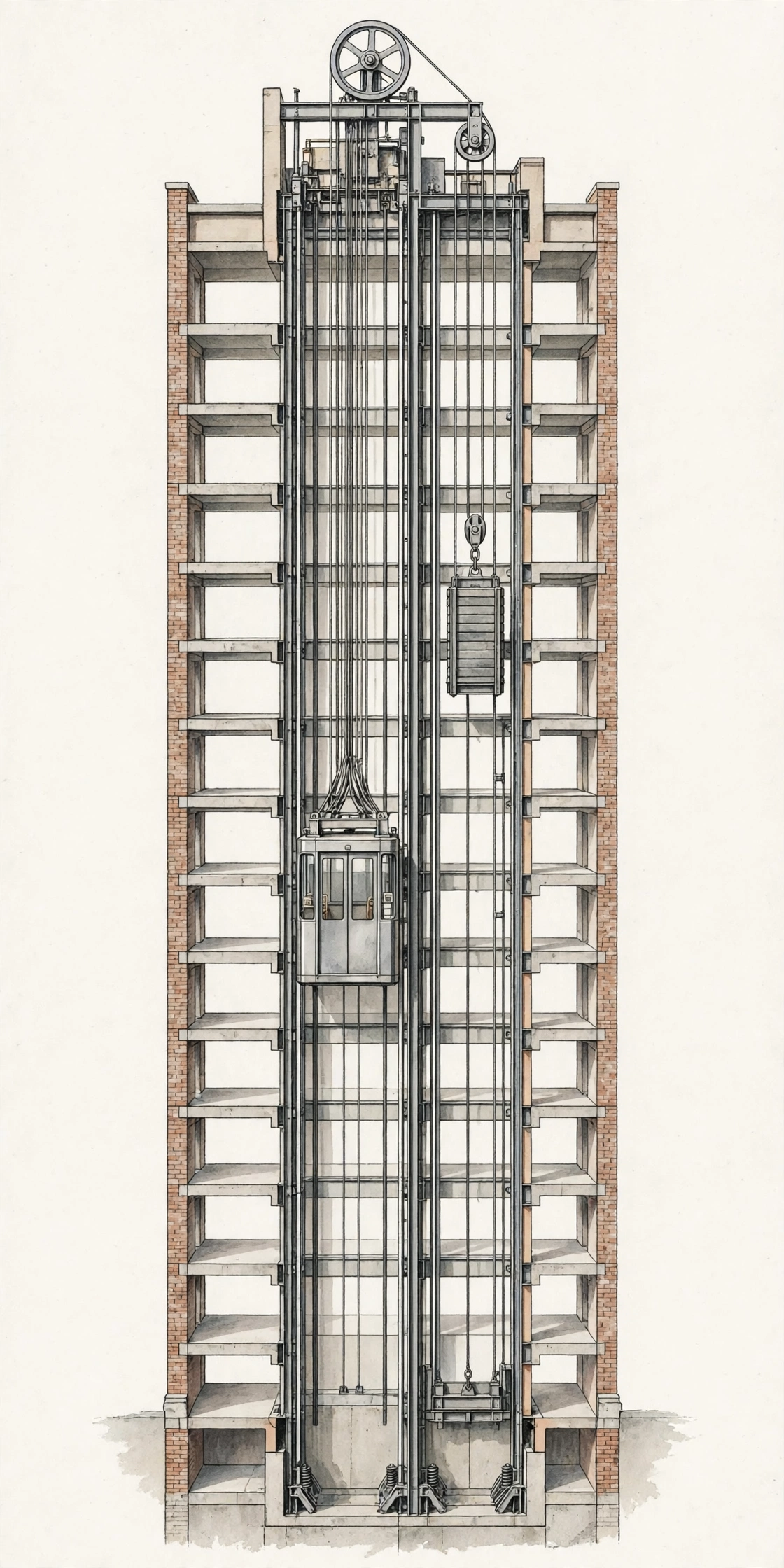
A modern lift looks simple from the inside. You see the doors, the buttons, the mirror, and the little screen that shows the floor numbers going up. Behind those walls, though, the lift travels inside a tall empty space called a shaft, which runs from the bottom of the building to the top, like a chimney. The car slides up and down inside that shaft on two steel rails, which keep it from swinging or wobbling.
Four main parts do almost all the work. The first is the car itself, the box you ride in. The second is a set of strong steel cables, usually four to eight of them, that hold the car from above. The third is the counterweight, a stack of heavy iron plates that hangs on the other end of those same cables. The fourth is the motor, which sits at the top of the shaft and turns a grooved wheel that the cables rest on. A small computer takes your button press and turns it into a smooth ride, and safety devices watch everything and step in if anything goes wrong.
Most lifts in tall buildings work this way, and they are called traction lifts, because the motor pulls the car by gripping the cables. Traction is just a fancy word for grip, like a car tyre gripping the road.
The See-Saw Secret: The Counterweight
Here is the cleverest part of the whole machine, and it starts with a playground memory. Remember a see-saw? When two children of about the same weight sit on opposite ends, the see-saw balances, and a tiny push is enough to send either side up or down. But when one child is much heavier than the other, the light child has to push with all their strength just to get off the ground.
A lift works on the same idea. The car hangs on one end of the cables, and the counterweight hangs on the other end, like the two ends of a see-saw. When the car goes up, the counterweight goes down. When the car goes down, the counterweight goes up. They always move in opposite directions, by exactly the same distance.
Now, here is the smart part. The counterweight is not made to match a full car. It weighs about the same as the empty car plus roughly half of the heaviest load the lift is allowed to carry. Engineers usually pick a number between 40 and 50 percent of the maximum load, because a lift is almost never completely full.
Why does this matter? Because of what gravity is — the pull that drags everything down toward the ground. Without a counterweight, the motor would have to fight gravity all by itself, lifting the full weight of the car and everyone inside it, every single trip. That would need a huge motor and a lot of electricity.
With the counterweight in place, the motor barely has to lift anything at all. Most of the time, the two sides are nearly balanced, and the motor only has to move the small difference in weight, plus a little extra to overcome friction. Sometimes, when the car is nearly empty and going up, the counterweight is actually the heavier side, and the motor’s job is mostly to hold back, like a brake, so the car does not rise too fast.
The Motor at the Top
So where is the motor, and what does it actually do? In most tall buildings, the motor lives in a small room at the very top of the shaft, called the machine room. Some newer lifts hide the motor inside the shaft itself, but the job is the same either way.
The motor is connected to a wheel with grooves cut into its edge, called a traction sheave. The steel cables lie in those grooves, with the car hanging on one side and the counterweight on the other. The cables are not wound around the wheel like thread on a spool. They simply rest in the grooves, and the weight pulling down on both sides presses them hard into the metal. When the motor turns the wheel, friction drags the cables along, and the car moves.
The motor also controls the speed. It starts gently, speeds up in the middle of the trip, and then slows down softly as the car nears the right floor. That smooth start and stop is why you do not feel thrown around when the lift moves. Inside the motor’s control box, electronic parts adjust the power hundreds of times a second, like a driver gently pressing and releasing a car’s accelerator.
Steel Cables: Stronger Than They Look
If you have ever held a steel cable in your hand, you know it does not look like much. It is about as thick as your finger, grey, and a little rough to the touch. But inside, it is made of many thin steel wires twisted together into strands, and those strands twisted together again into one rope. That twisting is what makes it so strong. A single wire can snap, but the rest of the strands keep holding.
A lift never hangs from just one cable. There are usually between four and eight cables, all sharing the load, and each one alone is strong enough to hold the whole car. Safety rules demand that together they can hold at least twelve times the weight they actually carry, so even if one cable failed completely, the others would still hold the car.
The cables also last a long time because they are checked regularly. Lift engineers inspect them for broken wires, wear, and rust, and they replace them long before they become a problem. A lift that is looked after properly is one of the safest machines you will ever ride in.
How the Lift Knows Where to Stop
Pressing a button looks simple. You press 7, and the lift takes you to the seventh floor. But how does it know when to stop, and how does it stop so exactly that the floor of the car lines up with the floor of the building?
The answer is a small computer called the controller, plus a set of sensors in the shaft. When you press a button, the controller remembers your floor and plans the trip. It tells the motor when to start, how fast to go, and when to slow down. As the car moves, sensors on the car read markers at each floor, like a train driver reading signs along the track. When the car reaches your floor, the controller tells the motor to stop, and a brake holds the car exactly in place.
The doors have their own clever system too. When the car arrives, the controller checks that the car is level with the floor, then tells the doors to open. If the car is even slightly off, the doors stay shut until it is fixed. That is why the floor of a lift almost always lines up perfectly with the hallway outside. It is not luck. It is measurement.
The controller also decides which lift to send when you press the call button in the hallway. In a building with several lifts, it picks the one that is closest, or the one that is already heading your way. It is a bit like the tiny computer that keeps a drone steady in the air, always measuring, always adjusting, always making small corrections so the ride feels smooth.
The Man Who Cut the Rope
Lifts existed long before the modern one. People used ropes and pulleys to haul goods up and down for hundreds of years. But nobody wanted to ride in one: if the rope broke, the platform fell, and anyone on it fell with it. Lifts were for boxes and barrels, not for people.
That changed because of one brave American inventor named Elisha Otis. In 1852, Otis was working in a factory in Yonkers, New York, and he was worried about the hoist that carried heavy equipment between floors. He designed a simple safety device: a spring that held two metal hooks back while the rope was tight, but pushed them out into a toothed rail on the sides of the shaft the moment the rope went slack. If the rope broke, the hooks would bite into the rail and stop the platform from falling.
It was a clever idea, but nobody was buying it. So in May 1854, Otis decided to show the world himself. At the Crystal Palace Exhibition in New York City, a great fair of new inventions, he stood on an open platform high above a crowd and ordered his assistant to cut the rope with an axe. The crowd gasped. The platform dropped a few inches. Then the safety hooks caught, and it stopped dead. Otis looked down at the crowd and said, “All safe, gentlemen, all safe.”
It was one of the most famous demonstrations in the history of engineering, and it worked. Orders started coming in. In 1857, Otis installed the first passenger lift with his safety device in a five-storey shop in New York, the E. V. Haughwout store on Broadway. Tall buildings only make sense if people can reach the top floors easily, and Otis’s safety brake made that possible.
The 1850s were a time when new machines were changing everyday life. Cars were still decades away — you can read about who invented the first car — but cities were already growing upward, and Otis gave them a way to climb.
The Governor: A Watchdog That Never Sleeps
Otis’s hooks were the great-grandfather of today’s safety brakes, but modern lifts have a smarter watchdog: a device called the overspeed governor. It sits at the top of the shaft, and it has one job, which is to notice if the car is moving too fast and stop it.
The governor is a small wheel with a thin rope of its own, fixed to the car, running up around the governor wheel and back down to a weight at the bottom of the shaft. As the car moves, it drags the rope around, so the governor wheel spins at a speed that matches the car’s exactly, like a speedometer made of rope and wheels.
Inside the governor wheel are two small weights held in by a spring. When the wheel spins faster, the weights are flung outward by the same force that pushes you to the side of a car when it turns a corner quickly. At normal speed, the spring holds them in. But if the car starts moving too fast, usually at about 115 percent of its normal top speed, the weights fly out far enough to trip a switch. That switch cuts the power to the motor and applies the motor’s brake.
If the car somehow keeps speeding up after that, the weights fly out further and lock the governor wheel in place. The governor rope then stops moving, and because the car is still moving, the rope pulls a lever on the car. That lever triggers the safety brakes, which clamp onto the steel guide rails on the sides of the shaft and bring the car to a firm stop.
What If a Cable Breaks?
This is the question almost everyone asks, and it is a fair one. You are standing in a metal box hanging by cables, high above the ground. What happens if a cable breaks?
The honest answer is: almost nothing. First, remember that a lift has several cables, and each one alone is strong enough to hold the car. If one cable broke, the others would keep holding it, and the lift would probably just stop and wait for an engineer. You might not even notice.
Second, even if every cable broke at once, which has almost never happened in a modern lift, the safety brakes would catch the car. The governor would sense the car speeding up, trip, and the brakes would clamp onto the guide rails. This is the direct descendant of the hooks Elisha Otis showed the crowd in 1854.
Third, the brakes are designed to fail safe. That is a strange phrase, but it means they are held open by electricity, and springs push them shut. So if the power goes out, the springs win, and the brakes close. The lift is designed so that losing power makes it safer, not more dangerous. It stops where it is and waits.
This is why lift accidents are so rare. A lift is not one safety device but layers of them: cables, then the governor, then the safety brakes, then buffers at the bottom of the shaft, big springs or oil cushions that soften the landing if a car ever reached the bottom. Every layer is built to work on its own.
The Other Kind: Hydraulic Lifts
Not every lift hangs from cables. In short buildings, two to six floors high, you will often find a different kind called a hydraulic lift. It works in a completely different way, and it is worth knowing about, because you have probably ridden in one without realising it.
A hydraulic lift has no cables and no counterweight. Instead, a strong piston sits under the car, inside a cylinder filled with oil. When the lift needs to go up, a pump pushes oil into the cylinder, and the oil pushes the piston up, lifting the car. When it needs to go down, a valve opens, the oil flows slowly back out, and the car sinks gently under its own weight.
Hydraulic lifts are simple, sturdy, and good at carrying very heavy loads, which is why you often see them in hospitals, car parks, and goods lifts. They are also smooth and quiet. Their weakness is height. The piston has to be as long as the distance the lift travels, so a hydraulic lift cannot climb very far. That is why tall buildings always use traction lifts with cables, and short buildings often use hydraulic ones.
Why the Doors Open Again
Anyone who rides lifts has seen it happen. The doors start to close, someone hurries in, and the doors slide open again. Or a bag gets caught, and the doors bounce back. It feels like the lift is being polite, but it is actually a safety system doing its job.
Lift doors have sensors. Older lifts used a rubber edge that felt pressure. If the closing door touched something, the edge squeezed, and the doors opened again. Modern lifts mostly use light beams. A row of invisible beams shines across the doorway, from one side to the other. If anything breaks a beam — a hand, a bag, a child running in — the lift knows the doorway is not clear, and it opens the doors again.
Some lifts also have a weight sensor in the floor. If the car is carrying more than it is allowed to carry, it will not move. A buzzer sounds, a light comes on, and the doors stay open until someone steps out.
These door sensors work a bit like the sensors that tell a traffic light when cars are waiting at a crossing. They watch, they measure, and they change what the machine does. The lift’s controller listens to them all the time, and it will not start a trip until the doors are fully closed and the doorway is clear.
What Happens in a Power Cut?
Lifts and power cuts are a classic worry. You are riding up to the tenth floor, the lights flicker, and everything stops. What now?
First, do not panic. The lift is designed for this. When the power goes, the motor stops, and the brakes, which are held open by electricity, snap shut on their springs. The car stops where it is and stays there. It does not fall. It cannot fall, because the brakes are gripping the rails and the cables are still holding it.
Second, you are not in the dark. Every lift has a small emergency battery that powers an alarm bell and a dim emergency light. Press the alarm button, and it will ring in the building, or connect you to a phone line or speaker so you can talk to someone outside. Most modern lifts also have an emergency phone or an intercom built into the panel.
Third, help is coming. In many buildings, a rescue battery moves the car slowly to the nearest floor and opens the doors when the power fails. This is called automatic rescue. If that does not happen, a trained engineer will come and lower the lift by hand until the car reaches a floor.
Never try to force the doors open yourself, or climb out of a lift stuck between floors. A lift that stops between floors is safe to wait in. The danger is in climbing out, because the car could move. Sit tight, press the alarm, and wait. Engineers do this every day, and they will get you out.
Frequently Asked Questions
What holds a lift up?
Steel cables hold the car, and a heavy counterweight on the other end balances most of its weight. A motor turns a grooved wheel, and friction drags the cables along to move the car up or down.
What is a counterweight, in simple words?
It is a stack of heavy iron plates that hangs on the other end of the cables from the car. It weighs about the same as the empty car plus roughly half of the heaviest load the lift can carry.
What happens if a lift cable breaks?
Almost nothing. A lift has several cables, and each one alone can hold the car. If all of them broke, which almost never happens, the safety brakes would grip the rails and stop the car.
Who invented the safe lift?
Elisha Otis, an American inventor. In 1854, at the Crystal Palace Exhibition in New York, he stood on a platform, had the rope cut, and his safety brake stopped the fall. He said, “All safe, gentlemen, all safe.”
What is the difference between a traction lift and a hydraulic lift?
A traction lift hangs from cables and uses a motor and counterweight, and it suits tall buildings. A hydraulic lift is pushed up from below by an oil-filled piston, with no cables, and it suits short buildings.
Is it safe to wait inside a lift during a power cut?
Yes. The brakes close by themselves when the power goes, so the car cannot fall. Press the alarm button, use the emergency light and phone, and wait for help. Never try to climb out yourself.
More from Zorium Daily
- What Is Gravity and Why Do Things Fall Down?
- Who Invented the First Car?
- How Does a Traffic Light Work?
- How Does a Drone Fly?
The next time you step into a lift and press a button, you will know what is happening behind the walls. A counterweight is quietly balancing your weight, a motor is tipping that balance one way or the other, and a governor is watching your speed, ready to stop the car if anything goes wrong. It all began with a simple idea from a playground see-saw, proved by a brave man with an axe in 1854.