How Does a Remote Control Work? Explained Simply
SUMMARY OF THIS ARTICLE
- A TV remote talks to your television with invisible infrared light, flashing a different secret pattern of light for every button you press.
- Your eyes cannot see infrared light, but the small sensor on the front of the TV can, and it reads each flash pattern like a short message.
- The pattern works a bit like Morse code: quick flashes and pauses that spell out “turn up the volume” or “go to channel five.”
- You have to point the remote at the TV because light travels in a straight line and cannot pass through solid things like walls, cushions, or people.
- Newer remotes use radio waves or Bluetooth instead of light, so they work even from another room, and your phone can act as a remote too.
The Little Clicker That Runs Your Evening
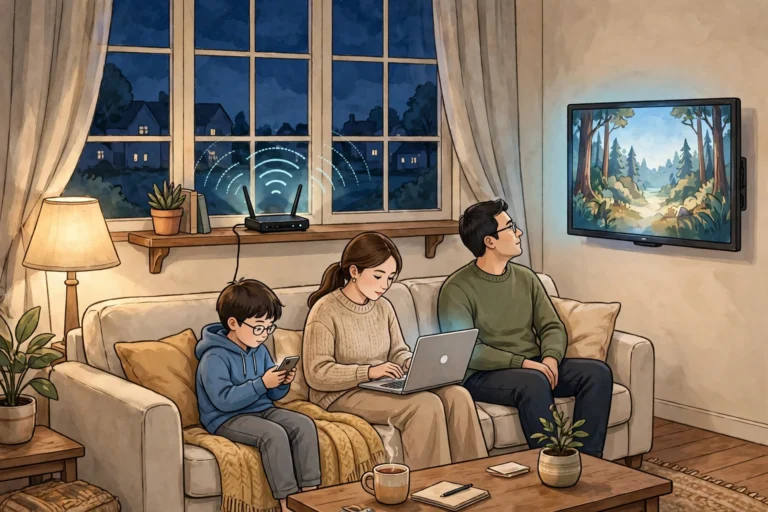
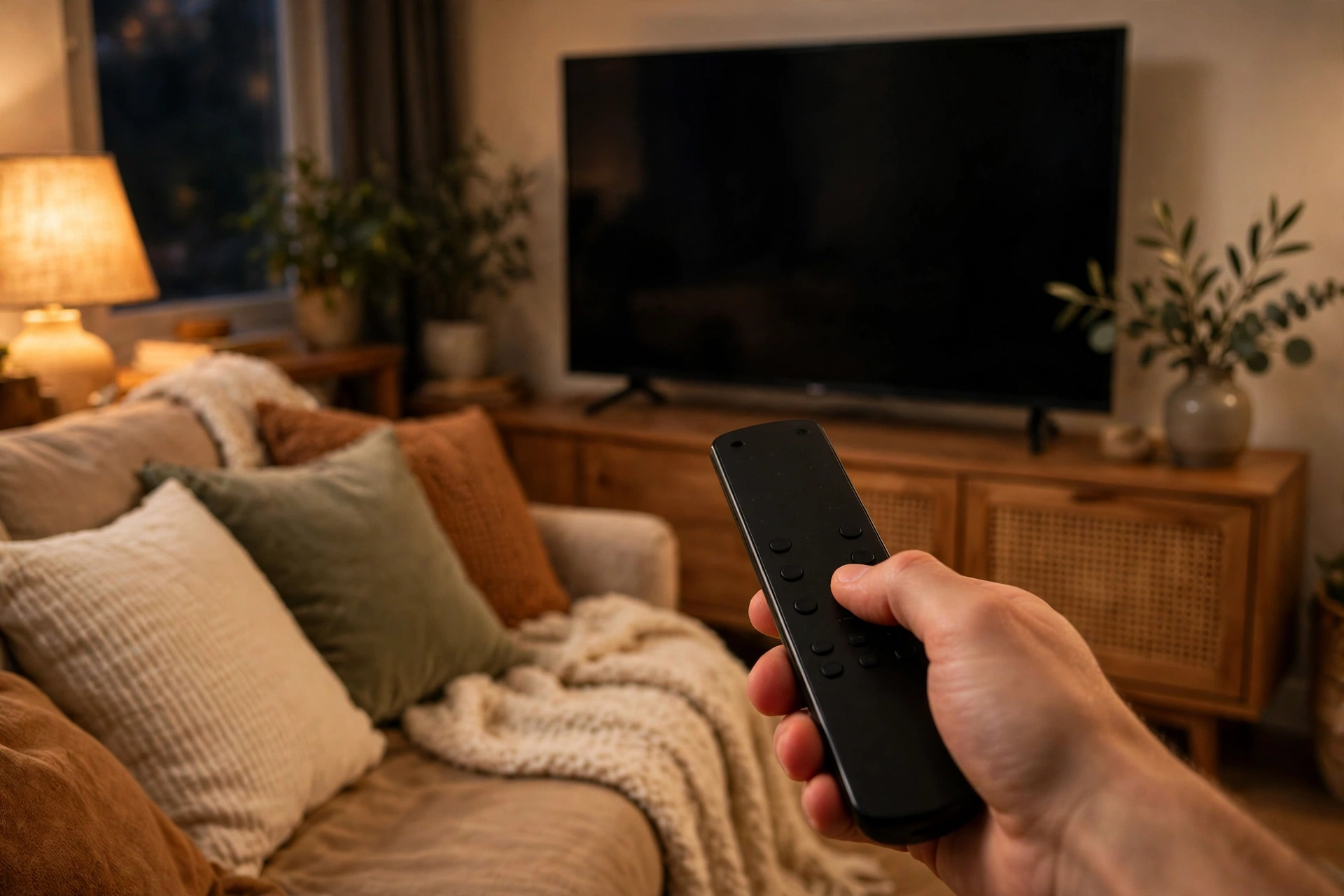
Think about your evening. You sink into the sofa and reach for that small black rectangle on the coffee table. Click. The TV wakes up. Click, click. The volume goes up a little. Click. The channel changes. You never get up, and you never touch the TV itself.
Most homes have several of these little clickers: one for the TV, one for the sound bar, maybe one for the air conditioner. In short, your remote is a tiny flashlight that flashes in a secret code, and your TV listens for that code with a special eye.
The Short Answer: It Talks in Invisible Light
Here is the whole secret in one sentence: when you press a button, your remote flashes a beam of invisible light in a special pattern, and a sensor on the TV reads that pattern and turns it into an action.
Most TV remotes use a type of light called infrared light. It sits just beyond the red end of the rainbow, outside the range our eyes can see. So when you press a button, the little bulb at the front of the remote is flashing away like crazy — but to you, it looks completely dark.
The TV has a small dark window on its front, usually near the bottom edge. Behind that window sits a sensor, a tiny electronic eye that is very good at spotting infrared light. When the flashes hit that sensor, the TV’s brain reads the pattern the way you might read a row of dots and dashes. Each button sends a different pattern, so the TV always knows which button you pressed.
That is why the same remote can turn the volume up, change the channel, open the menu, and switch the TV off. It is not sending different kinds of light. It is sending the same kind of light, arranged in different patterns, like words made from the same letters.
What Is Infrared Light, Anyway?
Light is a kind of energy that travels in waves, and our eyes can only see a small slice of it. That slice is what we call visible light, the colours of the rainbow: red, orange, yellow, green, blue, and violet.
But there is light on both sides of that slice that our eyes cannot pick up. Beyond violet sits ultraviolet light, the kind that gives you sunburn. Beyond red sits infrared light, which we feel as heat. A campfire, a warm oven, and even your own body all give it off.
A TV remote uses a special kind of bulb called an infrared LED. The one in your remote is built to give off infrared light, usually at a wavelength of about 940 nanometres — just past the red end of what our eyes can catch.
Because the light is invisible, the remote can flash it as much as it likes without bothering anyone in the room. No bright light. No noise. And the little LED is so cheap and uses so little power that a pair of batteries can run a remote for months.
Every Button Has Its Own Secret Code
Flashing a light is one thing. Flashing it in a way that means something is another. This is where the remote gets clever.
Inside every remote sits a tiny computer chip, smaller than your fingernail. When you press a button, it looks up that button in a little list stored in its memory, and it turns the matching code into a pattern of flashes.
Think of it like a language with only two letters: flash and pause. String enough flashes and pauses together in the right order, and you get a message. Change the order, and you get a different message.
Engineers have agreed on a few standard ways of writing these messages, called protocols. One of the most common is the NEC protocol, named after the company that first used it. In this system, every message starts with a long opening flash, then comes a string of short flashes and pauses. A short pause means zero, a long pause means one, and those zeros and ones say which device the message is for and which button was pressed.
The beauty of this system is that it is hard to get mixed up. Your TV remote’s code for “volume up” is different from the code for “channel down.” That is why pressing your remote does not change the channel on the TV next door. Engineers use the same trick of coded signals in other everyday machines, too. A lift knows which floor to stop at because its buttons send a coded message to the motor, and a traffic light changes colour on a careful timed pattern so drivers know when to stop and when to go.
How the TV Listens and Understands
The TV is not just sitting there hoping to catch a flash of light. It has a dedicated listener, a small part called an infrared receiver, tucked behind that dark window on the front of the set.
This receiver is tuned to listen for one very specific kind of flashing, because the world is full of infrared light. Sunlight is packed with it, and so is a hot lamp. If the TV reacted to all of it, it would change channels every time the Sun came out from behind a cloud.
So engineers gave the signal a kind of fingerprint. The remote does not just flash its LED on and off. It flickers it incredibly fast — about 38,000 times every second — while it sends its message. That rapid flicker is called the carrier frequency, and the TV’s receiver notices only light that flickers at exactly that speed. Steady light from the Sun or a lamp does not, so the receiver ignores it.
Once the receiver catches the right flicker, it turns the pattern back into an electrical signal and hands it to the TV’s main computer, which looks up the code, finds the matching command, and acts on it. All of this happens in a tiny fraction of a second, so to you it feels instant. You press, and the TV obeys.
Why You Have to Point It at the TV
Here is the part everyone has lived through. You are lying on the sofa, half asleep, and you press the volume button without lifting the remote properly. Nothing happens. You sit up, point the remote at the TV, and click — and suddenly it works.
The reason is simple: light travels in a straight line. It cannot bend around corners, and it cannot pass through solid things. Your remote is sending a beam of light, and that beam has to reach the sensor on the front of the TV. If a cushion, a blanket, a book, or your own leg is in the way, the beam stops there, and the TV never hears a thing.
This is called line of sight, and it is the biggest weakness of the infrared remote. You do not have to aim perfectly — the beam spreads out a little as it travels, and it can bounce off a pale wall or ceiling and still reach the TV — but you do have to give it a clear path.
Try It Yourself: See the Invisible Flash
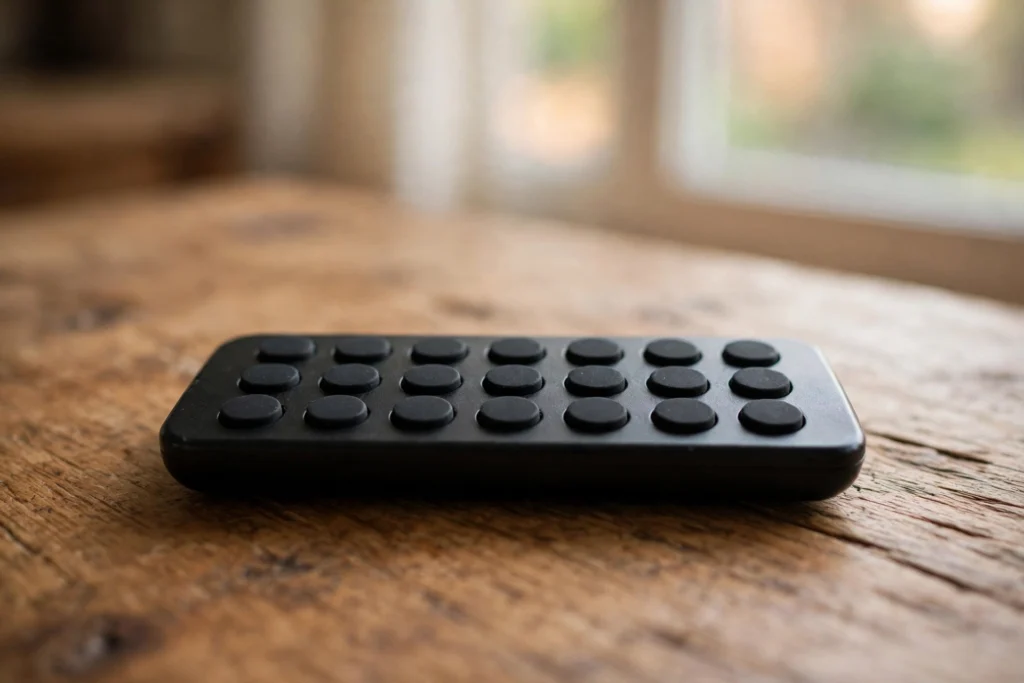
Here is a trick you can try at home right now, and it is genuinely fun. Take your TV remote and your phone. Open the camera app on your phone and point the front end of the remote at the camera lens. Now press and hold any button on the remote and watch the phone screen.
You should see the little LED at the tip of the remote glowing or flashing — usually a pale purple or white light. Your eyes cannot see it, but your phone camera can, because its sensor is sensitive to infrared light in a way your eyes are not.
This trick also works as a quick way to check whether a remote is working: if you press a button and see nothing, the batteries are probably flat.
One small warning: the trick does not work on every phone. Some newer phones have a stronger filter over their camera that blocks infrared light, so you may see nothing even when the remote is fine. If it does not work on your main camera, try the front-facing selfie camera — it often has a weaker filter.
Why Sunlight and Other Things Can Confuse It
Sunlight is the remote’s oldest enemy. The Sun pours out huge amounts of infrared light, and on a bright day that light can flood the TV’s sensor and wash out the small signal from your remote — like trying to hear a whisper next to a jet engine.
Most of the time, none of this matters. Modern receivers are good at filtering out the noise, and a normal living room is a friendly place for a remote. But if your remote only misbehaves on sunny afternoons, or only when a certain lamp is on, now you know why. Close the curtains, switch off the lamp, or just take one step to the side, and the problem usually disappears.
When the Remote Stops Working
Sooner or later, every remote stops working. You press the button and nothing happens. Before you decide it is broken, run through the usual suspects, because the fix is almost always simple.
First, check the batteries. A remote uses very little power, which is why a pair of batteries can last for months or even a year. But when they run low, the LED gets dimmer and its beam gets weaker, until one day the signal can no longer reach the TV. Fresh batteries fix this nine times out of ten.
Second, check for a blockage. Is something sitting in front of the TV’s sensor? A photo frame, a game console, a stack of books? Move it aside and try again. Also wipe the little LED on the front of the remote — dust over it can dim the beam.
Third, check the TV itself. Try pressing the buttons on the TV. If those work, the TV is fine and the remote is the suspect. One last tip: if a single button stops working while the others are fine, the rubber pad under it may be worn out. Pressing it firmly sometimes brings it back to life.
The First Remotes: A Wire, a Flashlight, and a Little Hammer
The remote control was not always the smooth plastic slab we know today. In the early days of television, changing the channel meant getting up and turning a stiff dial by hand.
The first TV remote appeared in 1950. It was made by an American company called Zenith, and it was called the Lazy Bones. The name was a joke: the whole point was to save lazy viewers the walk to the TV. But the Lazy Bones was not wireless at all. It was connected to the TV by a long cable that snaked across the living-room floor. People tripped over it, and dogs chewed it.
Zenith knew there had to be a better way, and in 1955 one of their engineers, Eugene Polley, came up with it. His invention was called the Flash-Matic, and it was the first wireless TV remote in the world. It worked like a flashlight. The TV had four light-sensitive cells, one in each corner of the screen, and the remote was a small torch you pointed at one of them. It was clever, and people loved it — but it had a flaw. Sunlight hitting the TV could trigger the cells by itself, so on bright days the channels sometimes changed on their own.
A year later, in 1956, another Zenith engineer, Robert Adler, solved the sunlight problem with a completely different idea. His remote, called the Space Command, used sound instead of light. Inside it were four tiny metal rods, and pressing a button struck one of them like a little hammer hitting a tuning fork. Each rod rang at a different note, too high for human ears to hear, and a microphone in the TV listened for the notes.
The infrared remote we use today came later, in the 1980s, and it beat both earlier designs. Light was cheap, the codes were precise, and sunlight could be filtered out. Within a few years, nearly every TV came with one. Polley and Adler were later honoured with an Emmy Award in 1997 for their pioneering work on the wireless remote.
Remotes That Do Not Need to Point: Radio and Bluetooth
Not every modern remote uses infrared light. If you have a newer smart TV, a streaming stick, or a games console, your remote may use radio waves instead — often Bluetooth, the same wireless link that connects headphones to a phone.
Radio waves behave very differently from light. They can pass through walls, cushions, and people, and they do not need a clear line of sight. That is why you can change the channel from the kitchen, or with the remote tucked under a blanket, and the TV still answers. It is the same kind of radio link that lets a drone fly high above its pilot and still take orders from the ground.
Bluetooth remotes can also carry voice commands: press the microphone button, say “find a comedy film,” and the remote sends your words to the TV.
There is a trade-off, though. Radio remotes use more power, so their batteries run down faster. They also need to be paired with the TV the first time you use them, a little like introducing two people who need to recognise each other. If the pairing is lost — after a power cut, for example — you may have to pair them again.
One Remote for Everything
If your living room has a TV, a sound bar, a streaming box, and a DVD player, you may have four remotes piled up on the coffee table — and you can never find the right one. That pile is the reason universal remotes exist.
A universal remote is a single remote that can pretend to be many different remotes. Inside its memory it stores the codes of thousands of devices, from hundreds of brands. When you set it up, you tell it which TV and sound bar you own, either by typing in a short code or by letting it search through its list until the TV responds. After that, it knows which pattern of flashes to send for each device.
Some universal remotes go further. They have a learning mode: you point your old remote at them, press a button, and they copy the pattern. It is like teaching a parrot a new word. A few minutes of pointing and pressing, and the universal remote has learned every button on the original.
Your Phone as a Remote
These days, the remote in your pocket may already be a remote for your TV. Most smart TVs have a companion app, made by the TV’s manufacturer, that turns your phone into a remote control. It connects to the TV over your home Wi-Fi network, and the app shows a set of on-screen buttons that work just like the real thing.
It is handy in an emergency — the night the remote’s batteries die and the shops are shut. It also has tricks a plastic remote cannot match: you can type a long film title on your phone’s keyboard instead of pecking at letters with arrow keys, and you can browse the TV guide on your phone while the show keeps playing.
There are limits. The phone and the TV must be on the same Wi-Fi network, so it will not work at a friend’s house unless you join their Wi-Fi first. And if your home internet goes down, the app may stop working too.
What the Future Holds
So what comes next for the remote control? The honest answer is that the little plastic clicker is slowly disappearing, and in some homes it already has.
Voice control is the biggest change: smart speakers and TVs with built-in microphones let you change the channel just by speaking. Gesture control is another idea — wave your hand, and a camera on the TV reads the movement. Some televisions can even follow your eyes, pausing a show when you look away.
But the remote has survived every prediction of its death so far. Pressing a button is fast, quiet, and private. It works in the dark, and it never misunderstands you the way a voice assistant sometimes does.
The most likely future is a mix. Your TV may answer to your voice when your hands are full, to your phone when the remote is lost, and to the old clicker the rest of the time. But the basic idea will stay the same: you press, something listens, and the TV obeys.

Frequently Asked Questions
How does a remote control work?
A remote control sends invisible infrared light in a coded pattern to your TV. When you press a button, a tiny chip inside the remote turns that button into a pattern of quick flashes, and a small LED at the front flashes the pattern across the room. A sensor on the TV reads the flashes, works out which button you pressed, and carries out the command.
Why do I have to point the remote at the TV?
You have to point the remote at the TV because infrared light travels in a straight line and cannot pass through solid objects. The beam from the remote must reach the small sensor on the front of the TV. If a cushion, a book, or a person blocks the path, the signal never arrives. You do not need perfect aim, but you do need a clear path.
Can I see the infrared light from a remote?
Not with your eyes, because infrared light sits just outside the range of colours humans can see. But you can see it with a phone camera. Open the camera app, point the front of the remote at the lens, press a button, and you should see the little LED glowing purple or white on the screen. Some newer phones filter infrared out, so try the front camera.
Why does my remote stop working sometimes?
The most common reason is flat batteries. A weak battery makes the LED dimmer, so its beam can no longer reach the TV, and the first sign is often that you have to point the remote more carefully or press buttons twice. Other causes are something blocking the TV’s sensor, dirt over the LED, or bright sunlight swamping the signal. Fresh batteries and a clear line of sight fix the problem most of the time.
What is the difference between an infrared remote and a Bluetooth remote?
An infrared remote sends its signal as flashes of invisible light, so it needs a clear line of sight to the TV and cannot work through walls. A Bluetooth remote sends its signal as radio waves, which pass through walls and cushions, so you do not need to point it at all. Bluetooth remotes can also carry voice control, but they use more battery power and need to be paired with the TV first.
Who invented the first TV remote control?
The first TV remote was the Lazy Bones, made by Zenith in 1950, but it was connected to the TV by a long cable. The first wireless remote was the Flash-Matic, invented by Zenith engineer Eugene Polley in 1955. It worked like a flashlight, shining a beam at light-sensitive cells on the TV. A year later, Robert Adler invented the Space Command, which used high-pitched sound instead of light. The infrared remote we use today came in the 1980s.
More from Zorium Daily
- How Does a Lift Work? Explained Simply
- How Does a Traffic Light Work?
- How Does a Drone Fly?
- What Is Gravity and Why Do Things Fall Down?
It is a small thing, the remote control, and most of us never give it a second thought. But the next time you press a button and the TV answers from across the room, remember what is happening: a secret code, written in light you cannot see, flying across your living room faster than you can blink.