How Does a Hair Dryer Work? Explained Simply
SUMMARY OF THIS ARTICLE
- A hair dryer does three jobs at once: a small fan pulls in cool room air, a coiled wire called nichrome heats that air, and the hot moving air carries the water off your wet hair as vapour.
- Heat alone is not enough. A hot wire sitting still would only warm the air around it, so the fan has to keep the air moving past the wire and out onto your hair.
- Wet hair dries because the hot air gives the water energy to turn into vapour, and the moving air then sweeps that vapour away before it can settle back down.
- A safety cut-off switch stops the dryer from overheating if the air vent gets blocked, and the cool-shot button blows cool air to set your style in place.
- The first hair dryers were heavy boxes with a tube and a bonnet that sat on your head, nothing like the small handheld dryer most of us hold today.
The Morning Rush
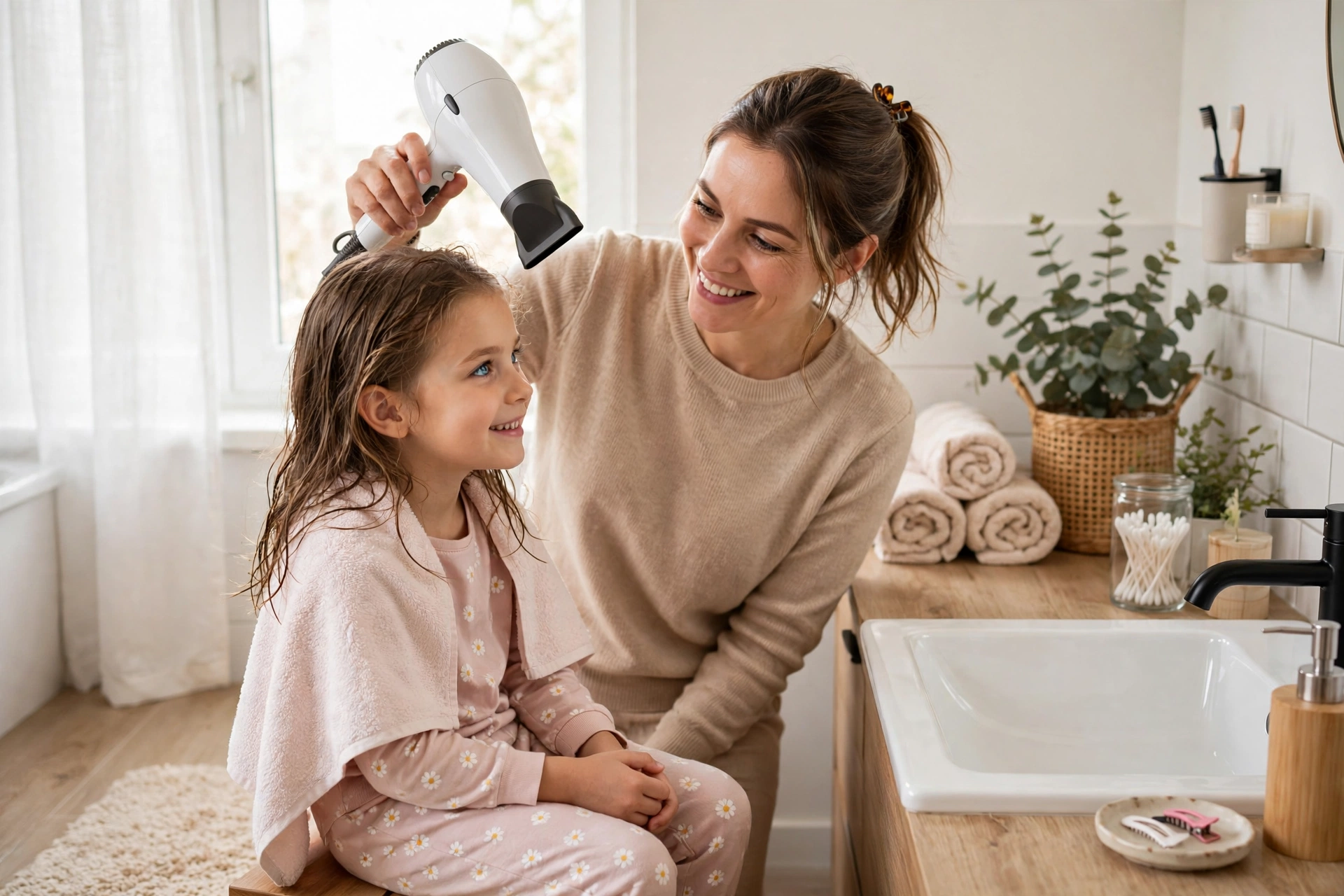
It is seven in the morning, and Sara has just stepped out of the shower. Her hair is dripping wet, the bathroom mirror is fogged up, and she has a bus to catch in twenty minutes. She wraps a towel around her hair for a moment, then picks up the small white machine on the shelf, plugs it in, and presses the button. The dryer hums, warm air rushes out, and she moves it slowly back and forth over her head. Within a few minutes her hair is dry, soft, and ready to brush. She switches the dryer off, hangs it back on its hook, and runs for the bus.
A small machine that fits in one hand pulls in ordinary room air, heats it up in a second, and blows it out hot enough to dry a whole head of wet hair in minutes. How does it do that The answer is simpler than you might think, and it comes down to three parts working together.
The Short Answer: Three Jobs in One Small Machine
Here is the whole idea in one sentence: a hair dryer is a fan, a heater, and a blower packed into one small case, and it dries your hair by blowing hot air over it so the water turns into vapour and floats away.
That is really all there is to it, but each of those three jobs matters, and if any one of them stopped, the dryer would stop working. The fan pulls in cool air from the room. The heater warms that air as it rushes past. The moving air carries the heat to your hair, picks up the water, and carries it away.
The moving air does the real work, and that is the idea this article keeps coming back to. Take away the heater, and you would have a small fan blowing cold air at wet hair, which would take forever. Once you see it, you will never look at your dryer in quite the same way again.
Job One: The Fan Pulls In Room Air
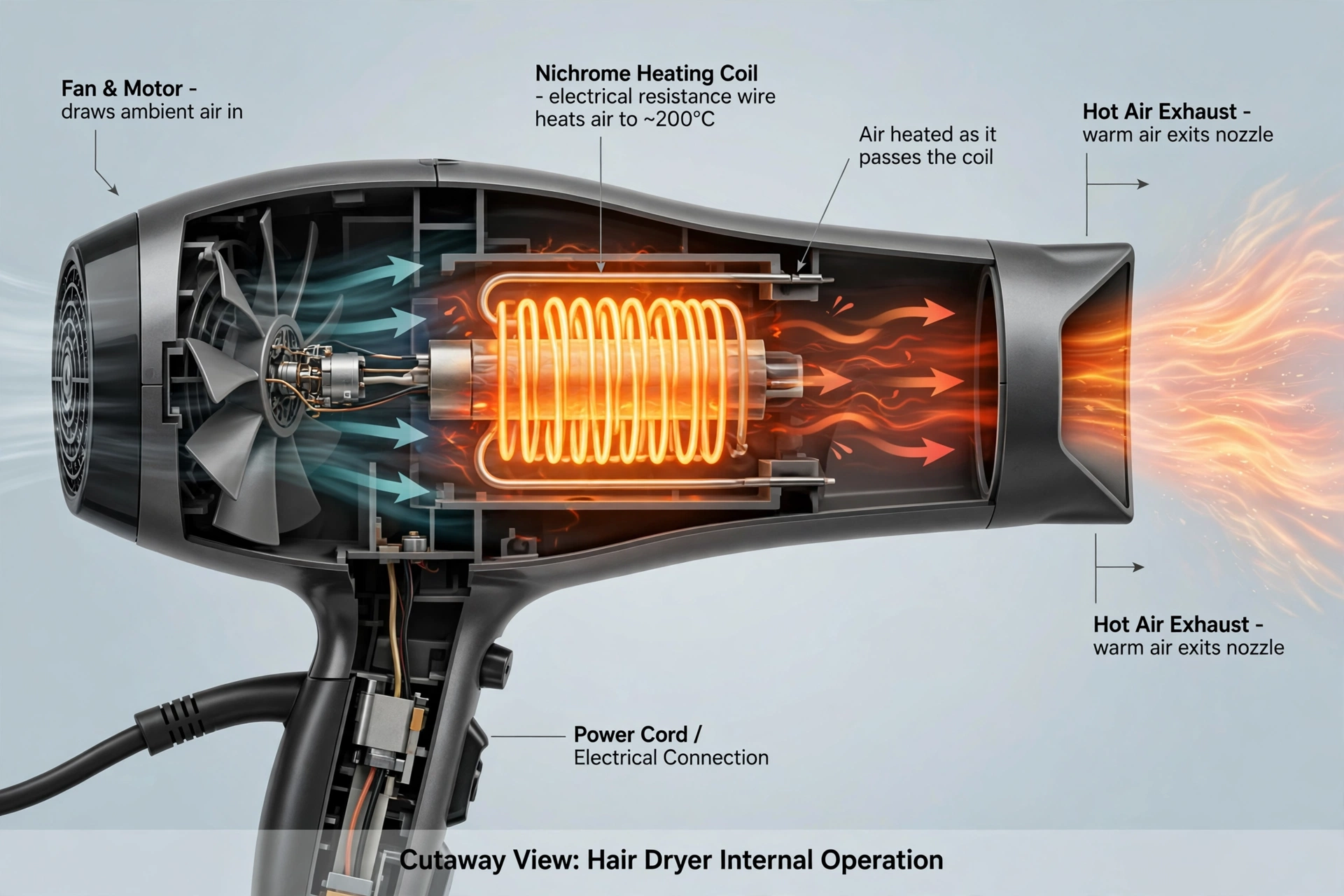
Every hair dryer starts with ordinary air, the same air you are breathing right now. At the back of the dryer, behind a small grille, there is a fan. When you switch the dryer on, a small electric motor starts spinning, and the fan spins with it, fast, thousands of turns every minute. The fan blades pull air in through the back grille and push it forward through the body of the dryer, towards the nozzle at the front.
The fan is the engine of the whole machine. A stronger fan moves more air, and more air can carry away more water. That is why a powerful dryer dries your hair faster than a weak travel dryer, even if both get just as hot. If the back grille gets blocked, by a towel, by long hair, or by a thick layer of dust, the fan cannot pull in enough air, the dryer gets louder, and the whole machine starts to heat up inside.
Job Two: The Hot Wire That Heats the Air
In the middle of the dryer, between the fan and the nozzle, there is a coil of thin wire. It does not look like much. It is a springy spiral, wound around a heat-proof frame. When electricity flows through this wire, the wire gets very hot, glowing red in some dryers, and the air rushing past it picks up that heat on its way out.
The wire is made of a special metal called nichrome, a mix of nickel and chromium, and it has two qualities that make it perfect for this job. First, it resists the flow of electricity, which sounds like a flaw but is exactly what you want here. When electricity struggles to push through a wire, the wire heats up, and that heat is the whole point. Second, nichrome does not melt or burn away at high temperatures, and it does not rust the way ordinary steel would. It can glow hot again and again, day after day, for years, without falling apart.
The heat settings on your dryer change how much electricity flows through this wire. On low, the wire gets warm and the air comes out gently warm. On high, the wire gets much hotter, and the air comes out hot enough to dry thick hair quickly. The wire itself never touches your hair. It sits safely inside the case, behind the nozzle. All it does is heat the air passing over it.
Job Three: Hot Moving Air Carries the Water Away
Now we come to the part that actually dries your hair, and it is the part most people get wrong. Your hair is wet because tiny drops of water are clinging to each strand. To dry it, that water has to leave the hair and go somewhere else. It has to turn into vapour, the invisible gas form of water, and float away into the room.
Heat gives the water the energy it needs to change. When hot air blows over a wet strand of hair, the heat passes into the water drops, and the water molecules start moving faster and faster. Some of them move fast enough to break free from the drop and escape into the air as vapour.
If the air around your hair stayed still, it would fill up with vapour and the drying would slow right down. The moving air solves this: fresh hot air keeps arriving, and the damp air keeps getting swept away.
This is why the fan matters as much as the heater. Heat alone turns water into vapour, but only moving air carries that vapour away fast enough to matter. Put the two together, hot air that never stops moving, and you get drying in minutes instead of hours.
Why Heat Alone Is Not Enough
It is tempting to think that hotter is always better, and that the hottest setting must be the best setting. It is not, and understanding why will save your hair a lot of damage.
Your hair is made of a protein called keratin, the same material as your fingernails. It is strong, but it does not like extreme heat. Very hot air can strip the moisture out of the hair itself, not just the water sitting on the surface, and that leaves the hair dry, brittle, and easy to break.
There is also a limit to how much good extra heat does. Once the air is hot enough to turn water into vapour quickly, making it hotter still does not speed things up by much, because the bottleneck becomes how fast the air can carry the vapour away. At that point, more airflow helps more than more heat. So the rule is simple: use enough heat to get the job done, and let the moving air do the rest. Your hair will thank you, and so will your electricity bill, because the heater is the part that uses most of the power.
Step by Step: One Puff of Air Through the Dryer
Let us follow one puff of air through the dryer, from the moment you press the button to the moment it reaches your hair.
You press the switch, and electricity flows from the wall socket into the dryer, through the cord, and into the motor and the heating wire at the same time. The motor wakes up and starts spinning the fan. The fan blades spin fast and pull cool room air in through the grille at the back of the dryer. The cool air rushes forward, flows over the motor, and reaches the hot nichrome coil, where it picks up heat in a fraction of a second.
The hot air is squeezed through the narrow nozzle at the front. The narrow shape speeds it up, the way water speeds up when you put your thumb over the end of a garden hose. Then the hot, fast air hits your wet hair. The heat passes into the water drops, the water turns into vapour, and the moving air sweeps the vapour away into the room. Then you switch the dryer off, the fan slows to a stop, the wire cools down, and the whole machine goes quiet again, waiting for the next morning.
The Buttons: Heat, Speed, and the Cool Shot
Look at the handle of your dryer and you will usually find two or three switches. They look simple, but each one controls a different part of the machine, and knowing what they do helps you dry your hair better.
The heat switch controls the nichrome wire. Low means less electricity through the wire, so the air comes out warm. High means more electricity, so the air comes out hot. The speed switch controls the fan. Low speed means the fan spins more slowly, so less air moves through the dryer. High speed means the fan spins faster, so more air rushes out. Speed and heat are separate jobs, and that is why many dryers let you mix them.
Then there is the cool-shot button, the one many people never touch. When you press it, it cuts the power to the heating wire but keeps the fan running, so cool room air blows out of the nozzle. Hairdressers use it at the end of a style, and the reason is simple. Heat makes hair soft and flexible, which is useful while you are shaping it with a brush. Cool air does the opposite: it helps the hair set and hold its shape. A quick blast of cool air at the end locks the style in place.
The Safety Net: The Cut-Off Switch
A hair dryer is a heater you hold in your hand, so safety matters. The most important safety part is one you will never see: a small device called a thermal cut-off switch, hidden inside the case near the heating wire. Its job is simple. It watches the temperature inside the dryer. If the temperature climbs too high, it cuts the power to the heating wire, and the dryer stops heating.
When would it need to do this? The most common cause is blocked airflow. If the back grille is covered, by a towel, by a pile of clothes, or by a thick mat of dust and hair, the fan cannot pull in enough cool air. The wire keeps heating, but there is not enough air moving past it to carry the heat away, so the temperature inside the case climbs fast. The cut-off switch steps in before the wire can burn out or the plastic case can melt.
If this happens often, check the back grille first. A quick clean, picking off the dust and hair with a small brush or an old toothbrush, usually fixes it. The wire also sits inside a heat-proof frame, and the nozzle keeps your fingers away from it. Never use a dryer near a full bath or with wet hands on a wet floor.
A Short History: Heavy Boxes, Tubes, and Bonnets
The hair dryer did not start out as a small machine you hold in your hand. The first ones were heavy, awkward, and nothing like the dryers we use today, and the story of how they shrank is a story of better motors, better wires, and better materials.
In the early 1900s, when electric hair dryers first appeared, they were large boxes that sat on a table or on the floor. A hose, a bit like a vacuum cleaner hose, ran from the box to a nozzle, or to a bonnet, a soft cap that fitted over your head like a shower cap with warm air pumped into it. You sat still under the bonnet while the box hummed away on the table beside you.
The first handheld dryers arrived in the 1920s, and they were still heavy by today’s standards, often weighing more than a kilogram, with a metal body that got hot to hold.
By the 1960s and 1970s, the handheld dryer had become a normal household object, light enough to hold in one hand, cheap enough for most families to own, and powerful enough to dry hair in minutes. Bonnet dryers never quite went away: you can still find them today for curly hair, the same box, tube, and cap idea, just lighter and safer.
Hair Dryer vs Vacuum Cleaner: Same Air, Different Job
A hair dryer and a vacuum cleaner look nothing alike, but they are cousins. Both are household machines that work by moving air, and both use a fan driven by an electric motor. The difference is what they do with that moving air.
A vacuum cleaner uses moving air to carry dust. Its fan throws air out of the back of the machine, the pressure inside drops, and the air outside rushes in through the nozzle, sweeping dust and crumbs along with it.
A hair dryer uses moving air to carry water. Its fan pulls air in, the nichrome wire heats it, and the hot moving air carries the water off your hair as vapour. This is a useful way to remember the difference. The vacuum moves dust with air pressure. The dryer moves water with hot air.
What About Ionic Dryers and Diffusers?
Walk into a shop today and you will see dryers that promise more than hot air. The most common extra is the ionic dryer. It releases tiny charged particles, called ions, into the airflow. The makers say these ions help water drops break up faster and reduce static, leaving hair smoother and less frizzy. The science is debated, and the effect is gentle rather than dramatic, but many people find their hair feels softer after using one.
The other common extra is the diffuser, a wide bowl-shaped attachment that spreads the air out over a large area instead of focusing it into a narrow blast. It is made for curly hair, because a narrow blast would blow the curls apart, while a gentle spread dries them without disturbing their shape.
A concentrator nozzle does the opposite job. It is the flat attachment that comes with many dryers, and it squeezes the air into a thin, focused stream, which is useful when you are drying one section at a time with a brush. None of these extras changes the core of the machine. The fan, the hot wire, and the moving air do the drying. The attachments only shape the air on its way out.
Everyday Mistakes That Make Drying Slower
Most hair dryers do not break. They just get slower and weaker until someone gives up on them and buys a new one. In most cases, the cause is simple, and it is easy to fix.
The most common mistake is drying hair that is dripping wet. A dryer is good at turning small amounts of water into vapour, but it struggles with a soaking head of hair. A minute with a towel first, gently squeezing the water out, not rubbing hard, saves several minutes of drying time and a lot of heat on your hair.
The next mistake is holding the dryer too close. When the nozzle is pressed right against the hair, the hot air has nowhere to go, the temperature shoots up in one spot, and the hair gets too hot. Hold the dryer about fifteen centimetres away, roughly the length of your hand, and keep it moving.
The third mistake is never cleaning the back grille. The fourth mistake is using the hottest setting for the whole drying time.
Five Small Habits for Healthy, Fast Drying
Everything in this article boils down to five habits. None of them takes more than a minute, and together they make drying faster, safer, and kinder to your hair.
First, towel-dry first. Squeeze gently, do not rub.
Second, keep the dryer moving and at a distance. Hold it about a hand’s length away, and sweep it slowly back and forth.
Third, use the heat in stages. Start hot to shift the worst of the wetness, drop to medium as the hair dries, and finish with the cool shot.
Fourth, clean the back grille often. Unplug the dryer, let it cool, and pick off the dust and hair.
Fifth, store the dryer safely. Keep it away from water, never use it near a full bath, and let it cool before you put it away in a drawer. A dryer that is looked after lasts for years.
Frequently Asked Questions
How does a hair dryer dry hair so fast?
It blows hot air over wet hair, and the heat turns the water into vapour while the moving air sweeps that vapour away. A hair dryer keeps bringing fresh hot air and carrying the damp air away, so the drying never slows down, and a whole head of wet hair can dry in a few minutes. It is that constant swap of air, fresh hot air in and damp air out, that makes the minutes fly by.
Why does a hair dryer need a fan if the wire does the heating?
Because heat alone cannot dry hair quickly. The nichrome wire heats the air, but without the fan, the hot air would just sit inside the case and the wire would overheat. The fan pulls in cool room air, pushes it past the hot wire, and blows it out onto your hair. Heating and moving air are a team, and neither one works well without the other.
What is nichrome, and why is it used in hair dryers?
Nichrome is a metal made mostly from nickel and chromium. It is used because it resists the flow of electricity, which makes it heat up, and because it can stay very hot without melting or rusting. Nichrome can glow hot again and again, day after day, for years, which makes it ideal for a small heater that has to work hard every morning.
What does the cool-shot button do, and should I use it?
The cool-shot button cuts the power to the heating wire but keeps the fan running, so cool room air blows out of the nozzle. You should use it at the end of drying, once your hair is nearly dry. Heat makes hair soft and easy to shape, and cool air helps it set and hold that shape.
Why does my hair dryer sometimes blow cold air and then heat up again?
That is the thermal cut-off switch doing its job. If the air vent gets blocked, or the dryer gets too hot inside, the switch cuts the power to the heating wire until the temperature falls to a safe level, and then it lets the heater work again. It is a safety feature, not a fault. If it happens often, check the back grille for dust and hair.
Is it safe to use a hair dryer every day?
Yes, for most people it is safe, as long as you use it sensibly. Keep the dryer moving and about a hand’s length from your hair, use the lowest heat that gets the job done, and finish with cool air. Keep it away from water and unplug it when you are done.
More from Zorium Daily
- How Does a Vacuum Cleaner Work? Explained Simply
- How Does a Microwave Oven Work?
- How Do Noise-Cancelling Earbuds Work?
- What Is Bluetooth and How Does It Work?
A hair dryer is not magic, and it is not just a heater. It is a small team of three parts working together: a fan that pulls in cool room air, a nichrome wire that heats that air as it rushes past, and the moving hot air itself, which turns the water on your hair into vapour and carries it away before it can settle back down. It is the combination, hot air that never stops moving, that dries your hair in minutes. Treat it well, keep the grille clean, use the heat in stages, and finish with a cool shot, and that small machine on your bathroom shelf will do its quiet, clever job every single morning, while you get on with your day.