
How to Make a Simple Monthly Budget That Actually Works
Have you ever reached the end of the month and wondered where your money went? You are not alone. Many people earn enough to live on, but still feel broke in the last week of the month. Often the problem is not that they earn too little. The problem is that they have no clear plan for their money.
A monthly budget is that plan. It is a simple list that shows what money comes in, what money goes out, and what is left for saving. It does not need to be fancy. It does not need a special app. It just needs to be honest, simple, and easy to keep.
This guide shows you how to make a budget step by step. You will learn how to find your real pay, sort your spending, and build a plan you can actually follow. This article is general information only, not personal financial advice. Every home is different, so take the ideas that fit your life and change the rest.
SUMMARY OF THIS ARTICLE
- A monthly budget is a simple plan for your money: what comes in, what goes out, and what you save.
- Start with your real take-home pay, not your full salary before tax and other cuts.
- Sort your spending into three groups: needs, wants, and savings, and give each group a limit.
- The 50/30/20 split is a popular rule of thumb, not a proven rule, so bend it to fit your real life.
- A short weekly check-in keeps your budget alive, and one bad month does not mean you have failed.
What Is a Monthly Budget, Really?
A budget is not a punishment. It is not a list of things you are banned from buying. Think of it more like a map. A map does not stop you from travelling. It helps you reach the place you want to go without getting lost.
Your budget works the same way. It shows where your money goes now. Then it helps you send your money where you want it to go next. That might mean paying rent on time, saving for a sudden bill, or having a little fun money without guilt.
Many people think a budget means cutting out all joy. That is not true. A good budget has room for fun. In fact, a budget with no fun money often fails, because it feels too strict to keep. The goal is balance, not misery.
A budget also helps you make calm choices. When you already know how much you can spend on food, clothes, or fun, you do not need to guess at the shop. You can look at your plan and decide with a clear mind. That calm feeling is one of the best things a budget gives you.
Step 1: Find Your Real Take-Home Pay
Every budget starts with one number: how much money you actually get each month. This is called take-home pay. It is the money that lands in your bank account after tax and other cuts are taken out.
This matters. Many people budget with their full salary. That is a mistake. If your salary is 3,000 a month, but only 2,400 reaches your bank account, then 2,400 is your real number. The other 600 is already gone. It pays tax, insurance, or pension cuts. You cannot spend it twice.
Look at your last few pay slips or bank deposits. If your pay is the same every month, the job is easy. Use that steady number. If your pay changes, because of shifts, tips, or freelance work, look at the last three months. Find the lowest month. Use that lower number as your base. In a good month, the extra money is a bonus. In a bad month, your plan still works.
List all the money that comes in. Your main job is first. Then add any other steady money, like a part-time job, child support, or benefits you receive every month. Only count money you can truly expect. Do not count a bonus you might get. Do not count money a friend might pay back. Hope is not income.
Step 2: Look at Last Month Before You Plan This Month
Before you make rules for the future, look at the past. Your last month of spending tells the truth about your habits. Guessing tells a story. The truth is more useful.
Open your bank app or your bank statements. Look at the last full month. Write down what you spent, group by group. Rent or mortgage comes first. Then bills like power, water, phone, and internet. Then food. Then travel. Then fun, clothes, and everything else.
Do not judge yourself while you do this. You are looking for facts, not shame. Maybe you spent more on takeaway food than you thought. Maybe a subscription you forgot about is still charging you each month. Maybe small daily buys add up to a big number. This is normal. Almost everyone finds a surprise or two.
If you can, look at two or three months, not just one. One month can be unusual. A birthday, a holiday, or a car repair can make one month look strange. Two or three months show the normal pattern. Use that pattern to set fair limits, not fantasy limits.
Step 3: Sort Your Spending Into Three Simple Groups
Now sort every cost into three groups: needs, wants, and savings. This simple sort is the heart of your budget. It turns a long messy list into a clear picture.
Needs are things you must pay to live and work. Rent or mortgage is a need. Basic food is a need. Power, water, and heating are needs. Travel to work is a need. Basic phone service is a need. Minimum payments on debts are also needs, because missing them can cause real trouble.
Wants are things that make life nicer but that you could live without for a while. Eating out is a want. Streaming services are wants. New clothes you do not truly need are wants. Holidays, hobbies, and fancy coffee are wants too. Wants are not bad. They make life enjoyable. They just come after needs.
Savings is money you set aside for the future. This includes an emergency fund, money for a goal, and extra payments toward debt beyond the minimum. Savings is not what is left over at the end of the month. In a good budget, savings gets its own line, just like rent does.
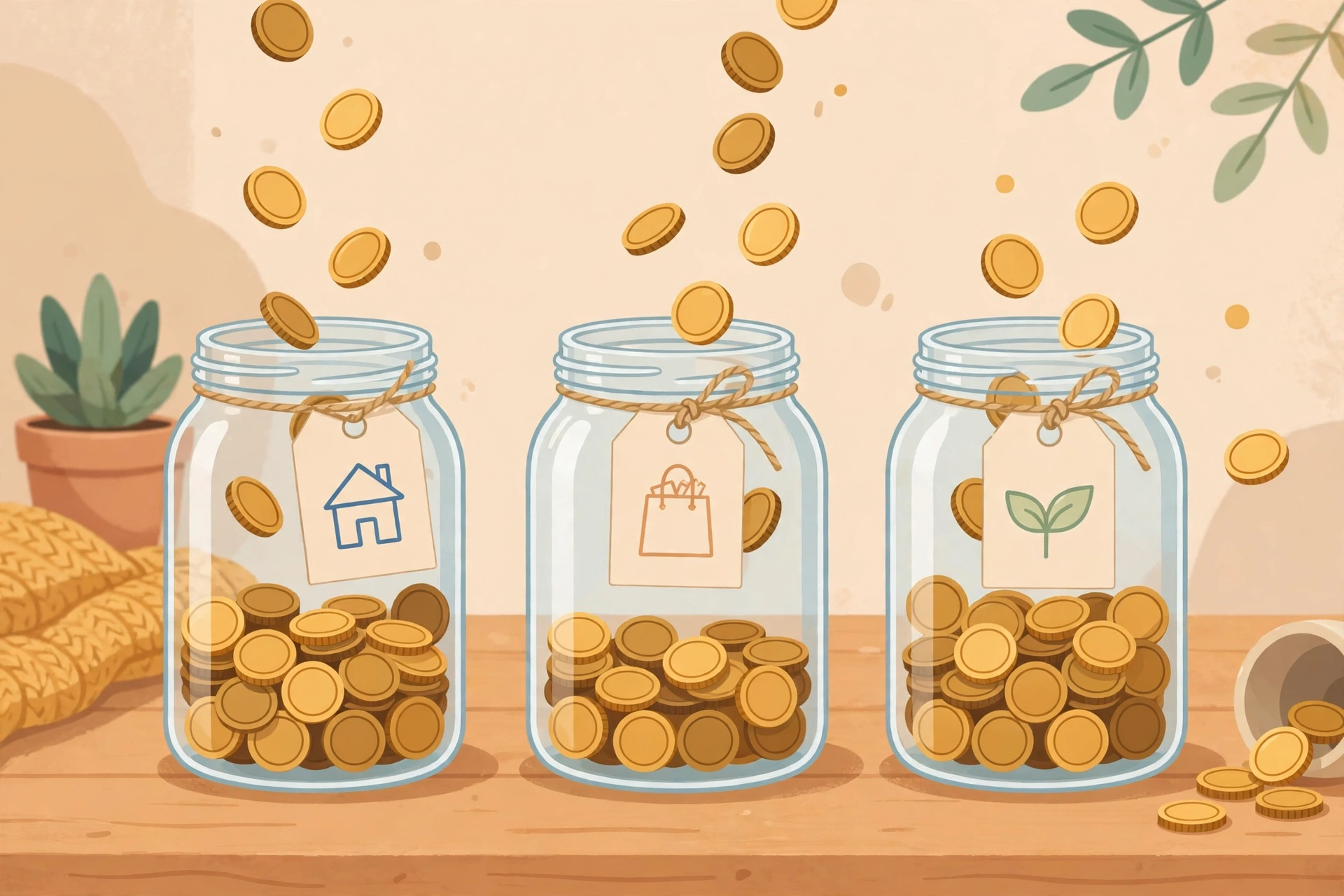
When you finish sorting, add up each group. Now you can see your real shape. Many people find their needs take more than half their pay. Many find their wants are bigger than they guessed. And many find their savings are close to zero. That is useful news. It shows you exactly what to fix first.
Step 4: Try the 50/30/20 Rule of Thumb
Once you know your groups, you need targets. A popular starting point is the 50/30/20 rule. It says: aim for about 50 percent of your take-home pay on needs, about 30 percent on wants, and about 20 percent on savings and extra debt payments.
Let us make that real. Imagine your take-home pay is 2,000 a month. Under this rule of thumb, you would aim for 1,000 on needs, 600 on wants, and 400 on savings. These are example numbers only, not advice for your home. Your rent, your family, and your town will change the maths.
Here is the honest label this rule needs: it is a popular rule of thumb, not a proven rule. No study proves that 50/30/20 is the right split for everyone. It is popular because it is easy to remember and easy to start with. It gives you a quick way to check whether your spending is roughly balanced.
For many people, the rule will not fit exactly. If you rent alone in an expensive city, your needs may take 60 or 70 percent of your pay. That does not mean you failed. It means your housing costs are high, and your wants and savings targets must be smaller for now. If you live with family and pay low rent, your needs may be only 40 percent, and you may be able to save more. Both cases are fine.
Use the rule as a compass, not as a cage. First, cover your needs and your minimum debt payments. Then save a small amount, even if it is far less than 20 percent. Then give yourself a fair amount for wants. Over time, as pay rises or costs fall, you can move closer to the split. A budget that fits your real life beats a perfect rule that you quit in week two.
Step 5: Write Your Plan Down, Line by Line
A budget in your head is not a budget. It is a wish. Write it down. Paper, a notebook, a spreadsheet, or a notes app all work. Pick the tool you will actually open. The best tool is the one you use.
Start with your take-home pay at the top. Then list your needs, one line each, with a limit next to each one. Then list your wants, one line each, with a limit. Then list savings, with its own line. Then add up all the limits. The total should be equal to or less than your pay.
Here is a simple example plan for a take-home pay of 2,000 a month. Remember, these are example numbers to show the shape of a plan, not a recommendation for you:
- Rent: 800
- Power, water, and internet: 150
- Food and household basics: 300
- Travel to work: 100
- Phone: 40
- Minimum debt payments: 110
- Savings: 200
- Eating out and fun: 150
- Clothes and personal care: 80
- Small extras and buffer: 70
- Total: 2,000
Notice two things in this example. First, savings has a line of its own, before fun money. Second, there is a small buffer line. A buffer is money set aside for small surprises, like a bus fare rise or a school cost. A budget with no buffer breaks at the first surprise. A buffer keeps it alive.
If your total is higher than your pay, do not panic. You have three choices. You can trim a want. You can find a cheaper option for a need, like a lower phone plan. Or you can look for a small way to add income. Trim wants first. They are the easiest and safest place to cut. Do not cut food, medicine, or safe travel to make the numbers fit. Your health and safety come first, always.
Step 6: Pay Yourself First, Even a Small Amount
Here is a habit that changes everything: save first, not last. Most people spend through the month and try to save what is left. Often, nothing is left. Life fills the gap. A sale appears. A friend invites you out. The money quietly disappears.
Paying yourself first flips the order. On pay day, move your savings amount to a separate place before you spend on anything else. Then you live on what is left. It feels strange at first. But after a month or two, it feels normal, like paying a bill.
Keep your savings in a separate account if you can. When savings sit in your daily spending account, they are too easy to spend. A separate account adds one small step between you and the money. That step is often enough to stop a quick, unplanned buy. Ask your bank about a simple savings account with no high fees, and read the terms in plain words.
Your first savings goal can be small. A starter emergency fund is a good first goal for many people, because it turns worry into calm. It is money kept aside for a sudden cost, like a broken phone or an urgent repair. You do not need a huge sum to start. Small, steady amounts add up, and even a small safety pot can make a sudden bill feel less frightening.
If money is very tight, start tiny. Save the price of one snack each week. Save a few coins each day. The amount matters less than the habit. A habit is a thing you do again and again without much thought. Once saving becomes a habit, it keeps going even in hard months, because you no longer need strong willpower each time.
Step 7: Plan for Bills That Do Not Come Every Month
Some bills do not arrive every month, and they are the ones that break budgets. Car insurance once a year. School costs each term. Holiday gifts in December. A car service twice a year. When these bills land, they feel like emergencies. But most of them are not surprises. You know they are coming. You just forgot to plan for them.
The fix is simple. List your once-a-year and few-times-a-year costs. Add them up for the whole year. Divide the total by 12. That gives you a monthly amount to set aside. For example, if your yearly costs add up to 600, set aside 50 each month. When the bill arrives, the money is already there. The bill stops being a shock.
Keep this money in a separate pot, or at least track it as its own line in your budget. Call it “yearly bills” or “coming costs.” Do not mix it with your emergency fund. Your emergency fund is for true shocks you could not plan for. Your yearly bills pot is for costs you know are coming. Both pots protect you, but they do different jobs.
Step 8: The Weekly 10-Minute Check-In
A budget is not a document you write once and forget. It is a living plan. It needs a short weekly check-in. Ten minutes is enough. Pick a day and a time, like Sunday evening, and keep it.
In your check-in, ask four short questions. First, how much have I spent so far this month in each group? Second, is any group close to its limit? Third, is there a bill or cost coming this week I forgot? Fourth, do I need to move money from one group to another? Moving money between groups is not failure. It is good budgeting. If food cost more this week, move a little from fun money to food. The total stays the same. The plan stays alive.

This weekly habit also catches small leaks early. A forgotten subscription. A streaming service you no longer watch. A habit of buying lunch every day that quietly adds up. Catching a leak in week one saves three weeks of overspending. Waiting until the end of the month is too late. The money is already gone.
Keep the check-in kind. You are reviewing numbers, not judging your worth. Some weeks will be over budget. That is normal life. A sick child, a broken shoe, or a higher power bill can push any week over. Look at the month as a whole, not one hard week. Steady progress beats perfect weeks.
When Your Needs Cost More Than You Earn
Sometimes the maths does not work. Your needs alone are more than your pay. This is a hard place to be, and it is not your fault alone. Rent, food, and bills have risen fast in many towns. Wages have not always kept up. If this is your situation, a budget still helps, but it cannot fix the gap by itself.
First, protect the essentials. Pay housing, basic food, power, water, and travel to work first. Pay minimum debt payments if you can. If you cannot pay a bill, contact the company early. Many companies have payment plans or hardship help. Asking early is much better than hiding and missing payments in silence.
Second, look for one or two real savings, not ten tiny cuts that make life miserable. Could a cheaper phone plan save money each month? Could cooking one more meal at home each week cut takeaway costs? Our guide to save on groceries shows how meal planning and less waste can lower the food bill without eating less. Could you pause a subscription you rarely use? Small, honest swaps help. Cutting food, medicine, or safe travel does not help. Never trade your health for a budget number.
Third, look at the income side. Could you pick up a few extra hours? Could you sell something you no longer use? Could you check whether you qualify for benefits or support you are not claiming? In the United States, the United Kingdom, Canada, Ireland, and New Zealand, there are free or low-cost debt and benefits advice services, often run by charities or government bodies. Look for a service that does not charge high fees or promise a quick fix. This article is general information only, not personal financial advice, so a local adviser who knows your situation can help more than any guide.
If debt feels out of control, do not face it in secret. Talk to a trusted person or a free debt advice service. A budget is a tool, not a cure for every money problem. Getting help early is a strong move, not a weak one.
Mistakes That Break Most Beginner Budgets
Most budgets fail for the same few reasons. Knowing them now can save you months of frustration.
The first mistake is making the budget too strict. You cut all fun money, all eating out, and all treats. The plan looks perfect on paper. By week two, you feel punished, and you quit. Then you spend more than before, as if to make up for lost time. A budget with room for fun lasts longer than a perfect budget you abandon. Keep a small fun money line, even if it is tiny. Joy is allowed, and it has a place.
The second mistake is guessing instead of tracking. You guess your food costs. You guess your fun costs. The guesses are too low, so the budget looks fine, but real life breaks it in week one. Use last month’s real numbers, even if they surprise you. Real numbers make a real plan.
The third mistake is forgetting irregular costs. You plan for rent and food, but forget car insurance, school costs, or holiday gifts. Then a big bill lands, and the whole month falls apart. Use the yearly bills pot from Step 7. It turns shocks into planned costs. For true shocks you could not see coming, that is what your emergency fund is for.
The fourth mistake is giving up after one bad month. One overspend does not ruin a budget. It teaches you something. Maybe your food limit was too low. Maybe a surprise bill hit. Adjust the limit, learn the lesson, and start the next month fresh. A budget is a habit, not a test. You do not fail a habit by missing one day. You fail it only by quitting for good.
Frequently Asked Questions
How long does it take to make my first budget?
About one hour, for most people. You need time to find your take-home pay, look at last month’s spending, and write your first plan. After that, the weekly check-in takes about ten minutes. Your first budget will not be perfect, and that is fine. Most people say their budget starts to feel natural after two or three months of weekly check-ins.
What if my pay changes every month?
Use your lowest recent month as your base. Look at the last three months, pick the lowest take-home pay, and build your plan on that number. In a better month, put the extra money toward savings or a goal first, before raising your fun spending. This way, a weak month never breaks your plan, and a strong month builds your safety net.
Should I save or pay off debt first?
This is general information only, not personal financial advice, because the right order depends on your debts and your life. A common beginner order is: pay all minimum debt payments on time, then build a small starter emergency fund, then put extra money toward the most costly debt. If debt interest is very high or collectors are involved, talk to a free debt advice service in your country for help with your exact situation.
How much fun money should I have?
There is no single right number. Fun money should fit after your needs, minimum payments, and savings are covered. For many beginners, a small weekly or monthly fun amount works well. It should be big enough to enjoy, but small enough to protect your goals. If you keep breaking your budget on fun, your fun limit may be too low, or your triggers may need a plan. A short pause before unplanned buys can help, and you can learn more in our guide to stop impulse buying.
What is the best budgeting method for beginners?
The best method is the one you will actually use. For most beginners, the three-group method in this guide, needs, wants, and savings, is the simplest place to start. The 50/30/20 split is a popular rule of thumb for setting targets, not a proven rule, so bend it to fit your rent and your life. If three groups feel too broad later, you can split them into smaller categories, one at a time.
How do I budget for food without eating less?
Food is often the easiest group to improve, because small habits add up. Plan meals, shop from a list, and waste less food. You do not need to eat less to spend less. Our guide to save on groceries shows how planning, seasonal food, and store brands can cut the food bill while you still eat well. Set your food limit from your real past spending, then trim it a little at a time, not all at once.
More from Zorium Daily
- Stop impulse buying — simple pauses and rules that help you buy on purpose, not by accident.
- Build an emergency fund — how to start a small safety pot, even on a small income.
- Save on groceries — eat well and spend less with a plan, a list, and less waste.
- More Money guides — browse the full Money section for more simple money guides.