What Causes an Earthquake?
SUMMARY OF THIS ARTICLE
- An earthquake is the shaking of the ground, caused when rocks deep inside Earth suddenly move and release stored energy.
- Most earthquakes happen because huge slabs of rock called tectonic plates slowly move, get stuck, and then suddenly slip along cracks called faults.
- The shaking starts deep underground at a point called the focus, and the place on the surface right above it is called the epicentre.
- The energy travels out as seismic waves, and scientists measure the size of an earthquake with the magnitude scale.
- Aftershocks can follow a big earthquake, a strong quake under the sea can make a tsunami, and the best thing to do in an earthquake is to drop, cover, and hold on until the shaking stops.
The Short Answer
An earthquake is the ground shaking under your feet. It can last a few seconds, or a minute or more. A small one may feel like a truck passing by, while a big one can shake a whole city and knock buildings down.
What causes all that shaking? Rocks deep inside Earth suddenly move, sending waves of energy through the ground. Most of the time, the move happens because of tectonic plates, huge slabs of rock that make up the outer shell of Earth. They move very slowly, but sometimes they get stuck. Pressure builds up, and when it gets too strong, the rocks slip all at once. That sudden slip is an earthquake.
What Is an Earthquake?
An earthquake is a sudden shaking of the ground. The shaking comes from deep inside Earth, from rocks moving far below our feet. It is not caused by wind or rain.
Most earthquakes are small. Earth has many small earthquakes every day, but most are too small for people to feel. Only sensitive machines can pick them up.
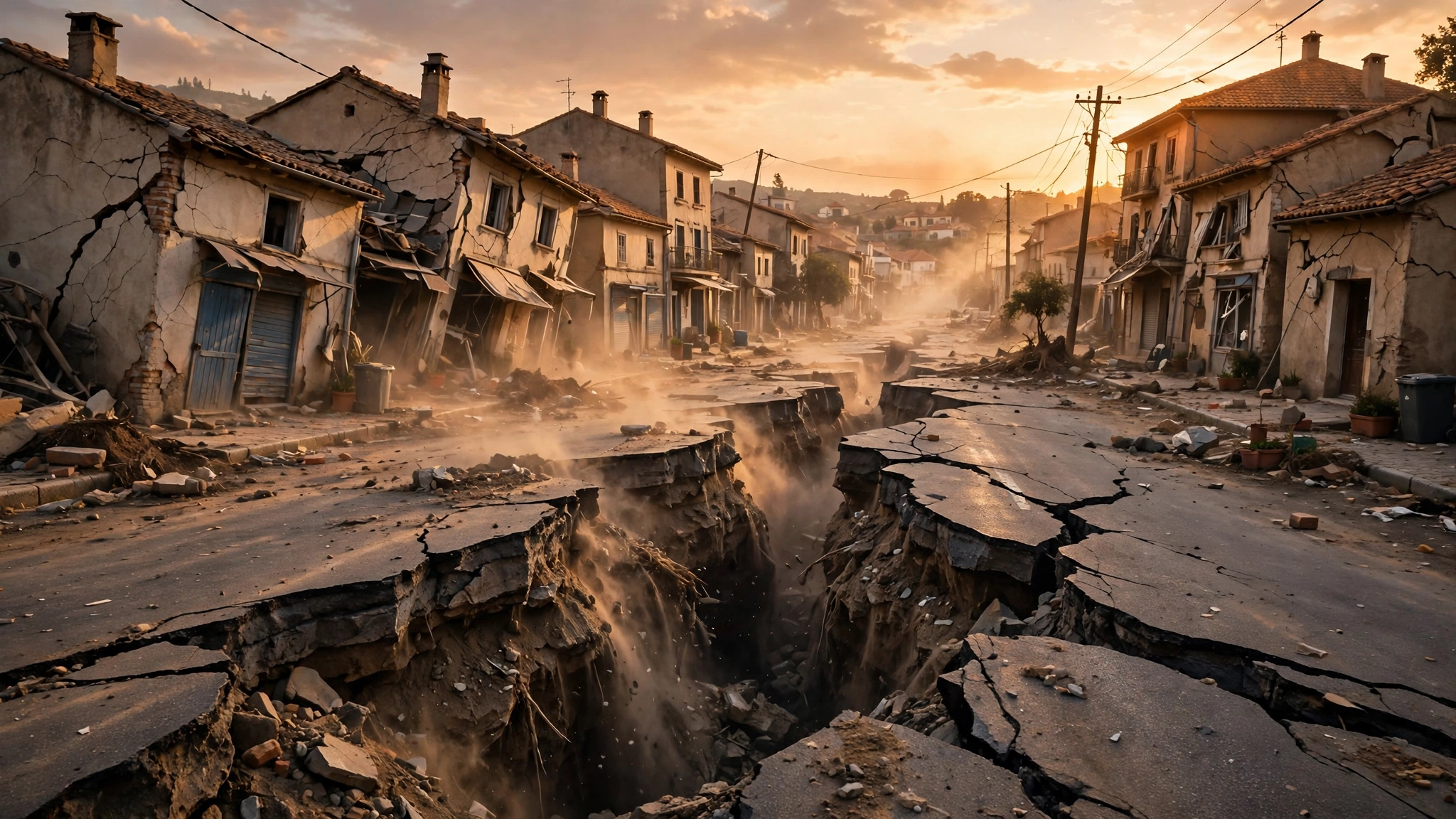
An earthquake can shake buildings, crack roads, and break water pipes. If it happens under the sea, it can push up a huge wave called a tsunami.
Earth Is Not One Solid Ball
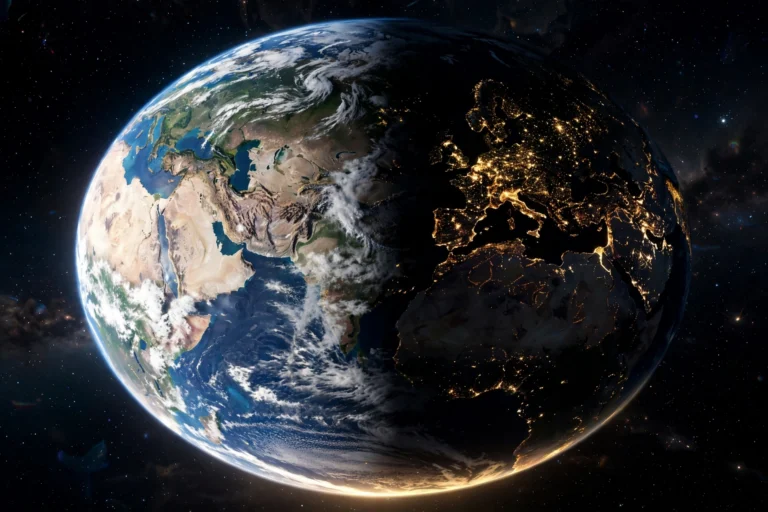
To understand earthquakes, it helps to know what Earth looks like inside. It has layers, a bit like an onion.
At the centre is the core, the hottest part, made of metal, mostly iron. The inner part is solid, and the outer part is liquid, like hot melted metal. Around the core is the mantle, a thick layer of hot rock that moves in slow circles over a very long time. This slow movement pushes the plates on the surface.
The outer layer is called the crust, the thin, hard shell we live on. If Earth were an apple, the crust would be about as thin as the skin of the apple. The crust and the top part of the mantle together form a hard layer called the lithosphere. It is broken into big pieces, and those pieces are the tectonic plates.
What Are Tectonic Plates?
Tectonic plates are huge slabs of rock. They fit together like the pieces of a giant jigsaw puzzle, and they cover the whole surface of Earth. Some plates are under the land, and some are under the sea.
There are about seven very large plates, and many smaller ones, such as the Pacific Plate, the North American Plate, and the Eurasian Plate.
These plates are always moving, very slowly, only a few centimetres each year. You cannot feel them move. But over millions of years, that slow movement adds up, and it can move whole continents.
The plates move because of heat inside Earth. The hot rock in the mantle moves in slow circles, a bit like soup moving in a pot on a stove, and it drags the plates along with it. Most of the time, the plates move smoothly. But at the edges, where two plates meet, the edges can catch and lock together. That is where most earthquakes begin.
The Three Ways Plates Move
Plates meet each other in three main ways, and each way can cause earthquakes.
The first way is when two plates slide past each other. They move in opposite directions, side by side, and the edges rub against each other. This is called a transform boundary. A famous example is the San Andreas Fault in California. When the edges get stuck and then slip, an earthquake happens.
The second way is when two plates push into each other and collide. One plate may be pushed down under the other. This is called a convergent boundary. The Himalayas were pushed up this way.
The third way is when two plates pull apart from each other. This is called a divergent boundary. New crust forms in the gap between them, as hot rock rises from below. This often happens under the sea. Earthquakes here are usually smaller, but they still happen.
What Is a Fault?
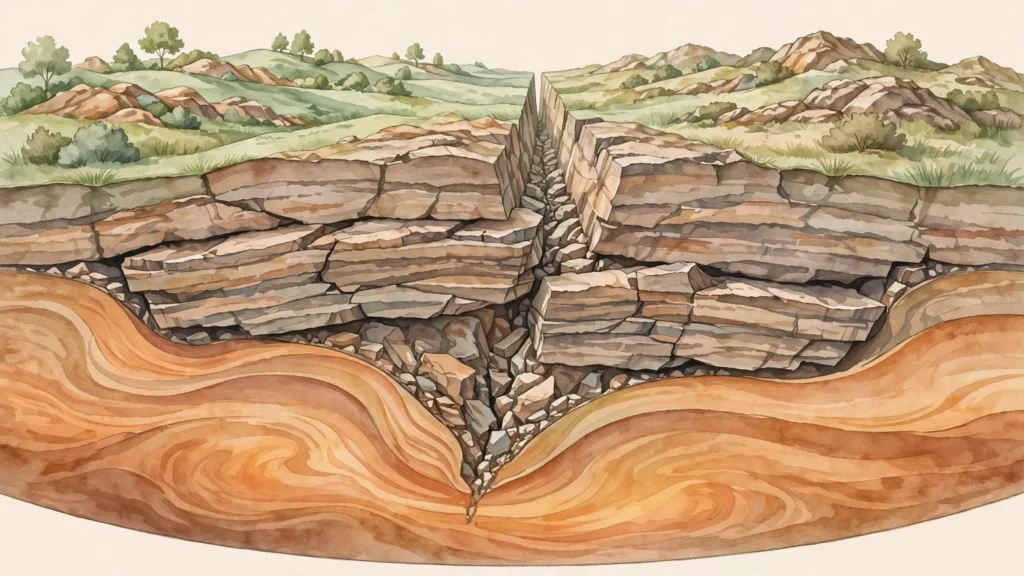
A fault is a crack in Earth’s crust, a place where rocks on one side can move against rocks on the other side. Faults form where plates meet, but they can also form inside a plate, where the rock is weak.
Think of a fault like a crack in a plate. If you drop a plate on the floor, it cracks along a weak line, and the two sides can slide past each other. A fault in the ground works in a similar way.
Some faults are short, only a few metres long. Some are huge, hundreds of kilometres long. The San Andreas Fault is more than 1,000 kilometres long. The longer the fault, the bigger the earthquake it can make. Faults come in three main types: normal, when rocks are pulled apart; reverse, when rocks are pushed together; and strike-slip, when rocks slide past each other sideways.
How Stress Builds Up
Here is the key idea. Rocks can bend a little, like a spring. When plates push on them, the rocks bend and store energy. The energy builds up slowly, over years, or even over hundreds of years. The plates keep pushing, but the fault stays locked, because friction holds the rocks in place. Friction is the force that stops things from sliding.
As the plates keep pushing, the stress grows, and the rocks store more and more energy, like a spring being pulled tighter and tighter. Then the stress becomes too strong. The friction can no longer hold the rocks in place. The fault suddenly slips, and all the stored energy is released at once.
Scientists call this the elastic rebound theory. Elastic means something can stretch and spring back. Rocks stretch, store energy, and then spring back with a sudden jump. That jump sends waves through the ground, and those waves are the earthquake.
The Focus and the Epicentre
Every earthquake has a starting point deep underground, where the rocks first break and slip. Scientists call it the focus, also called the hypocentre.
The focus can be shallow or deep. Most earthquakes start in the top 10 to 15 kilometres of the crust. Some start much deeper, down to 700 kilometres deep. Shallow earthquakes usually cause more damage, because the energy has a shorter way to travel.
The point on the surface directly above the focus is called the epicentre. When you hear on the news that an earthquake hit a city, the place they name is usually the epicentre, and the shaking is usually strongest near it.
Seismic Waves: How the Shaking Travels
When the rocks slip, they send out waves of energy that travel through the ground in all directions, like ripples from a stone dropped in a pond. There are three main kinds.
The first kind is called P-waves. P stands for primary, because these waves arrive first. P-waves squeeze and stretch the ground as they move, a bit like a spring being pushed and pulled. They are the fastest waves, travelling through rock at about 6 to 14 kilometres per second.
The second kind is called S-waves. S stands for secondary, because these waves arrive second. S-waves shake the ground from side to side, or up and down. They are slower than P-waves, but they usually cause stronger shaking.
The third kind is called surface waves. They travel along the surface of the ground, not deep inside Earth. They are the slowest of all, but they often cause the most damage, rolling the ground like ocean waves. Buildings shake hard when they pass under them.
Scientists use machines called seismographs to record these waves, and by using readings from three or more places, they can find the exact spot of the focus.
How Scientists Measure an Earthquake
When people talk about the size of an earthquake, they usually talk about its magnitude, a number that tells us how much energy the earthquake released. The bigger the number, the bigger the earthquake.
Scientists use the moment magnitude scale. You may also hear about the Richter scale, an older scale that the news still names sometimes. But for big earthquakes, scientists now use the moment magnitude scale, because it works better for large quakes.
The scale is not like a normal ruler. Each whole step up means about 32 times more energy. So a magnitude 6 earthquake releases about 32 times more energy than a magnitude 5, and a magnitude 7 releases about 1,000 times more energy than a magnitude 5.
Here is a simple guide. Below 2, people do not feel it. From 2 to 4, it can be felt but rarely causes damage. From 4 to 6, it can shake buildings and damage weak ones. From 6 to 7, it can cause serious damage over a wide area. From 7 to 8, it can destroy whole towns. Above 8, it is a great earthquake, and it is very rare.
Magnitude is not the same as intensity. Magnitude measures the energy at the source, while intensity measures how strongly the shaking is felt in a place. One earthquake has one magnitude, but it can have many different intensities. Near the epicentre, the intensity is high. Far away, it is low.
Why Some Earthquakes Are Stronger Than Others
Not all earthquakes cause the same damage. A big earthquake in an empty desert may hurt no one, while a smaller one under a crowded city can be a disaster.
The first thing is the magnitude. A bigger earthquake releases more energy, so it shakes the ground harder.
The second thing is the depth of the focus. A shallow earthquake is usually more dangerous, because the energy reaches the surface quickly and strongly.
The third thing is the distance from the epicentre. Places close to it feel the strongest shaking, and places far away feel much less.
The fourth thing is the ground itself. Soft ground, such as loose soil or wet sand, shakes more than hard rock.
The fifth thing is the buildings. Strong buildings that are built to bend a little can survive a strong shake, while weak buildings can fall down even in a moderate quake.
The sixth thing is how long the shaking lasts. A quake that shakes for a minute is much worse than one that shakes for 10 seconds.
Foreshocks and Aftershocks
A big earthquake rarely comes alone. The smaller shakes that come before the main quake are called foreshocks. They can happen days or hours before the big one. But they do not always happen, and scientists often cannot tell until the big quake has already happened.
The smaller shakes that come after the main quake are called aftershocks. They happen because the rocks around the fault are still settling into their new position, and they can go on for days, weeks, or even months. They are usually smaller than the main quake, but they can still damage buildings that were already weakened. That is why people are told to stay away from damaged buildings after a big earthquake.
Earthquakes Under the Sea and Tsunamis
Many earthquakes happen under the sea. The sea floor is full of faults, just like the land. When a strong earthquake happens under the sea, it can move the sea floor up or down by several metres, pushing the water above it. That push can make a huge wave called a tsunami.
A tsunami is not like a normal wave, which is made by wind and only moves the top of the water. A tsunami moves the whole column of water, from the surface to the sea floor. In the open sea, it may be less than a metre high, and it moves very fast, as fast as a jet plane. But near the coast, it slows down, grows taller, and can rush far inland with great force.
Not every undersea earthquake makes a tsunami. The earthquake must be strong and move the sea floor up or down. A sideways slip often does not push enough water to make a big tsunami, so scientists watch undersea earthquakes closely and send out warnings when they see the signs.
If you are near the coast and you feel a strong earthquake, or if you see the sea suddenly pull back from the shore, move to high ground at once. Do not wait to see the wave. A tsunami can arrive within minutes. The ocean is salty because rivers and sea-floor vents carry salt into it, as you can read in our guide to Why Is the Ocean Salty?
Other Causes of Earthquakes
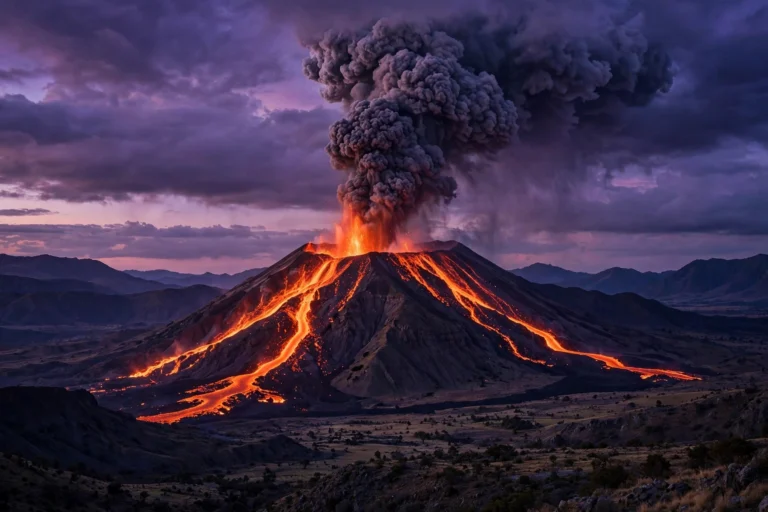
Tectonic plates cause most earthquakes, but they are not the only cause. Volcanoes can cause earthquakes. Before a volcano erupts, hot melted rock, called magma, pushes its way up through the ground, cracking the rock and shaking it. These quakes are usually small, but they can warn that an eruption is coming.
Landslides can also shake the ground when a huge mass of rock and soil slides down a steep hill and hits the ground with great force.
Human activity can cause small earthquakes too. Digging deep mines, filling a huge dam with water, or pumping water deep into the ground can change the pressure in the rocks and let a fault slip. Even so, nearly all the big and dangerous earthquakes come from tectonic plates.
Where Do Earthquakes Happen Most?
Earthquakes can happen anywhere, but most of them happen in narrow bands along the edges of tectonic plates.
The most active zone in the world is called the Ring of Fire, a long curve around the Pacific Ocean, running along the west coast of the Americas, across to Japan, the Philippines, Indonesia, and New Zealand. About 90 out of every 100 earthquakes in the world happen around this ring.
Another active zone runs through the Mediterranean Sea, the Middle East, and Asia, all the way to the Himalayas. Countries such as Turkey, Iran, Pakistan, and Nepal have many earthquakes.
Earthquakes also happen in the middle of the ocean, along the ridges where plates pull apart, but few people live there. They can also happen far from plate edges, inside a plate. These are called intraplate earthquakes, and they can still be strong.
Can Scientists Predict Earthquakes?
The honest answer is no, not yet. Scientists cannot say exactly when and where the next earthquake will happen, or how strong it will be.
Scientists can say where earthquakes are likely to happen. They know the fault lines, and they know how often big quakes have happened on each fault in the past. They can say that a place has a high chance of a big earthquake in the next 30 years. But they cannot give a date and a time, because the build-up of stress happens deep underground, where we cannot see it.
Scientists are working on early warning systems. These systems do not predict an earthquake before it starts. Instead, they detect the fast P-waves as soon as the quake begins, and they send a warning before the slower, stronger waves arrive. That can give people a few seconds to take cover.
Some animals seem to act strangely before an earthquake, but scientists have found no clear link. Animals may feel the small P-waves before people do, but that is not the same as predicting the quake. So the best plan is not to wait for a prediction. The best plan is to be ready.
What to Do During an Earthquake
If the ground starts to shake, stay calm and act fast.
The advice from safety experts is simple: drop, cover, and hold on. Drop down to your hands and knees, cover your head and neck under a strong table or desk, and hold on to the table leg.
If there is no table nearby, crouch against an inside wall, away from windows. Cover your head and neck with your arms, and stay away from shelves and anything that can fall on you. If you are in bed, stay there and cover your head with a pillow. Do not run outside during the shaking.
If you are outside, move to an open space, away from buildings, trees, and power lines. If you are in a car, pull over and stay in the car until the shaking stops.
After the shaking stops, check yourself and the people around you for injuries. Check for gas leaks, broken wires, and damaged walls. Do not use matches or lighters if you smell gas. Expect aftershocks, and be ready to drop, cover, and hold on again. If you are near the coast, move to high ground after a strong quake, because a tsunami may follow. Keep a small emergency kit at home with water, food, and a torch.
Common Myths About Earthquakes
There are many wrong ideas about earthquakes. Here are some of the most common ones.
Myth: Earthquakes only happen in hot weather. This is not true. Earthquakes happen in all seasons, day and night. The weather has nothing to do with them, because the cause is deep underground.
Myth: The ground can open up and swallow people. This is not true. In real life, the ground may crack, but the cracks are usually narrow. The real danger is falling buildings and falling objects.
Myth: A full Moon causes earthquakes. This is not true. The Moon does pull on Earth and make the tides, but that pull is far too small to cause an earthquake. Earthquakes happen at all times of the month. The Moon is often visible in the daytime sky, as you can read in our guide to Why Can We Sometimes See the Moon During the Day?
Myth: Small earthquakes stop big ones from happening. This is not true. Small earthquakes release only a tiny amount of energy. It would take many thousands of small quakes to release the energy of one big quake. And animals cannot predict earthquakes either. Animals may sense the first waves, but there is no proof that they can predict a quake days in advance.

Why This Matters
Understanding earthquakes matters because it saves lives. When people know why the ground shakes, they are less afraid, and when they know what to do, they can act fast.
Earth works as one system. Light bends and scatters in the air, which is why the sky looks blue, as you can read in our guide to Why Is the Sky Blue?. And the same kind of energy that shakes the ground can flash across the sky as lightning, as you can read in our guide to What Causes Thunder and Lightning?.
Frequently Asked Questions
What causes an earthquake in simple words?
An earthquake is caused when rocks deep inside Earth suddenly slip along a crack called a fault. The slip releases stored energy, and that energy travels through the ground as waves. We feel those waves as shaking.
What are tectonic plates?
Tectonic plates are huge slabs of rock that make up the outer shell of Earth. They fit together like pieces of a jigsaw puzzle and move very slowly. Most earthquakes happen at the edges where plates meet.
What is the difference between the focus and the epicentre?
The focus is the point deep underground where the earthquake starts. The epicentre is the point on the surface directly above the focus. The shaking is usually strongest near the epicentre and gets weaker farther away.
What is the difference between magnitude and intensity?
Magnitude measures how much energy the earthquake released at its source. It is one number for the whole earthquake. Intensity measures how strongly the shaking is felt in a particular place.
Can scientists predict earthquakes?
No, scientists cannot predict the exact time and place of an earthquake. They can say where earthquakes are likely, but they cannot give a date. Early warning systems can give people a few seconds of warning after the quake has started.
What should I do during an earthquake?
Drop, cover, and hold on. Drop to your hands and knees, take cover under a strong table or desk, and hold on until the shaking stops. Stay away from windows and heavy objects that can fall. Do not run outside during the shaking.
More from Zorium Daily
- What Causes Thunder and Lightning?
- Why Is the Ocean Salty?
- Why Can We Sometimes See the Moon During the Day?
- Why Is the Sky Blue?
The ground under our feet feels solid and still. Most days, it is. But deep below, Earth is always at work. Plates creep, rocks bend, and pressure builds, year after year, in silence. Then, in a single moment, the rocks slip, and the ground shakes. That is an earthquake.