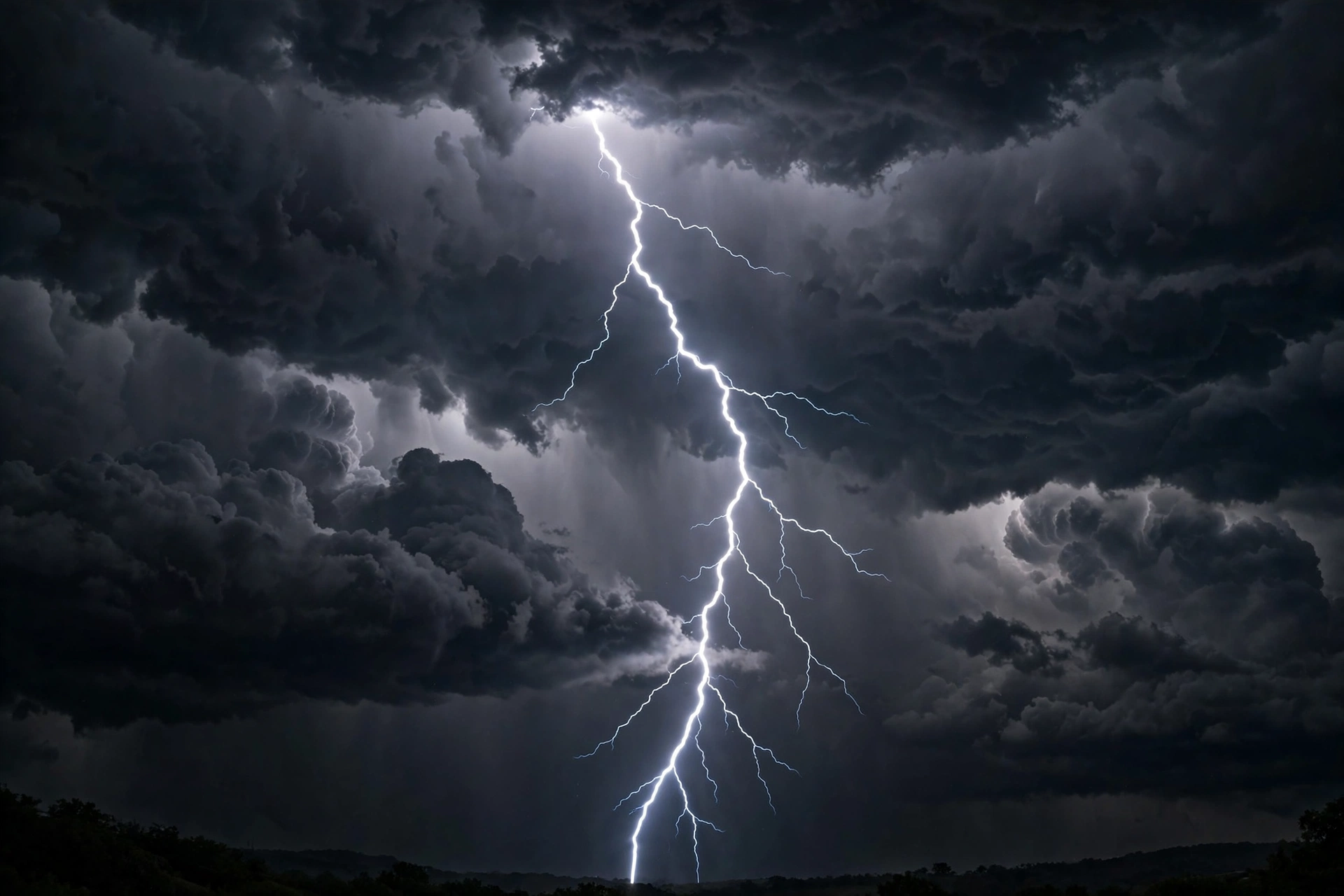
What Causes Thunder and Lightning?
You are walking home on a warm evening. The sky turns dark. Then a bright flash splits the sky, and a few seconds later a deep boom shakes the air. That flash is lightning. That boom is thunder. They come from the same event, but you see one before you hear the other.
Lightning is one of the strongest shows in nature. A single bolt can be hotter than the surface of the sun. Thunder is the sound of that bolt. Together, they tell you that a storm cloud is full of energy.
This article explains how it all works, in plain words: how a quiet cloud builds up electric charge, why the bolt jumps down, why thunder comes late, and how you can stay safe when a storm is near.
SUMMARY OF THIS ARTICLE
- Lightning is a giant spark of electricity that jumps inside a storm cloud, or between a cloud and the ground.
- A storm cloud builds up electric charge when ice and water drops bump into each other high in the sky.
- Thunder is the sound of air heating up and expanding very fast around a lightning bolt.
- You see the flash first because light travels much faster than sound, and counting the seconds until the thunder tells you how far away the storm is.
- Staying inside a strong building or a car is the safest place during a thunderstorm.
Lightning in One Sentence
Lightning is a giant spark. It is the same kind of spark you sometimes see when you touch a metal door after walking on a carpet, only much, much bigger.
A small spark jumps a tiny gap and makes a tiny click. A lightning bolt jumps through kilometres of air and makes a sound you can hear for many kilometres around. The idea is the same: electric charge builds up in one place, and when the build-up is strong enough, it jumps to another place to balance itself out.
How a Storm Cloud Builds Up Electric Charge
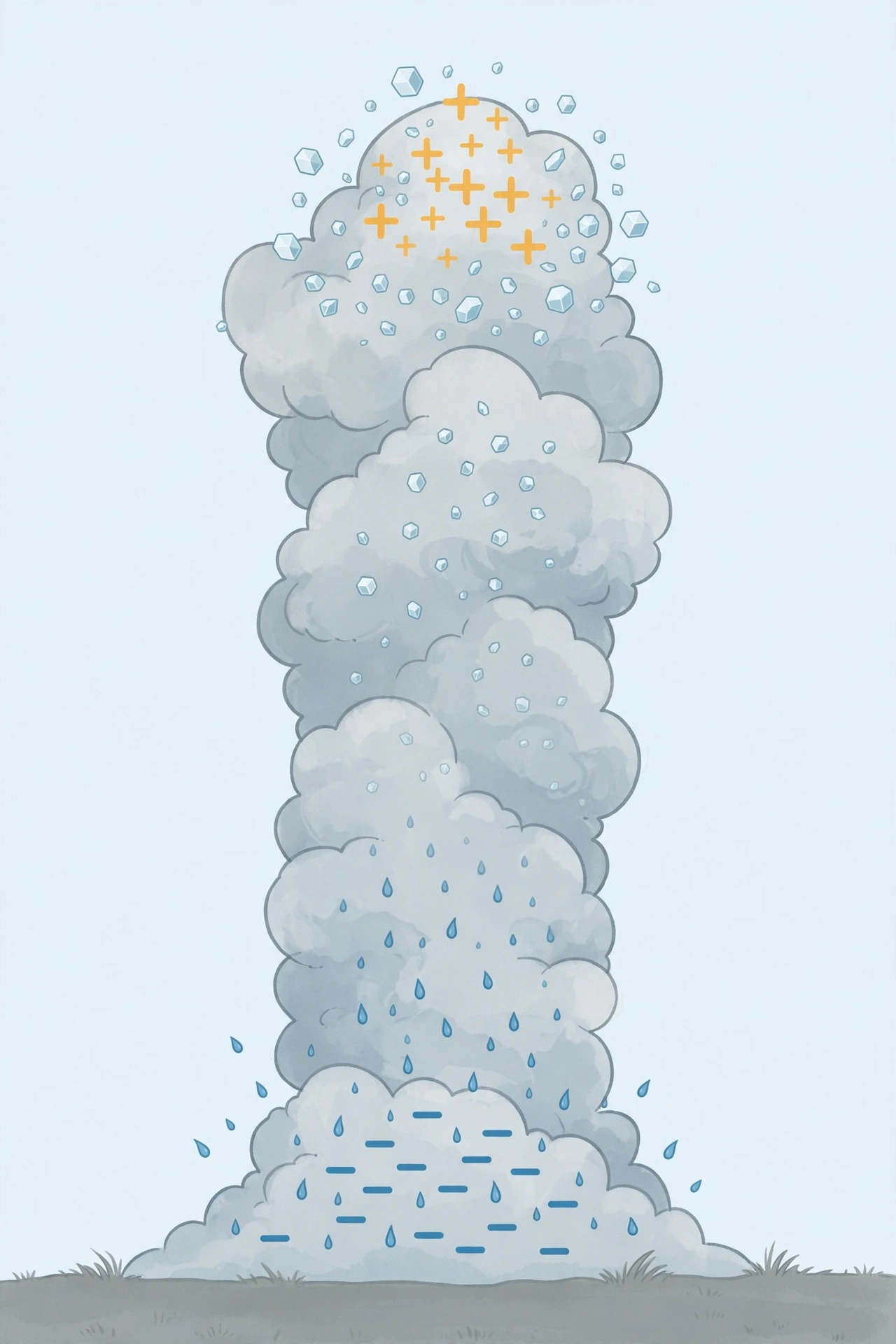
A storm cloud is not like a normal cloud. It grows very tall, like a tower. Warm, wet air rises from the ground, and as it rises it cools. The water in the air turns into tiny drops, and higher up it turns into ice.
Inside the tall cloud, there is a lot of movement. Strong winds push air up and down. Small ice crystals and soft hail bump into each other again and again. Each bump moves a tiny bit of electric charge from one piece to another.
Slowly, the top of the cloud becomes positively charged, and the bottom becomes negatively charged. The top and the bottom pull apart, like the two ends of a battery. This build-up can take 20 to 30 minutes.
The ground below the cloud also changes. The negative charge at the bottom of the cloud pushes away the negative charge on the ground, so the ground under the cloud becomes positively charged. Now there is a strong pull between the cloud and the ground.
When the pull gets strong enough, the air cannot hold it back any more. The charge jumps, and that jump is lightning.
The Lightning Bolt — a Giant Spark
A lightning bolt does not fall in one smooth line. It moves in steps, very fast. First, a thin, faint path of charge moves down from the cloud. It is called a stepped leader. It moves in short jumps, and each jump is about 50 metres long.
When the stepped leader gets close to the ground, something rises to meet it. Tall things on the ground, like trees, buildings, and poles, send up a thin path of positive charge. When the two paths meet, a strong current rushes up from the ground to the cloud. That bright rush is the main flash you see.
The whole thing takes less than a second. Your eyes see one bright bolt, but a fast camera would show many small steps.
A lightning bolt is very hot. The air around it heats up to about 30,000 degrees Celsius in a tiny moment. That is about five times hotter than the surface of the sun. The air heats so fast that it expands with great force, and that is what makes thunder.
Most lightning stays inside the clouds. It jumps from one part of a cloud to another part. Only about one in five bolts reaches the ground. But the bolts that reach the ground are the ones we need to watch, because they are the ones that can hurt people and start fires.
Why Thunder Comes After the Flash
Light and sound both travel, but light is much faster. Light travels at about 300,000 kilometres per second. Sound travels at about 343 metres per second in warm air. That is a huge difference.
When lightning flashes, the light reaches your eyes almost at once, even if the storm is far away. The sound takes longer. It must travel through the air, metre by metre, all the way to your ears.
That is why you see the flash first and hear the thunder later. The longer the wait, the farther away the storm is.
Thunder can sound different in different storms. Sometimes it is a sharp crack, like a whip. Sometimes it is a long, low rumble that rolls across the sky. A sharp crack usually means the bolt was close. A long rumble means the sound came from a long bolt, or it bounced off clouds and hills on its way to you.
Sometimes you see lightning but hear no thunder at all. That usually means the storm is very far away, more than 25 kilometres away. The sound fades before it reaches you. People sometimes call this “heat lightning”, but it is just normal lightning from a far storm.
Counting Seconds to Guess How Far Away the Storm Is
You can guess how far away a storm is with a simple trick. When you see the flash, start counting seconds: one, two, three. Stop when you hear the thunder.
Sound travels about one kilometre every three seconds. So divide the number of seconds by three, and you get the distance in kilometres.
For example, if you count 3 seconds, the storm is about 1 kilometre away. If you count 6 seconds, it is about 2 kilometres away. If you count 15 seconds, it is about 5 kilometres away.
If you count less than 30 seconds, the storm is close enough to be a danger. You should go inside. If the wait gets shorter each time, the storm is moving towards you.
This trick is simple, but it works. It has helped people stay safe for a long time. Try it the next time you see a storm, and watch how the numbers change as the storm moves.
Types of Lightning
Not all lightning looks the same. There are a few common types, and each one tells you something about the storm.
Cloud-to-ground lightning is the type most people know. It jumps from the bottom of a cloud down to the ground. It is the most dangerous type, because it can hit people, trees, and buildings.
Intra-cloud lightning stays inside one cloud. It jumps from one part of the cloud to another part. It is the most common type. You often see it as a soft glow inside the cloud, lighting up the whole cloud from within.
Cloud-to-cloud lightning jumps between two different clouds. It looks like a bright line across the sky. It is less common than intra-cloud lightning, but it can be very bright.
Sheet lightning is not a separate type. It is what you see when a bolt is hidden behind a cloud. The whole cloud lights up like a sheet. It can look soft and pretty, but it is still the same powerful spark.
Ball lightning is rare and strange. People say they have seen a small, glowing ball of light float through the air during a storm. Scientists are still not sure what it is. It is very rare, and it does not happen in most storms.
Why Lightning Hits Tall Things
Lightning looks for the shortest, easiest path to the ground. Tall things stick up into the sky, so they are closer to the cloud. That makes them easy targets.
A tall tree, a church tower, a metal pole, or a person standing alone in an open field can all attract lightning. That is why you should never shelter under a single tall tree in a storm. The tree is a good target, and the current can travel through the tree and into the ground around it.
Water is also a danger. If you are swimming or in a boat, you are on a flat surface, and you are the tallest thing around. Lightning can strike the water, and the current can spread through it. Get out of the water as soon as you hear thunder.
Metal does not attract lightning, but it does carry it well. That is why lightning rods work. A lightning rod is a metal rod on top of a tall building. It gives the bolt an easy, safe path to the ground, so the building is not damaged.
The safest place in a storm is inside a strong building with a roof, or inside a car with a metal roof and closed windows. The building or car gives the current a safe path around you.
Staying Safe in a Storm
Thunderstorms are beautiful to watch, but they can be dangerous. Lightning kills about 24,000 people around the world each year, and many more are hurt. Most of those deaths could be avoided with simple steps.
Here are simple safety tips. These are general information, not emergency advice. If someone is hurt by lightning, call for emergency help at once.
When you hear thunder, go inside. A strong building with a roof and walls is the safest place. Stay away from windows and doors. Do not touch water taps, baths, or metal pipes during a storm, because lightning can travel through pipes and wires.
If you are in a car, stay inside it. Close the windows and do not touch metal parts. A car with a metal roof can protect you, because the current goes around the outside of the car and into the ground.
If you are outside and you cannot get inside, crouch down low. Keep your feet close together and stay away from tall trees, poles, and water. Do not lie flat on the ground. Do not use an umbrella, because it makes you taller.
Wait 30 minutes after the last thunder before you go back outside. Many people are hurt by lightning after they think the storm has passed. The storm may still be close, even if the rain has stopped.
If you are with a group, spread out. Do not stand close together. If lightning hits one person, it can hurt others nearby.
Do not use a phone with a wire during a storm. A mobile phone is safe to use, but a phone with a cord can carry the current. Do not take a shower or a bath during a storm, because the water and pipes can carry the current.

Why Some Storms Have No Thunder You Can Hear
Sometimes you see a storm in the distance, but you hear nothing. There are a few reasons for this.
The storm may be too far away. Sound fades as it travels. After about 25 kilometres, thunder is too quiet to hear. The light still reaches you, but the sound does not.
The wind may carry the sound away from you. Sound travels through air, and strong winds can bend it. If the wind is blowing away from you, the thunder may never reach your ears.
The land can block the sound. Hills, buildings, and trees can get in the way. The sound bounces off them or is absorbed by them. You may hear a soft rumble instead of a loud boom, or nothing at all.
Some storms are also quieter than others. A storm with a lot of rain can muffle the sound. The rain drops absorb some of the energy. The thunder is still there, but it is softer.
If you see lightning but hear no thunder, do not think the storm is safe. It may be moving towards you. Keep watching, and go inside if the flashes get closer.
How Often Does Lightning Strike?
Lightning is common. Around the world, about 100 lightning bolts strike the ground every second. That is about 8 million strikes every day.
Some places get more lightning than others. Warm, wet places near the equator get the most. The place with the most lightning in the world is Lake Maracaibo in Venezuela. There, lightning flashes almost every night for about 300 nights a year. People call it the “never-ending storm”.
In the United States, Florida gets the most lightning. It is called the “lightning capital” of the country. In the United Kingdom, lightning is less common, but it still happens, mostly in summer.
The chances of being struck by lightning are very small. In a lifetime, the chance is about 1 in 15,000 in the United States. But the chances go up if you spend a lot of time outside in storms. Fishermen, farmers, and people who work outside have a higher risk.
Lightning can also start fires. A bolt that hits a dry tree or dry grass can start a wildfire. In some places, lightning is one of the main causes of forest fires.
Lightning Around the World
People have watched lightning for thousands of years. In many old stories, lightning was the weapon of a god. In Greek stories, Zeus threw lightning bolts. In Norse stories, Thor made thunder with his hammer. In Hindu stories, Indra used a lightning bolt called the vajra.
Today, scientists can watch lightning from space. Satellites can see the flashes from high above the Earth. They help scientists learn where storms are and how they move.
Lightning also helps the Earth in a small way. It makes a gas called nitrogen oxide, which helps plants grow. It also cleans the air a little. But these good effects are small compared to the danger it brings.
In some places, people use lightning rods to protect buildings. The idea was first tested by Benjamin Franklin in the 1700s. He showed that lightning is electricity, and that a metal rod can guide it safely to the ground. Today, tall buildings, airports, and power stations all use lightning rods.
Common Myths About Lightning
There are many wrong ideas about lightning. Here are a few of them.
Myth: Lightning never strikes the same place twice. This is not true. Tall buildings are struck many times. The Empire State Building in New York is struck about 20 to 25 times each year.
Myth: Rubber tyres on a car protect you from lightning. This is not true. It is the metal roof and body of the car that protect you, not the tyres. The current travels around the metal shell and into the ground.
Myth: If it is not raining, you are safe from lightning. This is not true. Lightning can strike up to 15 kilometres away from the rain. This is sometimes called a “bolt from the blue”. If you can hear thunder, you are close enough to be in danger.
Myth: You should lie flat on the ground during a storm. This is not safe. Lying flat makes you a bigger target for the current in the ground. Crouching low with your feet together is safer.
Myth: A person struck by lightning is still charged with electricity. This is not true. Lightning does not stay in the body. It is safe to touch a person who has been struck, and you should call for help at once.
Knowing the truth about lightning helps you stay safe. It also helps you enjoy the storm without fear, as long as you are in a safe place.
Frequently Asked Questions
Why does lightning happen?
Lightning happens when a storm cloud builds up electric charge. The top of the cloud becomes positive and the bottom becomes negative. When the charge gets strong enough, it jumps through the air as a giant spark. That spark is lightning.
Why is thunder sometimes loud and sometimes quiet?
Thunder is loud when the bolt is close to you. It is quiet when the bolt is far away, because sound fades as it travels. A long rumble can come from a long bolt, or from sound bouncing off clouds and hills.
Can lightning strike on a sunny day?
Yes, it can, but it is rare. Lightning usually comes from a storm cloud. But a bolt can jump sideways from a storm cloud and strike a place where the sky looks clear. This is called a “bolt from the blue”. If you hear thunder, the storm is close enough to be a danger.
Is it safe to use a phone during a thunderstorm?
A mobile phone is safe to use. A phone with a cord is not safe, because the wire can carry the current. Do not use a wired phone, and do not take a shower or bath during a storm.
What should I do if someone is struck by lightning?
Call for emergency help at once. It is safe to touch the person, because lightning does not stay in the body. If you know first aid, give it. The person may need help with breathing or with the heart.
Why do we count seconds between the flash and the thunder?
We count seconds to guess how far away the storm is. Sound travels about one kilometre every three seconds. If you count 9 seconds, the storm is about 3 kilometres away. If the wait gets shorter, the storm is moving towards you.
More from Zorium Daily
If you liked this story about the sky, you may like these stories too. Read about the Moon during the day — Why Can We Sometimes See the Moon During the Day? Read about why the Moon looks orange near the horizon — Why Does the Moon Look Orange Near the Horizon? Read about why the sky is blue — Why Is the Sky Blue? You can also explore more stories in the Science category.