Who Invented Paper Money?
SUMMARY OF THIS ARTICLE
- Paper money was not invented by one single person. It grew step by step in China, over hundreds of years, because heavy metal coins were hard to carry for big trades.
- The first government paper money in the world was called jiaozi, issued in China during the Song dynasty, in the 11th century, with government control from about 1024.
- Before jiaozi, merchants in China used paper receipts, sometimes called flying cash, so they did not have to carry heavy coins on long, dangerous journeys.
- Paper money worked because people trusted it. When rulers printed too much of it, or fakes spread, trust broke down and prices rose fast.
- Europe learned about paper money much later. Sweden issued the first European banknotes in 1661, about 600 years after China, because its copper coins were far too heavy.
- Today, most money is not paper at all. It is numbers in bank accounts and on phones. But the old idea is the same: money works when people agree to trust it.
A Note in Your Pocket
Take a banknote out of your pocket, if you have one. It is light and thin, and it fits in a wallet. You can buy food, a book, or a bus ticket with it.
Why does a shop accept it? The paper itself is not worth much. You cannot eat it or build a house with it. The shop accepts it because of trust: it trusts that other people will accept it too, and that the government or bank behind it will keep its promise. That trust is the real invention behind paper money.
This is a story from history about how that trust was built, broken, rebuilt, and spread around the world. It starts in China, more than 1,000 years ago, with a simple problem: coins were too heavy.
The Short Answer First
Who invented paper money? The short answer is: the people of China, during the Song dynasty, in the 11th century.
The longer answer is more honest. No one person invented paper money in one go. Merchants, shopkeepers, bankers, and rulers each added one small step: first paper receipts for coins left in a safe place, then private notes traders passed from hand to hand, then official notes made and controlled by the government.
Historians often point to one key year: about 1024, when the Song government set up an office to issue jiaozi, the first state paper money. That date is widely used, but early history is not always exact, and historians still debate small details about the very first private notes. The big picture is clear: China came first, by hundreds of years. So if a test asks, “Who invented paper money?” the safe answer is “China, in the Song dynasty.” There is no single inventor to name.
Before Paper Money: Barter, Shells, and Coins
Long before paper money, people traded directly. A farmer with extra grain might trade with a fisher who had extra fish. This is called barter, and it works only when both people want what the other person has.
So people started to use things that everyone agreed had value, such as shells, salt, beads, cloth, and animal skins. These were better than barter, but still awkward: shells can break, salt can melt in rain, and skins are hard to divide into small amounts.
Then came metal coins. A coin had a set weight and a set value. You could count coins and save them. China made early coins, and so did lands around the Mediterranean Sea, such as Lydia and Greece, in about the 600s BCE. BCE means “Before Common Era,” the years before year 1.
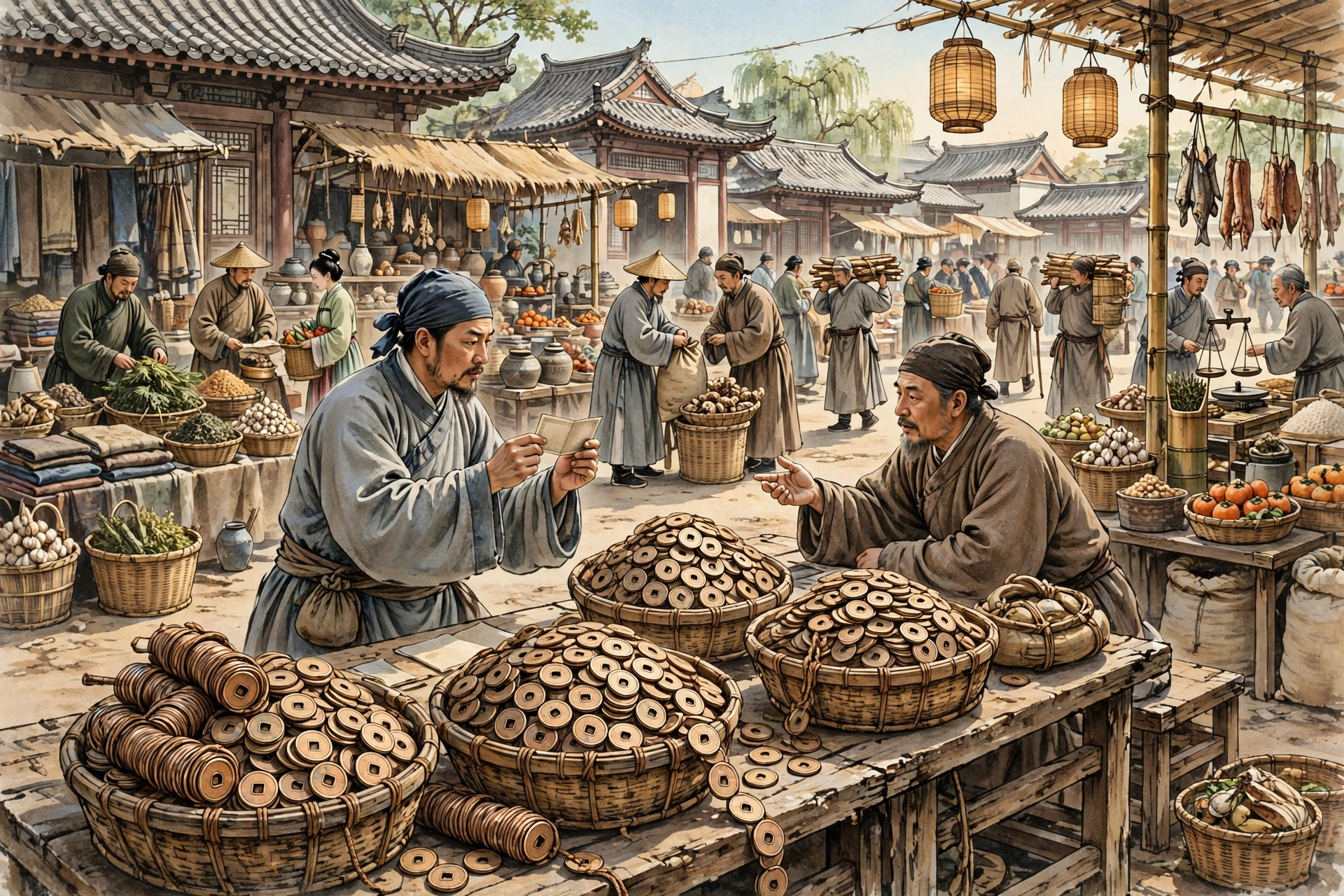
But coins had their own problem, and in China it was very large. Chinese coins, called cash, were often made of copper or bronze, each with a hole in the middle, so people could thread many coins on a string, like beads. For small shopping, that worked fine. For big shopping, it was a nightmare: buying a horse or a cart of rice might need thousands of coins, weighing several kilograms, so traders had to hire carts and guards just to move their money.
Worse, China sometimes did not have enough copper, and in some areas it used iron coins, even heavier for the same value. A trader in Sichuan, in southwest China, faced this problem every day. People needed a lighter way to move value, and that need gave birth to paper money.
How Paper Itself Was Invented
Paper money could not exist before paper itself, and paper was also invented in China. Most books tell of a court official named Cai Lun who, in about 105 CE, during the Han dynasty, improved how paper was made, using tree bark, hemp, old cloth, and fishing nets. CE means “Common Era,” the years from year 1 onward.
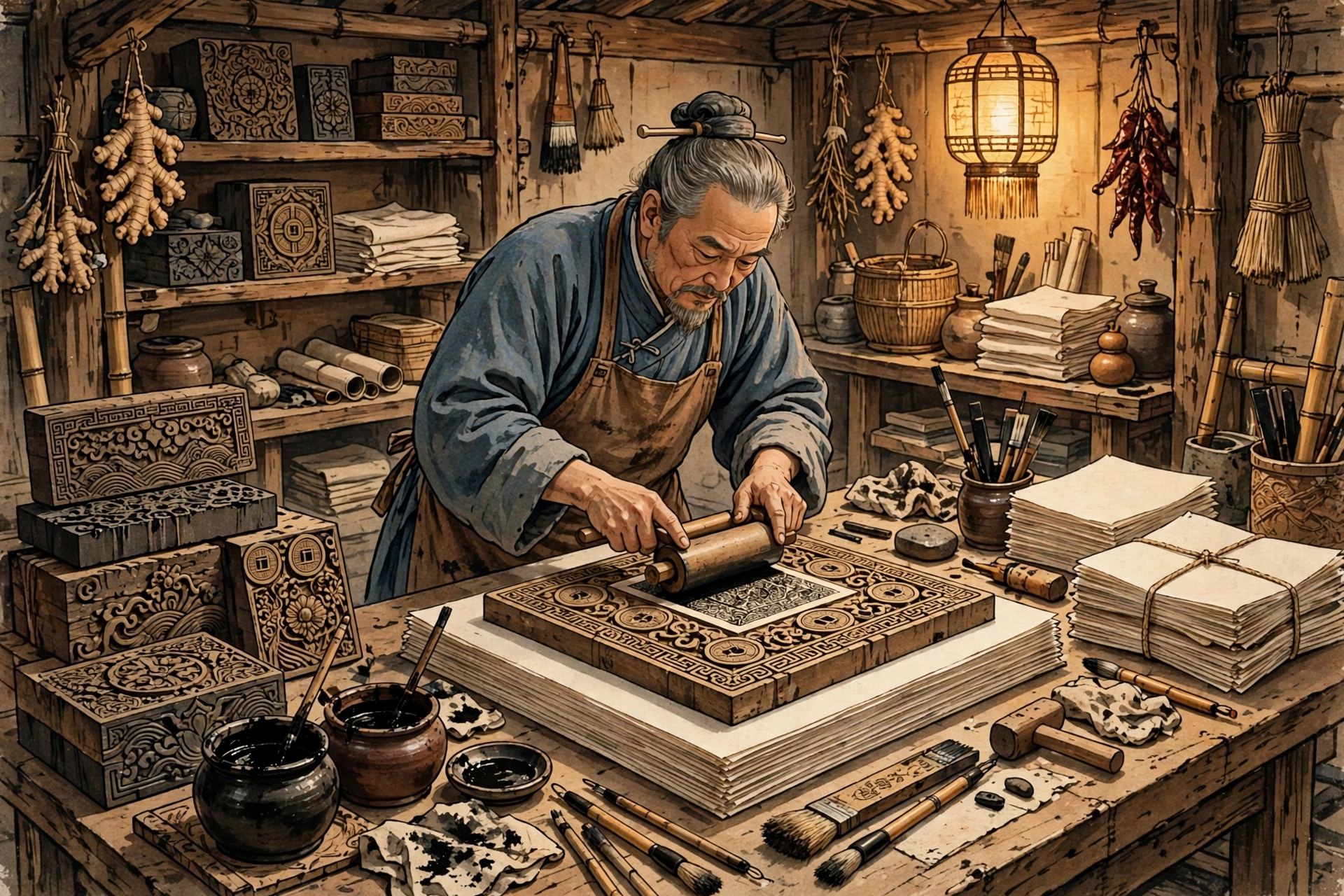
Historians are careful here: people in China may have made rough paper a little earlier. Cai Lun’s work still matters because he made paper better, cheaper, and more useful. Paper was light, flat, and easy to write on, could be cut to a set size, stamped with a seal, and carry a promise in writing. China also developed woodblock printing, where a design was carved into wood, covered in ink, and pressed onto paper, so workers could make many copies of the same note. Without cheap paper and printing, paper money could not have worked.
The First Step: Flying Cash in the Tang Dynasty
The Tang dynasty ruled China from 618 to 907 CE. Trade was growing, but merchants travelling long distances had to carry heavy coins to pay for silk, tea, and grain, on long roads where robbers were a real danger.
So merchants found a smarter way. A merchant in one city could leave his coins with a trusted agent, shop, or government office, and receive a paper receipt stating how much he had left behind. He could then travel light to another city, show the receipt, and collect coins there, or use the receipt to pay someone else.
These early paper drafts were often called flying cash, because the money seemed to fly from city to city while the heavy coins stayed safe in one place. Flying cash was not yet true paper money, because it was still a receipt for coins held elsewhere. But it taught a huge lesson: a piece of paper could stand for money, if people trusted the person who gave it. Historians debate the exact start of flying cash, so dates from this early period are approximate, not exact to the year.
The Big Step: Jiaozi in the Song Dynasty
The Song dynasty ruled China from 960 to 1279 CE. Trade grew bigger, cities grew, and taxes were often paid in money rather than grain or cloth, so the old weight problem got worse.
In Sichuan, sixteen merchant companies came together and began to issue paper notes called jiaozi. At first these were private notes: a person left iron coins with a merchant house and received a jiaozi note, which could later be used to pay someone else or exchanged back for coins. Some houses issued too many notes and could not pay coins back, so trust fell and the government stepped in with rules.
Then, in about 1024, the Song government took direct control, setting up a special office in Chengdu, the capital of Sichuan, to issue jiaozi. This is the moment most historians call the birth of government paper money. The notes were printed with woodblocks, in several colours of ink, on special paper, with different fibres at different offices to make fakes harder to copy, and each note carried seals, marks, and a value.
Early jiaozi notes expired after about two or three years and had to be exchanged for new ones, sometimes for a small fee, and they worked only in certain areas at first. Over time the system grew: in 1107 the currency was given a new official name, qianyin, and spread beyond Sichuan, and later the Southern Song government issued other notes, called huizi, in large amounts. By 1265 the Song government tried a truly national paper currency, but it lasted only about nine years, because the Song dynasty was weakening and fell to the Mongols in 1279.
Why Paper Money Worked So Well
Paper money solved real problems. It was light, so a trader could carry a large amount of value in a small pocket instead of hiring a cart for coins. It was easier to count and store than heavy chests of metal. It helped trade grow, because buyers and sellers were no longer limited by how much metal they could carry. And it let the government manage money in a new way, by printing notes and setting rules about their value — a power that was useful, but also dangerous.
Above all, paper money worked because of trust and rules. People accepted a note because they believed they could use it again tomorrow, and because the government said it must be accepted. Seals, colours, special paper, and harsh punishments for fakes all helped build that trust. Without trust, a note was just a pretty piece of paper.
When Paper Money Went Wrong
Paper money had three big enemies: too much printing, fakes, and loss of trust. China met all three, and the lessons still matter today.
The first enemy was overprinting. When a government needs money fast, for a war or a crisis, printing more notes looks easy. But if the number of notes grows much faster than the amount of goods to buy, each note buys less and prices rise. This is called inflation: in simple words, your money buys less than before. Song, Yuan, and Ming rulers all fell into this trap, printing more notes to pay soldiers and bills, until traders raised prices and people began to refuse the notes or trade only in silver and coins.
The second enemy was counterfeiting, which means making fake money to cheat people. Early Chinese printers tried to stop fakes with complex designs, many colours, special paper fibres, seals, and signatures, and the punishment was often death. Even so, skilled fakers kept trying, because fake money could buy real goods, and every fake note made honest people less sure about real notes too.
The third enemy was war and weak government. When a dynasty was falling, people stopped trusting its promises and went back to silver, gold, grain, or barter. The Ming dynasty, which ruled China from 1368 to 1644, printed too much paper money without enough backing, and by about 1450 it had largely stopped its programme. China then relied mostly on silver for hundreds of years, until the late 1800s, when the Qing dynasty began to issue the yuan. The lesson is simple: paper money is a promise. If the promise is kept and the amount is controlled, it works. If the promise is broken, the paper becomes worthless.
Marco Polo and the Wonder of the West
For hundreds of years, most people in Europe had never seen paper money. They used coins made of gold, silver, and copper, valuable because the metal itself was valuable. Paying with paper seemed strange, even foolish.
Then came travellers from Europe to Asia, along the Silk Road and by sea. The most famous was Marco Polo, a merchant traveller from Venice, in Italy, who is said to have spent many years at the court of Kublai Khan, the Mongol ruler who founded the Yuan dynasty in China. His book described many wonders of China, including paper money.
Marco Polo wrote, in words that amazed European readers, that the Great Khan paid his people and armies with pieces of paper made from mulberry tree bark, stamped with the Khan’s seal, which no one dared to refuse on pain of death. Merchants brought gold, silver, and gems to the Khan and received paper in return, which they could use all over the empire. A large amount of value weighed almost nothing, while the same value in gold would be heavy to carry.
Historians debate some details of Marco Polo’s story, including how far he personally travelled; some parts may have come from other travellers’ tales. But the core fact is not in doubt: the Yuan dynasty did use paper money, called chao, across a wide area, and the Mongols carried it beyond China, into Persia and other parts of their empire.

Europe Finally Tries Paper Money: Sweden
Europe’s first real banknotes came from Sweden, and once again the reason was heavy coins. Sweden had a lot of copper but not much silver, so it made large copper coins, called daler; some copper plates could weigh up to about 20 kilograms, so buying a house in copper would need a cart.
In 1656, a merchant named Johan Palmstruch started Sweden’s first bank, Stockholms Banco, in Stockholm. In 1661, it began to issue paper credit notes, called kreditivsedlar, promising payment in metal coins on demand, signed by hand, stamped with seals, and printed on handmade paper.
At first the notes were a great success, but the bank made the same old mistake: it issued too many notes and lent too much money without enough metal backing them. When people came to claim their coins, the bank could not pay them all. It failed in 1667, and Palmstruch was punished for mismanagement. Yet the failure did not kill the idea. In 1668, Sweden founded a new bank from the ruins of the old one. That bank, later called Sveriges Riksbank, is now known as the world’s oldest surviving central bank — a country’s main bank, which helps control money and supports other banks.
England, France, and the Paper Money Bubble
After Sweden, other European countries tried paper money, with mixed results. The Bank of England was founded in 1694 and began to issue banknotes, at first handwritten promises to pay coins on demand. Over time printed notes became normal, and the bank helped make them trusted in Britain because it was strong, careful, and backed by law.
France had a more dramatic story. In 1716, a Scottish banker named John Law set up a bank in France and began to issue paper money to help a country deep in debt after wars. At first his system seemed to work: people bought shares in his Mississippi Company, which promised trade riches in North America, and prices rose fast. A new word appeared in Paris: millionaire. Then trust broke. Too much paper had been printed, and in 1720 a government order cut the value of the notes. Panic spread, people rushed to turn paper into coins, the system collapsed, and Law fled France in disguise. France’s bubble — a fast rise and fall — taught Europe the same lesson China had learned centuries earlier: paper money helps an economy grow only if its amount is controlled and its promise is kept.
Paper Money in America
The United States also learned about paper money through war and trouble. During the American Revolution, from 1775 to 1783, the Continental Congress needed money to pay soldiers and buy supplies, but it had little gold or silver, so it printed paper notes called Continentals. At first people accepted them out of patriotism and hope, but Congress printed more and more, from a few million to hundreds of millions, and the notes lost value fast. British forces made things worse by printing fake Continentals and spreading them in America. By the end of the war, Continentals were almost worthless, and Americans began to say that something useless was “not worth a Continental.”
After independence, Americans were cautious about paper money. The Constitution gave Congress the power to coin money and punish counterfeiting, but many different banks issued their own notes for a long time, which caused confusion, and some banks failed, leaving their notes worthless. Slowly the system became more central and trusted, with national banknotes and later Federal Reserve notes becoming standard.
What Is a Banknote, Really?
What makes a modern banknote different from the early jiaozi or the Swedish kreditivsedlar? Less than you might think. A modern banknote is still a promise. In most countries today, it is not backed by a fixed amount of gold in a vault — you cannot take a note to a bank and demand gold for it. Instead, it is backed by law, by the economy, and by the trust of the people who use it. Economists call this fiat money, from a Latin word meaning “let it be made”: it has value because the government says it is legal money, and because people agree to use it.
That is why central banks are so careful: they try to keep the amount of money in line with the amount of goods and services in the economy. If they print far too much, prices rise and trust falls. If they print far too little, trade can slow down. Modern notes also carry security features early notes did not have: special paper or polymer (a type of plastic), watermarks, security threads, colour-changing ink, tiny printing, and raised marks for blind people — the modern version of the Song dynasty’s coloured inks, special fibres, and seals.
Coins still exist for small amounts, but in many countries people now use cards, phones, and online payments even more than cash. First, heavy metal became light paper. Now, light paper is becoming invisible numbers. The form changes. The idea stays the same: a trusted promise that lets strangers trade with each other.
Why This Old Story Matters Today
You might think paper money is old history, with no link to your life. But it matters for three reasons. First, inventions rarely come from one genius alone: paper money came from merchants tired of heavy coins, printers who could copy designs, rulers who needed to pay armies, and ordinary people who agreed to trust a note. Second, trust is the most valuable part of money — a note is only as strong as the promise behind it. Third, printing more money does not create more food, houses, or medicine. It only divides the same goods among more notes, so each note buys less. That is why the old failures in China, Sweden, France, and America still appear in school books today.
The next time you hold a banknote, or tap a phone to pay, remember the merchants of Sichuan with their heavy iron coins, the woodblock printers in Chengdu, and Marco Polo’s amazement — and the simple question at the heart of it all: who do we trust, and why?
Frequently Asked Questions
Who invented paper money?
Paper money was invented in China, during the Song dynasty, in the 11th century. There was no single inventor. Merchants, bankers, and the government each added steps, from paper receipts to private notes to official notes called jiaozi, which the government took control of in about 1024.
When was paper money first used?
Paper receipts for coins, sometimes called flying cash, were used in China during the Tang dynasty, from 618 to 907 CE. The first government paper money, jiaozi, came in the Song dynasty, in the 11th century, with government control from about 1024. Exact early dates are approximate, and historians debate small details.
What was the first paper money called?
The first government paper money was called jiaozi, in China. Later Chinese paper money had other names, including qianyin, huizi, and chao. In Europe, the first banknotes were Swedish credit notes, called kreditivsedlar, issued in 1661.
Why was paper money invented?
It was invented because metal coins were too heavy and hard to carry for large trades. In parts of China, iron coins were especially heavy. Paper notes were light, easy to carry, easy to count, and safer on long journeys, and they helped trade grow.
Did Marco Polo invent paper money?
No. Marco Polo was a traveller from Venice who described Chinese paper money to European readers after visiting the court of Kublai Khan. His book helped Europeans learn about the idea, but paper money had already existed in China for hundreds of years. Historians debate some details of his travels, but the Yuan dynasty’s use of paper money is well known.
Which country was first in Europe to use paper money?
Sweden was first in Europe. In 1661, Stockholms Banco, Sweden’s first bank, issued paper banknotes, because its copper coins were extremely heavy. The bank later failed because it issued too many notes, but Sweden went on to found the world’s oldest surviving central bank in 1668.
Why did early paper money sometimes fail?
It failed mainly for three reasons: rulers printed too much of it, fakes spread, and people lost trust during wars or weak rule. When too many notes chased the same goods, prices rose fast and notes lost value. This is called inflation. When people stopped trusting the promise behind a note, they went back to silver, gold, or barter.
Is paper money still backed by gold today?
In most countries, no. Modern banknotes are not backed by a fixed amount of gold. They are backed by law, by the economy, and by public trust. This is called fiat money, and central banks try to control the amount of money so prices stay fairly stable.
More from Zorium Daily
If you liked this story about how money changed, you may also like our story about why we have seven days in a week, which explains how another everyday system took its shape long ago. You can also read how ancient people measured an hour without modern clocks, using the sun, shadows, and water. For more, visit the History section on Zorium Daily.
You may also like Why Do Prices Go Up? Inflation Explained in Simple Words, which explains inflation in simple words.