Who Invented the First Aeroplane? Explained Simply
SUMMARY OF THIS ARTICLE
- The first aeroplane was invented by two brothers, Orville and Wilbur Wright, bicycle makers from Ohio in the United States.
- Their machine, the Wright Flyer, lifted off the ground at Kitty Hawk on 17 December 1903, and Orville stayed in the air for 12 seconds and flew 120 feet.
- Their real breakthrough was not the engine. It was a way to steer the machine in the air, called three-axis control.
- Before the Wright brothers, people had flown in balloons and gliders, but nobody could control a powered machine in the air and land it safely.
- Today we say “airplane” in the United States and “aeroplane” in Britain. Both words mean the same machine.
A Boy, a Toy, and a Dream That Would Not Let Go
Think of a child on a long flight, pressed against the small window, watching the clouds drift past far below. The plane is huge and heavy, yet it floats in the sky as if it weighs nothing. Sooner or later the child turns to a parent and asks the question every curious person asks: who thought of this first? Who looked up at the birds and decided that people could fly too?
Long before that child, there were two boys in a small house in Ohio who asked the same question. Their father, a church minister, came home one day with a small toy: a little helicopter made of paper and cork, with a rubber band that spun a tiny propeller. When you wound it up and let it go, it flew up to the ceiling. The boys played with it until it broke, and then they built their own copies out of paper and bamboo. That toy was their first taste of flying, and the taste never left them.
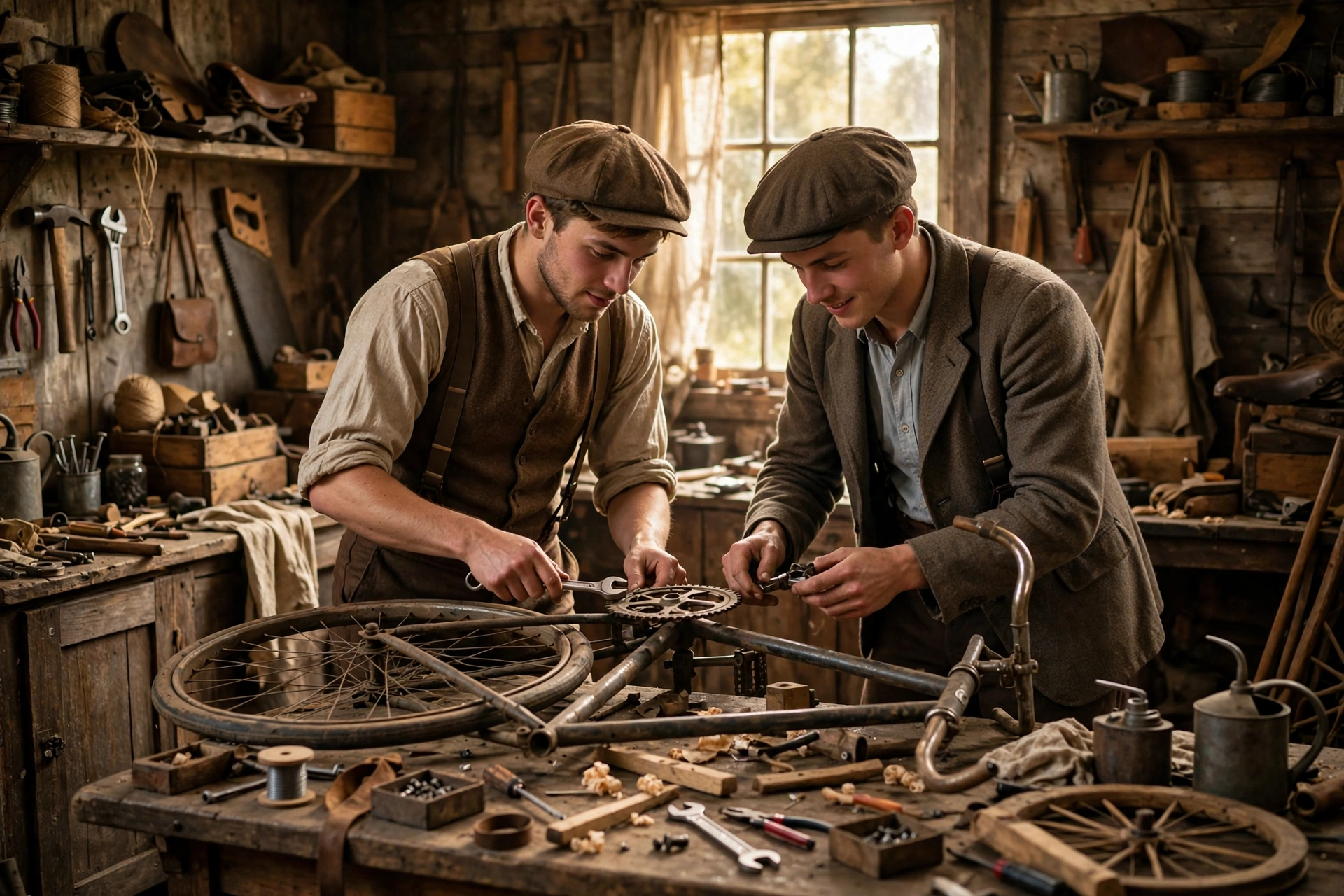
Those two boys were Orville and Wilbur Wright. They grew up to run a small bicycle shop, fixing bikes and selling new ones. They were not rich, and they had never been to university. They were two ordinary brothers with a workshop, a few tools, and a stubborn idea. And in the end, those two ordinary brothers did what kings, armies, and rich inventors had failed to do for hundreds of years. They built a machine that could fly, and they flew it themselves.
The Honest Answer: Two Bicycle Makers from Ohio
So who invented the first aeroplane? The honest answer is Orville and Wilbur Wright, two brothers from Dayton, Ohio. Their machine was called the Wright Flyer. On 17 December 1903, at Kitty Hawk in North Carolina, Orville lay down on the lower wing, the engine roared, and the Flyer rose into the air. He stayed up for 12 seconds and travelled 120 feet, about the length of a cricket pitch. Then the machine came down and landed on the sand.
Twelve seconds does not sound like much. A person can hold their breath longer than that. But those twelve seconds changed the world, because they were the first twelve seconds of controlled, powered, sustained flight by a heavier-than-air machine. Let us take those words apart, because they matter.
Controlled means the pilot could steer. The machine did not just shoot into the air and crash wherever the wind took it. The pilot could turn it, keep it level, and bring it down in one piece. Powered means it had its own engine: no hill to slide down, no strong wind to push it. Sustained means it stayed in the air for more than a brief hop. And heavier-than-air means the machine was heavier than the air around it, like a bird, not lighter like a balloon. A balloon floats because it is full of hot air or gas. A bird flies because its wings push against the air — and so did the Wright Flyer.
That is why the Wright brothers get the credit. Other people had built machines that left the ground before them. But nobody before the Wrights had put all four things together in front of witnesses, with a camera taking photographs to prove it.
Why Flying Was So Hard
People had dreamed of flying for thousands of years. In a Greek story, Daedalus made wings from feathers and wax for himself and his son, and they flew away from prison. But nobody knew how to make the dream real.
The first people who really got off the ground did it with balloons. In 1783, two French brothers, Joseph-Michel and Jacques-Etienne Montgolfier, built a big balloon of paper and cloth, filled it with hot air, and watched it rise over Paris carrying a sheep, a duck, and a rooster. A few weeks later, two men went up themselves and flew over Paris for about twenty-five minutes. But a balloon is at the mercy of the wind. It can rise and fall, but it cannot be steered the way a bird can. It goes where the wind takes it. That is floating, not flying.
Then came the gliders: machines with wings but no engine. You launch one from a hill, and it slides down through the air, the way a paper plane slides across a classroom. The most important glider maker was a German engineer, Otto Lilienthal. In the 1890s, he made more than two thousand glider flights from hills near Berlin. But in 1896, a sudden gust tipped his glider over, and he fell from about fifty feet and died. The glider could not be steered well enough to save him.
Before Lilienthal, an Englishman named Sir George Cayley had worked out the basic idea of a modern aeroplane on paper: fixed wings, a tail to keep it steady, and a propeller to push it forward. He even built a glider that carried a person in 1853. But the engines of his day were made of heavy iron and burned coal, far too heavy to fly. His ideas were right, but the machines of his time could not catch up with them.
So by 1900, the pieces were on the table, but nobody had put them together. People knew wings could lift and propellers could push. What nobody knew was how to keep a flying machine under control in the air. That was the wall every inventor kept hitting, and the wall the Wright brothers decided to climb.
The Secret Was Not the Engine. It Was Steering.
Here is the part most people miss. The Wright brothers did not invent the wing, and they did not invent the engine. What they invented was control, and control was the missing piece that made everything else work.
Wilbur had the key idea while twisting an empty cardboard box in the bicycle shop one day. He noticed that when he twisted the ends in opposite directions, the shape changed smoothly. What if a wing could do the same thing — one wing tip twisting up and the other down, like a bird tilting its wings? Then the machine would lean to one side and turn, the way a cyclist leans into a corner.
That idea became wing warping, and it was the heart of the Wright brothers’ machine. Cables ran from a cradle the pilot lay in to the wing tips. When the pilot shifted his hips, the cables pulled, one wing tip twisted up and the other twisted down, and the machine banked into a turn. It came straight from their years of working with bicycles. A bicycle stays upright because the rider leans and steers at the same time. A flying machine, they realised, needed the same kind of balance: you steer it all the time, with small movements, the way you steer a bike.
But wing warping alone was not enough. A real aeroplane needs to be controlled in three ways at once. A machine in the air can roll from side to side, like a boat rocking in waves. It can pitch its nose up and down, like a seesaw. And it can yaw, its nose swinging left or right, like a car turning a corner. If you cannot control all three, the machine will tip over, dive, or spin, and you will crash.
The Wright brothers built a machine that gave the pilot control over all three. Wing warping controlled the roll. A small wing at the front, called the elevator, controlled the pitch. A tail at the back, called the rudder, controlled the yaw. Together, these three controls are called three-axis control, and they are still the basis of how every aeroplane is steered today. When a pilot in a modern jet moves the controls, the same three things are happening, just with much fancier machinery doing the work.
Kitty Hawk: Why a Lonely Beach?
The Wright brothers lived in Dayton, Ohio, far from the sea. So why did they travel hundreds of miles to a windswept beach in North Carolina to fly their machine? The answer shows how carefully they thought about every detail.
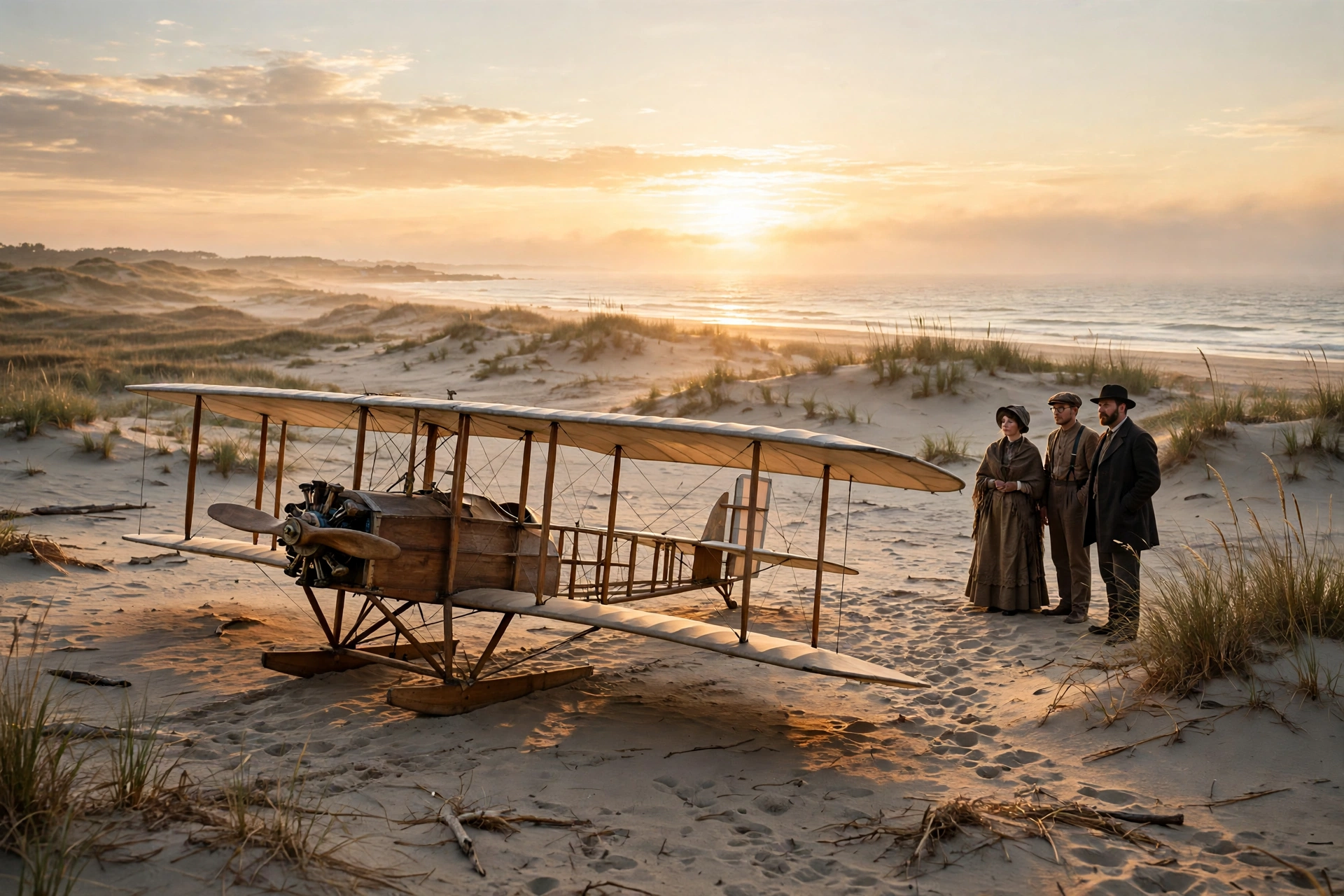
First, they needed wind. A steady wind blowing against the wings gives a machine extra lift, the way a kite rises more easily on a windy day. Kitty Hawk had strong, steady sea winds almost every day. Second, they needed soft ground. A flying machine in 1903 was fragile, made of spruce wood and cloth, and crashes were almost certain. Sand is soft. If the machine came down hard, the sand would cushion it, and the pilot might walk away unhurt. Third, they needed privacy. They did not want crowds, reporters, or rival inventors watching them fail. Kitty Hawk in 1903 was a tiny fishing village with almost nobody in it. There were more sand dunes than people.
There was one more reason, and it was a clever one. The sand dunes at Kitty Hawk were big, smooth hills of soft sand, and the brothers used them the way glider pilots use a hill. They could launch their gliders from the top of a dune and slide down through the air, testing their wings and their steering without an engine at all. For three summers, from 1900 to 1902, they came back to fly gliders and learn. They made hundreds of glider flights and crashed many times. Each crash taught them something. By the time they added an engine in 1903, they already knew how to fly. The engine was the last piece, not the first.
17 December 1903: Twelve Seconds That Changed Everything
The morning of 17 December 1903 was cold and windy, the wind blowing at about twenty-seven miles an hour, strong enough to whip sand across the beach. The brothers had planned to fly the day before, but the wind had been too strong even for them. Now they decided to try.
They set up a wooden rail, about sixty feet long, on the flat sand. The Wright Flyer sat on a small trolley on top of the rail, like a train waiting to leave a station. The rail gave the machine a straight path to speed up before lift-off. The engine, a small petrol engine the brothers had built with their bicycle shop mechanic, Charles Taylor, was warmed up and ready. It made about twelve horsepower, less than a small lawn mower today, but it was light, and light mattered.
Five people watched: three men from the local life-saving station, a boy, and the man who ran the telegraph office. One of them, John Daniels, held the camera. The brothers had tossed a coin to decide who would fly first, and Wilbur won. But his attempt the day before had ended in a small crash, so it was Orville’s turn.
At about half past ten, Orville lay down on the lower wing, flat on his stomach. Wilbur held one wing steady, then let go. The engine roared, the Flyer rolled down the rail, picked up speed, and rose into the air.
It stayed up for 12 seconds and travelled 120 feet, then came down on the sand, a little roughly but in one piece. John Daniels pressed the camera button at just the right moment and took one of the most famous photographs in history. It shows the Flyer just a few feet above the ground, Orville lying on the wing, and Wilbur running alongside it, his coat flapping in the wind. That photograph is still printed in history books all over the world.
The Four Flights That Morning
The brothers did not stop after one flight. One lucky flight could be an accident, and they wanted proof. So they took turns. Wilbur flew next, also for about twelve seconds. Orville flew a third time, staying in the air for fifteen seconds and flying about two hundred feet. Then Wilbur flew the fourth and last flight of the day, and it was the best one yet: fifty-nine seconds in the air, and eight hundred and fifty-two feet across the sand. That is longer than two football pitches laid end to end. By the fourth flight, the machine was not just hopping. It was flying.
After the fourth flight, a strong gust caught the Flyer on the ground and flipped it over. The machine was badly damaged, and it never flew again. The brothers did not mind. They had done what they came to do. They packed up the broken Flyer, sent a telegram to their father in Dayton, and went home. It said they had flown a machine with a motor, the flights were successful, and they would be home for Christmas.
What is striking about that day is how ordinary it all was. There were no crowds, no brass band, and no big ceremony. Just two brothers, five witnesses, a camera, a cold wind, and a machine made of wood and cloth. The world did not notice at first. Most newspapers ignored the story, and many people did not believe it. But looking back now, those four flights were the beginning of everything that followed: air mail, air travel, jet engines, and one day, a machine that would carry people to the Moon. You can read about that later leap in Who Was the First Person to Walk on the Moon? — but that journey began with twelve seconds over the sand at Kitty Hawk.
What About the Other People Who Said “I Did It First”?
Whenever a great invention appears, other people step forward and say they did it first. The aeroplane is no exception. Several names have been put forward, and it is worth meeting them honestly.
In Brazil, many people say the first aeroplane was built by Alberto Santos-Dumont, a Brazilian inventor who lived in Paris. In 1906, three years after the Wright brothers, Santos-Dumont flew a strange-looking machine called the 14-bis in Paris, in front of a large crowd. His flight was public and widely reported, while the Wright brothers had flown in secret on a lonely beach. In Brazil, Santos-Dumont is a national hero. But his machine took off on wheels from flat ground, and the Wrights had flown three years earlier. The Wrights were first. Santos-Dumont was the first to fly in public in Europe, which is a different honour.
In New Zealand, some say a farmer named Richard Pearse flew a machine in 1903, possibly before the Wright brothers. Pearse certainly built a flying machine and got it off the ground. But his machine was not controlled the way the Wright Flyer was, and there is no solid proof of the exact date. Pearse was clever and brave, but the Wrights have the photographs, the witnesses, and the written records from the day itself.
In France, Clement Ader built a machine called the Eole in 1890 and claimed it flew a short distance, but it crashed, it could not be steered, and he never repeated the flight. It was a hop, not a flight.
The pattern is the same in every case. Other inventors built machines that left the ground. Some of them were brave, clever, and years ahead of their time. But none of them had a machine that a pilot could steer, keep in the air, and land safely, and then fly again. The Wright brothers did. That is why historians, museums, and schools give the credit to Orville and Wilbur Wright. They were the first to put all the pieces together and prove it.
From 120 Feet to the Whole World
The change that followed was slow at first, and then it was fast. In the years after 1903, the Wright brothers kept improving their machines. They flew longer, higher, and in circles, and they carried passengers. By 1908, Wilbur was flying in France in front of huge crowds. By the First World War, aeroplanes were watching enemy positions from the sky. By the 1920s, people were flying across oceans.
Today, more than a hundred thousand flights take off every day around the world, and millions of people fly. A journey that took weeks by ship in 1903 now takes a few hours by air. Food, medicine, and letters travel by aeroplane. All of that began with two brothers lying on a wing over the sand at Kitty Hawk, travelling 120 feet in twelve seconds.
One small detail shows how far the journey went. In 1969, the astronaut Neil Armstrong carried a tiny piece of cloth from the Wright Flyer in his pocket when he landed on the Moon. A piece of the first aeroplane travelled to the Moon with the first person to walk there. It was a quiet thank-you from one generation of flyers to another. If you want that next chapter, the article on Who Was the First Person to Walk on the Moon? tells it the same plain way.
The Wright Flyer itself is still with us. The original machine, repaired after the wind damaged it in 1903, now hangs in the Smithsonian museum in Washington, D.C. It looks small and fragile next to the huge jets in the same building, but visitors stop and stare: it is the machine that taught the world to fly.
Their story holds a lesson that goes beyond aeroplanes. They were not the richest inventors or the most famous, and they did not have the best education. What they had was a habit anyone can copy: they tested small things, they learned from every crash, and they never guessed when they could measure. Before they built the Flyer, they tested more than two hundred tiny wing shapes in a wind tunnel in their bicycle shop, and when their measurements disagreed with the books, they trusted their own. Some achievements belong to one person. This one belonged to two brothers, and it is better for it.

Frequently Asked Questions
Who invented the first aeroplane?
Orville and Wilbur Wright, two brothers from Dayton, Ohio, in the United States, invented the first aeroplane. They were bicycle makers, not university professors. Their machine, the Wright Flyer, made the first controlled, powered, sustained flight on 17 December 1903 at Kitty Hawk, North Carolina.
How long was the first flight?
The first flight lasted 12 seconds and covered 120 feet, about the length of a cricket pitch. Orville Wright was the pilot. Later the same morning, Wilbur flew for 59 seconds and covered 852 feet, longer than two football pitches laid end to end.
What is three-axis control, and why did it matter?
Three-axis control lets a pilot steer a flying machine in three ways: rolling from side to side, pitching the nose up and down, and turning the nose left or right. The Wright brothers were the first to give a pilot control over all three at once. Without it, earlier machines wobbled and crashed.
Did anyone fly before the Wright brothers?
Yes, people flew in balloons and gliders before 1903, and some inventors built machines that left the ground for a few seconds. But nobody before the Wright brothers had flown a machine that was controlled, powered, and able to stay in the air and land safely. Balloons float but cannot be steered, and gliders have no engine.
Why did the Wright brothers choose Kitty Hawk?
They chose Kitty Hawk because it had steady sea winds, soft sand for safe landings, and almost no people around. The wind gave the wings extra lift, the sand cushioned crashes, and the quiet beach let them work in private. They had already spent three summers there testing gliders.
What happened to the Wright Flyer after the first flight?
A gust of wind flipped the Flyer over after the fourth flight that morning, and it was badly damaged, so it never flew again. The brothers repaired it later, and today the original Wright Flyer hangs in the Smithsonian museum in Washington, D.C.
More from Zorium Daily
- Who Invented the First Car?
- Who Invented the First Train?
- Who Invented the Telephone?
- How Did People Travel Before Cars Were Invented?
The next time you look up and see an aeroplane crossing the sky, remember that it all began with two bicycle makers, a toy helicopter, and twelve seconds over the sand. The Wright brothers proved that an ordinary person with a careful mind and a stubborn dream can change what the whole world believes is possible.