How Does a Vacuum Cleaner Work? Explained Simply
By Zorium Daily Technology Desk
SUMMARY OF THIS ARTICLE
- A vacuum cleaner does not really “suck” dust up. A motor spins a fan, the air pressure inside drops, and the air outside rushes in to fill the gap, carrying dust along with it.
- A spinning brush loosens dirt from deep inside carpet fibres before the moving air can carry it away.
- The dust is caught in a bag or a bin, and a filter cleans the air before it blows back out into the room.
- The first powered suction cleaner was built by Hubert Cecil Booth in 1901, and the first portable electric home vacuum came from James Murray Spangler in 1907.
- Keeping the bag or bin empty, the filter clean, and the brush free of tangled hair is what keeps a vacuum working well.
The Short Answer
You push a button, a motor hums, and the floor gets clean. But something clever is going on inside, and it is not quite what most of us picture.
Most people say a vacuum cleaner sucks dust up. But a vacuum cleaner cannot really suck anything. There is no pulling hand inside it, no magnet for dust. What it does is much simpler, and once you see it, you cannot unsee it.
A vacuum cleaner moves air. That is its whole job.
Wait — It Does Not Really “Suck”?
Air is always pressing down on everything. You cannot feel it because it presses on you evenly from all sides, all day long. When a vacuum cleaner is off, the air pressure inside the machine and the air pressure in the room are the same. Nothing moves. The dust just sits there.
Switch the machine on and the motor starts spinning a fan. The fan throws air out through the back of the machine. Now there is less air inside than there was a second ago. The pressure inside drops below the pressure in the room. That difference is small, but it is enough. The heavier air outside pushes its way in through the only opening it can find, which is the nozzle on the floor. It rushes in fast, and it sweeps up loose dust and dirt as it goes.
So the cleaning power comes from the air outside, not from the machine reaching out and grabbing things.
The Four Jobs Inside Every Vacuum Cleaner
Every vacuum cleaner, from a cheap upright to a fancy robot that wanders around on its own, has the same four jobs to do. The parts look different from model to model, but the jobs never change.
First, it has to move air. That is the motor and the fan. The motor is the muscle. The fan is the part that actually pushes the air. When the motor spins the fan fast, air is thrown out of the machine and the pressure inside drops.
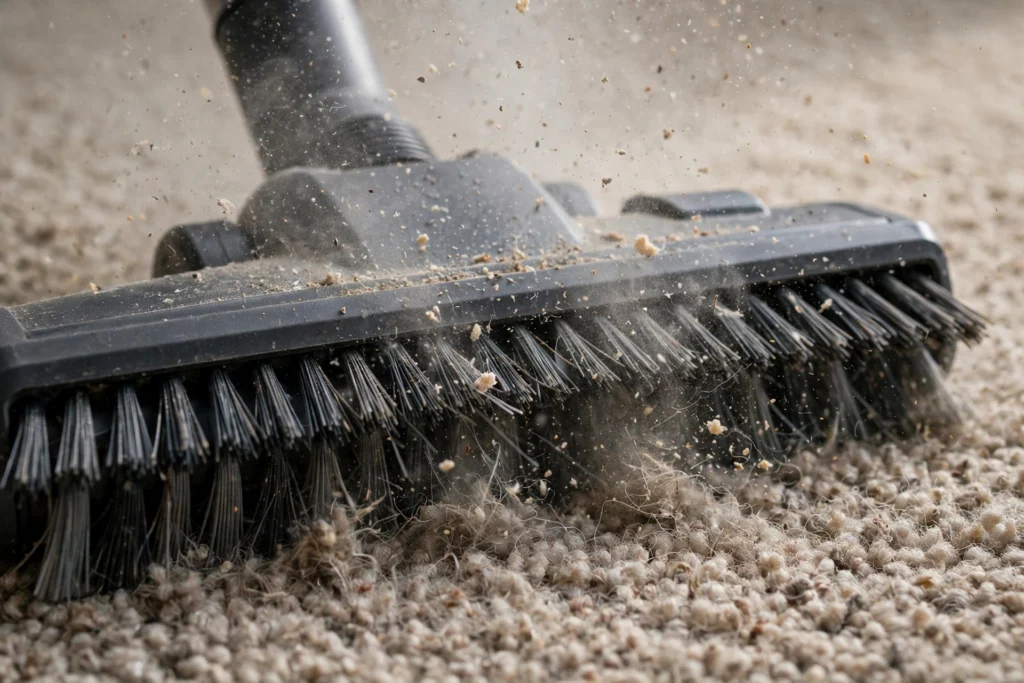
Second, it has to loosen the dirt. That is the brush, sometimes called a beater bar or a brush roll. It is the round, spinning bar with stiff bristles that you can see under the head of an upright vacuum. It spins fast and flicks at the carpet, shaking loose the dirt that is hiding deep down between the fibres. On hard floors there is often no brush at all, or the brush stops spinning, because there is nothing for it to dig into.
Third, it has to catch the dirt. That is the bag or the bin. The dusty air rushes in through the nozzle and hits the bag or bin first. The bag is made of a cloth or paper that lets air through but holds the dust back. Keep the dirt, let the air go.
Fourth, it has to clean the air on its way out. That is the filter. Even after the bag or bin has caught most of the dust, tiny bits are still floating in the air inside the machine. The filter catches those before the air blows back into your room.
Step by Step: What Happens When You Switch It On
Let us walk through one second of cleaning, from the moment your thumb hits the switch.
You press the button. Electricity flows to the motor. The motor wakes up and starts spinning, and it spins fast — thousands of turns every minute in many machines. The fan is fixed to the same spinning shaft, so it spins just as fast.
The fan throws air out of the back of the machine. Inside the machine, the air gets thinner and the pressure drops. Outside, the air in your room is still pressing at its normal strength, and it looks for a way in through the nozzle on the floor.
Air rushes in through the nozzle. It is moving fast now, much faster than the still air in the room. As it rushes across the carpet, it picks up loose dust, crumbs, hair, and tiny bits of paper. The air carries them up through the tube and into the body of the machine.
Inside the body, the dirty air hits the bag or the bin. The dust is too heavy and too big to pass through, so it stays behind. The air, now mostly clean, pushes on through to the filter. The filter catches the fine dust that slipped past the bag. Then the clean air blows out of the back vent, back into the room.
All of that happens in less than a second, over and over, as long as the machine is running. It is a loop: air in, dust caught, clean air out.
A lift uses a motor to pull its cabin up and down a tall building, and a vacuum cleaner uses a motor to spin its fan. Different jobs, same idea.
The Brush: The Part Most People Forget
If moving air did all the work, you could clean a carpet with a hair dryer held backwards. You cannot, and the reason is the brush.
Carpet is not a flat surface. It is a forest of tiny fibres standing up, and dirt falls down between them and hides there. The rush of air from the nozzle only touches the top of that forest. The dirt buried deep down barely feels it. It stays put, and the carpet still looks dirty even after you have been over it three times.
That is why most upright vacuums have a spinning brush roll under the head. The brush spins much faster than the wheels turn. Its stiff bristles reach down between the carpet fibres and flick the buried dirt loose. They shake it, beat it, and lift it up into the path of the rushing air. Once the dirt is loose and floating, the air can carry it away easily.
On a hard floor, though, the brush can be more trouble than help. It can scatter crumbs across the room before the air gets a chance to catch them, and it can scratch a polished floor. That is why many machines let you turn the brush off for hard floors.
Bag or Bin: Where the Dust Goes
The dusty air has to go somewhere, and it has to leave its dust behind. That is the job of the bag or the bin, and the two types of machine do it in slightly different ways.
In a bagged vacuum cleaner, the dirty air flows into a bag made of thick paper or cloth. The material of the bag is full of tiny holes. Air can pass through those holes easily. Dust cannot. The dust stays trapped inside the bag, and the clean air flows out through the walls of the bag. It is a simple idea, and it has worked for more than a hundred years.
A bag has one big weakness, though. As it fills up, the tiny holes in the material get blocked with dust. Less air can get through, the rush of air at the nozzle gets slower, and the machine picks up less dirt.
In a bagless vacuum cleaner, there is no bag at all. There is a clear plastic bin instead, and the air inside it spins around very fast, like water going down a plughole. This spinning throws the dust outward, against the walls of the bin, where it loses speed and drops to the bottom. The air in the middle stays fairly clean and flows on toward the filter.
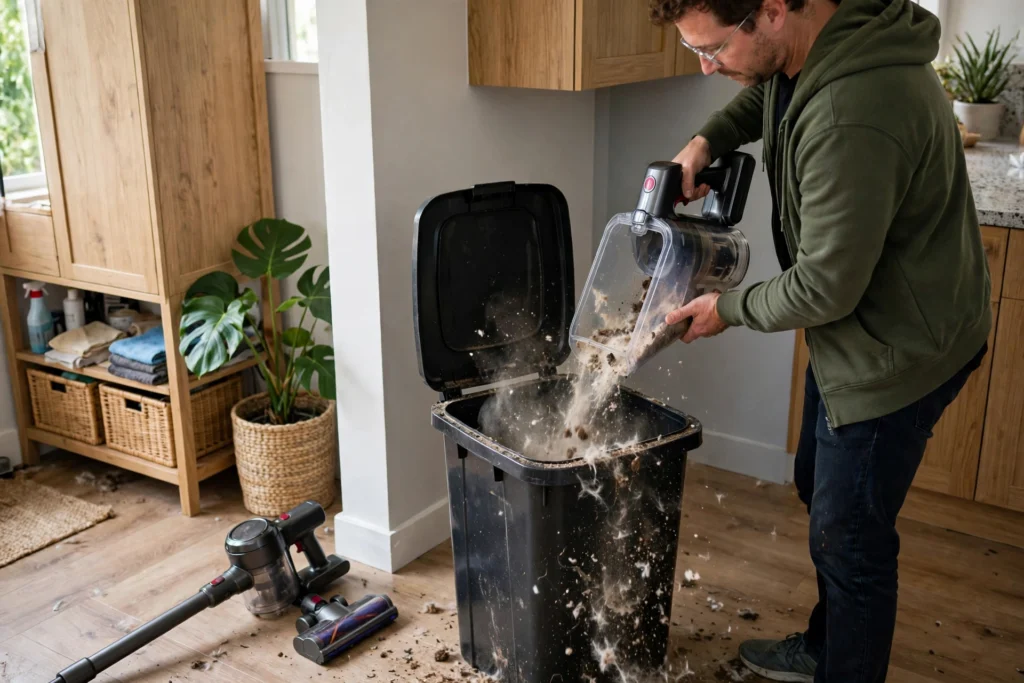
Bagless machines let you see the dust piling up, and you can empty the bin without buying new bags. Emptying a full bin can puff a little dust back into the air if you are not careful, though. Both kinds do the same job in the end.
The Filter: Why the Air Coming Out Is Cleaner
Here is a question most people never ask: if a vacuum cleaner blows air back into the room, why does the room not get dustier?
The answer is the filter, and it is doing more work than you might think. The bag or the bin catches the big stuff — the crumbs, the hair, the bits you can see. But dust is not only big stuff. Some dust is so fine that it floats in the air like smoke. It is far too small to see, and it can slip straight through the bag. If nothing caught it, the machine would just pick it up from the floor and spray it out the back, and you would breathe it in. That would be worse than not cleaning at all.
So the air passes through one or more filters before it leaves the machine. A filter is a sheet of material with very tiny holes, much smaller than the holes in a bag. The finest dust gets stuck in it, and only clean air gets through. Some machines have a basic filter. Others have a HEPA filter, which stands for High-Efficiency Particulate Air. A HEPA filter is made to catch extremely tiny bits, and it is often used in homes where someone has allergies or asthma.
Filters get dirty too, and a dirty filter chokes the machine just like a full bag does. Air cannot get through easily, the pressure difference falls, and the cleaning power drops. Many filters can be tapped gently outside to knock the dust off, and some can be washed and dried. The manual that comes with the machine usually says which kind you have.
A Short History: From Horse-Drawn Machines to Your Cupboard
The vacuum cleaner did not arrive all at once. It grew up in steps, and some of the early steps were wonderfully strange.
The first real powered suction cleaner came in 1901, built by a British engineer named Hubert Cecil Booth. Booth had watched a machine that cleaned by blowing air at chairs and trains, and he thought the idea was backwards. Blowing just moved the dust around. What if the machine sucked the dust in instead? His first machine, nicknamed “Puffing Billy,” was enormous. It was pulled by a horse, parked outside the building, and fed dust in through long hoses pushed through the windows. It was not something you kept in a cupboard, but it proved that suction cleaning worked, and rich homes and hotels paid to have it visit.
The machine that most of us would recognise came a few years later. In 1907, an American janitor named James Murray Spangler built a portable electric vacuum cleaner in his spare time. Spangler had asthma, and the carpet sweeper he used at work filled the air with dust and made his breathing worse. So he built his own cleaner from spare parts: a fan motor, a soap box, a broom handle, and a pillowcase to catch the dust. It was the first vacuum cleaner that looked like the ones we use today.
Spangler did not have the money to build many of them, so he sold his design to William H. Hoover in 1908. Hoover improved it, built a factory, and sent salespeople door to door to show families how it worked.
After that, the changes came steadily. Machines got lighter, bags got better, and bagless machines arrived, using spinning air to separate dust without a bag. Then came cordless machines with rechargeable batteries, and robot vacuums, small flat discs that wander around the floor on their own using sensors. A robot vacuum is really the same four jobs squeezed into a disc. The whole story is a story of shrinking: Booth’s machine needed a horse, Spangler’s needed two hands, and a robot needs nobody at all.
Why Some Vacuums Pick Up Better Than Others
If you have ever used two different vacuum cleaners in the same house, you will know that some pick up more than others. It is not magic, and it is not always about price. It comes down to a few simple things.
The first is airflow. A strong motor that spins the fan fast moves more air, and more air can carry more dust. But a big motor is not everything. The air has to flow smoothly through the machine. If the tube is narrow, bent, or partly blocked, the air slows down, and the cleaning power drops, no matter how strong the motor is.
The second is the seal. The nozzle has to sit close to the floor. If there is a big gap between the nozzle and the carpet, air slips in from the sides instead of rushing across the dirt. The air takes the easy path and skips the dirty patch.
The third is the brush. On carpet, a fast-spinning brush that reaches deep into the fibres makes a huge difference. It frees the dirt that air alone cannot reach. On hard floors, the brush matters much less, and a good seal and strong airflow matter more.
The fourth is how full the bag or bin is, and how clean the filter is. A full bag or a clogged filter chokes the airflow, and everything else suffers.
Bagged, Bagless, Cordless, Robot — What Is Different Inside?
Walk into a shop today and you will see a wall of vacuum cleaners that look nothing alike. Uprights, sticks, handhelds, robots. They are all the same machine in different shapes, with one or two trade-offs each.
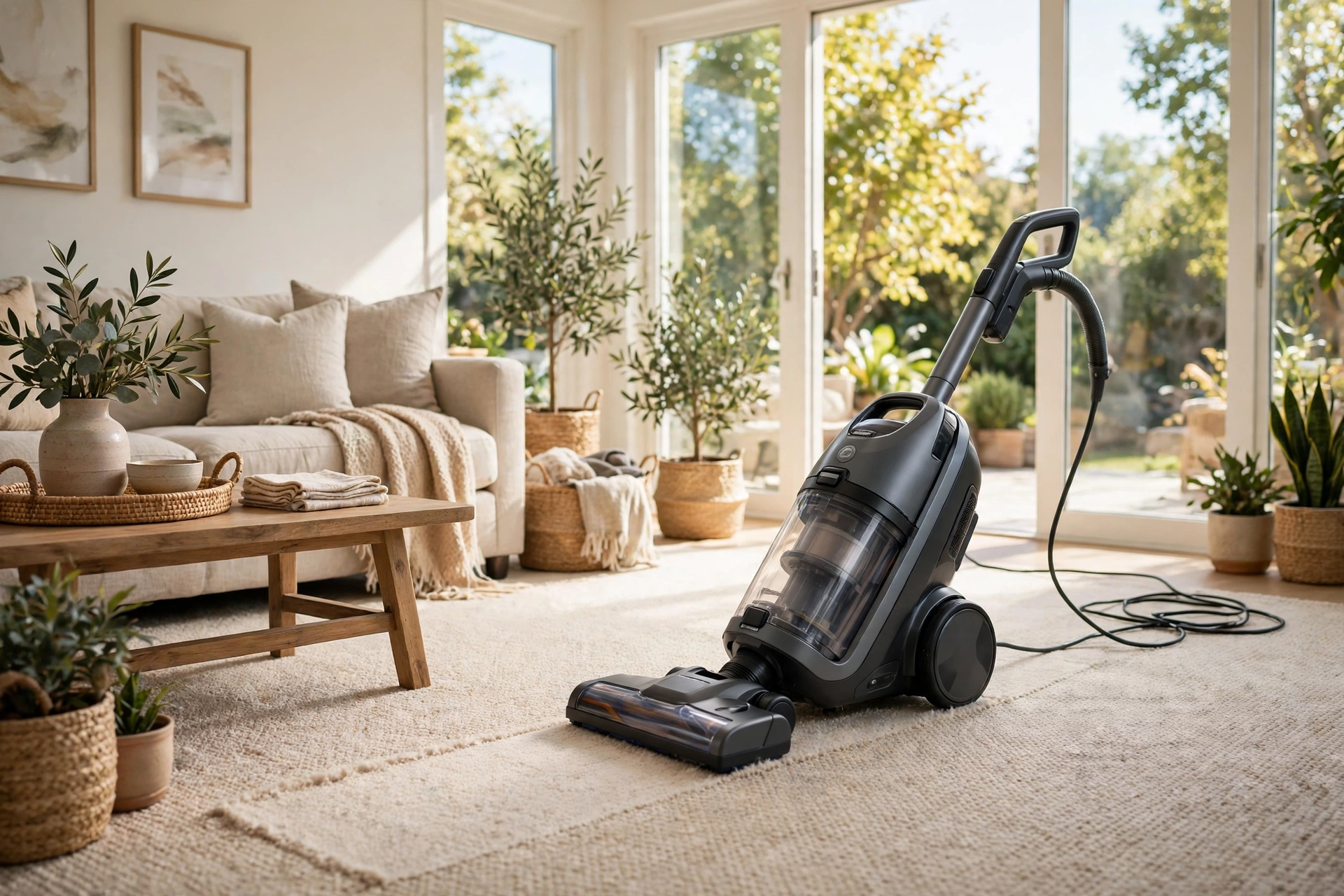
An upright vacuum cleaner is the classic shape: a tall body you push in front of you, with a wide head and a big spinning brush at the bottom. It is strong on carpet. The trade-off is weight, and it can be heavy to carry up stairs.
A stick vacuum cleaner is a long, thin tube with the motor and bin near the handle. It is light and easy to store, and many run on a rechargeable battery, so there is no cord to drag around. The trade-off is time: a battery only lasts so long, and the small bin needs emptying more often.
A handheld vacuum cleaner is a small machine you hold in one hand, made for stairs, car seats, and small spills. It has the same four parts, just smaller and less powerful, so it is for little jobs, not whole rooms.
A robot vacuum cleaner is a flat disc that cleans on its own, using sensors to feel its way around the room. It is wonderful for keeping a floor tidy day after day, but it cannot push deep into a thick carpet the way a big upright can, and it cannot climb stairs.
A robot vacuum finds its way around the room using sensors, a bit like the way a traffic light uses sensors to know when cars are waiting. And a drone stays in the air because its spinning blades push air downward, the same kind of push-and-pull with air that a vacuum cleaner uses, just in the opposite direction.
Everyday Mistakes That Make a Vacuum Work Harder
Most vacuum cleaners do not break. They just get slower and slower until someone gives up on them.
The most common mistake is running with a full bag or bin. People keep going because the machine still makes noise. Noise is not cleaning, though. A full bag chokes the airflow, and the machine just hums while picking up almost nothing. Empty the bin or change the bag when it is about two-thirds full, not when it is bursting.
The next mistake is never cleaning the filter. Filters are quiet workers, and they do not complain. They just slowly clog up. A quick tap outside, or a wash if the manual says it can be washed, brings the airflow back. Let it dry fully before you put it back, because a damp filter grows smells and can damage the motor.
The third mistake is ignoring the brush. Hair and string wrap around it week after week. The brush spins slower and slower until it barely touches the carpet. A minute with scissors every month keeps it free.
The fourth mistake is vacuuming up things the machine was not made for. Wet spills, broken glass, and large bits of food can all cause trouble. Water can damage the motor, and big bits can block the tube. Pick those up by hand first.
A Quick Experiment You Can Try at Home
You do not need any special equipment to see the science of a vacuum cleaner with your own eyes. You just need the machine and a little curiosity.
Take a small pile of dry crumbs, like biscuit crumbs, and put them on a hard floor. Hold the nozzle a short distance above the crumbs, without touching them, and switch the machine on. Watch what happens. The crumbs nearest the nozzle lift first and disappear up the tube. The crumbs a little further away tremble and slide toward the nozzle. The ones furthest away do not move at all.
Now try the same thing on a carpet, pressing the crumbs lightly into the fibres with your hand. Far fewer crumbs move, because the carpet is holding them. Now lower the head so the brush touches the carpet and go over the same patch again. The crumbs lift and vanish. That is the brush doing its job, freeing dirt that air alone could not move.
Frequently Asked Questions
Does a vacuum cleaner really suck up dust?
Not quite. A motor spins a fan, the fan pushes air out of the machine, and the air pressure inside drops. The air outside then rushes in through the nozzle to fill the gap, carrying loose dust along with it. The dust is pushed in by the air around the machine, not pulled in by the machine itself.
Why has my vacuum cleaner lost its cleaning power?
The most common reason is blocked airflow. Check three things: the bag or bin, the filter, and the tube. A bag that is nearly full, a filter full of fine dust, or a sock stuck in the hose can all choke the air and make a strong machine feel weak. Hair wrapped around the brush can slow it down on carpet too.
Bagged or bagless — which one is better?
Both do the same job, and the right choice depends on what matters to you. A bagged machine is tidy to empty, because you just throw the sealed bag away, but you have to buy new bags. A bagless machine costs nothing extra to run and lets you see the dust building up, but emptying the bin can puff a little dust into the air.
Can a vacuum cleaner clean hard floors as well as carpet?
Yes, and in some ways hard floors are easier, because the dirt sits on top instead of hiding between fibres. Turn the spinning brush off for hard floors, so it does not scatter crumbs across the room or scratch a polished surface. A head with soft strips works well here. Move slowly, and let the rushing air pick up the dust in one pass instead of chasing it around.
How often should I empty the bin or change the bag?
Do not wait until it is bursting. Empty a bagless bin or change a bag when it is about two-thirds full, because a full bag or bin blocks the airflow and the machine picks up less dirt with every pass. A quick empty takes a minute, and it keeps the machine working at full strength.
Why does my vacuum cleaner smell bad?
A bad smell usually comes from something damp or old sitting inside the machine. Wet dirt in a bag can turn into a smelly paste, and a filter that was put back while still damp can grow a musty smell. Empty the bin or change the bag, clean or replace the filter, let everything dry fully, and the smell usually goes away with the dirt.
More from Zorium Daily
- How Does a Lift Work?
- How Does a Traffic Light Work?
- How Does a Drone Fly?
- How Does a Remote Control Work?
The next time you switch on a vacuum cleaner, listen to it for a moment before you start pushing it around the room. That hum is a small motor spinning a fan, dropping the air pressure inside, and letting the air in your room do the cleaning. A brush frees the dirt, a bag or bin catches it, and a filter makes sure the air going back out is cleaner than the air that came in. It is a simple idea, more than a hundred years old: air always rushes in to fill an empty space, and if there is dust in its way, the dust comes along for the ride.