Why Do We Have 12 Months in a Year?
SUMMARY OF THIS ARTICLE
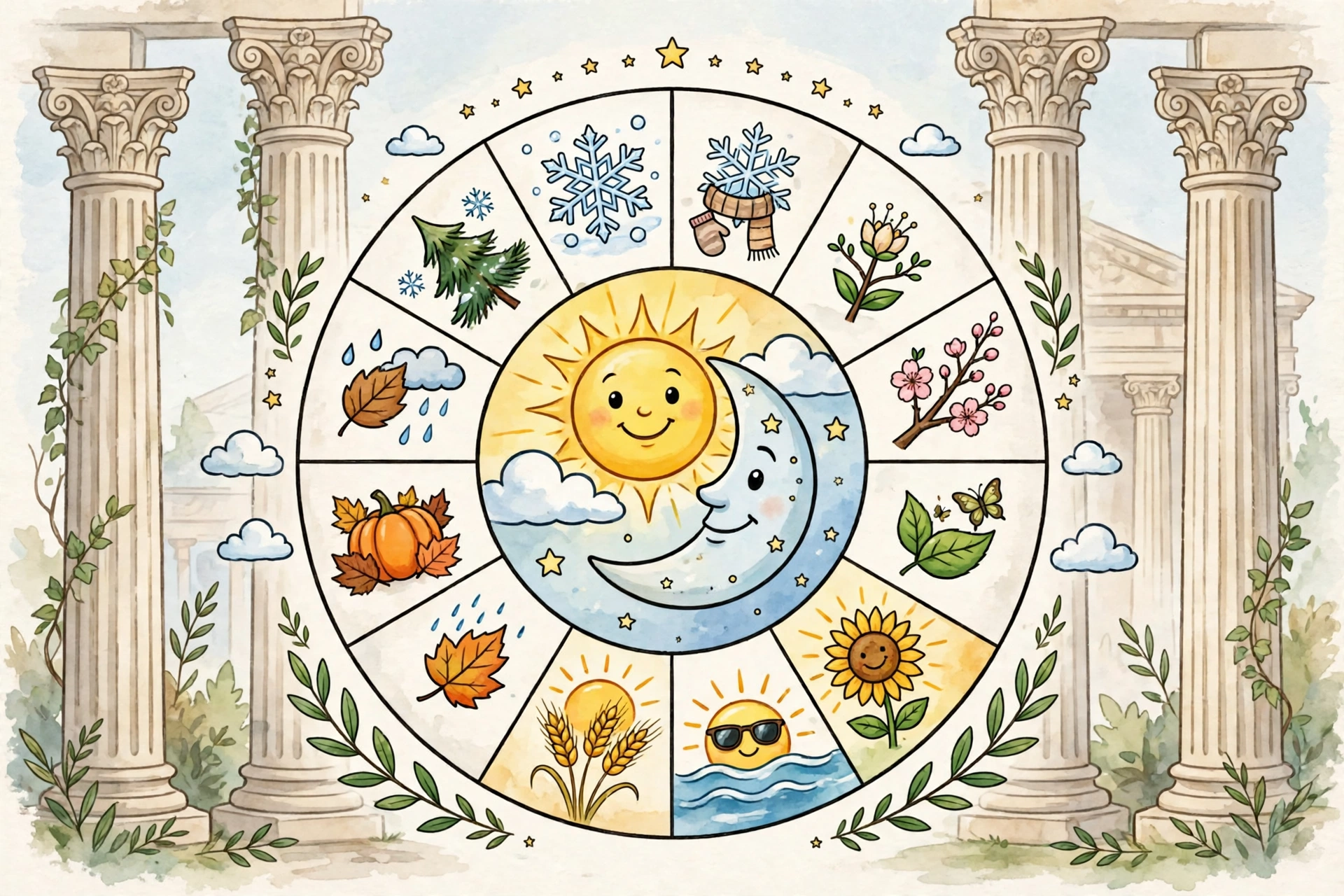
- A year has 12 months mainly because of the Moon. About 12 Moon cycles fit into one trip around the Sun.
- Early calendars, including the Roman calendar, used the Moon and the seasons to divide the year.
- The Roman calendar started with 10 months, then added January and February to make 12 months.
- Later, Julius Caesar reformed the calendar, and the month names we use today come from Roman gods, rulers, and numbers.
- The Gregorian calendar, used in most of the world today, keeps 12 months with a leap day to stay in step with the seasons.
Introduction
Look at any calendar on your wall. You will see January, February, March, and so on, until December. Twelve months, every year, without fail. It feels so normal that we rarely ask why. Why 12? Why not 10, or 13, or 20?
The answer is not a single decision by one person. It is a long story, built over thousands of years, from watching the Moon, the Sun, and the seasons. It involves farmers, priests, Roman rulers, and even a pope. And it explains why some months have 31 days, why February is short, and why September, which means seventh, is actually the ninth month.
In this article, we will explain, in simple words, why we have 12 months in a year, how the Roman calendar shaped our calendar, and why 12 has stayed, even though other numbers might seem simpler.
The Moon Gave Us a Natural Clock
Long before clocks or printed calendars, people looked at the sky to measure time. The most obvious cycle, after day and night, was the Moon.
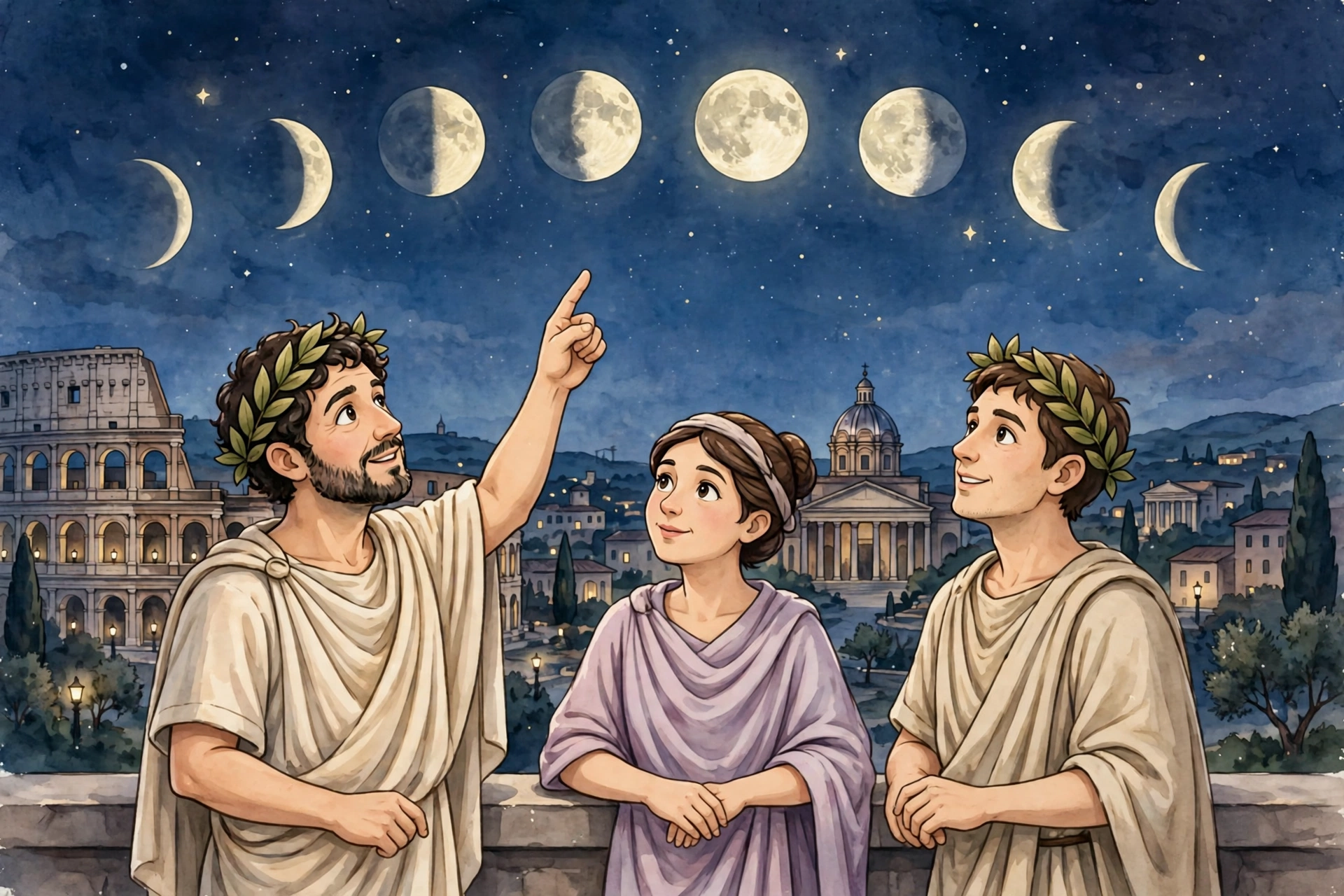
The Moon changes shape in a regular pattern. It starts as a thin crescent, grows to a full Moon, then shrinks back to nothing, then starts again. One full cycle takes about 29.5 days. Early people noticed this and used it to count time. Each Moon cycle became a month. In fact, the English word month comes from the word Moon.
A year is different. A year is the time Earth takes to travel once around the Sun, about 365.25 days. If you divide 365.25 by 29.5, you get about 12.4. That means about 12 Moon cycles fit into one year, with a little extra left over.
This is why 12 became a natural number for months. It was close to the number of Moon cycles in a year, and it was easy to work with. The number 12 can be divided by 2, 3, 4, and 6, which made it useful for splitting the year into halves, quarters, and seasons.
Other numbers were also used. Some cultures used 10 months, because humans have 10 fingers. Some used 13 months, because 13 Moon cycles is closer to a full year. But 12 became the most common, and, as we will see, the Romans made it stick.
The Early Roman Calendar: Only 10 Months
The early Roman calendar is where our story really begins. More than 2,700 years ago, the Romans used a calendar with only 10 months.
In the earliest version, the year started in March, in spring, when farming began. The 10 months were:
- Martius (March)
- Aprilis (April)
- Maius (May)
- Iunius (June)
- Quintilis (July, but then it meant fifth month)
- Sextilis (August, but then it meant sixth month)
- September (seventh month)
- October (eighth month)
- November (ninth month)
- December (tenth month)
Notice something odd. September, October, November, and December sound like they should be the seventh, eighth, ninth, and tenth months, and in the early Roman calendar, they were. The names come from Latin numbers: septem means seven, octo means eight, novem means nine, and decem means ten.
The names tell us the story. September was the seventh month, not the ninth. December was the tenth month, not the twelfth. The calendar had only 10 months, and the year was about 304 days long, much shorter than a real year.
What about winter? In the early Roman calendar, winter was not really counted. After December, there was a gap, a period of about 60 days with no month name, until March came again. Farmers did not need to plan much in winter, so the Romans simply left it out. That worked for a while, but it caused problems, because the calendar drifted away from the seasons.
Why January and February Came Last
As Rome grew, the 10-month calendar became a problem. A calendar that ignored winter and was shorter than a real year meant festivals and farming seasons moved out of step. People needed a better system.
Around 713 BC, tradition says, the Roman king Numa Pompilius added two new months to cover winter: January and February. This made the year 12 months long, and about 355 days, much closer to a real year.
January was named after Janus, the Roman god of doors, gates, and beginnings. Janus had two faces, one looking back at the old year and one looking forward to the new year. That made January a perfect name for the first month of the year, though at first January was still at the end of the year, not the start.
February was named after Februa, a Roman festival of purification. February was a time to clean, to prepare, and to get ready for spring. It was placed at the end of the year, as a kind of closing month.
Later, the start of the year was moved to January, so January became the first month and February the second. That is why today January is first, even though it was one of the last months added. The old names, September to December, stayed in place, even though they no longer matched their numbers. That is why September, the seventh month by name, is now the ninth month in our calendar.
Julius Caesar and the Julian Calendar
Even with 12 months, the Roman calendar still drifted. Months were added or removed by priests for political reasons, and the calendar fell out of step with the seasons. By the time of Julius Caesar, in 45 BC, the calendar was about three months out of step. Spring festivals were happening in winter.
Caesar ordered a reform. With the help of the astronomer Sosigenes, he created the Julian calendar. This calendar had 12 months, with fixed lengths, and a leap day every four years to account for the extra 0.25 days in a year. The year became 365.25 days on average, which was much more accurate.
Caesar also renamed Quintilis, the fifth month, to July, after himself. Later, the Roman emperor Augustus renamed Sextilis, the sixth month, to August, after himself. That is why July and August have their current names, and why they both have 31 days. Tradition says Augustus wanted his month to be as long as Caesar’s, so he took a day from February and added it to August. Whether that story is fully true or not, it is a popular explanation for why February is so short.
The Julian calendar was a huge improvement. It kept 12 months, gave them stable lengths, and stayed in step with the seasons for many centuries. It was used across the Roman Empire, and then across Europe, for over 1,600 years.
From the Julian Calendar to the Gregorian Calendar
The Julian calendar was good, but not perfect. A real year is about 365.2425 days, not 365.25 days. The small difference, about 11 minutes per year, added up over centuries. By the 1500s, the calendar was about 10 days out of step with the seasons. Easter, an important Christian festival tied to spring, was drifting.
In 1582, Pope Gregory XIII ordered another reform, creating the Gregorian calendar, which is the calendar most of the world uses today. The Gregorian calendar kept 12 months, with the same names and mostly the same lengths, but changed the leap year rule.
In the Gregorian calendar, a year is a leap year if it can be divided by 4, except for years ending in 00, which are leap years only if they can be divided by 400. So 2000 was a leap year, but 1900 was not. This small change made the calendar much more accurate, losing only about one day every 3,000 years.
To fix the drift, Pope Gregory also removed 10 days from October 1582. People went to sleep on October 4 and woke up on October 15. That must have been confusing, but it put the calendar back in step with the seasons.
Different countries adopted the Gregorian calendar at different times. Catholic countries adopted it in 1582. Britain and its colonies adopted it in 1752, removing 11 days. Some countries, like Russia, did not adopt it until the early 1900s. Today, the Gregorian calendar is the international standard for business, travel, and daily life, even though some cultures also use other calendars for religious or traditional purposes.
Why Some Months Have 30 Days and Others Have 31
One of the most common questions about 12 months is why they do not all have the same number of days. The answer is history, not logic.
In the Julian and Gregorian calendars, the months have these lengths:
- January: 31 days
- February: 28 days, 29 in a leap year
- March: 31 days
- April: 30 days
- May: 31 days
- June: 30 days
- July: 31 days
- August: 31 days
- September: 30 days
- October: 31 days
- November: 30 days
- December: 31 days
The pattern is not perfectly regular, because the lengths were set by Roman tradition and later adjustments, not by a simple rule. February is the shortest, because it was the last month added, and because it was used as the month to adjust for leap days. The other months kept their lengths from the Julian calendar, with small changes over time.
A famous rhyme helps children remember: Thirty days hath September, April, June, and November. All the rest have thirty-one, except February alone, which has 28 days, and 29 in a leap year. This rhyme has been taught for centuries, because the pattern is hard to remember by logic alone.
Why Not 13 Months?
Some people have suggested a 13-month calendar. After all, 13 Moon cycles fit a year slightly better than 12, and 13 months of 28 days each would make 364 days, a very neat system. Each month would have exactly four weeks, and each date would always fall on the same weekday. That sounds simple.
So why did 13 not win? First, 12 was already deeply established by Roman tradition and by religion. Changing to 13 would mean renaming months, changing holidays, and breaking centuries of habit. Second, 13 is a prime number, which means it cannot be divided neatly into halves or quarters. A year with 12 months can be split into two halves of six months, or four quarters of three months, which is useful for business and seasons. A year with 13 months cannot be split so neatly.
Third, some cultures saw 13 as unlucky, which made a 13-month calendar less popular. In the end, the practical benefits of 12, its divisibility, its history, and its link to the Moon, outweighed the neatness of 13.
Other calendars have tried different systems. The French Revolutionary calendar, used briefly in the 1790s, had 12 months of 30 days each, plus extra days. The International Fixed Calendar, proposed in the early 1900s, had 13 months of 28 days each. Neither caught on, because changing a calendar is hard, and people are used to 12.
How 12 Months Shape Our Lives Today
Twelve months shape almost everything about how we plan time. School years are divided into terms that fit inside months. Work is often planned in quarters, three months at a time. Rent, bills, and salaries are usually paid monthly. Holidays and festivals are tied to specific months, like Christmas in December or New Year in January.
Even our language reflects 12 months. We say monthly, quarterly, and yearly. We talk about a monthly budget, a quarterly report, or an annual review. The 12-month system is so deep in our lives that it is hard to imagine a different system.
Other calendars still exist. The Islamic calendar has 12 months, but it is based on the Moon, so it is about 354 days long, and its months move through the seasons over time. The Chinese calendar also uses Moon cycles, with a leap month added sometimes to stay in step with the Sun. The Hebrew calendar has 12 or 13 months in different years. Each system solves the same problem, fitting Moon cycles and Sun years together, in a different way.
But for international business, travel, and daily life, the Gregorian calendar with 12 months is the standard. It is the calendar your phone, your computer, and your school all use, even if your family also uses another calendar for religious festivals.
Frequently Asked Questions
Why do we have 12 months and not 10?
We have 12 months because about 12 Moon cycles fit into one year, and because the Romans added January and February to their original 10-month calendar to cover winter. The 12-month system was then kept by the Julian and Gregorian calendars.
Did the Romans invent the 12-month year?
The Romans did not invent the idea of 12 months, but they made it standard in Europe. Earlier cultures also used Moon cycles, but the Roman calendar, with its 12 months and month names, is the direct ancestor of our calendar today.
Who decided that September would be the ninth month?
No one person decided it. September was originally the seventh month. When January and February were added at the start of the year, September moved to ninth place, but its name stayed the same. That is why the name no longer matches its position.
Why is September called September if it is not the seventh month?
September comes from the Latin word septem, meaning seven. It was the seventh month in the early Roman calendar. The name stayed even after the calendar changed, so today it is the ninth month with a name that means seven.
Why does February have only 28 days?
February was the last month added, and it was used to adjust the calendar. In the Roman system, February was the month where leap days were added. Later, tradition says Augustus took a day from February to make August as long as July. That left February as the shortest month.
Did all cultures use 12 months?
No. Some cultures used 10 months, some used 13 months, and some used calendars based on the Moon with a variable number of months. But 12 became the most common, because it fits Moon cycles, the Sun year, and the need to divide the year into halves and quarters.
Will we ever change to a different number of months?
It is very unlikely. Changing the calendar would affect computers, legal contracts, school years, and holidays around the world. The 12-month system works well enough, and people are used to it, so it is likely to stay for a very long time.
More from Zorium Daily
- How to Make a Simple Monthly Budget That Actually Works — Zorium Daily
- How Does a Bookshop Make Money? — Zorium Daily
- Why Can We Sometimes See the Moon During the Day? — Zorium Daily
- How Do Noise-Cancelling Earbuds Work? — Zorium Daily