Why Do We Cry?
By Zorium Daily News Desk
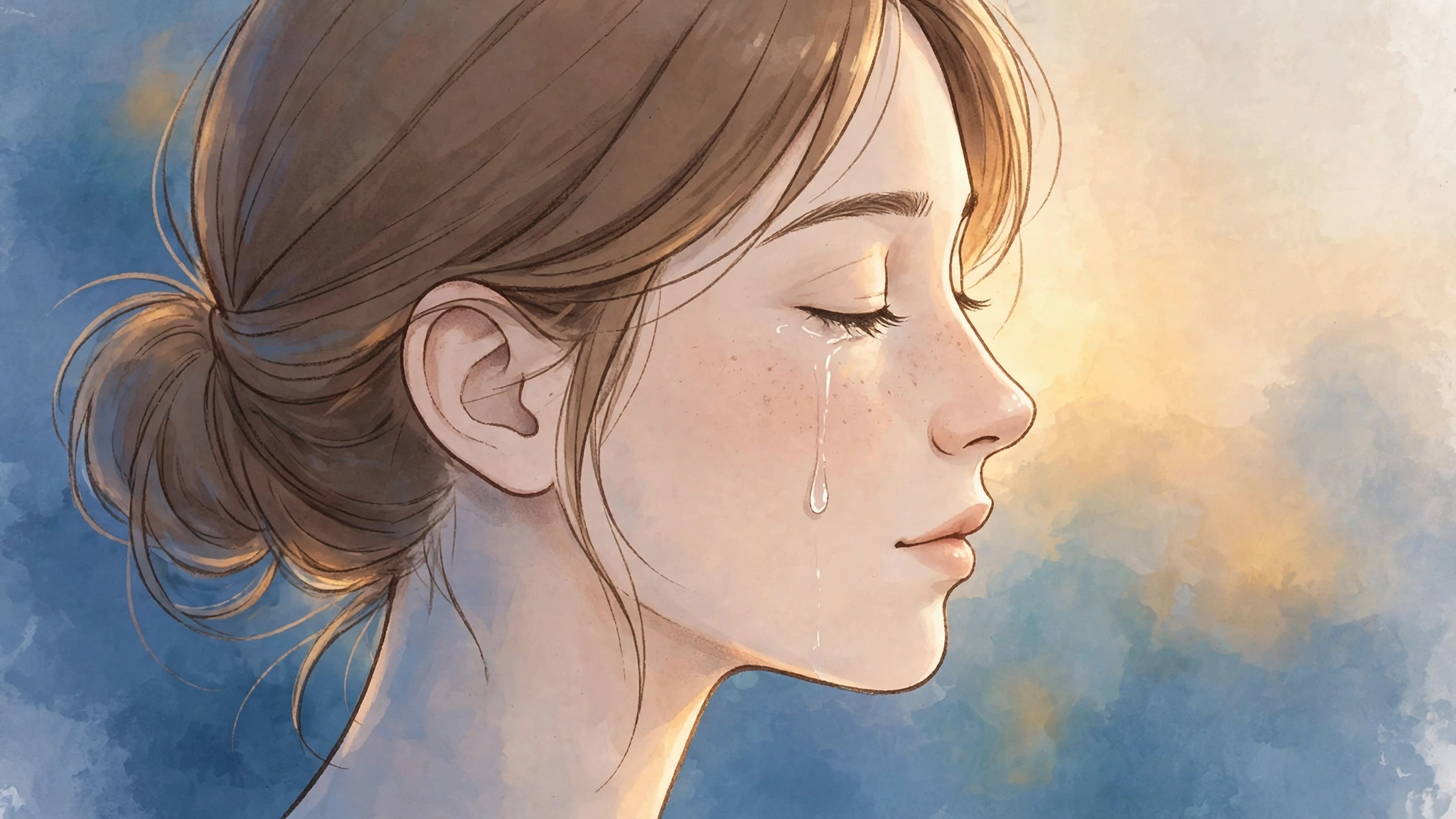
You are watching a sad film. The hero loses someone he loves. Your eyes feel hot. Then a tear rolls down your cheek. You did not plan it. You did not choose it. It just happened.
Or think of a happy day. Your best friend gets good news. Your child takes her first steps. A song you love fills the room. Your eyes fill up again. This time the tears come from joy, not pain.
Why does the body do this? Why does salty water leak from our eyes when we feel sad, happy, scared, or moved? Why do we cry at films, at weddings, at goodbyes, and even when we cut an onion? And why do humans cry in this way, when no other animal seems to do it?
This article gives general health information only. It is not medical advice. If you are worried about your health, talking to a doctor is always the safest step.

SUMMARY OF THIS ARTICLE
- Tears are salty water made by small glands near your eyes, and they keep your eyes wet, clean, and safe.
- There are three types of tears: basal tears that work all day, reflex tears that wash out dust and onion fumes, and emotional tears that come from strong feelings.
- We cry when we are sad because the brain’s feeling centre sends a signal to the tear glands, and tears also tell other people that we need care.
- We cry when we are happy because very strong joy can flood the same system, and tears help the body calm down again.
- Crying is normal at every age, but crying very often, or crying that will not stop, can be worth talking about with a doctor.
What Are Tears?
A tear is a small drop of salty water. It comes from your eye and rolls down your cheek. Tears are mostly water. About 98 out of every 100 parts of a tear is water. The rest is a mix of salt, oil, mucus, and tiny proteins. Mucus is the sticky, wet stuff that helps things spread smoothly. Proteins are tiny building blocks in the body that do many jobs. Some proteins in tears fight germs. Tears are not plain water. They are a special fluid made for a special job.
That job starts with the surface of your eye. The front of your eye is called the cornea. The cornea is clear, like a window. It must stay wet and smooth so you can see clearly. If it dries out, your vision gets blurry and your eye feels sore. Tears spread over the cornea like a thin, smooth film. Each time you blink, your eyelid wipes a fresh layer of tears across the eye.
The Three Types of Tears
Scientists divide tears into three types. Each type has its own trigger, which means its own cause, and its own job. The three types are basal tears, reflex tears, and emotional tears. They all come from the same glands, but they are not the same.
Basal tears are the quiet workers. The word basal means basic, or at the base of things. These tears flow all day, every day, even when you feel nothing at all. You almost never notice them, because they flow in tiny amounts. Their job is to keep the eye wet, smooth, and safe. They wash away dust, feed the cornea, and stop germs from settling in. Without basal tears, your eyes would dry out in minutes. People who do not make enough basal tears get a problem called dry eye. Their eyes feel gritty, sore, and tired.
Reflex tears are the emergency cleaners. The word reflex means an action your body does on its own, without you thinking about it first. When you cut an onion, your eyes may sting and water. Those are reflex tears. Smoke, dust, wind, a stray eyelash, and bright light can set them off too. Reflex tears flow in much larger amounts than basal tears. Their job is to flush the eye fast, like a flood washing dirt off a road. You do not choose to make reflex tears. Your eye senses trouble and orders a wash, all on its own.
Emotional tears are the mystery. They appear when you feel a strong emotion: sadness, grief, joy, anger, fear, relief, or awe. Awe is the strong feeling you get when something is grand or deeply moving, like a great view or a kind act. Emotional tears are the ones that roll down your cheeks during a sad film or at a wedding. Most researchers believe these tears are unique to humans. No other animal is known to cry in this way because of feelings. Dogs and cats make basal and reflex tears, but they do not shed tears of sadness or joy. What is clear is that emotional tears are triggered by the brain, not by the eye. Something in your feelings starts them, not dust or smoke. Here is a simple way to remember the three types. Basal tears are the daily care team. Reflex tears are the emergency cleaners. Emotional tears are the messengers. They carry news about how you feel inside to the world outside.
How Tears Are Made
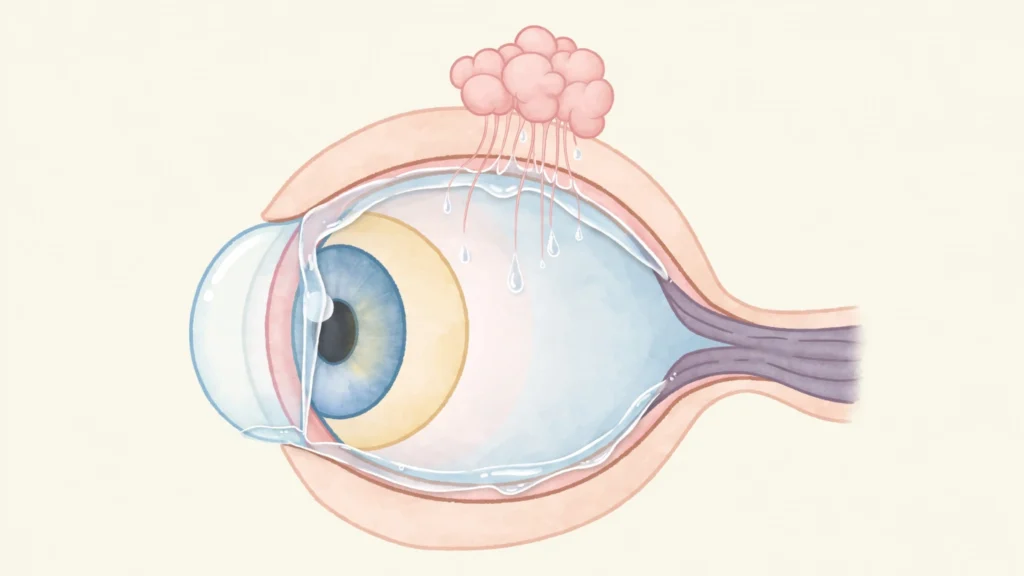
Tears are made by small glands near your eyes. The main one is called the lacrimal gland. Lacrimal is a science word that means “to do with tears.” You have one lacrimal gland above each eye, tucked under the bone at the outer top corner. It is about the size of a small almond. You cannot see it or feel it. It works quietly, day and night. The lacrimal gland makes the watery part of tears. Small glands in the eyelids make the oil layer. Tiny cells on the surface of the eye make the mucus layer. Together they build the full tear film.
Once tears are made, they spread across the eye. Your eyelid does the spreading. Every blink wipes a fresh layer over the cornea. The old tears then drain away through tiny holes at the inner corners of your eyes. These holes lead into small tubes that carry the tears into your nose. That is why you may need to blow your nose after a good cry. The tears did not vanish. They drained down.
The brain controls the whole system. For basal tears, the control is quiet and steady. For reflex tears, the control is fast. Nerves on the surface of the eye sense dust or onion fumes. They send an alarm to the brain. The brain orders the glands to make a flood at once. This is the same kind of fast loop that makes you sneeze when dust lands in your nose. A signal goes in, an order goes out, and the body acts in less than a second.
Emotional tears use a different path. The signal starts deep in the brain, in the parts that deal with feelings. Scientists call this area the limbic system. The limbic system is like the emotional heart of the brain. It notices loss, love, fear, and joy. When a feeling is strong enough, the limbic system sends a message to a lower part of the brain, near the brain stem, and from there along nerves to the lacrimal glands. The glands open up, and tears flow.
Why We Cry When We Are Sad
Sadness is the most common reason for emotional tears. Loss, grief, loneliness, shame, and disappointment can all open the floodgates. But why does a feeling in the mind make water come out of the eyes? The answer has two parts: one inside the body, and one between people.
Inside the body, sadness lights up the limbic system, the brain’s feeling centre. The limbic system talks to the brain stem. The brain stem talks to the tear glands. The glands make tears.
But there is a second part, and many scientists think it is the more important one. Tears are a signal. They are a message to other people. A tearful face is hard to ignore and hard to fake. When someone sees your tears, they can read your feelings at once, even from across a room, even without words. Studies have shown that people read sadness much better on a face with tears than on the same face with the tears wiped away. That signal has a job. It asks for help. It says, “I am hurting. Please stay. Please be kind.” In babies, the cry is a loud alarm that brings a parent close. In adults, tears are a quieter version of the same tool. A friend who sees your tears may sit with you, hold your hand, or ask what is wrong. That support can be the real help that crying brings.
Why We Cry When We Are Happy
Happy tears confuse people. If tears mean sadness, why do we cry at weddings, at births, at surprise parties, and when a team wins? The answer is that tears do not mean sadness. They mean strong feeling. Joy can be just as strong as grief, and it can flood the same system.
Think of a wedding. Two people promise to love each other for life. Family and friends watch. Music plays. The feeling is big: love, hope, pride, and relief all at once. The limbic system lights up, just as it does in sadness. The signal travels to the tear glands. Tears flow.
Scientists have a name for this kind of mixed feeling: a dimorphous expression. A person may cry while smiling. The body seems to use a second feeling to balance the first one. When joy is so big that it feels too much, tears may help bring the feeling back down to a level the body can handle. It is like opening a small valve to let pressure out of a full tank.
Happy tears also work as a signal, just like sad tears. At a wedding or a birth, tears tell everyone in the room, “This matters to me. This moment is deep.” Other people read that signal and feel closer to you. The tears invite hugs, smiles, and shared joy. Relief can bring tears as well. Imagine waiting for news about someone you love. The waiting is long and hard. Then the news comes, and it is good. The person is safe. The tension breaks, and tears come. The body has been holding tight for hours. When the danger passes, the body lets go, and tears are part of that letting go.
Awe can do the same. A great view, a moving song, or a kind act can bring tears too, and some people also get goosebumps at these moments. Both are signs that the body’s feeling system is fully awake. So happy tears are not a puzzle once you see the pattern. Tears follow strong feeling, not just sad feeling. Joy, relief, awe, and love can all be strong enough to start the same chain: feeling, signal, glands, tears.
Tears That Protect the Eye
So far we have talked about feelings. But tears have a much older job: protection. Long before humans cried from emotion, animals used tears to protect their eyes. That job still matters every day.
The eye is open to the world. Dust, smoke, pollen, and tiny insects can land on it at any time. The eye cannot close itself every second. It needs a guard that works all the time. Tears are that guard. Basal tears wash the surface clean, hour after hour. Reflex tears rush in when something bigger lands.
Tears also fight germs. The proteins in tears can break down the walls of some bacteria. They can trap viruses and carry them away. The oil layer slows drying, so the germ-fighting film stays in place. When you have a cold, your eyes may water more. That is part of the same defence. The body is washing the eyes while it fights the cold.
Wind and cold can also make eyes water. On a cold day, the wind dries the eye surface. The eye answers with more tears. Bright light can do the same. Onions are the famous example. When you cut an onion, it releases a gas that stings the eye. It touches the nerves on the eye surface. The nerves send an alarm to the brain. The brain orders a flood of reflex tears to wash the gas away. That is why your eyes water when you cook. The tears are not sadness. They are cleaning.
If tears stop working well, the eye suffers fast. People with dry eye feel burning, itching, and blurry vision. Their eyes get red. They may get more eye infections. Doctors can help with artificial tears, which are eye drops that copy the real thing. But nothing works quite as well as the body’s own tear film, made fresh all day.
Why Humans Are the Only Animals That Cry Emotional Tears
Dogs whine. Cats mew. Baby birds call for food. Many animals make sounds when they are upset. Many animals also make tears. A dog’s eyes water when dust gets in. A horse’s eyes water in the wind. But no other animal is known to shed tears because it feels sad or happy. That is a human thing. Why?
The second idea is about faces. Humans have very open faces. Our eyes are large and easy to see. Our skin is bare, so a tear shows up clearly on a cheek. Many animals have fur or feathers that hide wetness. A tear on a furry face is hard to see. A tear on a bare human cheek is easy to see. Some scientists think emotional tears could only evolve in a species where tears are visible. Our bare faces made the signal possible.
It is worth saying what we do not know. We do not know exactly when in human history emotional tears first appeared. We do not know if early humans cried the way we do. We cannot ask them. We can only look at clues: babies, faces, groups, and brains. The honest answer is that science has good ideas but no final proof. That is normal. Some questions take a long time to answer, and this is one of them. What we can say is that emotional tears fit the human story. We are a species that survives by caring for each other. A signal that brings care, calms conflict, and shares joy fits that story well.

What Crying Does to the Body
Crying is not just tears. It is a whole-body event. When you cry hard, many parts of the body change at once. Understanding those changes helps explain why crying can feel so strong, and why it can leave you tired.
First, your breathing changes. A hard cry often starts with fast, shallow breaths. You may gulp air. Your chest may heave. Your shoulders may shake. This is the body’s stress response at work. The stress response is the system that gets you ready for danger: heart faster, breath faster, muscles tense. Crying often starts in that state.
Then, as the cry goes on, the body may shift. The calming system, called the parasympathetic system, begins to take over. Your heart rate slows. Your breathing deepens. Your muscles loosen. This shift is one reason people say they feel lighter after crying. The body has moved from high alert to rest. Scientists think this shift is real, but they also warn that it does not happen for everyone, and it does not happen after every cry.
Second, your face and throat change. The muscles around your eyes tighten. Your eyebrows pull together. Your throat may feel tight, as if a lump is stuck there. That lump feeling is real. The muscles in the throat tighten during strong feeling, and the throat narrows a little. That is why it can be hard to speak while crying. The voice may shake or break.
Crying in Babies vs Adults
Babies cry more than anyone. A healthy baby may cry for one to three hours a day, spread across many short bursts. A baby cries because crying is the baby’s only language. A baby cannot say, “I am hungry,” or “I am cold,” or “I am tired.” The cry must say it all.
New babies often cry without tears. Their tear glands are still maturing. Real tears usually appear in the first few weeks of life. Before that, the cry is all sound. After that, sound and tears work together. This is one reason doctors pay attention to tears in babies. A baby who never makes tears after the first month may need a check, just to be sure the tear ducts, the tiny tubes that drain tears, are open and working.
Adults cry less often than children, but they still cry. Crying less often as an adult is normal. The number alone says little. What matters more is the pattern: why you cry, how long it lasts, and whether you can recover after.
When Crying a Lot Can Be a Sign to Talk to a Doctor
Crying is normal. Most crying needs no doctor. But there are times when crying a lot, or crying that feels out of control, is worth talking about with a doctor. This section gives general information only. It is not medical advice, and it cannot diagnose you.
First, think about how often and how long. Everyone has sad weeks. A loss, a break-up, or a hard time at work can bring many tears for a while. That is a normal human response to a hard event. But if crying is daily, heavy, and lasts for weeks without easing, it may be a sign that something deeper is going on. It may be linked to low mood, anxiety, or grief that has become stuck. These are common health problems, and they can be treated. Talking to a doctor is a strong first step, not a sign of failure.
Second, think about what comes with the crying. Crying plus other changes deserves attention. The changes to watch for include: sleep that is much worse for weeks, appetite that drops or rises sharply, loss of interest in things you used to enjoy, feeling worthless or hopeless most days, trouble focusing at work or school, or thoughts of harming yourself. If you ever feel you might harm yourself, please reach out for help right away, to a doctor, a trusted person, or a crisis helpline in your country. You do not have to face that feeling alone.
Third, think about crying that does not match the moment. If you cry often and cannot say why, or if small things set off very big crying again and again, that pattern is worth mentioning to a doctor. The same is true if you cannot stop crying once you start, or if crying keeps you from work, school, or family life.
Frequently Asked Questions
Why do my eyes water when I am not sad?
Your eyes water for many reasons besides sadness. Wind, cold air, smoke, dust, bright light, and onion fumes can all set off reflex tears. Allergies and colds can make eyes water too. If watering is constant, painful, or comes with vision changes, talk to a doctor.
Is it true that crying removes toxins from the body?
No, not in the way people often claim. Tears do carry tiny amounts of stress hormones, but the amount is far too small to clean the body. Crying may still help you feel better, but the help likely comes from the brain calming down and from comfort from other people, not from flushing out toxins.
Why do I cry at happy events like weddings?
Happy tears happen because tears follow strong feeling, not just sad feeling. Joy, relief, pride, and awe can be strong enough to start the same chain: feeling, signal, glands, tears. Happy tears also send a message to others that the moment matters deeply to you.
Do animals cry emotional tears?
No other animal is known to shed tears from emotion the way humans do. Animals make basal tears to keep their eyes wet and reflex tears to wash out dust. Dogs and cats may whine or make sounds when upset, but they do not cry tears of sadness or joy. Emotional tears appear to be unique to humans.
Why do babies cry so much?
Babies cry because it is their only way to ask for help. They cannot speak, so crying tells parents they are hungry, tired, cold, wet, or in pain. A healthy baby may cry one to three hours a day in total. Most crying is normal. If a baby cries for a very long time and cannot be soothed, or cries with fever, vomiting, or unusual sleepiness, talk to a doctor promptly.
Can crying too much be bad for your health?
Crying itself is not harmful. It is a normal body response. But crying very often, for weeks, along with poor sleep, loss of interest, or hopeless feelings, can be a sign of a health problem such as low mood or anxiety. If you are worried about how much you cry, talking to a doctor is the safest step.
More from Zorium Daily
- Why Do We Get Hiccups? — another body reflex that starts on its own and is hard to stop.
- Why Do We Sneeze? What Happens Inside Your Nose? — how your nose clears dust with a fast burst of air.
- Why Do We Dream? — what science thinks about the movies your brain plays at night.
- Why Do We Get Goosebumps? — the tiny muscles under your skin and why strong feelings wake them up.