How Does a Sweet Shop Make Money? Explained Simply
SUMMARY OF THIS ARTICLE
- A sweet shop makes money the same way most small shops do: it buys or makes sweets for less than the price it sells them for, and the gap between the two is its profit.
- Most of the money comes from everyday sales — small bags, boxes, and sweets sold by weight — with a big lift from festivals, weddings, and other celebrations.
- The shop also pays for a lot of things: sugar and other ingredients, rent, staff wages, boxes and wrapping, electricity, and more.
- One box of sweets looks profitable, but after rent and wages little is left — industry guides put typical net profit for candy shops at 5% to 25% of sales.
- Location, freshness, and trust matter most: a busy-street shop selling fresh sweets people love beats a hidden shop with a bigger menu.
The Smell That Pulls You In
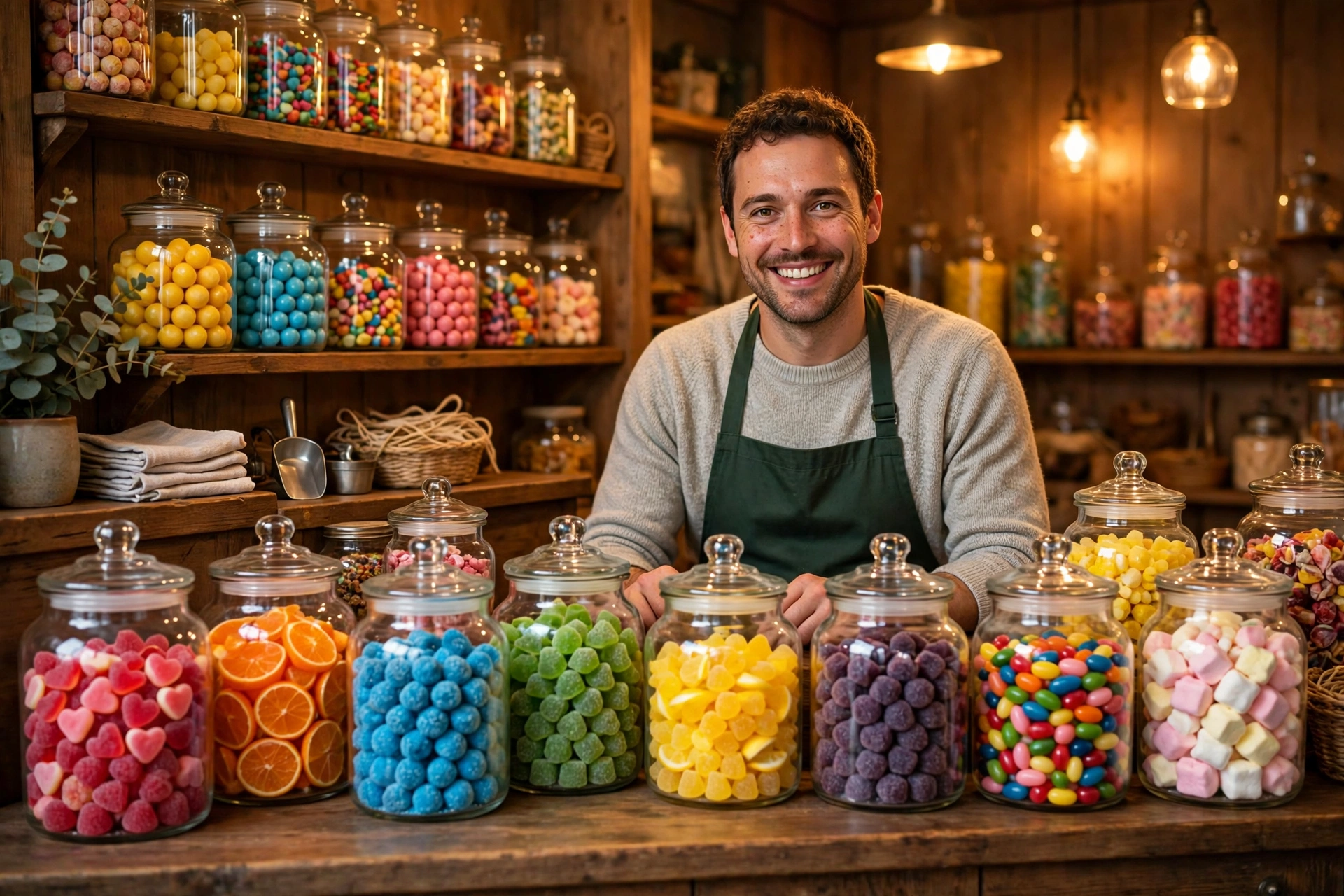
Walk past a good sweet shop on a cold evening and you will know it before you see it. Warm sugar hangs in the air. Through the window you can see trays of sweets in bright colours — red, green, gold, white — stacked in neat rows like little jewels. Someone is weighing out a bag for a customer. Someone else is pointing at a box and asking, “How much for this one?”
It looks simple, and in a way it is. A sweet shop takes sugar, milk, flour, nuts, and a few other plain ingredients, turns them into something people love to eat, and sells them for more than the ingredients cost. But the simple picture hides a lot of hard work. Behind that glass counter there is rent to pay, staff to pay, boxes to buy, and a fridge that never stops humming. Some sweet shops do very well. Others close quietly after a year or two, and the people walking past never know why.
What a Sweet Shop Actually Sells
The first thing to understand is that a sweet shop does not sell one thing. It sells a whole range of things, and each one plays a different part.
The heart of the shop is the loose sweets sold by weight. You point at a tray, the shopkeeper scoops some into a bag or a box, weighs it, and tells you the price. A child buys a small bag after school. A worker picks up half a kilo on the way home. A grandmother buys a box for the grandchildren visiting on Sunday. None of these sales is huge on its own, but there are dozens of them every day, and they add up.
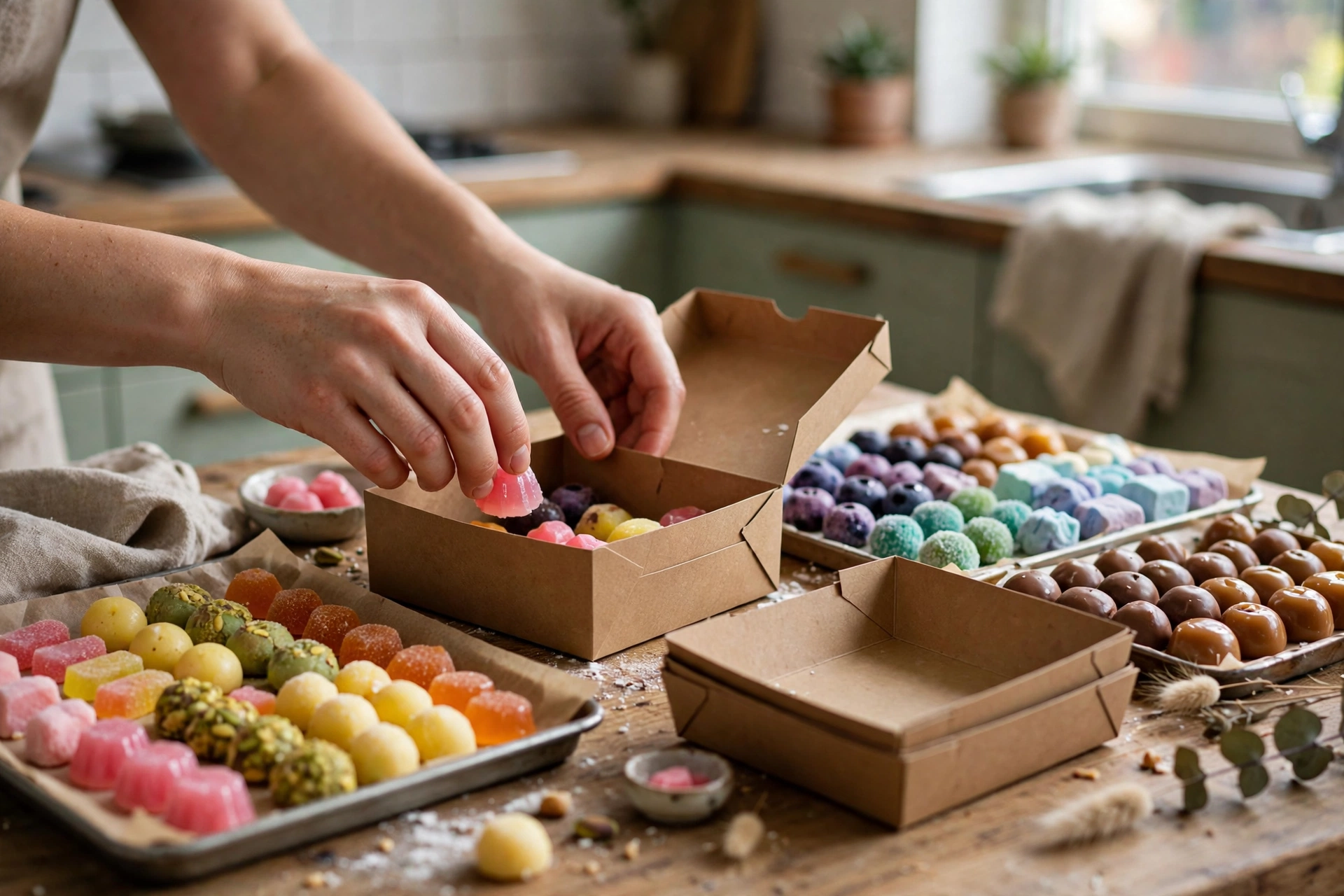
Then there are the gift boxes. These are the pretty boxes with a ribbon, the ones people buy when they visit someone, say thank you, or celebrate something small. A gift box costs more than loose sweets, because you are paying for the box, the ribbon, and the care that went into packing it, not just the sweets inside.
And then there are the special orders — a wedding that needs two hundred boxes, a festival order for a whole neighbourhood, a company that wants gift hampers for its staff. These can change a whole month, and we will come back to them, because they matter more than most people realise.
If you enjoy this kind of plain look at how shops work, you will like our guide to how a bakery makes money, which follows the same idea with bread and cakes instead of sweets.
Where the Money Comes In
A sweet shop’s income comes from a few clear streams, and a healthy shop usually has more than one.
Daily walk-in sales are the base. These are the small, regular purchases — a bag here, a box there, a few pieces weighed out for a child with pocket money. They do not make anyone rich in a single day, but they are steady, and steady matters. A shop that can count on a certain amount of money every day can order ingredients with confidence and pay wages on time.
Gift boxes and hampers are a step up. Around festivals, the shop fills with people buying boxes to send to relatives, to give to neighbours, or to carry to a family gathering. A hamper with mixed sweets, a ribbon, and a card can sell for several times the price of the loose sweets inside it. The customer is happy, because the gift looks lovely. The shop is happy, because the sale is worth far more than a small bag.
Online orders are newer, but they are growing fast. Some sweet shops now take orders on the phone or through a website and deliver boxes to people’s homes. This brings in customers who never walk past the shop at all. It also brings new costs — delivery, packing, and sometimes a fee to the delivery service — so it is not free money.
Festivals and Weddings: The Big Days
Ask any sweet shop owner which weeks matter most, and you will get the same answer: festival weeks, wedding season, and the days around big family celebrations. This is when a sweet shop can earn in a week what it normally earns in a month.
Think about a wedding. A family may order hundreds of boxes — one for each guest, plus trays for the ceremony itself, plus extra for relatives who could not come. That is one order, one customer, and it can be worth more than a whole ordinary week of walk-in sales. The shop may work through the night to finish it. The owner may call in extra help. It is hard work, but the money is real.
Festivals work the same way. Before a big festival, whole neighbourhoods buy sweets at once — for their own families, for guests, for neighbours, and for the community hall. Shops prepare for weeks, ordering extra sugar, extra milk, and extra boxes. The shelves are full, the staff are busy, and the till rings all day long.
Industry guides note that for candy shops in general, the big holidays — Halloween, Christmas, Valentine’s Day, and Easter — can account for well over half of all confectionery sales in a year, and busy periods can lift sales by a fifth or more compared with an ordinary month. The exact holidays differ from place to place, but the pattern is the same everywhere: celebrations sell sweets.
The Costs: Where the Money Goes
Now the other side. A sweet shop’s money flows out just as fast as it flows in, and the list of costs is longer than most customers imagine.
Ingredients come first. Sugar is the biggest one — a sweet shop can use sacks of it every week. Then milk, ghee or butter, flour, nuts, dried fruit, saffron, cardamom, and colouring. Prices for these move up and down. When sugar prices rise, every single sweet in the shop costs more to make, and the owner has to decide whether to raise prices, shrink the size of each sweet, or accept less profit. None of those choices is easy, because customers notice all three.
Rent is usually the biggest fixed cost. The shop pays the same rent every month whether it sells a lot or a little. A small shop on a busy street may pay far more than a bigger shop on a quiet street, and that is a trade-off the owner thinks about every day. Good location brings customers, but it also eats into profit before the first sweet is sold.
Staff wages come next. Even a small shop usually needs at least two or three people: someone making the sweets, someone serving customers, someone packing boxes and keeping the shop tidy. During festival weeks, the owner may need extra hands. Industry guides for candy shops suggest labour can take up roughly a fifth to nearly a third of what the shop earns, which is a big slice.
Packaging is a cost people often forget. Every box, every bag, every ribbon, every little paper cup costs money. A plain plastic bag is cheap. A beautiful gift box with gold print and a ribbon is not. Since gift boxes are a big part of the business, packaging adds up to real money over a month. Electricity and gas are always running too — the fridges keep the milk sweets cool day and night, the stoves run for hours, and the lights stay on so the shop looks bright and welcoming.
Our guide to how a coffee shop makes money shows a very similar list of costs — beans instead of sugar, but the same rent, wages, and electricity eating away at every sale.
A Worked Example: One Box of Sweets
Numbers make this much clearer, so here is a simple worked example. Remember, this is an example with round numbers, not the accounts of any real shop. Every real shop is different, and prices change from place to place. But the shape of the maths is the same everywhere.
Imagine a box of mixed sweets that sells for $10. That is the price on the sticker, the money the customer hands over.
First, the ingredients. Sugar, milk, ghee, flour, nuts, and flavouring for the sweets inside the box come to about $4. That is the biggest single cost of making the box.
Then the box itself, the paper inside, and the ribbon: about $1. It does not sound like much, but pretty packing is not free.
Then the share of the kitchen costs for that box: gas for the stove, electricity for the fridge, and a little wear on the pots and trays. Call it about $1.
Then the share of the shop assistant’s time: taking the order, weighing the sweets, packing the box, and serving the customer. Call it about $1.
Add it up: $4 for ingredients, $1 for the box, $1 for kitchen costs, $1 for serving. That is $7 of costs for one $10 box. So $3 is left over before rent and wages for the month are paid. That $3 is called the gross profit on the box, and it is 30% of the price.
Now here is the part that surprises most people. That $3 is not the owner’s profit. Not yet. The rent for the shop still has to come out of it. So do the wages of the people who are not directly packing that one box, the insurance, the licence, the repairs, and the advertising. Only after all of those are paid does the owner know what the shop really earned.
Suppose the shop sells 100 of those boxes in a day, along with many smaller sales. That is $300 of gross profit from the boxes in one day. Over a month, that might be $9,000 of gross profit. It sounds like a lot. But if the rent is $2,000 a month, wages for the team are $4,000, and electricity, insurance, and other fixed costs are another $1,500, that leaves $1,500. That is the real monthly profit in this example — about 5% of the shop’s total sales.
Why Location Matters So Much
You can make the finest sweets in the world, but if nobody walks past your door, nobody will buy them. Location is one of the biggest reasons one sweet shop thrives and another one fades, and it is the first thing a smart owner thinks about.
A shop near a market, a school, a temple, a mosque, a church, or a busy bus stop gets customers without trying. People pass by every day. A mother picks up sweets on the way home from the market. A student stops in after school. A family on its way to a celebration pops in for a box. The shop does not have to shout for attention, because the street brings the customers to it.
A shop tucked away down a quiet side road has the opposite problem. It may pay far less rent, which sounds like a good deal, but it has to work much harder to be found. It needs advertising, word of mouth, and loyal regulars. Some quiet-street shops do very well this way — they become famous for one special sweet, and people travel to find them. But that takes years of building a name, and most new shops cannot wait that long.
Rent and location pull in opposite directions, and the owner has to balance them. A prime spot costs more, but it can bring in far more sales. A cheap spot costs less, but the shop may sit half empty. The right answer is different for every shop, and getting it wrong is one of the commonest reasons a new sweet shop struggles.
Why Freshness Is Everything
Sweets are not like shoes or books. They do not sit on a shelf for months waiting for a buyer. Most fresh sweets last only a few days, and customers can tell the difference between a sweet made this morning and one made three days ago. Freshness is not a nice extra for a sweet shop. It is the whole business.
A shop that sells fresh sweets builds trust fast. Customers come back because they know the sweets will taste the same every time — soft, warm, sweet, and just made. Over time, that trust becomes the shop’s best advertising, and it costs nothing.
A shop that sells stale sweets loses trust even faster. One bad box is enough. A customer who bites into a dry sweet does not complain to the owner — they simply never come back, and they tell their neighbours why. In a business built on regular customers, that quiet loss hurts more than any single bad day.
The Thin Margin: Why Small Numbers Matter
We have already seen that the profit on one box can look healthy while the real monthly profit is thin. That thinness is the daily reality of a sweet shop, and it explains a lot of the decisions owners make.
The first reason is competition. A sweet shop rarely stands alone. There is usually another shop a short walk away, and customers can compare prices in seconds. If one shop raises its prices too far, customers drift to the other one. That keeps prices in check, which is good for customers and hard for owners. The street sets the price, and the owner has to make the maths work inside that price.
The second reason is waste. Unsold sweets, spilled milk, a batch that did not turn out right, a fridge that broke overnight — all of these eat into the margin. A shop that wastes a tenth of what it makes has already lost a tenth of its profit. Careful owners watch waste closely, because every sweet thrown away is money thrown away.
So how do sweet shops survive on thin margins? By selling a lot, by wasting little, and by keeping customers coming back. Volume is the answer. A shop that sells a thousand boxes a month at a small profit per box earns more than a shop that sells a hundred boxes at a bigger profit per box.
If you want to see how another small food business handles the same puzzle, read our guide to how a supermarket makes money. Supermarkets work on even thinner margins than sweet shops, and they survive the same way: by selling a huge amount, every single day.
Extra Ways Sweet Shops Earn
The cleverest sweet shops do not rely on one kind of sale. They build several small streams of income, so that a slow week in one stream is covered by a good week in another.
Gift hampers and corporate orders are one. A company may order fifty hampers for its staff at festival time, or a hotel may order sweets for its guests every week. These are regular, planned orders, and they are worth a lot because the shop can prepare for them in advance, with no waste and no guessing.
Snacks and drinks are another. A shop that sells savoury snacks or a cup of tea gives customers a reason to stop, sit, and stay a little longer. A customer who came in for a snack often leaves with a box of sweets as well. The snack brings them in; the sweets go home with them.
Online orders and delivery are growing. A shop with a simple website or a phone number for orders can sell to people across the whole city, not just the people on its street. Some shops even ship gift boxes to other cities or other countries, for families who want to send a taste of home to relatives far away. Delivery adds costs, but it also adds customers the shop could never reach on foot.
None of these extras is magic. Each one takes work, and each one has its own costs. But together, they make the shop stronger, because it no longer depends on a single kind of customer walking through a single door.
What Makes One Sweet Shop Do Better Than Another
Put all of this together, and a clear picture appears. The sweet shops that last are not always the ones with the biggest shop or the fanciest sign. They are usually the ones that get a handful of simple things right, day after day.
They know their costs. The owner can tell you, without looking it up, what a box of sweets costs to make, what the rent is, and what is left at the end of the month. That knowledge is power, because it means no surprise can sink the shop.
They keep their sweets fresh and their quality steady. Customers know what they will get, and they trust it. Trust is slow to build and quick to lose, and the best shops guard it carefully.
They are in the right place, or they have built a name strong enough that people come to find them. Either way, customers can reach them easily, and they keep coming back.
And they keep adding small extras — a snack counter, online orders, gift hampers, seasonal specials — so that the business does not rest on one leg.
None of this is glamorous. It is early mornings, careful counting, honest sweets, and a clean shop. But that is how a sweet shop makes money: not in one big moment, but in hundreds of small sales, made well, day after day, year after year.

Frequently Asked Questions
How does a sweet shop make money?
A sweet shop makes money by selling sweets for more than they cost to make or buy. The shop pays for ingredients, rent, staff wages, packaging, and electricity, and the money left over after all those costs is its profit. Most of the money comes from everyday sales of loose sweets and boxes, with extra income from gift boxes, festival orders, weddings, and online sales.
What are the main costs of running a sweet shop?
The main costs are ingredients such as sugar, milk, ghee, flour, and nuts; rent for the shop; wages for staff; packaging such as boxes, bags, and ribbons; and electricity and gas for fridges, stoves, and lights. Industry guides suggest labour alone can take up roughly a fifth to nearly a third of what a candy shop earns.
How much profit does a sweet shop make?
It varies a lot from shop to shop, but industry guides for candy shops generally put gross profit margins between 45% and 75%, and net profit — what is left after every cost, including rent and wages — between 5% and 25% of sales.
Why are sweets more expensive during festivals?
Festival demand is very high, and shops often use extra staff, work longer hours, and buy special packaging such as gift boxes and hampers, all of which cost more. The sweets themselves may also use more expensive ingredients, such as nuts and saffron, for festival specials.
Why do some sweet shops also sell snacks?
Snacks bring in customers who might not come in just for sweets, and they give people a reason to stay longer. A customer who stops for a snack often buys a box of sweets on the way out, and a customer who comes for sweets may add a snack. The two products help each other sell.
Can a sweet shop make money from online orders?
Yes, and more shops are doing it every year. Online orders let a shop sell to people who never walk past its door, including gift boxes sent to other cities or countries. But delivery adds costs — packing, courier fees, and sometimes a fee to the delivery service — so online sales only help if the shop prices them to cover those extra costs. For a shop on a quiet street, online orders can be a lifeline.
More from Zorium Daily
- How Does a Bakery Make Money?
- How Does a Coffee Shop Make Money?
- How Does a Supermarket Make Money?
- How Do Shops Decide Prices?
The next time you walk past a sweet shop and breathe in that warm smell of sugar, take a second look at the counter. Behind the glass jars and the neat rows of sweets there is a small business doing a careful balancing act — buying ingredients, paying rent, keeping sweets fresh, and hoping enough neighbours walk through the door to make it all add up. The shop makes its money the honest way: one box, one bag, one happy customer at a time.