Who Invented the Wheel? Explained Simply
By Zorium Daily History Desk
SUMMARY OF THIS ARTICLE
- Nobody knows the name of the person who invented the wheel, because it was invented so long ago that nobody wrote anything down — and it was probably the work of many people over many years, not one single inventor.
- The oldest clear evidence points to Mesopotamia, the land between the Tigris and Euphrates rivers in what is now Iraq, around 3500 BC, where the Sumerians were the first people we know of to use wheels.
- The first wheels were not for carts or wagons at all. They were potter’s wheels — flat, spinning discs that helped potters shape smooth, round clay pots.
- The oldest surviving wooden wheel with an axle comes from the Ljubljana Marshes in Slovenia, and it is about 5,200 years old, dating to around 3200 BC.
- Spoked wheels, the lighter kind with thin wooden arms instead of a solid disc, came much later, around 2000 BC, and they changed travel and war forever.
The Question with No Single Name
Ask who invented the light bulb and you get a name: Thomas Edison. Ask who invented the telephone and you get another name: Alexander Graham Bell. So it feels natural to ask the same question about the wheel. Who was the clever person who first thought of it?
Here is the honest answer, and it may surprise you: nobody knows. There is no name to give you. The wheel was invented so long ago — more than 5,000 years ago — that writing had barely been invented. Nobody wrote down “today I made a wheel” on a clay tablet and signed it. And even if someone had, the wheel was probably not the idea of one person on one day. It was more like a slow idea that grew, step by step, in the hands of many people who never met each other.
That does not make the story boring. In fact, it makes it better. The wheel is one of the oldest and most useful ideas in the whole of human history, and the story of how it came to be is full of mud, clay, clever potters, buried wagons, and one very old wheel that sat in a swamp in Slovenia for over five thousand years.
So let us forget the idea of a single hero inventor for a minute. Instead, let us travel back to a time before roads, before cars, before bicycles, before suitcases with little wheels on them — back to a world where moving anything heavy was a huge, sweaty problem.
Life Before the Wheel: Everything Was Heavy
Imagine you live 6,000 years ago. You have just cut down a tree, and you need to move a thick, heavy log back to your village. Or you have grown a pile of grain, and you need to carry it to the market. Or you have dug up a big stone, and you need to get it to the place where your new house is being built.
What do you do? You have no truck, no cart, no wheelbarrow, and not even a bicycle. You have your own two legs, your own two arms, and maybe a donkey if you are lucky.
People in those days had a few tricks. They dragged things along the ground on a wooden sledge, a bit like a sled without snow. They put round logs underneath a heavy stone and rolled it forward, moving the back log to the front again and again, like a slow conveyor belt made of trees. They carried things in baskets on their heads or on their backs. All of it worked, but all of it was slow, tiring, and hard on the body.
Now, here is something interesting. People already understood that round things roll. They had seen tree trunks roll down a hill and rolled logs under heavy stones. The idea of roundness was not new. What was new — and what took a long time to work out — was how to fix a round thing to a frame so it could spin freely, carry weight, and keep going in a straight line. That is the real invention: not the circle, but the wheel and the axle working together.
The Short Answer: The Sumerians, Around 3500 BC
If you had to give the shortest possible answer to “who invented the wheel?”, it would be this: the Sumerians, in Mesopotamia, around 3500 BC.
Mesopotamia means “the land between the rivers”. It sat between two great rivers, the Tigris and the Euphrates, in the place we now call Iraq. The Sumerians lived there in busy cities with names like Uruk and Ur. They were farmers, traders, builders, and craftspeople. They were also the first people we know of who developed writing, pressing little wedge-shaped marks into wet clay tablets — not on paper, which would not exist for thousands of years. So it is no surprise that they were also among the first to use the wheel.
But here is the twist that most people get wrong. The Sumerians did not invent the wheel to move things around. Their first wheels were not under carts. They were under pots.
The Potter’s Wheel Came First
Picture a potter sitting on the ground with a lump of wet clay. She wants to make a round pot — a bowl for soup, or a jar to store grain. She can shape it by hand, but her hands are not perfect. One side comes out thicker than the other. The rim wobbles. The pot leans a little to the left.
Now imagine she puts that lump of clay on a flat, heavy disc that can spin. She gives the disc a push with her foot or her hand, and it keeps turning. As it spins, she presses the clay gently with her fingers, and the spinning does the work of keeping everything even. The pot comes out smooth, round, and straight. She can make ten pots in the time it used to take to make two, and every one of them looks the same.
That spinning disc is the potter’s wheel, and it was the first wheel in history. It appeared in Mesopotamia around 3500 BC, and it spread quickly because it was so useful. Potters in the great city of Uruk were turning out neat, even pots by the thousand. A pot made on a wheel was better than a pot made by hand, and it took less time. In a busy city where people needed jars for grain, oil, and water, that mattered a lot.
Here is a good way to remember it: the wheel started as a tool for making things, not for moving things. It spun in one place, on a table or on the ground, for about 300 years before anyone thought of putting wheels under a cart. The idea had to jump from “a disc that spins” to “a disc that rolls along the ground carrying a load” — and that jump took time, because a wheel on a cart has to deal with bumps, weight, and steering, while a potter’s wheel just sits there and spins.
So the next time you hold a round, smooth mug or a neat little bowl, spare a thought for those first potters. They were not trying to change the world. They were trying to make a better pot. And in doing so, they gave the world its most important invention.
From Clay to Carts: The Big Leap
Somewhere around 3500 to 3300 BC, someone had a new idea. What if you took two of those round discs, fixed them to the ends of a stick, and put a platform on top? What if the discs could roll along the ground and carry a load?
It sounds simple now, but it was a real puzzle back then. A potter’s wheel spins on a vertical stick, like a record on a turntable. A cart wheel spins on a horizontal stick, the axle, and it has to carry weight while it rolls. The axle has to be strong enough not to snap. The wheels have to stay on the axle and not wobble off. The cart has to turn corners without tipping over. Getting all of that right took clever hands and a lot of patient trial and error.
The first carts were slow and heavy. Their wheels were solid discs of wood, cut from a tree trunk or made from three planks nailed together. A solid wheel is strong, but it is also heavy, and it makes the cart hard to pull. Oxen did the pulling, because oxen are strong and steady, even if they are not fast. A farmer could load his cart with grain, hitch up an ox, and walk to the market with a load that would have taken ten men to carry on their backs. That was a quiet revolution.
Archaeologists have found pictures of these early carts pressed into clay and painted on pots. One of the most famous is on a clay pot from a place called Bronocice, in what is now Poland. The pot is about 5,500 years old, and it shows a little wagon with four wheels — one of the oldest pictures of a wheeled vehicle anywhere in the world. Around the same time, pictures of wheeled carts started showing up in Mesopotamia too, on clay tablets and stone carvings from the city of Uruk.
The Oldest Wheel We Can Still Touch
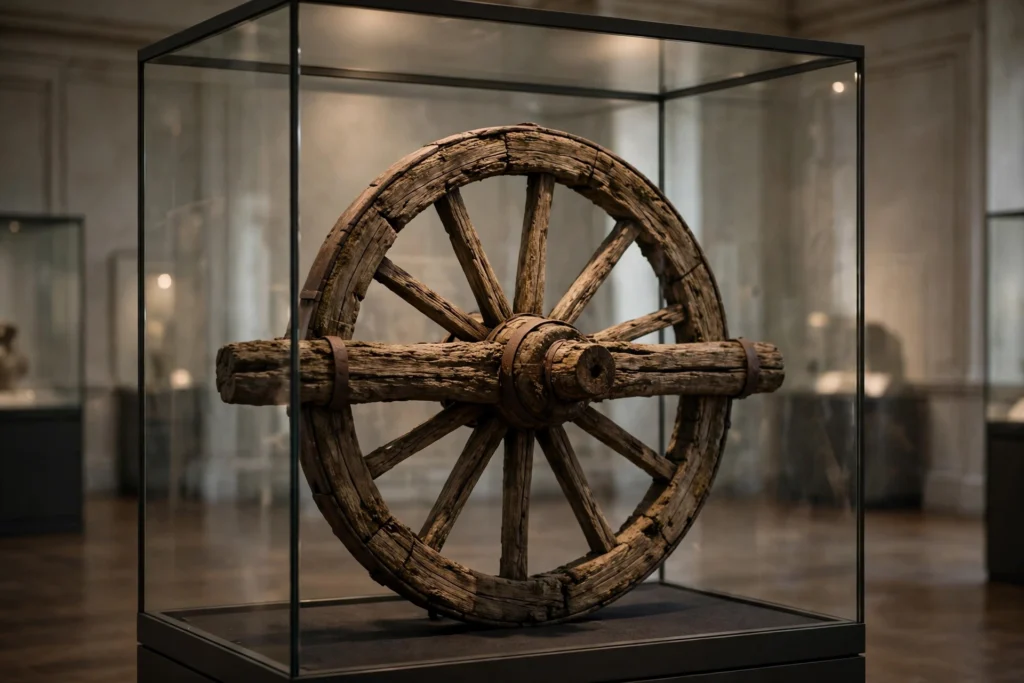
Here is one of my favourite parts of this story. In 2002, archaeologists digging in the Ljubljana Marshes, a flat, wet area near the city of Ljubljana in Slovenia, found something amazing buried in the mud: a wooden wheel, still in one piece, with its axle still attached.
The wheel was made from ash wood, and the axle was made from oak. It was about 70 centimetres across — roughly the size of a large pizza — and it had belonged to a two-wheeled cart, a bit like a handcart. Scientists used a method called radiocarbon dating to work out its age, and the answer came back at around 3200 BC. That makes it about 5,200 years old, the oldest wooden wheel with an axle ever found.
Why did it survive for so long when other wooden wheels rotted away? Because it sank into wet, muddy ground where there was almost no air. Without air, the tiny living things that normally eat wood could not do their work, so the wheel just sat there in the dark mud, waiting. It is a bit like a time capsule that nobody meant to bury.
Today that wheel lives in the City Museum of Ljubljana, where visitors can stand in front of it and look at something a person made with their own hands more than five thousand years ago. Think about that for a second. The person who made it never knew about phones, cars, or computers. They never saw a train or a plane. But they built a wheel and an axle that still fit together perfectly after five thousand years in a swamp. That is real skill.
The Ljubljana wheel also tells us something important: by 3200 BC, people in Europe already had working carts with wheels and axles. The wheel was not just a Mesopotamian idea by then. It was spreading across the ancient world, from the rivers of Iraq to the marshes of Slovenia, and people everywhere were finding new uses for it.

Spoked Wheels: Lighter, Faster, Stronger
For more than a thousand years, wheels were solid discs of wood. They were tough, and they did the job, but they had one big problem: they were heavy. A solid wooden wheel is like carrying a thick slice of tree trunk everywhere you go. It slows you down, and it wears out the animal pulling it.
Then, around 2000 BC, someone came up with a better design: the spoked wheel. Instead of a solid disc, the wheel had a hub in the middle, a rim on the outside, and thin wooden spokes joining the two, like the spokes of a bicycle wheel today. The gaps between the spokes meant there was far less wood, so the wheel was much lighter, and a lighter wheel means a faster cart and a happier horse.
Spoked wheels first showed up on light, fast chariots, the two-wheeled war vehicles pulled by horses. Chariots were the sports cars of the ancient world: fast, light, and a little bit scary. Armies that had chariots could move quickly across a battlefield, and kings loved to be seen riding in them. The Egyptians, the Hittites, and later the Assyrians all built chariots with spoked wheels, and the design spread across the ancient world.
Making a spoked wheel was not easy. The spokes had to be exactly the right length, the rim had to be bent into a perfect circle, and the hub had to hold everything tight. If one spoke was too short, the wheel wobbled. The people who built these wheels were skilled craftspeople, and their work was worth a lot of money.
A Newer Idea: Miners in the Mountains?
For a long time, the story was simple: the wheel was invented in Mesopotamia around 3500 BC, and that was that. But in 2024, a team of researchers published a study that made historians sit up and take notice. The team was led by Richard Bulliet, a historian at Columbia University, working with engineers Kai James and Lee Alacoque. Their idea was that the wheel may be even older than we thought — and that it may have started in a surprising place.
Their theory goes like this. In the Carpathian Mountains, in what is now Hungary and the countries around it, Neolithic people were mining copper ore around 3900 BC. Copper was precious stuff in those days, used for tools and ornaments, and the miners had to move heavy baskets of rock out of the mines. The researchers suggest that the miners started by rolling baskets on round logs, then slowly worked out how to put rollers on a frame, and then how to make a wheel and axle. Step by step, over many years, the cart was born in the copper mines.
It is a clever theory, and the researchers used computer models to show how the design could have changed, step by step, from a rolling log to a working wheel. But it is still a theory, not a proven fact. Some researchers now think the wheel may go back to around 3900 BC, but others are not yet convinced, and the debate is still going on.
Why Some Places Never Used Wheels
Here is a strange fact. Some of the cleverest civilisations in history never used the wheel for transport at all. The Maya, the Aztecs, and the Incas in the Americas built great cities, pyramids, and roads — but they had no wheeled carts. They knew about round things, and they even made little wheeled toys for children, so they understood the idea. They just never put wheels under a cart.
Why not? Nobody knows for sure, but there are some good guesses. First, they had no horses, oxen, or donkeys to pull a cart — the animals that pull carts in the Old World did not live in the Americas. Second, their land was full of steep mountains and thick jungle, where a wheeled cart would be more trouble than it was worth. Carrying goods on your back, or on a llama, made more sense on a narrow mountain path. It is a good reminder that a great invention is only useful if it fits the place and the life of the people using it.
What the Wheel Changed
Once the wheel caught on, the world started to move faster — quite literally. Farmers could grow more food, because they could carry it to market. Traders could travel further, so goods and ideas moved between cities that had never met before — all of it paid for in grain, silver, or shells, long before paper money existed. Builders could haul heavy stones to build temples and walls. Armies could move quickly. And ordinary people could visit family in the next town without walking for days with a heavy basket on their back.
The wheel also changed how people thought. Once you have a wheel, you can build a water wheel to grind grain, a spinning wheel to make thread, a mill to press olives. The same simple idea — a circle that spins around a fixed centre — turned up again and again in different machines. It is one of those ideas that keeps on giving. A thousand years after the first potter’s wheel, people were still finding new jobs for it.
And the wheel has never gone away. Your bicycle has two of them. Your car has four. The bus you ride to school, the plane you fly in, the suitcase you drag through the airport — all of them roll on wheels. Five thousand years later, we are still rolling on the same idea.
The Wheel in Your Life Today
Next time you ride your bike, take a second to look down at the wheels. They are light, strong, and round, with thin spokes and a smooth tyre. Now imagine the first cart wheels: heavy discs of solid wood, creaking along a dirt track behind a slow ox. The journey from one to the other took thousands of years, thousands of clever hands, and countless small improvements that nobody wrote down.
Look around your own home and count the wheels. The shopping trolley at the supermarket rolls on four small ones. A wheelchair gives someone the freedom to move around their town. A skateboard, a scooter, a pram, a wheelbarrow in the garden — wheels are so common that we hardly notice them anymore. They have become invisible, like the air we breathe, and that is the mark of a truly great invention: it works so well that we forget it was ever invented at all.
That is the real story of the wheel. It was not one flash of genius. It was potters, miners, farmers, carpenters, and chariot builders, each one making the idea a little bit better, passing it on to the next person, who passed it on again. No name on a plaque. No single hero. Just people solving problems, one round thing at a time.
Frequently Asked Questions
Who invented the wheel?
No single person invented the wheel, and no name was ever recorded. The oldest evidence points to the Sumerians in Mesopotamia, in what is now Iraq, around 3500 BC. The wheel most likely grew out of the work of many people over many years, starting with the potter’s wheel.
When was the wheel invented?
The first wheels appeared around 3500 BC, which is about 5,500 years ago. The oldest surviving wooden wheel with an axle, found in the Ljubljana Marshes in Slovenia, dates to around 3200 BC. A 2024 study suggests the idea may go back even further, to around 3900 BC, but that is still being debated.
What was the wheel first used for?
The first wheels were potter’s wheels, used for shaping clay pots. A potter put a lump of clay on a spinning disc and used the spin to make smooth, even pots. It took about 300 years before wheels were put under carts and wagons to carry loads.
What is the oldest wheel ever found?
The oldest surviving wheel with an axle is the Ljubljana Marshes Wheel, found in Slovenia in 2002. It is made of ash wood with an oak axle, it is about 70 centimetres across, and it is around 5,200 years old. You can see it today in the City Museum of Ljubljana.
When were spoked wheels invented?
Spoked wheels appeared around 2000 BC, more than a thousand years after the first solid wooden wheels. They were lighter than solid wheels because the gaps between the spokes meant less wood, and they were first used on fast, horse-drawn chariots.
Why did some civilisations never use the wheel?
The Maya, Aztecs, and Incas built great cities without wheeled carts, even though they knew the idea and made wheeled toys. They had no large animals like horses or oxen to pull carts, and their steep mountains and thick jungles made carrying goods on foot more practical than rolling a cart.
More from Zorium Daily
- Who Invented Paper?
- Who Invented Paper Money?
- How Did People Send Messages Before Phones Were Invented?
- Who Invented the Telephone?
The wheel has no inventor’s name on it, and maybe that is fitting. It belongs to everyone who ever pushed a cart, spun a pot, or fixed a bicycle tyre — to all of us, rolling along on an idea that is five thousand years old and still going strong. The next time you hear the soft hum of a wheel turning, remember the potters of Mesopotamia, the miners in the Carpathian Mountains, and the wheel that waited in a Slovenian swamp for someone to find it. They never knew each other, and they never knew what they had started. But the world has been rolling ever since.