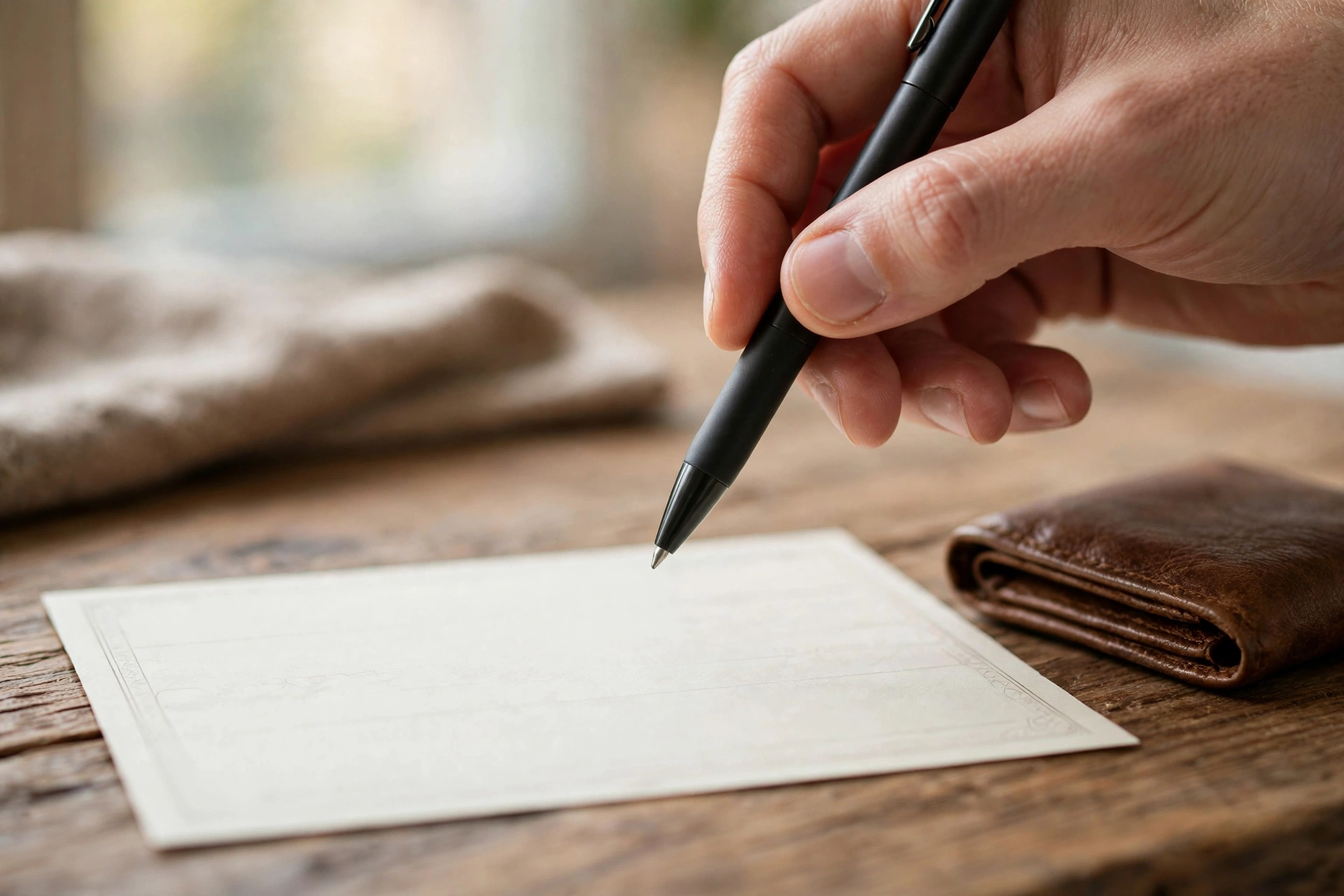
What Is a Cheque and How Does It Work? Explained Simply
SUMMARY OF THIS ARTICLE
- A cheque is a written order that tells your bank to pay a set amount of money to a named person.
- Three people are part of every cheque: the drawer who writes it, the bank that pays it, and the payee who receives the money.
- To fill one in, you write the date, the payee’s name, the amount in words and in figures, and then you sign it.
- When a cheque is paid in, the money does not move at once. Clearing usually takes a few days.
- If there is not enough money in the account, the cheque bounces, which means the bank refuses to pay it.
A Little Piece of Paper That Moves Money
Picture this. It is a Saturday morning, and Sara is sitting at her kitchen table with a cup of tea going cold beside her. Rent is due on Monday. She does not want to carry a pile of cash across town, and her landlord, Mr. Thompson, is an older man who likes things on paper. So Sara opens her chequebook, takes out her pen, and writes a cheque. One small slip of paper, a few careful lines, and her rent is on its way.
That is really all a cheque is. It is a short written note from you to your bank. It says, in plain words, please pay this person this much money from my account. You do not hand over cash. You do not tap a card. You give someone a piece of paper, and the bank does the moving for you.
It sounds old-fashioned, and in some ways it is. People tap phones to pay for coffee now. They send money in seconds with an app. Yet cheques have not gone away. They still turn up in letterboxes, in school offices, and in the drawers of small businesses. If you have never written one, the first time can feel a bit strange. What do you write, and where? What if you make a mistake? What happens if the money is not there?
This article walks through it all, slowly and simply. By the end, you will know what a cheque is, who is involved, how to fill one in without worry, what happens after you hand it over, and what a bounced cheque means. No bank jargon. No long words where short ones will do. Just a clear picture, the way a kind neighbour might explain it over the garden fence.
So, What Is a Cheque, Really?
A cheque is a written order telling your bank to pay someone. That is the whole idea in one line, and it is worth holding on to, because everything else grows out of it.
Think of it like a note you leave for a friend who keeps your money safe. You might say, “Please give fifty pounds to Anna for me.” A cheque says the same thing, only it is written on a special printed form from your bank, and the bank follows it. The money comes out of your account and goes into the account of the person named on the cheque.
The form itself is simple. It has your name and your account details printed on it already. It has spaces for the date, for the name of the person who should get the money, for the amount, and for your signature. Your signature matters a lot, as we will see. It is your way of saying, yes, I really did write this, and I really do want this payment to happen.
It is a proper instruction to a bank, and banks take it seriously.
The Three People in Every Cheque
Every cheque has three people in it, even if two of them never meet. Once you know who they are, the whole thing makes much more sense.
First, there is the drawer. That is the person who writes the cheque. If Sara writes a cheque for her rent, Sara is the drawer. The name comes from the idea of drawing money out of an account. The drawer is the one who decides how much to pay and who should receive it, and the drawer signs the cheque to show that the decision is theirs.
Second, there is the bank. The bank holds the drawer’s money — read how banks keep your money safe — and follows the instruction on the cheque. It checks the signature, checks that there is enough money in the account, and then moves the money. The bank is the quiet worker in the middle. It does not keep the money. It simply passes it along, the way a post office passes a letter along.
Third, there is the payee. That is the person who gets the money. If Sara writes the cheque to Mr. Thompson, he is the payee. His name goes on the cheque, and the money is meant for him. Nobody else should be able to take it, which is one reason people like cheques. The name is right there on the paper.
So the pattern is simple. The drawer writes it. The bank pays it. The payee receives it. Three people, one small piece of paper, and a clear job for each of them. If you ever get confused while reading about cheques, come back to these three, and the rest will fall into place.
How to Fill In a Cheque, Step by Step
Filling in a cheque is a little like filling in a short form. Go slowly, use a pen, and write clearly. Most mistakes happen when people rush.
Start with the date. Write the date on the line at the top, usually on the right-hand side. Use the day you are writing the cheque. Writing a date in the future can cause trouble, because the person may not be able to pay it in until that date arrives, and it can lead to confusion. Keep it simple and write today’s date.
Next, write the payee’s name. This goes on the line that says “Pay” or “Pay to”. Write the full name of the person or business that should get the money. Spell it carefully. If you write the wrong name, the wrong person might have trouble using it, or the bank might refuse it. If you are paying a business, use its full name, not a nickname.
Then comes the amount, and here is the part that surprises many people. You write the amount twice. Once in figures, in the small box, using numbers. And once in words, on the long line, using letters. So if you are paying eighty pounds, you write 80.00 in the box and “Eighty pounds only” on the line. Why twice? Because words are harder to change than numbers. If someone tried to turn a 1 into a 7, the words would still say the true amount, and the bank would spot the difference. It is a small safety trick that has worked for a very long time.
Finally, sign your name. Your signature goes at the bottom, usually on the right. It should match the signature your bank has on file for you. The bank compares them. If the signature looks very different, the bank may ask questions or refuse the cheque. So sign the way you normally sign, in your usual handwriting, and do not let someone else sign for you.
One more small tip, from many tired cheque writers. Draw a line through any empty space left on the amount line, after the words. That stops anyone from adding extra words later. It takes two seconds, and it keeps the cheque safe.
What Happens After You Hand It Over?
Let us follow Sara’s rent cheque on its journey. She hands it to Mr. Thompson on Monday morning. He smiles, folds it into his wallet, and later that day he takes it to his own bank, or he pays it in using his banking app by taking a photo of it. That step is called paying in a cheque.
His bank then sends a message, in effect, to Sara’s bank. It says, “Mr. Thompson has this cheque. Please pay him eighty pounds from Sara’s account.” Sara’s bank checks the details. Is the signature right? Is there enough money? Is the cheque still valid, and has it not already been paid? If all is well, the money moves from Sara’s account to Mr. Thompson’s account.
In the past, this journey meant real paper travelling between banks in vans and sorting offices. Today, much of it happens with photos and computer systems, which is faster. But the idea is the same. One bank talks to the other, checks are made, and the money changes hands without any cash ever leaving a pocket.
You might wonder why you cannot just hand someone cash and be done with it. Sometimes you can, and cash is fine for small things. But a cheque leaves a record. Sara can look at her bank statement and see that the rent was paid. Mr. Thompson can see that it arrived. If there is ever a question about it, the paper trail helps. That record is part of why cheques have lasted so long.
How Long Does the Money Take to Arrive?
This is the part that catches people out. A cheque is not instant. When Mr. Thompson pays in Sara’s cheque, the money does not jump across that same second. Clearing takes a few days.
Clearing is the name for the time banks need to check everything and move the money safely. In many places, it takes two to four working days. The exact time can change from country to country and from bank to bank, and weekends and public holidays can add a little extra time. But the simple rule to remember is this: a cheque is slow money, not fast money.
That matters for both sides. If you write a cheque, do not think the money has left your account the moment you hand the paper over. It is still there for a day or two, and you must keep enough in the account until it clears. If you spend it on something else in the meantime, you could run short, and that leads to trouble, as we will see next.
If you receive a cheque, do not think you can spend the money the same afternoon. Pay it in, wait for it to clear, and then use it. Banks usually show the money in the account before it has fully cleared, which can be confusing. A good habit is to wait until your bank says the money is truly available, and only then treat it as yours to spend.
Think of it like posting a letter: it will arrive, but it takes a day or two. If you need money to move in seconds, a card payment is a better choice. If a few days is fine, a cheque does the job nicely.
What Is a Bounced Cheque?
Now for the phrase most people have heard but few can explain: a bounced cheque. It sounds odd, almost funny, like a ball bouncing off a wall. In truth, it is not funny at all for the people involved.
A bounced cheque is a cheque the bank refuses to pay. The most common reason is simple. There is not enough money in the drawer’s account. Sara writes a cheque for eighty pounds, but by the time Mr. Thompson pays it in, her account holds only forty. The bank looks, sees the shortfall, and says no. The cheque bounces back, unpaid.
When that happens, two people feel the knock. The payee does not get the money they expected. They may have been counting on it for their own bills, so a bounced cheque can cause real trouble for them. The drawer may face a fee from their bank, and their name takes a hit. A bounced cheque can harm trust. A landlord, a shop, or a business may think twice before taking another cheque from the same person.
A cheque can also bounce for other reasons. The signature might not match. The cheque might be out of date, because cheques do not last for ever, and an old one may be refused. The drawer might have asked the bank to stop the cheque, perhaps because it was lost. But not having enough money is the reason people mean most of the time.
The way to avoid it is plain. Before you write a cheque, check your balance. Make sure the money is there, and leave it there until the cheque clears. Keep a little extra in the account, just in case. A small habit like that saves embarrassment, fees, and a difficult phone call. And if you receive a cheque that bounces, talk to the person who wrote it calmly. It is often a mistake, not a trick, and a fresh cheque or a bank transfer can put it right.

A Worked Example: Maya Pays Her Rent
Let us put it all together with a clear worked example. This is an example, with small round numbers, to show how the steps fit.
Maya rents a small flat. Her rent is 500 pounds a month. On the first day of the month, she sits down and writes a cheque.
First, she writes the date: 1 November. Then, on the payee line, she writes the name of her landlord, Mrs. Patel. In the small box, she writes the amount in figures: 500.00. On the long line, she writes the amount in words: “Five hundred pounds only”. Then she draws a line through the empty space after those words, and she signs her name at the bottom.
Maya is the drawer. Her bank is the bank that will pay. Mrs. Patel is the payee. Maya hands the cheque to Mrs. Patel that same day. Mrs. Patel pays it into her own bank the next morning.
Clearing takes a few days. During that time, Maya keeps at least 500 pounds in her account. She does not spend it on a new coat, even though the coat is on sale. She knows the money is promised, and she leaves it alone.
A few days later, the money moves. Maya’s account falls by 500 pounds. Mrs. Patel’s account rises by 500 pounds. The rent is paid, and both of them have a record of it on their bank statements. Nothing more is needed.
Now imagine the other side of the story. Suppose Maya had only 300 pounds in her account when she wrote that cheque. The bank would refuse to pay the full 500. The cheque would bounce. Mrs. Patel would not get her rent, Maya might pay a fee, and both of them would have a problem to sort out. The example shows why the simple step of checking your balance first matters so much.
Why Cheques Are Rarer Now, and Where They Still Show Up
Cheques used to be everywhere. People paid for groceries with them. They paid the plumber with them. They sent them in birthday cards. Then cards, bank transfers, and phone payments arrived, and cheques began to fade. They are slower, they need paper and a pen, and they ask you to wait a few days. For everyday shopping, a card simply wins.
Yet cheques are still used, and for good reasons. Many landlords still take them for rent, especially older landlords who like a paper record. Schools still take them for fees and trips, because a cheque from a parent is easy to track. Some small businesses still pay a supplier with a cheque, because it feels formal and leaves a clear trail. And gifts are a lovely case. A grandparent might tuck a cheque into a birthday card for a grandchild, with a short note and a hug. It feels more personal than a bank transfer, and the child can pay it into a savings account and watch the balance grow.
So cheques have moved from the centre of daily life to the edges. They are not the first choice for buying a coffee, but they are still a steady choice for rent, school fees, some business payments, and gifts. Knowing how they work is still useful, even in a world of instant payments. One day, a landlord, a school, or a grandparent may hand you one, and you will be glad you know what to do with it.
Cheque or Check? A Quick Word About Spelling
If you read American websites, you may see the same thing spelled “check”. Do not worry. It is the same idea. In Britain, Ireland, Australia, and many other places, the word is “cheque” with a “q”. In the United States, it is “check” with a “k”. The paper, the people, and the process are the same. Only the spelling changes.
This matters when you search online. An American article about a “bounced check” is talking about the same thing as a British article about a “bounced cheque”. A “checkbook” in America is a “chequebook” in Britain. Keep that in mind, and you will not get confused when the two spellings turn up side by side. For this article, we use “cheque”, the British spelling, because that is the spelling most of our readers will know. But if you live in America, just swap the letters in your head, and everything still fits.
A Few Simple Habits That Keep Your Cheques Safe
A chequebook is a little book of promises. Treat it with care, and it will serve you well. A few simple habits make all the difference.
Keep your chequebook somewhere safe, the way you would keep your bank card. Do not leave it lying around, and do not let anyone else use it. If you lose it, tell your bank at once, so they can watch out for cheques you did not write.
Never sign a blank cheque. A signed cheque with no payee and no amount is like a signed blank note. Anyone who finds it could fill it in. Always fill in the name and the amount first, and sign last.
Write clearly, in pen, and never in pencil. Pencil can be rubbed out and changed. Pen is much harder to alter, which is what you want.
Check your bank statement often. Look for the cheque payments going out, and check that the amounts match what you wrote. If something looks wrong, call your bank straight away. The sooner you spot a problem, the easier it is to fix.
Finally, keep a note of the cheques you write. Many chequebooks have a small stub at the back. Write the date, the payee, and the amount there each time, and match each cheque against your notes when your statement arrives.

Frequently Asked Questions
What is a cheque in simple words?
A cheque is a written order telling your bank to pay a named person a set amount of money. You write it on a printed form from your bank, sign it, and hand it to the payee. The bank then moves the money from your account to theirs.
Who are the three people on a cheque?
The drawer writes the cheque, the bank pays it, and the payee receives the money. The drawer decides the amount and signs the cheque. The bank checks the details and moves the money safely.
How do I fill in a cheque?
Write the date, then the payee’s full name on the pay line. Write the amount in figures in the small box and in words on the long line. Draw a line through any empty space, then sign at the bottom in your usual signature.
How long does a cheque take to clear?
Clearing usually takes a few working days, often two to four days, depending on your bank and country. Weekends and public holidays can add extra time. Wait until your bank says the money is available before you spend it.
What does a bounced cheque mean?
It means the bank refused to pay the cheque, most often because there was not enough money in the account. The payee gets nothing, and the drawer may pay a fee. Always check your balance before you write a cheque.
Are cheques still used today?
Yes, though they are rarer than they used to be. People still use them for rent, school fees, some business payments, and gifts, such as a birthday cheque from a grandparent. For quick everyday shopping, cards and bank transfers are now more common.
More from Zorium Daily
- What Is a Gift Card and How Does It Work?
- How Do Banks Keep Your Money Safe?
- What Is a Receipt and Why Do Shops Give You One?
- What Is Interest and Why Do Banks Pay It?
A cheque may look like a simple piece of paper, but it carries a clear promise, and now you know how that promise travels from your hand to the bank and on to the person you meant to pay.